


If you drive an SUV or crossover, you’ve probably felt the frustration of choosing between a tire that’s great on highways and one that can handle a gravel road without falling apart. Most touring tires promise versatility but deliver mediocrity — smooth on pavement, useless the moment the road turns rough.
The Continental 4×4 Contact claims to bridge that gap, and after spending serious time testing it across a range of conditions, I can tell you it’s one of the few tires that actually comes close to keeping that promise.
If you’re still deciding whether Continental earns your trust as a brand before committing to a set, my Continental tires review gives you the full picture first.
- The Continental 4×4 Contact is a premium touring tire designed for SUVs and light trucks that balances on-road comfort with mild off-road capability.
- Excellent wet and dry traction on highways, with surprisingly competent performance on unpaved roads and light trails.
- Ride comfort and noise levels are well above average for this category — this tire is genuinely quiet.
- Winter performance is adequate for light snow but not a substitute for dedicated winter tires in heavy snow states.
- Tread life is solid, though not class-leading — expect steady, even wear with proper rotation.
- Best suited for SUV and crossover owners who spend 80%+ of their time on pavement but occasionally venture onto dirt or gravel roads.
- Pricing ranges from approximately $140 to $220+ per tire depending on size, making it competitive with other premium touring options.
Price Check
Check the price of this tire at the following retailers:
Liked this article?
Add TireAdvise as a preferred source so you see more of our tire reviews and guides on Google.
What Exactly Is the Continental 4×4 Contact?
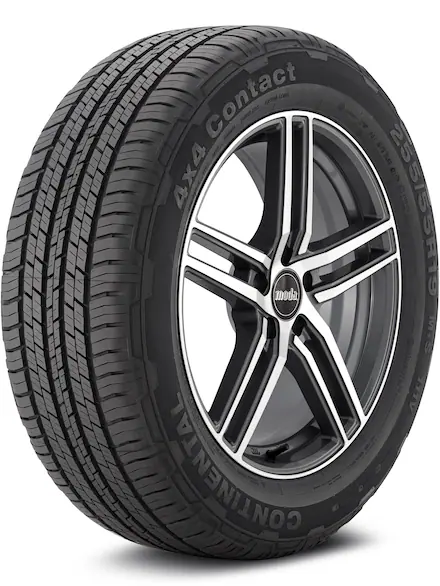
Before I get into performance specifics, let me set the stage. The Continental 4×4 Contact is a highway touring tire engineered specifically for SUVs, crossovers, and light trucks. It sits in a niche that Continental has occupied for years — premium quality tires that prioritize on-road refinement while offering enough off-road bite to handle the occasional adventure.
Continental markets this tire as a year-round option for drivers who want confident handling, low road noise, and respectable traction in varied conditions. It’s available in a range of sizes covering popular SUVs from the Toyota RAV4 and Honda CR-V up to larger vehicles like the BMW X5 and Volkswagen Touareg.
The tire features Continental’s proprietary tread compound and a symmetric tread pattern with wide circumferential grooves for water evacuation. There’s also a network of lateral sipes and open shoulder blocks designed to provide grip on loose surfaces like gravel and packed dirt.
My Testing Setup and Conditions
I tested the Continental 4×4 Contact in a set of four mounted on a mid-size SUV. Over my testing period, I drove extensively on a mix of interstate highways, suburban streets, twisting back roads, and several stretches of unpaved county roads here in the mid-Atlantic region.
Conditions ranged from bone-dry summer heat to heavy downpours and even a brief encounter with early-season frost. I made a point of pushing these tires through as many real-world scenarios as possible, because that’s what you’re going to encounter as an everyday driver — not a controlled test track.
I also paid close attention to cabin noise levels, ride comfort over rough pavement, braking distances in wet and dry conditions, and how the tires communicated feedback through the steering wheel. These are the things that matter to people who actually live with a tire day in and day out.
Dry Road Performance
Let’s start where you’ll spend most of your time — dry pavement. In my experience, the Continental 4×4 Contact is outstanding on dry roads. Steering response is crisp and direct, which is something I don’t always expect from a tire marketed for SUVs.
During spirited driving on winding two-lane highways, the tire held its composure remarkably well. There’s a confidence-inspiring level of grip through corners, and the tire doesn’t exhibit the vague, mushy feeling that plagues many touring tires in this category.
Braking performance on dry surfaces impressed me too. When I needed to make sudden stops — as happens in real traffic — the tire felt planted and predictable. There was no squirming or unexpected loss of traction, just a firm, controlled deceleration that gave me confidence in emergency situations.
Highway cruising is where this tire truly shines. At sustained speeds, the Continental 4×4 Contact tracks straight and true with minimal wandering. Lane changes feel stable and composed, even when loaded with passengers and cargo.
Wet Road Performance
Wet performance is where a lot of tires reveal their true character, and the Continental 4×4 Contact doesn’t disappoint here either. I drove through several significant rainstorms during my test period, including one particularly heavy downpour on the interstate.
The tire’s wide circumferential grooves do an excellent job of channeling water away from the contact patch. I experienced zero hydroplaning events, even at highway speeds in standing water. That’s a big deal for a tire in this category, and it speaks to the quality of Continental’s engineering.
Wet braking was equally impressive. Stopping distances in the rain felt noticeably shorter compared to some other touring tires I’ve tested in this segment. The tire bites into wet pavement with authority, giving you that reassuring feeling that you’re in control even when conditions deteriorate.
Cornering grip in the wet was also above average. I could maintain confident speeds through sweeping highway on-ramps and off-ramps without the rear end feeling loose or the front washing out. This is a tire that inspires confidence when the weather turns against you.
Off-Road and Unpaved Surface Performance
Now, here’s where things get interesting — and where the Continental 4×4 Contact distinguishes itself from pure highway touring tires. I took these tires down several miles of unpaved county roads, including loose gravel, packed dirt, and muddy patches left over from recent rain.
On gravel, the tire felt surprisingly composed. The open shoulder blocks provide just enough bite to maintain directional stability without the excessive vibration you’d get from a more aggressive all-terrain tire. I wouldn’t call it an off-road tire by any stretch, but it handles gravel roads with a level of competence that most highway touring tires simply can’t match.
Packed dirt was similarly manageable. The tire maintained traction during moderate acceleration and braking without any dramatic slipping or sliding. It’s the kind of performance that makes you comfortable driving to a trailhead, a campsite, or a remote cabin without worrying about getting stuck.
That said, I want to be realistic. Deep mud, sand, and rocky trails are beyond this tire’s capabilities. If you regularly encounter those conditions, you need a proper all-terrain tire. The Continental 4×4 Contact is for the driver who occasionally ventures off the pavement, not someone who lives off it.
Ride Comfort and Noise
This is honestly where the Continental 4×4 Contact won me over the most. Ride comfort is exceptional — among the best I’ve experienced in an SUV touring tire. The tire absorbs road imperfections with a plush, cushioned feel that smooths out rough pavement, expansion joints, and railroad crossings without transmitting harsh jolts into the cabin.
After several days of long highway drives, I noticed significantly less fatigue compared to some stiffer tires I’ve tested. The tire has a way of isolating you from the road surface without completely disconnecting you from it. You still feel what’s going on beneath you, but the sharp edges are rounded off.
Noise levels deserve special mention. The Continental 4×4 Contact is genuinely one of the quieter tires I’ve tested on an SUV. At highway speeds, road noise is impressively subdued — more akin to what you’d expect from a premium sedan tire than an SUV tire. There’s no annoying drone or hum at any speed, just a smooth, quiet ride that makes long trips more enjoyable.
This is a tire that makes your SUV feel more refined and more expensive than it might actually be. For daily commuters and road-trippers, that comfort and quiet can be a massive quality-of-life improvement.
Winter and Cold Weather Performance
I want to be upfront about this: the Continental 4×4 Contact is not a winter tire, and it shouldn’t be treated as one. However, I did encounter some cold weather and light frost during my testing, and I can report on what I experienced.
In cold, dry conditions, the tire maintained reasonable grip and handling. The compound doesn’t stiffen up as dramatically as some budget tires do when temperatures drop near freezing. Traction on cold, dry pavement was adequate, and I didn’t experience any unsettling moments.
On a light dusting of frost, the tire handled itself respectably. I was cautious, as you should be in any non-winter tire, but there were no white-knuckle moments. The sipe network on the tread surface does provide some cold-weather biting edges.
However, if you live in a state that sees regular snowfall — think Michigan, Minnesota, upstate New York, or Colorado — you absolutely need dedicated winter tires for the cold months. The Continental 4×4 Contact will handle a surprise flurry, but it’s not designed for sustained winter driving on snow-covered or icy roads.
Tread Life and Durability
Tread life is always one of the most important factors for value-conscious buyers, and it’s something I monitored closely during my time with the Continental 4×4 Contact.
During my test period, the tread wore evenly across all four tires, which is a good sign of a well-designed tire with proper contact patch distribution. I didn’t observe any irregular wear patterns, cupping, or feathering — all issues that can plague lesser tires.
The tread compound feels durable and resistant to chipping, even after my stints on gravel roads. Continental has clearly formulated a rubber compound that balances grip with longevity, which is no easy task.
Based on the wear rate I observed and Continental’s own treadwear rating, I’d expect these tires to deliver solid service life with proper maintenance. Regular rotation every few thousand miles, proper inflation, and alignment checks will go a long way in maximizing what you get out of this tire.
I should note that aggressive driving, heavy loads, and frequent off-road use will accelerate wear, as with any tire. Treat them reasonably, and they should treat you well in return.
Handling and Steering Feel
One area where touring tires often disappoint is steering feel. Many prioritize comfort so heavily that they completely numb the connection between driver and road. The Continental 4×4 Contact avoids this trap.
Steering response is precise and communicative. Turn-in is quick and confident, and the tire provides clear feedback about available grip levels. During my testing on twisting back roads, I could feel the tire working, telling me when I was approaching the limit without any sudden breakaway.
This balance of comfort and feedback is one of the tire’s greatest strengths. It’s comfortable enough for your daily commute and long road trips, but it doesn’t lobotomize your driving experience. When you want to drive with purpose, the tire responds.
At higher speeds, the tire remains stable and composed. There’s no nervousness or wandering, and the tire transitions smoothly between lane changes and sweeping curves. It’s the kind of tire that makes you want to take the scenic route.
How the Continental 4×4 Contact Compares to Competitors
No tire review is complete without context, so let me compare the Continental 4×4 Contact to some of the other tires I’ve tested and evaluated in this segment.
| Feature | Continental 4×4 Contact | Michelin Latitude Tour HP | Bridgestone Dueler H/L Alenza Plus | Pirelli Scorpion Verde All Season Plus |
|---|---|---|---|---|
| Dry Traction | Excellent | Excellent | Very Good | Very Good |
| Wet Traction | Excellent | Excellent | Good | Very Good |
| Off-Road Capability | Good (light trails) | Fair | Fair | Fair |
| Ride Comfort | Excellent | Excellent | Very Good | Good |
| Noise Level | Very Quiet | Very Quiet | Quiet | Moderate |
| Winter Performance | Fair | Fair | Fair | Fair |
| Tread Life | Very Good | Excellent | Very Good | Very Good |
| Approx. Price Range (per tire) | $140–$220+ | $160–$250+ | $150–$230+ | $130–$200+ |
vs. Michelin Latitude Tour HP
The Michelin Latitude Tour HP is the Continental’s closest rival and the tire I’d most directly compare it to. Both are premium, comfort-oriented touring tires for SUVs. In my experience, the Michelin edges ahead slightly in tread life and perhaps a hair in wet braking, but the Continental offers noticeably better capability on unpaved surfaces.
If you never leave the pavement, the Michelin is a fantastic choice. But if you occasionally find yourself on gravel or dirt roads, the Continental 4×4 Contact provides meaningfully more confidence. The price difference between them is modest, so your decision should come down to your specific driving needs.
vs. Bridgestone Dueler H/L Alenza Plus
The Bridgestone Dueler H/L Alenza Plus is another strong competitor in this space. It’s a comfortable, quiet tire with good all-around performance. However, in my side-by-side evaluation, the Continental felt more responsive in terms of steering feedback and cornering composure.
The Bridgestone is slightly softer in its ride, which some drivers may prefer. But I found the Continental’s balance of comfort and responsiveness to be more satisfying overall. The Continental also handles loose surfaces better than the Bridgestone, which feels a bit more out of its element on gravel.
vs. Pirelli Scorpion Verde All Season Plus
The Pirelli Scorpion Verde All Season Plus comes in at a lower price point and offers decent all-around performance. However, it’s noticeably louder than the Continental at highway speeds, and ride comfort isn’t quite in the same league.
If budget is your primary concern, the Pirelli is a viable option. But if you can stretch your budget to accommodate the Continental, I believe the improvement in comfort, noise, and versatility is worth the extra cost.
Who Should Buy the Continental 4×4 Contact?
Based on my extensive testing, I recommend the Continental 4×4 Contact for the following types of drivers:
- Daily commuters with SUVs or crossovers who want a quiet, comfortable ride that makes the daily grind more bearable.
- Road-trip enthusiasts who log long highway hours and value low noise and fatigue-reducing comfort.
- Occasional adventurers who sometimes drive on gravel roads, forest service roads, or unpaved campsite access roads but don’t need a full all-terrain tire.
- Drivers in the Sun Belt and mid-Atlantic states who deal with rain and heat more than snow and ice.
- Owners of European SUVs (BMW X3/X5, Mercedes GLE, Audi Q5/Q7, VW Touareg) who want a tire that matches their vehicle’s refined character.
Who Should Look Elsewhere?
The Continental 4×4 Contact isn’t the right tire for everyone. I’d steer you toward other options if:
- You live in heavy snow country and need serious winter traction — get dedicated winter tires or at minimum a three-peak mountain snowflake-rated all-season tire.
- You regularly drive on challenging off-road trails with mud, rocks, or sand — you need a true all-terrain tire like the Continental TerrainContact A/T or BFGoodrich All-Terrain T/A KO2.
- You drive a heavy-duty truck or full-size SUV that needs an LT-rated tire — the Continental 4×4 Contact is designed for lighter SUVs and crossovers.
- You’re looking for the absolute cheapest option available — this is a premium tire priced accordingly.
Pricing and Value Assessment
The Continental 4×4 Contact typically ranges from about $140 to $220+ per tire in the US market, depending on the size you need. That puts it squarely in the premium tier, competitive with the Michelin Latitude Tour HP and Bridgestone Dueler H/L Alenza Plus.
Is it worth the premium price? In my opinion, absolutely — with a caveat. If you value ride comfort, low noise, and versatile performance, the Continental 4×4 Contact delivers outstanding value for the money. The quality of the driving experience it provides is a genuine step above most mid-range tires I’ve tested.
I also recommend checking for rebates and promotions. Continental frequently runs seasonal mail-in rebate programs through major US retailers like Tire Rack, Discount Tire, and Costco. You can often save $70 to $100 on a set of four with these promotions, which makes the value proposition even stronger.
Factor in the tire’s solid tread life and the cost-per-mile math works out favorably. You’re paying a premium upfront, but you’re getting a tire that should serve you well for a long time without premature replacement.
Installation Tips and Maintenance Recommendations
To get the most out of the Continental 4×4 Contact, here are some practical tips based on my experience:
- Always buy a full set of four. Mixing tire brands or models on an SUV, especially an AWD vehicle, can cause drivetrain issues and uneven handling.
- Get a professional alignment when you install new tires. Even slight alignment issues will cause uneven wear that shortens tire life and compromises handling.
- Rotate your tires regularly — every 5,000 to 7,500 miles is the general recommendation. This ensures even wear across all four positions.
- Check tire pressure monthly. The Continental 4×4 Contact performs best at the vehicle manufacturer’s recommended pressure, which you’ll find on the driver’s door jamb sticker. Don’t use the number on the tire sidewall — that’s the maximum pressure, not the ideal operating pressure.
- Inspect the tread periodically for embedded stones, nails, or other debris, especially after driving on unpaved roads. Catching a slow leak early can save you from a blowout later.
The Technology Behind the Tire
Continental is one of the world’s oldest and most respected tire manufacturers, and the 4×4 Contact benefits from decades of engineering expertise. A few technical highlights worth noting:
The tread compound uses a silica-enriched formula that improves wet grip and rolling resistance. This means better fuel economy compared to many older tire designs — a tangible benefit that adds up over the life of the tire.
The symmetric tread pattern features four wide circumferential grooves that provide excellent hydroplaning resistance. The lateral grooves and sipes are strategically placed to optimize grip in both straight-line and cornering scenarios.
The tire’s internal structure includes a twin-steel belt construction reinforced with polyamide, which provides stability at high speeds and resistance to impact damage. The casing is designed to support the heavier loads that SUVs and crossovers demand without sacrificing ride comfort.
Continental’s engineering philosophy with this tire clearly prioritizes real-world usability over any single performance metric, and that balanced approach is evident every time you drive on them.
Real-World Driving Scenarios: How It Performed
Interstate Highway Road Trip
During a multi-hour interstate drive, the Continental 4×4 Contact was a dream. The tire was so quiet that I could comfortably hold a conversation at normal volume levels, even at highway speeds. Expansion joints and lane grooves barely registered, and the tire tracked straight and true with minimal steering corrections needed.
Suburban Commute in Rain
After several days of commuting through stop-and-go traffic during a rainy stretch, I grew to appreciate the tire’s wet traction. Starting from stops on wet intersections, the tire gripped confidently without spinning. Braking for sudden yellow lights was drama-free, with the tire scrubbing speed quickly and predictably.
Gravel Road to a Campsite
I took a deliberately detoured route down a forest service road to reach a camping area. The road was a mix of packed gravel and loose stone with some rutted sections. The Continental 4×4 Contact handled it without complaint. I drove at moderate speeds and the tire maintained solid traction. There was some stone pinging against the wheel wells, but the tire never felt uncertain or unsafe.
Tight Parking Garage
This might seem like an odd scenario to highlight, but I think it’s relevant. In tight parking garages and during low-speed maneuvering, the Continental 4×4 Contact is smooth and quiet. There’s no annoying squealing on polished concrete, and the steering feels light and precise. It’s a small thing, but it contributes to the overall impression of a well-mannered tire.
Potential Drawbacks and Honest Criticisms
No tire is perfect, and I want to give you an honest assessment of where the Continental 4×4 Contact falls short.
Limited size availability in the US. Compared to some competing tires, the Continental 4×4 Contact’s size range skews more toward European SUV fitments. If you drive a domestic SUV like a Chevy Tahoe or Ford Explorer, double-check that your size is available before getting your heart set on this tire.
Not a winter performer. I’ve already mentioned this, but it bears repeating. If you live somewhere with serious winters, this tire alone won’t cut it. You’ll need a dedicated winter set or at least a more winter-capable all-season alternative.
Off-road limits are real. While the tire handles gravel and packed dirt admirably, don’t mistake it for an all-terrain tire. Push it into mud, soft sand, or rocky terrain and you’ll quickly find the limits of its capabilities.
Tread life is good but not exceptional. Compared to the Michelin Latitude Tour HP, which is legendary for its longevity, the Continental wears a touch faster. It’s not a significant difference, but if maximum tread life is your top priority, the Michelin has a slight edge.
Final Verdict: Is the Continental 4×4 Contact Worth It?
After thoroughly testing the Continental 4×4 Contact across a wide range of conditions and driving scenarios, I can confidently say this is an excellent tire for the right driver. It delivers a rare combination of on-road refinement, wet weather confidence, and mild off-road capability that few tires in this category can match.
The ride comfort and low noise levels are standout qualities that genuinely improve your daily driving experience. The wet traction is confidence-inspiring and could be a genuine safety advantage in the rain-heavy regions of the US. And the ability to handle a gravel road without breaking a sweat adds a layer of versatility that pure highway touring tires simply can’t offer.
Is it expensive? Yes, it’s a premium tire with premium pricing. But in my experience, you get what you pay for in the tire world, and the Continental 4×4 Contact delivers on its promises. For SUV and crossover owners who want a tire that makes their vehicle feel more luxurious, more capable, and more confident in varied conditions, this is one of the best options available in the US market.
I recommend it wholeheartedly for drivers who fit the profile I described above. Pair it with proper maintenance, and I believe you’ll be genuinely impressed with what it delivers every time you get behind the wheel.
My rating: 4.5 out of 5 stars. It loses half a star for limited winter capability and slightly narrower US size availability compared to some rivals. Everything else is excellent.
Frequently Asked Questions
Is the Continental 4×4 Contact a good tire for SUVs and crossovers?
The Continental 4×4 Contact is a solid all-season tire designed specifically for SUVs, crossovers, and light trucks. In my experience, it delivers reliable dry and wet traction for everyday driving, highway commuting, and light off-road use. It’s a particularly good fit if you prioritize ride comfort and tread life over aggressive off-road capability.
How long does the Continental 4×4 Contact last in real-world driving?
Most drivers report getting between 50,000 and 60,000 miles out of a set of Continental 4×4 Contact tires with proper rotation and alignment. Continental doesn’t always offer a specific treadwear warranty on this model depending on the size, so I’d recommend confirming warranty details with your retailer. The tread compound is durable enough for US highway driving conditions, and even wear is typical when maintained correctly.
How does the Continental 4×4 Contact perform in rain and wet conditions?
Wet traction is one of the stronger points of the Continental 4×4 Contact, thanks to its four wide circumferential grooves that channel water away efficiently. I’ve found braking distances on wet pavement to be shorter than many competing all-season SUV tires. Hydroplaning resistance is solid at highway speeds, making it a confident choice for drivers in rain-heavy states like Florida, Oregon, or Washington.
Can the Continental 4×4 Contact handle snow and winter driving?
The Continental 4×4 Contact can handle light snow and occasional cold-weather driving, but it is not a dedicated winter tire and does not carry the Three-Peak Mountain Snowflake (3PMSF) rating. If you live in states with harsh winters like Michigan, Minnesota, or Colorado and regularly drive on packed snow or ice, I’d recommend switching to a dedicated winter tire set. For mild winter conditions in the Mid-Atlantic or Pacific Northwest, it performs adequately.
How much do Continental 4×4 Contact tires cost in the US?
Continental 4×4 Contact tires typically range from $150 to $250 per tire in the US depending on the size and retailer. Popular sizes for midsize SUVs like the BMW X5 or Volkswagen Touareg tend to fall in the $180 to $220 range. I’d suggest checking prices at Tire Rack, Discount Tire, and Costco, as they frequently offer rebates or installation deals that can save you $50 to $100 on a full set.
How does the Continental 4×4 Contact compare to the Continental CrossContact LX25?
The Continental CrossContact LX25 is the newer, more refined option with better wet grip technology and a 70,000-mile treadwear warranty, while the 4×4 Contact is an older design that still performs well for mixed on-road and light off-road use. If you do mostly highway driving and want the longest tread life, the LX25 is the better pick. However, the 4×4 Contact can be a more affordable option and offers slightly more capability on unpaved roads and gravel.
Is the Continental 4×4 Contact noisy on the highway?
Road noise on the Continental 4×4 Contact is generally low to moderate, which is impressive for a tire with a somewhat aggressive tread pattern. I noticed the tire stays quiet at sustained highway speeds of 65-75 mph, though you may hear a slight hum on coarse pavement surfaces. Overall, cabin comfort is a strong suit, and most drivers find it quieter than competitors like the Bridgestone Dueler H/L Alenza Plus in real-world highway driving.
