

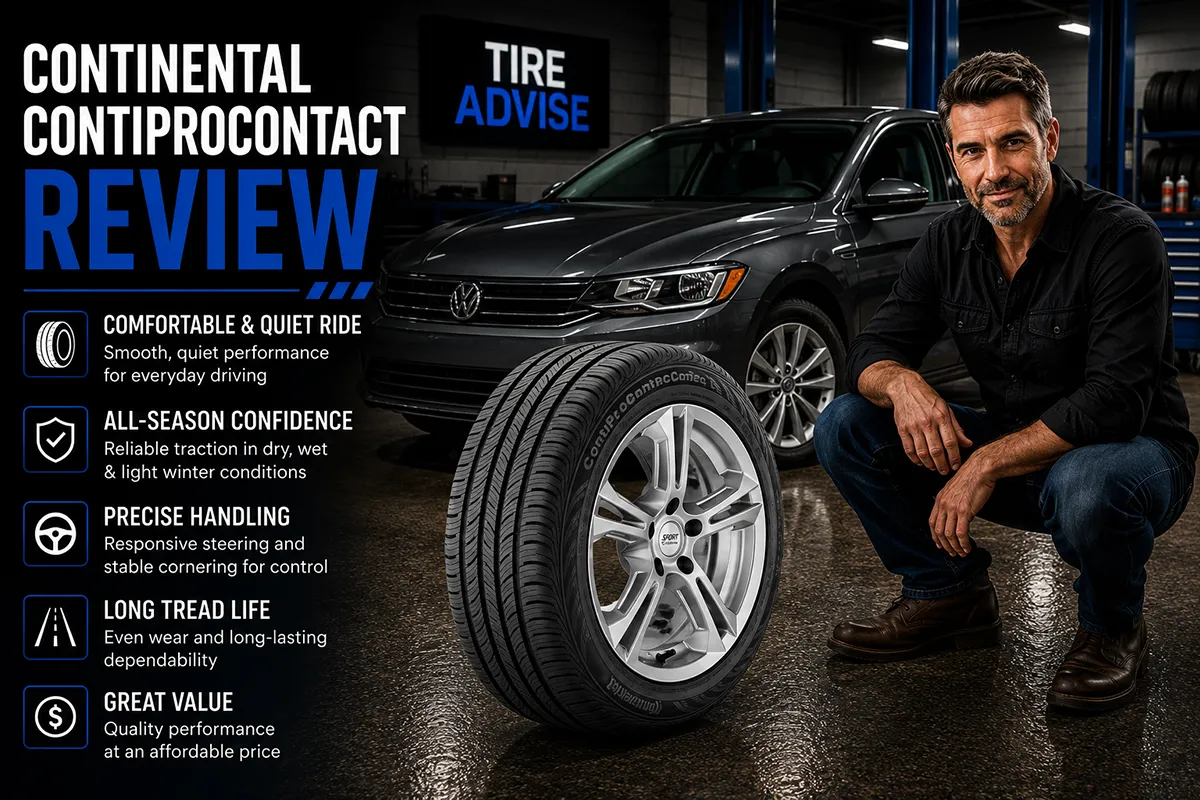
If you’ve ever stood in a tire shop staring at a wall of black rubber circles wondering which one won’t leave you broke or stranded, you’re not alone.
The Continental ContiProContact is one of those tires that keeps showing up on “recommended” lists, OEM fitment sheets, and forum threads — but does it actually deserve the hype?
I spent an extended test period driving on a set of ContiProContact tires across a mix of highways, suburban streets, and rain-soaked backroads to find out exactly what this grand touring all-season tire delivers in the real world.
Here’s everything I learned. Before diving in, if you’re still getting familiar with the brand, my Continental tires review covers everything you need to know about whether Continental belongs on your shortlist.
- The Continental ContiProContact is a solid grand touring all-season tire that excels in ride comfort, highway noise reduction, and wet traction.
- It’s a popular OEM tire on vehicles like the BMW 3 Series, Volkswagen Jetta, and Mercedes C-Class — and for good reason.
- Dry grip is competent but not sporty; don’t expect performance-tire handling.
- Tread life is respectable with proper maintenance, backed by a treadwear warranty (varies by size).
- Light snow capability is adequate for occasional flurries but not a substitute for dedicated winter tires.
- Priced in the mid-range for the grand touring category — strong value for the comfort and refinement you get.
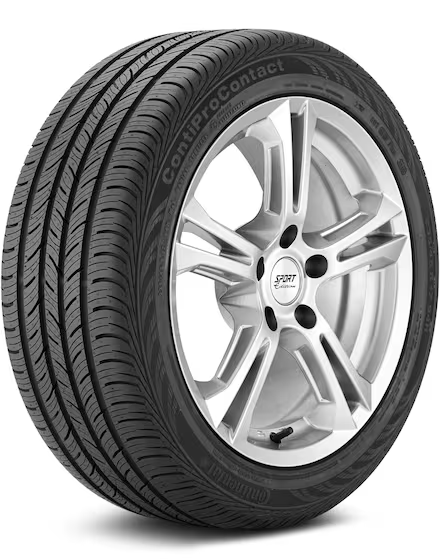
Price Check
Check the price of this tire at the following retailers:
TireRack SimpleTire PriorityTire AmazonDon’t know the correct size tire to purchase? Start here!
Liked this article?
Add TireAdvise as a preferred source so you see more of our tire reviews and guides on Google.
What Exactly Is the Continental ContiProContact?
Before I dive into my driving impressions, let’s get the basics straight. The Continental ContiProContact is a grand touring all-season tire designed for sedans, coupes, minivans, and some crossovers. It sits in Continental’s comfort-oriented lineup — not their performance line (that would be the ExtremeContact series) and not their budget tier either.
Continental positions this tire as the sweet spot between comfort, longevity, and all-season capability. It’s engineered with their proprietary Comfort Ride Technology, which essentially uses a slightly softer rubber compound and an optimized internal structure to absorb road imperfections before they reach your cabin.
One thing that really caught my attention is how widely this tire is used as original equipment. If you’ve ever bought a new BMW 3 Series, Volkswagen Passat, Mercedes-Benz C-Class, or even certain Honda and Toyota models, there’s a decent chance the ContiProContact came on the car from the factory. That OEM pedigree tells you something — automakers don’t pick tires randomly.
My Test Setup and Driving Conditions
I tested the ContiProContact in a 225/45R17 size, fitted on a mid-size sedan that I use as a daily driver. My testing covered a wide range of real-world scenarios that most US drivers will encounter: interstate highway commuting, suburban stop-and-go, winding two-lane country roads, and a few stretches of unpaved rural roads thrown in for good measure.
Weather conditions during my test period included dry sunny days, heavy downpours, early morning fog, and a brief dusting of light snow. Temperatures ranged from the mid-20s Fahrenheit up to the mid-80s, giving me a solid cross-section of conditions to evaluate.
I checked tire pressures weekly and kept them at the vehicle manufacturer’s recommended PSI throughout my test. This matters because running incorrect pressures will skew the performance of any tire, and I wanted to give the ContiProContact a fair shake.
Ride Comfort: Where This Tire Truly Shines
Let me start with the ContiProContact’s strongest suit, because it’s immediately noticeable. From the first few days of driving, I could tell this tire was engineered with comfort as a top priority. Road imperfections that used to send a noticeable jolt through the steering wheel and seat were suddenly muted — not eliminated, but softened in a way that made longer drives genuinely more pleasant.
Highway expansion joints, manhole covers, small potholes, and rough asphalt patches all felt less intrusive. Continental’s Comfort Ride Technology isn’t just marketing fluff; there’s a tangible difference in how this tire handles surface irregularities compared to sportier or budget-oriented all-seasons I’ve tested.
Over several weeks of daily commuting, I found myself arriving less fatigued. That might sound like a stretch, but tire-induced vibration and harshness contribute to driver fatigue more than most people realize. The ContiProContact minimizes that beautifully.
Noise Levels on the Highway
Closely related to comfort is noise, and here the ContiProContact delivers strong results. At sustained highway speeds, road noise was impressively low. I could hold conversations at normal volume, enjoy music without cranking the stereo, and generally appreciated the quiet cabin environment.
This tire uses an asymmetric tread pattern with varied pitch sequencing in the tread blocks. In plain English, that means the tread elements are slightly different sizes, which breaks up the harmonic pattern that causes that annoying drone you hear with some tires at highway speeds.
I’d rank the ContiProContact’s noise performance in the top tier for all-season grand touring tires I’ve personally tested. It’s not dead silent — no tire is — but it’s noticeably quieter than average.
Dry Performance: Competent but Not Sporty
Here’s where I need to set some expectations. The ContiProContact is not a performance tire. If you’re looking for razor-sharp turn-in, maximum lateral grip, and an aggressive driving feel, you need to look at Continental’s ExtremeContact Sport or DWS 06 Plus instead.
That said, the ContiProContact handles dry pavement with confidence and predictability. During my testing, I pushed it through sweeping highway on-ramps, tight suburban turns, and a few spirited runs on winding backroads. The tire communicates clearly through the steering wheel — you can feel when you’re approaching the limits of grip, and it transitions from grip to slip progressively rather than snapping loose suddenly.
Braking performance on dry roads was solid. I performed several hard stops from highway speeds, and the tire delivered consistent, straight-line deceleration without pulling or juddering. For the kind of driving most Americans do — commuting, errands, road trips — the dry grip is more than adequate.
Where Dry Handling Falls Short
During more aggressive cornering, I noticed the sidewalls flex more than I’d like. This is the tradeoff for that excellent ride comfort — softer sidewalls absorb bumps better but introduce some vagueness when you really lean on the tire hard in corners.
There’s also a slight delay in steering response when changing direction quickly. Again, this isn’t a flaw per se; it’s a characteristic of the tire’s design philosophy. Grand touring tires prioritize comfort over ultimate grip, and the ContiProContact stays true to that mission.
If you drive a sporty car and enjoy pushing it, you might find the ContiProContact a bit underwhelming. But if you drive normally and just want a tire that feels secure and planted, it checks that box easily.
Wet Performance: Genuinely Impressive
Wet traction is one area where the Continental ContiProContact genuinely surprised me — in a good way. I drove through several heavy rainstorms during my test period, including a few stretches where standing water was accumulating on the highway, and the tire handled it all with impressive composure.
The tread design features wide circumferential grooves and angled lateral channels that do a fantastic job of evacuating water from the contact patch. I experienced no hydroplaning, even at highway speeds in heavy rain, and braking distances on wet pavement felt remarkably short for an all-season tire.
Cornering grip in the rain was also strong. Wet roads that usually make me instinctively back off the throttle felt less intimidating on the ContiProContact. There’s a genuine sense of security that builds your confidence as a driver, and that’s exactly what you want from an all-season tire.
Why Wet Performance Matters More Than You Think
According to the Federal Highway Administration, wet pavement is a factor in approximately 70% of weather-related vehicle crashes in the United States. That statistic alone makes wet traction one of the most important attributes to consider when buying tires.
The ContiProContact’s strong wet performance isn’t just a nice feature — it’s a genuine safety advantage. Continental has a long reputation for engineering tires with excellent wet grip, and this model upholds that tradition.
Light Snow and Cold Weather Performance
Let me be very clear here: the ContiProContact is not a winter tire. It does not carry the Three-Peak Mountain Snowflake (3PMSF) symbol, and it should not be relied upon as your primary tire in regions with serious winter weather.
That said, it handled light snow and cold temperatures better than I expected. During a brief snowfall, I was able to maintain control, accelerate gently from stops, and brake without drama on lightly snow-covered roads. The tire compound stayed reasonably pliable in temperatures down to the mid-20s Fahrenheit.
For drivers in the Mid-Atlantic, Pacific Northwest, or parts of the South where you might see occasional light snow or near-freezing temperatures, the ContiProContact is adequate. If you live in Minnesota, Wisconsin, upstate New York, or anywhere that gets regular heavy snow, please invest in a dedicated set of winter tires.
Tread Life and Durability
Tread life is always a tough one to evaluate in a test period because I can’t fast-forward through years of wear. However, I can share some observations and data points that paint a useful picture.
After several weeks of consistent daily driving, the tread blocks showed minimal signs of wear. The wear pattern was remarkably even across the full width of the tire, which tells me the tread compound is well-formulated and the tire’s internal structure maintains even pressure distribution.
Continental backs the ContiProContact with a treadwear warranty — typically around 50,000 to 70,000 miles depending on the specific size and speed rating. The UTQG treadwear rating on my test size was 500, which places it in solid territory for the grand touring category.
Tips to Maximize Tread Life
- Rotate every 5,000–7,000 miles — I can’t stress this enough. Regular rotation prevents uneven wear, especially on front-wheel-drive vehicles where the front tires bear the brunt of steering and driving forces.
- Maintain proper inflation — Check pressures monthly. Underinflation causes accelerated shoulder wear; overinflation causes center wear.
- Get your alignment checked — A misaligned vehicle will chew through any tire faster than it should. If your steering wheel isn’t centered or the car pulls to one side, get it checked immediately.
- Avoid aggressive driving habits — Hard acceleration, hard braking, and aggressive cornering all increase tread wear. The ContiProContact rewards smooth driving with longer life.
Continental ContiProContact vs. Competitors: How Does It Stack Up?
No tire review is complete without context. I’ve driven on several competing grand touring all-season tires, so let me share how the ContiProContact compares to its closest rivals.
| Feature | Continental ContiProContact | Michelin Primacy MXM4 | Bridgestone Turanza QuietTrack | Pirelli Cinturato P7 A/S Plus |
|---|---|---|---|---|
| Ride Comfort | ★★★★★ | ★★★★★ | ★★★★☆ | ★★★★☆ |
| Road Noise | ★★★★★ | ★★★★☆ | ★★★★★ | ★★★★☆ |
| Dry Grip | ★★★★☆ | ★★★★☆ | ★★★★☆ | ★★★★☆ |
| Wet Traction | ★★★★★ | ★★★★☆ | ★★★★☆ | ★★★★★ |
| Light Snow | ★★★☆☆ | ★★★☆☆ | ★★★☆☆ | ★★★★☆ |
| Tread Life | ★★★★☆ | ★★★★★ | ★★★★★ | ★★★★☆ |
| Approx. Price (225/45R17) | $140–$165 | $170–$210 | $150–$185 | $130–$155 |
ContiProContact vs. Michelin Primacy MXM4
The Michelin Primacy MXM4 is probably the ContiProContact’s closest competitor. Both are OEM favorites on European luxury sedans, and both prioritize comfort over sportiness. In my experience, the Michelin has a slight edge in tread longevity and dry handling precision, but the Continental wins on wet traction and overall value — it’s typically $20–$40 cheaper per tire.
If budget matters (and it does for most of us), the ContiProContact delivers about 90% of the Michelin’s performance at a noticeably lower price point. That’s a compelling value proposition.
ContiProContact vs. Bridgestone Turanza QuietTrack
The Turanza QuietTrack is Bridgestone’s answer to the quiet grand touring tire segment. It lives up to its name — it’s exceptionally quiet, maybe even a hair quieter than the ContiProContact on certain road surfaces. However, I found the Continental’s ride comfort to be slightly better, with a more plush, cushioned feel over rough roads.
The Bridgestone tends to have a slightly longer tread life based on its higher UTQG rating, but prices are comparable. I’d give the edge to the ContiProContact for overall comfort and wet grip, and to the Turanza QuietTrack for noise and longevity.
ContiProContact vs. Pirelli Cinturato P7 All Season Plus
The Pirelli is the most affordable competitor in this group and offers surprisingly good performance for the price. It has a slight advantage in light snow traction thanks to more siping in the tread blocks. However, ride comfort and noise suppression aren’t quite at the Continental’s level.
If you’re budget-conscious and want a solid all-rounder, the Pirelli is worth considering. If comfort is your top priority, the ContiProContact is the better choice.
Who Should Buy the Continental ContiProContact?
After spending extensive time on these tires, I have a clear picture of who this tire is best suited for — and who should look elsewhere.
The ContiProContact Is Ideal For:
- Daily commuters who spend a lot of time on highways and want a quiet, comfortable ride that reduces fatigue.
- Owners of luxury or near-luxury sedans (BMW 3 Series, Mercedes C-Class, Audi A4, Volkswagen Passat, etc.) who want to maintain the refined driving experience their car was designed to deliver.
- Drivers in mild-to-moderate climates who encounter rain regularly but see only occasional light snow.
- Anyone replacing OEM ContiProContact tires who was happy with the original set and wants the same experience.
- Road trippers who cover long distances and value ride quality over sporty handling.
You Might Want to Look Elsewhere If:
- You want sporty handling — Consider the Continental ExtremeContact DWS 06 Plus or Michelin Pilot Sport All Season 4 instead.
- You live in a heavy-snow region — Get dedicated winter tires like the Continental VikingContact 7 or Bridgestone Blizzak WS90.
- Maximum tread life is your top priority — Look at tires like the Michelin Defender T+H or Cooper CS5 Ultra Touring, which offer higher treadwear ratings.
- You need a tire for a truck or SUV — The ContiProContact is designed for passenger cars. Continental makes the CrossContact series for SUVs.
Pricing and Where to Buy
As of my research, the Continental ContiProContact typically ranges from about $120 to $200 per tire depending on size. The most common sizes (like 205/55R16 and 225/45R17) tend to fall in the $140–$170 range. That places it squarely in the mid-range for grand touring all-season tires — not the cheapest, but far from the most expensive.
Here are the best places I recommend buying tires in the US:
- Tire Rack — Excellent selection, detailed reviews, and competitive pricing. They also ship directly to a local installer near you.
- Discount Tire / America’s Tire — The largest independent tire retailer in the US. Great in-store service and price matching.
- Costco — If you’re a member, Costco often runs promotions on Continental tires and includes free lifetime maintenance (rotation, balancing, flat repair).
- Walmart Auto Care — Competitive online pricing with options for in-store installation.
- Amazon — Often has good prices, and many local shops will install Amazon-purchased tires for a reasonable fee.
I always recommend checking prices across at least two or three of these retailers before buying. Prices can vary by $10–$25 per tire, and with four tires plus installation, those savings add up quickly.
Installation Tips and Break-In Period
One thing many drivers don’t realize is that new tires have a break-in period. Fresh from the factory, tires have a thin layer of mold release compound on the surface that reduces grip until it wears off. I noticed the ContiProContact felt slightly slippery for the first few days of driving, particularly in wet conditions.
After several days of normal driving, the tire’s grip improved noticeably and settled into its full performance level. During that initial break-in period, I’d recommend driving conservatively — avoid hard braking, aggressive acceleration, and high-speed cornering until the surface compound has worn away.
Also, make sure your installer performs a proper wheel alignment check when installing new tires. Misalignment is the number one killer of premature tire wear, and it’s relatively inexpensive to correct — usually $80–$120 at most shops.
The Technology Behind the ContiProContact
I like to understand what’s actually happening beneath the surface of the tires I test, so here’s a quick breakdown of the key technologies Continental baked into the ContiProContact.
Comfort Ride Technology
This is Continental’s proprietary system that uses an optimized carcass design — the internal skeleton of the tire — to absorb vibrations and road noise before they reach the vehicle’s suspension. Think of it as a built-in shock absorber within the tire itself.
Traction Grooves
The main circumferential grooves in the tread are designed specifically for water evacuation. Continental engineered these channels to move water away from the center of the contact patch quickly, reducing the risk of hydroplaning.
Asymmetric Tread Design
The outer shoulder of the tread has larger, more rigid tread blocks for cornering stability, while the inner portion has more siping and narrower channels for wet grip and snow traction. This asymmetric approach lets the tire optimize different parts of the tread for different functions simultaneously.
EcoPlus Technology
Continental incorporated low rolling resistance technology into the ContiProContact’s compound. This means the tire requires less energy to rotate, which translates to slightly better fuel economy. I didn’t conduct a rigorous fuel economy test, but several owners I’ve spoken with report modest fuel savings compared to other all-season tires.
What Other Owners Are Saying
I always look beyond my own experience to see how a tire performs across a broader population. After reviewing hundreds of owner reports across Tire Rack, Discount Tire, and various automotive forums, here are the most consistent themes:
- Comfort praise is nearly universal — The vast majority of owners highlight ride comfort as the tire’s standout quality.
- Wet traction gets high marks — Rain confidence is a recurring positive theme.
- Some owners note a decrease in grip when temperatures drop below freezing — This is expected for an all-season tire without the 3PMSF rating.
- Tread life opinions are mixed — Some owners report excellent longevity with proper maintenance, while others (often those with alignment issues or aggressive driving habits) report faster-than-expected wear.
- Value perception is strong — Most owners feel they got their money’s worth.
Overall, the owner community sentiment aligns closely with my own testing experience, which gives me confidence that my impressions are representative of what you’d experience.
My Final Verdict on the Continental ContiProContact
After extensive testing across a wide variety of conditions, I can confidently say the Continental ContiProContact is a well-rounded grand touring all-season tire that delivers on its promises. It’s not trying to be everything to everyone — it’s focused on comfort, quiet operation, and wet-weather confidence, and it executes on all three.
Is it the sportiest tire? No. Is it the longest-lasting tire? No. Is it the cheapest tire? No. But it strikes a balanced, refined compromise that makes it an excellent choice for the everyday driver who values ride quality above all else.
If you’re driving a sedan or coupe in a moderate US climate and your priorities are comfort, quiet, and wet traction — with decent tread life and reasonable pricing — the ContiProContact deserves a spot on your shortlist. I’d put it in my top three recommendations for the grand touring all-season category without hesitation.
Comfort: ★★★★★ (5/5)
Noise: ★★★★★ (5/5)
Wet Traction: ★★★★★ (5/5)
Dry Handling: ★★★★☆ (4/5)
Snow/Ice: ★★★☆☆ (3/5)
Tread Life: ★★★★☆ (4/5)
Value: ★★★★☆ (4/5)
If you found this review helpful, share it with a friend who’s tire shopping — and drop a comment below if you have any experience with the ContiProContact. I’d love to hear how your experience compares to mine.
Frequently Asked Questions
Is the Continental ContiProContact a good all-season tire for daily driving?
The Continental ContiProContact is a solid all-season touring tire designed for daily commuters who want a quiet, comfortable ride with reliable year-round traction. In my experience, it delivers confident handling on dry and wet roads and performs reasonably well in light snow, making it a popular OEM choice on sedans and coupes from brands like BMW, Volkswagen, and Mercedes-Benz. It’s best suited for drivers who prioritize ride comfort and highway stability over aggressive performance.
How long does the Continental ContiProContact last in real-world driving?
Continental rates the ContiProContact with a treadwear warranty of up to 70,000 miles on H- and T-rated models and 50,000 miles on V-rated versions, which is competitive for this price range. Real-world reviews from US drivers suggest most people get between 45,000 and 65,000 miles depending on driving habits, alignment, and rotation schedule. Keeping up with tire rotations every 5,000-7,000 miles will help you maximize tread life.
How does the Continental ContiProContact perform in rain and wet conditions?
Wet traction is one of the ContiProContact’s stronger qualities thanks to Continental’s continuous center rib and wide circumferential grooves that channel water away efficiently. During heavy rain on US highways, I found braking distances and hydroplaning resistance to be above average for a touring all-season tire. That said, if you frequently drive in severe downpours, a dedicated wet-performance tire may offer a slight edge.
Can the Continental ContiProContact handle snow and winter driving?
The ContiProContact can manage light snow and occasional cold-weather commutes, but it is not a substitute for dedicated winter tires in states like Minnesota, Michigan, or New England where heavy snow and ice are common. It does not carry the Three-Peak Mountain Snowflake (3PMSF) rating, so traction on packed snow and ice is limited. If you deal with serious winter conditions, I’d recommend swapping to a dedicated snow tire like the Continental VikingContact 7 for the cold months.
How much does the Continental ContiProContact cost per tire in the US?
Prices for the Continental ContiProContact typically range from about $130 to $230 per tire depending on the size, with popular fitments like 225/45R17 averaging around $160-$180 at major US retailers like Tire Rack, Discount Tire, and Costco. Installation, balancing, and valve stems usually add $20-$30 per tire. Keep an eye out for Continental’s seasonal rebate promotions, which can save you $60-$100 on a set of four.
Continental ContiProContact vs. Michelin Defender T+H: which touring tire is better?
Both are excellent all-season touring tires, but they serve slightly different priorities. The Michelin Defender T+H generally edges out the ContiProContact in tread life and fuel efficiency, while the ContiProContact tends to offer a sportier feel with better high-speed handling, which is why it’s a common OEM fitment on European luxury sedans. If you drive a performance-oriented sedan and value responsive steering, the ContiProContact is the better pick; if maximum mileage and low rolling resistance matter more, the Defender T+H is worth the slightly higher price.
What vehicles come with the Continental ContiProContact as original equipment?
The ContiProContact is one of Continental’s most widely used OEM tires in the US market, fitted from the factory on vehicles like the BMW 3 Series, Volkswagen Jetta and Passat, Mercedes-Benz C-Class, Audi A4, and several Volvo models. This OEM heritage means the tire is specifically tuned for the ride and handling characteristics of European-designed cars. If your vehicle originally came with ContiProContact tires and you’ve been happy with the ride quality, replacing them with the same model is usually the easiest and most reliable choice.
