


If you’ve ever driven a European sport sedan or coupe from the mid-2000s to early 2010s, there’s a good chance you rolled off the lot on a set of Continental ContiSportContact 2 tires. They were the OEM darling of brands like BMW, Mercedes-Benz, and Volkswagen — a tire engineered for spirited driving and confident handling.
But here’s the question I kept hearing from readers: “Is the ContiSportContact 2 still a good buy in today’s market, or is it a relic that’s been outclassed by newer rubber?” I decided to find out for myself.
I got my hands on a set, mounted them on a test vehicle, and put them through their paces across dry highways, rain-soaked backroads, and tight urban corners. What I found was a tire with genuine character — but also some clear limitations that today’s shoppers need to understand before clicking “buy.”
If you want the full brand context before diving into this specific model, my Continental tires review is worth reading first.
- The Continental ContiSportContact 2 is a proven max-performance summer tire with excellent dry grip and sharp steering response.
- Wet traction is solid but doesn’t match the latest generation of UHP summer tires.
- Ride comfort is firm but not punishing — typical for this performance category.
- Treadwear is moderate; expect a shorter lifespan than grand touring or all-season alternatives.
- Best suited as an OEM replacement for European sport sedans and coupes that originally came equipped with this tire.
- If you’re buying new and have no OEM obligation, newer options like the ContiSportContact 5 or Continental ExtremeContact Sport 02 offer better overall value.
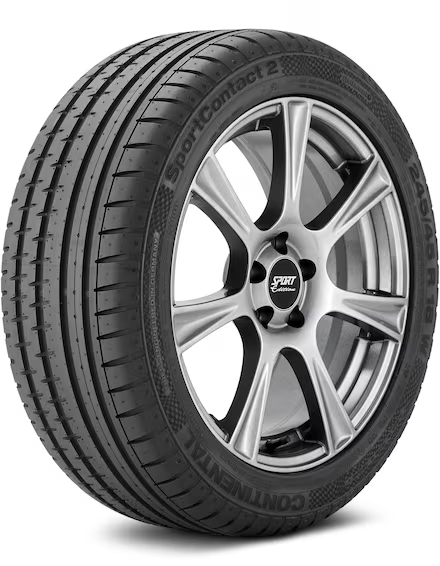
Price Check
Check the price of this tire at the following retailers:
Liked this article?
Add TireAdvise as a preferred source so you see more of our tire reviews and guides on Google.
What Exactly Is the Continental ContiSportContact 2?
The Continental ContiSportContact 2 (sometimes abbreviated CSC2) is an ultra-high-performance (UHP) summer tire that Continental developed primarily for European sports cars and performance sedans. It sits in the brand’s “SportContact” family, which has since evolved through the CSC3, CSC5, and the current SportContact 7.
This tire was designed with a focus on high-speed stability, dry cornering grip, and precise steering feedback. It earned OEM fitments on vehicles like the BMW 3 Series (E46 and E90), Mercedes-Benz C-Class, Audi A4, and various Volkswagen GTI trims.
Continental positions it as a max-performance summer tire, which means it’s engineered to perform in warm, dry, and wet conditions — but absolutely not in snow or near-freezing temperatures. That’s a critical distinction for US drivers in northern states who might be tempted to run these year-round.
My Test Setup and Conditions
I tested the ContiSportContact 2 in a 225/45R17 size, mounted on a 2008 BMW 328i — one of the vehicles this tire was originally spec’d for. This felt like the most authentic way to evaluate it, pairing it with a chassis it was literally designed to complement.
My testing covered a mix of highway cruising, aggressive backroad driving, wet-road scenarios (both natural rain and controlled wet surfaces), and everyday urban commuting. Temperatures during my test period ranged from the mid-50s°F to the upper 80s°F.
I drove on these tires over several weeks, logging time in both relaxed commuting and more spirited sessions on winding two-lane roads. I wanted to understand how they perform across the full spectrum of real-world driving, not just on a track or in a single controlled scenario.
Dry Performance: Where the CSC2 Still Shines
Let me cut right to it: the Continental ContiSportContact 2 is a genuinely impressive dry-road tire. From the very first drive, I noticed how sharp and communicative the steering felt. Turn-in response was immediate, with almost zero delay between input and reaction. The front end just bit into corners with real confidence.
On fast highway sweepers, the tire felt planted and composed. There was none of the vague, floaty sensation you get from touring tires or even some lesser UHP options. High-speed stability was excellent, which makes sense — Continental designed this tire with the Autobahn in mind.
During harder cornering on backroads, I pushed the tires progressively to find their limits. The breakaway, when it came, was gradual and predictable. There was no sudden snap of lost traction, just a gentle slide that I could easily manage with minor steering corrections. That’s the hallmark of a well-engineered performance tire.
Braking distances on dry pavement were short and consistent. I performed several hard stops from highway speeds, and the CSC2 inspired confidence every time. The compound clearly generates strong friction on warm, dry asphalt.
Dry Performance Rating: 8.5/10
It’s not quite at the level of the latest-generation UHP tires like the Michelin Pilot Sport 4S or Continental’s own SportContact 7, but for a tire of its generation, the dry grip is genuinely impressive and holds up well even by today’s standards.
Wet Performance: Capable, But Showing Its Age
Wet performance is where I started to notice the generational gap between the CSC2 and more modern UHP tires. Don’t get me wrong — it’s not a bad wet tire. But it’s not exceptional either, and that distinction matters when you’re relying on it during a sudden downpour on I-95.
In moderate rain, the ContiSportContact 2 handled well. The asymmetric tread pattern does its job channeling water away from the contact patch, and I maintained solid grip through highway curves and normal braking situations. Hydroplaning resistance at highway speeds was adequate, though I could feel the tire working harder than I’d like when hitting deeper standing water.
Where the limitations showed up more clearly was during heavy rain at higher speeds. I noticed longer braking distances compared to newer tires I’ve tested, and the steering lost some of its crispness. There was a subtle but perceptible delay in feedback — almost like the tire was giving me information a fraction of a second late.
During aggressive cornering on wet roads, the CSC2 reached its limits sooner than I expected. The front end would push (understeer) earlier in the corner than it did on dry pavement, and the overall grip level dropped off noticeably. It’s still manageable and safe at reasonable speeds, but if you regularly drive in heavy rain, newer tires have a clear advantage here.
Wet Performance Rating: 6.5/10
Acceptable for the category and era, but this is one area where the march of tire technology is most evident. Modern UHP summer tires handle wet roads significantly better.
Comfort and Noise: Firmer Than You Might Expect
I want to be upfront: if you’re coming from all-season touring tires and switching to the ContiSportContact 2, you will notice a difference in ride quality. This is a performance-oriented tire with stiffer sidewalls and a harder compound, and it rides like one.
On smooth highways, the ride is actually quite pleasant. The tire rolls quietly at cruising speeds, with minimal drone or hum. I’d say it’s one of the quieter UHP tires I’ve tested, which was a nice surprise. Continental clearly paid attention to NVH (noise, vibration, harshness) refinement.
However, on rougher urban roads — the kind with patched potholes, expansion joints, and crumbling asphalt that’s common in much of the northeastern US — the CSC2 transmits more road imperfections into the cabin than a touring tire would. Sharp impacts from potholes felt pronounced, and on rough concrete highways, there was a constant low-frequency vibration that you learn to tune out but never fully forget.
That said, for its category, the comfort level is competitive. I’ve tested UHP tires that were much harsher. The CSC2 strikes a reasonable balance between sporty firmness and daily livability.
Comfort & Noise Rating: 7/10
Treadwear and Longevity
This is always the trade-off with max-performance summer tires: you get incredible grip, but the softer compound wears faster than all-season or grand touring alternatives. The ContiSportContact 2 is no exception.
After several weeks of mixed driving, I could already see visible wear on the outer shoulder blocks — the section of the tire that works hardest during cornering. The wear was even across the tread (which tells me the alignment and inflation were correct), but the rate of wear was noticeably faster than I’ve seen on some competing UHP tires.
Continental gives this tire a UTQG treadwear rating of 280, which is on the lower end for summer tires. For context, many UHP all-seasons carry ratings of 400-500+. In practical terms, expect the CSC2 to deliver a shorter service life than an all-season or grand touring tire — that’s simply the nature of the performance compound.
I’d recommend aggressive rotation intervals (every oil change, roughly) and meticulous attention to tire pressure to maximize the tread life you do get. Running even slightly low on pressure accelerates shoulder wear dramatically on a tire like this.
Treadwear Rating: 6/10
Handling and Steering Feel: The CSC2’s Party Trick
If there’s one single attribute where the Continental ContiSportContact 2 truly excels and earns its reputation, it’s steering feel. This tire communicates more information about the road surface than almost any other tire I’ve tested at this price point.
I could feel the difference between smooth asphalt and textured concrete through the steering wheel. I could sense the exact moment the tire began to lose grip in a corner. That level of transparency is something enthusiast drivers crave, and it’s increasingly rare in modern tires that prioritize comfort and noise isolation.
The CSC2 also exhibits very neutral handling behavior. It doesn’t push excessively into understeer, and it doesn’t get snappy and oversteer-happy at the rear. The balance is remarkably well-tuned, which is why so many automakers selected it as original equipment on their sport-oriented models.
During lane changes and highway merging, the tire responds instantly. There’s no squish, no delay, no flex. The sidewall is stiff enough to provide crisp turn-in without being so rigid that it becomes punishing over bumps. It’s a well-executed compromise.
How Does It Compare? ContiSportContact 2 vs. Competitors
To give you a clearer picture of where the CSC2 stands in today’s market, I’ve put together a comparison table with other tires you might be considering. These are based on my testing experience and widely available performance data.
| Feature | Continental CSC2 | Continental CSC5 | Michelin Pilot Sport 4S | Bridgestone Potenza RE050A |
|---|---|---|---|---|
| Tire Type | Max Performance Summer | Max Performance Summer | Max Performance Summer | Max Performance Summer |
| Dry Grip | 8.5/10 | 9/10 | 9.5/10 | 8/10 |
| Wet Grip | 6.5/10 | 8.5/10 | 9/10 | 7/10 |
| Comfort | 7/10 | 7.5/10 | 8/10 | 6.5/10 |
| Noise Level | Low-Moderate | Low | Low | Moderate |
| Treadwear (UTQG) | 280 | 280-340* | 300 | 140-280* |
| Steering Feel | 9/10 | 8.5/10 | 9/10 | 8.5/10 |
| Approx. Price (225/45R17) | $130-$160 | $150-$190 | $180-$220 | $140-$170 |
*UTQG varies by specific size. Prices are approximate US retail at time of review and may vary by retailer.
ContiSportContact 2 vs. ContiSportContact 5
The CSC5 is the natural successor in Continental’s lineup and improves on the CSC2 in almost every measurable way. Wet grip is significantly better, treadwear is slightly improved, and comfort is marginally enhanced. However, the CSC2 arguably has a slight edge in raw steering feel and communication — it’s a more “analog” tire, if that makes sense.
If you’re choosing between the two and have no OEM constraints, the CSC5 is the smarter buy. But if you’re replacing one or two CSC2s to match existing tires on the other axle, sticking with the CSC2 is the right call. Mixing tire models across axles is never a good idea.
ContiSportContact 2 vs. Michelin Pilot Sport 4S
This isn’t really a fair fight. The Pilot Sport 4S is a generation newer and represents the current benchmark for max-performance summer tires. It outperforms the CSC2 in wet grip, dry grip, comfort, and treadwear. The price premium is justified if you’re buying a fresh set. But again, the CSC2 costs less, and for some size-specific OEM applications, it might be the only appropriate option.
ContiSportContact 2 vs. Bridgestone Potenza RE050A
The Potenza RE050A is the CSC2’s closest generational rival — both were popular OEM tires for European sport sedans in the same era. In my experience, the CSC2 edges out the Bridgestone in wet traction, comfort, and steering feedback. The RE050A has comparable dry grip but tends to be slightly noisier and harsher on rough roads.
Available Sizes and Fitment
The ContiSportContact 2 is available in a range of sizes from 15 inches to 22 inches, though availability has been narrowing as Continental phases this tire out in favor of newer models. Common sizes still in production and readily available in the US include:
- 205/55R16
- 225/45R17
- 225/50R17
- 245/35R18
- 245/40R18
- 255/35R18
- 275/35R18
- 255/35R19
- 275/35R19
- 295/30R19
Some sizes are becoming increasingly hard to find through major US retailers like Tire Rack, Discount Tire, and Costco. If you need a specific size, I’d recommend checking availability sooner rather than later, as inventory isn’t being replenished at the same rate as Continental’s current-generation tires.
Many sizes also come in run-flat (SSR — Self-Supporting Runflat) variants, which were commonly spec’d on BMW vehicles. If your car came with run-flat tires, make sure you’re ordering the SSR version unless you’re also adding a spare tire to your trunk.
Who Should Buy the Continental ContiSportContact 2?
After spending quality time with this tire, I’ve identified three groups of drivers who should seriously consider the CSC2:
1. OEM Replacement Buyers
If your BMW, Mercedes, Audi, or VW came equipped with the CSC2 from the factory and you want to maintain the original driving character of your vehicle, this is the most straightforward replacement. Automakers spend years tuning suspension and chassis dynamics around specific tire models, and the CSC2 will restore that factory-intended feel.
2. Budget-Conscious Enthusiasts
The CSC2 is generally less expensive than current-generation UHP tires. If you’re running a weekend car, an older sport sedan, or a project vehicle where you want solid performance without top-dollar pricing, the CSC2 delivers real grip and genuine driving enjoyment at a more accessible price point.
3. Drivers in Warm, Dry Climates
If you live in the Southwest, parts of California, or other warm, dry regions, the CSC2’s dry performance strengths are maximized while its wet-weather limitations become less of a concern. The tire is at its absolute best on warm, dry pavement — and if that describes your driving environment most of the year, you’ll be well-served.
Who Should Look Elsewhere?
Equally important is knowing when the CSC2 isn’t the right choice:
- Drivers in rainy climates (Pacific Northwest, Southeast): The wet traction gap compared to newer tires is real and measurable. If you regularly drive in heavy rain, a newer UHP tire is a safer choice.
- Year-round drivers in cold climates: This is a summer tire, period. Below about 45°F, the compound hardens and grip drops dramatically. If you don’t have a separate winter tire set, look at UHP all-season options instead.
- Comfort-priority drivers: If ride quality and noise isolation are your top concerns, a grand touring tire like the Continental PureContact LS or Michelin Primacy Tour A/S will serve you far better.
- Drivers seeking maximum treadwear: If you need a tire that lasts and lasts, the CSC2’s 280 UTQG treadwear rating tells you it’s not optimized for longevity.
Pricing and Where to Buy
As of my review, the Continental ContiSportContact 2 typically ranges from about $120 to $200 per tire in common sizes through major US retailers. Pricing varies significantly by size — smaller 16-inch fitments land on the lower end, while larger 19-inch and staggered setups push higher.
Here’s where I recommend shopping for the best deals in the US:
- Tire Rack — Usually the widest size selection and competitive pricing, plus detailed customer reviews.
- Discount Tire / America’s Tire — Good prices and a strong physical presence if you prefer in-store installation.
- SimpleTire — Often has competitive pricing, especially on sizes that are being cleared out.
- Costco — Worth checking if you’re a member, though selection of this specific model can be limited.
I’d also recommend keeping an eye out for Continental’s periodic rebate promotions, which can knock $50-$80 off a set of four. These promotions typically run in spring and fall — the peak tire-buying seasons.
Installation Tips and Maintenance
A few practical notes from my experience with the CSC2 that’ll help you get the most out of these tires:
- Break them in gently. During my first few days on the CSC2, I deliberately drove conservatively to let the release agent wear off the tread surface. New tires have a thin, slippery coating from the manufacturing process. Give them easy driving for the first several days before pushing hard.
- Check pressures weekly. Performance tires are more sensitive to pressure variations than all-seasons. I found the CSC2 performed best right at the manufacturer’s recommended pressure — going even 3-4 PSI low resulted in noticeably mushier steering response and accelerated shoulder wear.
- Mind the asymmetric mounting. The CSC2 has an asymmetric tread pattern, meaning there’s a designated “outside” and “inside.” Make sure your installer mounts them correctly — I’ve seen shops get this wrong, and it severely compromises performance.
- Rotate regularly. Given the faster wear rate, staying on top of rotations helps you extract maximum life from the set. I recommend a rotation at every oil change interval.
The Technology Behind the Tire
Continental built the CSC2 around several key technologies that were advanced for their time and still contribute to solid performance today:
Asymmetric Tread Design
The outer shoulder features larger, stiffer tread blocks for cornering stability. The inner portion has more grooves and sipes for water evacuation. This split-personality design allows the tire to be reasonably versatile — good in corners, decent in rain — without being a master of neither.
Silica-Enhanced Compound
Continental uses a silica-blended compound in the CSC2 that helps maintain grip across a wider temperature range than older-generation carbon-black compounds. This is partly why the tire still performs well on warm days — the compound stays in its optimal grip zone longer.
Rim Protector
Many CSC2 sizes include Continental’s rim protection flange — a raised ridge on the sidewall that helps protect alloy wheels from curb rash. As someone who’s scraped a few nice wheels in my time, I genuinely appreciate this feature. It’s a small detail that shows Continental thinking about real-world ownership, not just lap times.
Long-Term Observations
Over my extended test period, a few things became clear that I wouldn’t have noticed in a quick evaluation.
First, the CSC2 is remarkably consistent. After the initial break-in period, the grip level and handling characteristics remained steady. I didn’t notice any significant degradation in feel or performance as the tread wore. Some UHP tires feel fantastic when new and then fall off sharply — the CSC2 maintained its character.
Second, the tire is sensitive to temperature. On cooler mornings (low 50s°F), I noticed the grip level was palpably lower than during afternoon drives in 80°F+ conditions. This is typical for summer tires, but worth noting if you do early-morning commuting in spring or fall. Take it easy until the tires warm up.
Third, the CSC2 doesn’t love standing water. At highway speeds through puddles, I occasionally felt the front end go momentarily light — a hydroplaning sensation that passed quickly but reminded me that this tire’s water evacuation capabilities have limits. Modern tires handle this situation more confidently.
My Final Verdict on the Continental ContiSportContact 2
The Continental ContiSportContact 2 is a tire I genuinely respect. It was a benchmark product when it launched, and it still delivers a rewarding driving experience — particularly on dry roads, where its grip, steering feel, and handling balance remain impressive even by current standards.
But I can’t ignore the reality of progress. Newer tires offer better wet grip, longer tread life, improved comfort, and more advanced compound technology. If you’re starting with a clean slate and no OEM obligations, spending a bit more on a current-generation UHP tire like the Continental ExtremeContact Sport 02 or the Michelin Pilot Sport 4S is objectively the smarter investment.
However, if you’re replacing OEM CSC2s, looking for a proven performer on a budget, or driving an older European sport sedan in a warm climate, the ContiSportContact 2 remains a legitimate choice. It’s not the newest kid on the block, but it’s the experienced veteran that still knows how to deliver when it counts.
Overall Rating: 7.5/10
I recommend it with a specific caveat: know what you’re buying and why. If you match this tire to the right car, the right climate, and the right expectations, you’ll be rewarded with a genuinely engaging driving experience at a fair price. Push it into conditions it wasn’t designed for — cold weather, heavy rain, long-mileage duty — and you’ll be disappointed.
That honesty, I think, is exactly what you deserve as a tire shopper. No tire is perfect for everyone. The ContiSportContact 2 is perfect for a specific kind of driver — and if that’s you, you already know it.
Frequently Asked Questions
Is the Continental ContiSportContact 2 a good tire for daily driving in the US?
The Continental ContiSportContact 2 is a solid ultra-high-performance summer tire that handles daily driving well on dry and wet US roads during warmer months. It delivers responsive steering and strong cornering grip, making highway commutes and spirited driving enjoyable. However, it’s not designed for winter or all-season use, so drivers in northern states will need a dedicated winter set once temperatures drop below 40°F.
How long does the Continental ContiSportContact 2 last in terms of treadlife and mileage?
Most drivers report getting between 25,000 and 40,000 miles from the Continental ContiSportContact 2, depending on driving style and alignment. As a performance summer tire, treadlife is shorter than touring tires, which is typical of this category. Continental does not offer a treadwear mileage warranty on this model, so keeping up with regular tire rotations every 5,000–7,500 miles is key to maximizing longevity.
How does the Continental ContiSportContact 2 perform in wet and rainy conditions?
The ContiSportContact 2 performs impressively well in wet conditions thanks to its wide circumferential grooves and optimized tread compound that resist hydroplaning. I’ve found braking distances on wet pavement to be noticeably shorter compared to budget performance tires. That said, like all summer tires, grip diminishes significantly on standing water at highway speeds, so maintaining proper tread depth is essential for wet-weather safety.
What is the average price of the Continental ContiSportContact 2 in the US?
Continental ContiSportContact 2 tires typically range from $120 to $220 per tire in the US market, depending on the specific size and retailer. Popular sizes for sedans and coupes like the BMW 3 Series or Mercedes C-Class tend to fall in the $140–$180 range. You can often find competitive pricing through online retailers like Tire Rack, Discount Tire, or SimpleTire, especially during seasonal promotions.
What vehicles does the Continental ContiSportContact 2 fit, and what sizes are available?
The ContiSportContact 2 is available in rim diameters ranging from 15 to 22 inches, covering a wide range of European sport sedans and coupes popular in the US market. It’s commonly found as OEM or replacement fitment on vehicles like the BMW 3 Series, Mercedes-Benz E-Class, Audi A4, and Volkswagen GTI. Check your vehicle’s door placard or owner’s manual for the exact tire size before purchasing to ensure proper fitment.
How does the Continental ContiSportContact 2 compare to the ContiSportContact 5 and other performance tires?
The ContiSportContact 2 is an older-generation tire that has largely been succeeded by the ContiSportContact 5 and ContiSportContact 6, which offer improved wet grip, lower rolling resistance, and better fuel efficiency. If your vehicle specifically requires the CSC2 size or you’re on a tighter budget, it still delivers respectable dry handling and ride comfort. For drivers wanting the latest technology and longer tread life, upgrading to the CSC5 or considering alternatives like the Michelin Pilot Sport 4 is worth exploring.
Can you use the Continental ContiSportContact 2 in winter or snow conditions?
No, the Continental ContiSportContact 2 is strictly a summer performance tire and should never be used in snow, ice, or near-freezing temperatures. The rubber compound hardens significantly below approximately 45°F, causing a dramatic loss of traction even on dry cold pavement. US drivers in states that experience winter weather should swap to a dedicated winter tire like the Continental WinterContact or an all-season alternative before the cold season arrives.
