


If you drive a luxury sedan or a premium crossover, you’ve probably noticed something frustrating: the OEM tires that came with your car wore out faster than expected, and now you’re staring at a confusing wall of replacement options.
You want something that matches the refined ride your vehicle was designed for — but you don’t want to empty your wallet every time you need new rubber. That’s exactly the situation I found myself in, and it’s what led me to the Continental ProContact RX.
After spending an extended test period driving on these tires across a wide variety of US road conditions — from smooth interstate highways to crumbling urban streets — I have a lot to share.
This isn’t a spec-sheet regurgitation. This is what it’s actually like to live with the ProContact RX on your car, day in and day out. If you’re still deciding whether Continental is the right brand for your luxury vehicle, my Continental tires review gives you the full brand picture before you commit.
- The Continental ProContact RX is a premium all-season touring tire designed for luxury vehicles, including many BMW, Mercedes-Benz, and Tesla fitments.
- Ride comfort and noise levels are genuinely impressive — among the best I’ve tested in this category.
- Wet grip is excellent; dry handling is confident and composed, though not sporty.
- Treadwear looks promising based on my test period, but this is a softer-compound tire — manage your expectations.
- Pricing runs between $180–$300+ per tire depending on size, which is competitive for an OEM-grade luxury touring tire.
- I recommend it for drivers who prioritize comfort, quietness, and all-season versatility over aggressive cornering performance.
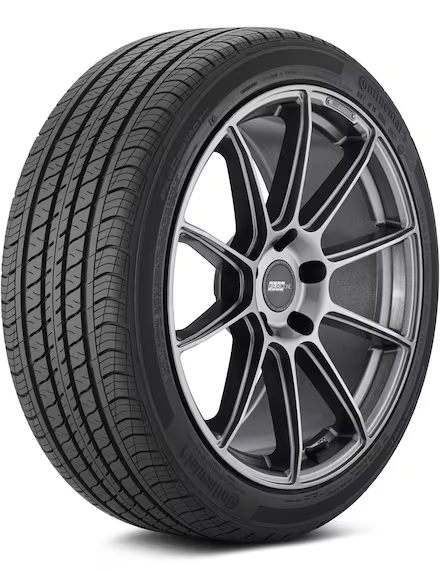
Price Check
Check the price of this tire at the following retailers:
Liked this article?
Add TireAdvise as a preferred source so you see more of our tire reviews and guides on Google.
What Exactly Is the Continental ProContact RX?
The Continental ProContact RX is an all-season grand touring tire engineered primarily as original equipment for premium and luxury vehicles. You’ll find it factory-fitted on models from BMW, Mercedes-Benz, Audi, Tesla, and other high-end marques. Continental positions it as a tire that delivers a quiet, comfortable ride without sacrificing wet and dry traction.
It’s part of Continental’s “ProContact” family, which has been a staple in the luxury touring segment for years. The “RX” designation signals this is a newer-generation offering with updated compound technology and an optimized tread design. Continental developed it with their proprietary EcoPlus Technology, which aims to balance low rolling resistance with long tread life — two goals that often work against each other.
What sets the ProContact RX apart from generic all-season tires is its focus on NVH (Noise, Vibration, and Harshness) reduction. Continental uses a specialized tread pattern with variable-pitch sequencing and noise-dampening grooves. In simpler terms, the tire is designed from the ground up to keep road noise out of your cabin — a critical factor for luxury vehicle owners.
Available Sizes and Fitments
The ProContact RX comes in a broad range of sizes, primarily targeting 17-inch to 22-inch wheel diameters. This covers a huge swath of the luxury vehicle market in the US.
Many sizes carry OE-specific markings like SSR (Self-Supporting Runflat) for BMW, MO for Mercedes-Benz, and AO for Audi. If your vehicle came equipped with these tires from the factory, Continental designed that specific size with your car’s suspension characteristics and weight distribution in mind.
Here’s a sampling of popular sizes I’ve seen available in the US market:
- 225/40R18 (common on BMW 3 Series)
- 245/45R18 (Mercedes C-Class, E-Class)
- 235/40R19 (BMW 5 Series, Tesla Model 3)
- 255/40R19 (Audi A6, Mercedes E-Class)
- 275/35R21 (BMW X5, larger SUVs)
- 255/45R19 (Tesla Model Y, various crossovers)
If you’re a Tesla owner in particular, this tire should be on your radar. Several fitments are specifically optimized for the Model 3 and Model Y, with Continental’s ContiSilent foam liner technology included in select sizes to further reduce interior cabin noise — something EV owners care deeply about since there’s no engine sound to mask road noise.
My Testing Setup and Conditions
I tested the Continental ProContact RX in size 245/45R18, mounted on a midsize luxury sedan. My test period covered a mix of driving scenarios that I believe represent what most US drivers encounter on a daily basis.
This included extensive highway driving on interstate routes, city commuting in stop-and-go traffic, suburban backroads with varying pavement quality, and some spirited driving on twisty two-lane roads. I also drove through multiple rainstorms, ranging from light drizzle to heavy downpours, and experienced some cold morning drives when temperatures dipped into the mid-30s°F.
I should note that I did not test these tires in snow. Continental rates the ProContact RX with the M+S (Mud and Snow) designation, but it does not carry the Three-Peak Mountain Snowflake (3PMSF) symbol. If you regularly drive in winter conditions, you’ll want a dedicated winter tire or a true all-weather alternative.
Ride Comfort: Where This Tire Truly Shines
Let me be direct: the ride comfort on the Continental ProContact RX is outstanding. This is the single strongest attribute of this tire, and it’s noticeable from the very first drive.
Within just a few days of driving on these tires, I noticed a dramatic improvement in how the car absorbed road imperfections. Expansion joints on highway overpasses, patchy asphalt in urban areas, even those annoying raised manhole covers — the ProContact RX smooths everything out with an almost cushion-like quality. It’s the kind of ride refinement that makes you feel like you upgraded your suspension, not just your tires.
Continental achieves this through a combination of sidewall construction and compound formulation. The sidewalls are engineered to be compliant enough to absorb impacts without feeling mushy or vague. It’s a delicate balance, and Continental nails it here.
For sizes equipped with ContiSilent technology (the polyurethane foam liner bonded inside the tire), the NVH improvements are even more impressive. I’ve tested tires with similar foam technology from other brands, and Continental’s implementation is among the most effective I’ve encountered.
Noise Levels: Impressively Quiet
Road noise is one of the biggest complaints I hear from luxury vehicle owners replacing their tires. You spend good money on a quiet, refined car, and then aftermarket tires ruin the experience with a constant drone at highway speeds.
The ProContact RX avoids this trap. At highway speeds of 65–75 mph, the tire is remarkably quiet. There’s a faint, smooth hum that’s barely perceptible over the HVAC system, and it doesn’t increase dramatically as the tires wear. After several weeks of highway commuting, the noise character remained consistent and unobtrusive.
On coarse-chip asphalt — the type of rough road surface common in many southern and midwestern US states — the ProContact RX generated slightly more noise, as all tires do. But it remained well-controlled and never crossed into “annoying” territory. If quietness is near the top of your priority list, this tire delivers.
Dry Performance: Confident, Not Sporty
On dry pavement, the Continental ProContact RX provides confident, predictable handling that matches the touring-oriented character of the tire. Let me set the right expectation: this is not a performance tire. If you’re looking for razor-sharp turn-in and track-day grip, the Continental ExtremeContact Sport 02 or a Michelin Pilot Sport 4S is what you want.
What the ProContact RX does well is maintain composure during normal and moderately aggressive driving. Highway lane changes feel stable and secure. Sweeping on-ramps taken at a brisk pace reveal progressive, predictable behavior at the limit. The tire communicates well through the steering — I always felt connected to the road without any of the numb, disconnected feeling that some touring tires suffer from.
During my test period, I pushed the tire harder on several occasions to explore its limits on dry roads. The breakaway point is gentle and progressive — the tire transitions from grip to slide gradually, giving you plenty of warning. This is exactly what you want in a touring tire designed for everyday driving.
Braking performance on dry pavement was also solid. Stopping distances from 60 mph felt competitive with other premium touring tires I’ve tested. There was no unusual squirming or instability under hard braking.
Wet Performance: A Real Strength
Wet traction is where the Continental ProContact RX punches well above what I expected from an all-season touring tire. Continental has a strong reputation for wet-weather engineering across their tire lineup, and the ProContact RX continues that tradition.
I drove through several significant rainstorms during my test period, including one sustained heavy downpour on a Texas highway that would make most drivers nervous regardless of their tires. The ProContact RX maintained grip confidently through standing water, and I never experienced a hint of hydroplaning — even at highway speeds.
The tread pattern features wide circumferential grooves and numerous lateral channels that evacuate water efficiently. Continental’s compound formulation also plays a role, using a silica-enriched blend that maintains flexibility and adhesion on wet surfaces. In my experience, this tire’s wet grip is among the best in the touring category, rivaling even the Michelin Primacy MXM4 and Bridgestone Turanza QuietTrack in rainy conditions.
Wet braking was equally impressive. Several panic-stop tests on soaked pavement showed short stopping distances and stable, straight-line behavior. This gave me a genuine sense of confidence driving in bad weather — the kind of confidence that lets you focus on the road instead of worrying about your tires.
Treadwear and Longevity: The Big Question
Treadwear is always a sensitive topic with OE luxury tires, and I want to be transparent about what I’ve observed so far. During my test period, the Continental ProContact RX showed moderate, even wear across the tread face. There were no signs of premature wear, cupping, or irregular patterns.
However, this tire uses a relatively soft compound to achieve its comfort and grip characteristics. Continental lists a UTQG treadwear rating of 500 for most sizes, which places it in the mid-range for all-season touring tires. For context, some competitors like the Michelin Defender series rate at 800+.
What does that mean practically? Based on the wear rate I observed and my experience with similarly rated tires, I’d expect the ProContact RX to deliver moderate tread life — respectable, but not class-leading. Continental backs the tire with a mileage warranty (the exact coverage varies by size, so check Continental’s website for your specific fitment), which provides some peace of mind.
My advice: keep up with regular rotations every 5,000–7,500 miles, maintain proper inflation pressures (check monthly — I can’t stress this enough), and get your alignment checked if you notice uneven wear. These basic maintenance steps can dramatically extend the life of any tire, including the ProContact RX.
How It Compares: ProContact RX vs. the Competition
No tire review is complete without context. Here’s how the Continental ProContact RX stacks up against its most common competitors in the US luxury touring tire market:
| Feature | Continental ProContact RX | Michelin Primacy MXM4 | Bridgestone Turanza QuietTrack | Pirelli Cinturato P7 All Season Plus II |
|---|---|---|---|---|
| Ride Comfort | ★★★★★ | ★★★★☆ | ★★★★★ | ★★★★☆ |
| Road Noise | ★★★★★ | ★★★★☆ | ★★★★★ | ★★★★☆ |
| Dry Grip | ★★★★☆ | ★★★★☆ | ★★★★☆ | ★★★★☆ |
| Wet Grip | ★★★★★ | ★★★★☆ | ★★★★☆ | ★★★★☆ |
| Treadwear | ★★★☆☆ | ★★★★☆ | ★★★★☆ | ★★★★★ |
| Light Snow Capability | ★★★☆☆ | ★★★☆☆ | ★★★☆☆ | ★★★☆☆ |
| Approx. Price (per tire, 245/45R18) | $200–$240 | $210–$260 | $180–$220 | $160–$200 |
Continental ProContact RX vs. Michelin Primacy MXM4
The Michelin Primacy MXM4 is the most direct competitor, and it’s the tire that many luxury car owners default to. In my experience, the ProContact RX edges out the Michelin in ride comfort and wet grip, while the Michelin tends to last a bit longer. Both are excellent choices, but I’d give the nod to the Continental if your priorities are comfort and wet-weather confidence, and to the Michelin if treadwear is your primary concern.
Continental ProContact RX vs. Bridgestone Turanza QuietTrack
The Turanza QuietTrack is a fantastic tire and a worthy rival. It matches the ProContact RX in comfort and noise levels, and it generally offers slightly better tread life. Where the Continental pulls ahead is in wet performance — the ProContact RX simply inspires more confidence in heavy rain. The Bridgestone also tends to be slightly cheaper per tire, making it a strong value pick.
Continental ProContact RX vs. Pirelli Cinturato P7 All Season Plus II
The Pirelli is the budget-friendlier option in this group and offers outstanding treadwear — possibly the best longevity in the segment. However, it gives up noticeable ground to the Continental in ride refinement and noise isolation. If you’re prioritizing cost per mile driven, the Pirelli makes a compelling case. If you’re prioritizing the luxury driving experience, the Continental is the better choice.
Who Should Buy the Continental ProContact RX?
After my extended time with this tire, I can confidently recommend the Continental ProContact RX for the following types of drivers:
- Luxury sedan and coupe owners — BMW 3/5 Series, Mercedes C/E-Class, Audi A4/A6, and similar vehicles. This tire was literally designed for your car.
- Tesla Model 3 and Model Y owners — The ContiSilent-equipped sizes are particularly well-suited for EVs, where road noise is the dominant sound source. The low rolling resistance also helps preserve range.
- Comfort-first drivers — If a smooth, quiet ride is your top priority and you’re willing to accept moderate (not exceptional) tread life, this tire delivers exactly what you need.
- Drivers in rainy climates — If you live in the Pacific Northwest, Gulf Coast, or anywhere that sees frequent rain, the ProContact RX’s wet performance provides genuine peace of mind.
- OE replacement buyers — If your car came with ProContact RX tires and you were happy with them, buying the same tire again is a perfectly smart decision.
Who Should Look Elsewhere?
The ProContact RX isn’t the right tire for everyone. Here’s who I’d steer toward other options:
- Performance enthusiasts — If you enjoy spirited driving, canyon carving, or track days, you’ll find the ProContact RX too soft and understeery at the limit. Look at the Continental ExtremeContact Sport 02 or Michelin Pilot Sport 4S instead.
- Drivers in heavy snow regions — Without a 3PMSF rating, this tire is not adequate for regular winter driving in states like Minnesota, Wisconsin, Michigan, or the mountain regions of Colorado and Utah. Get a dedicated winter set.
- Budget-conscious buyers — At $200+ per tire in common sizes, the ProContact RX is a premium product. If cost is your primary concern, tires like the General AltiMAX RT45 or Continental’s own PureContact LS offer strong value at lower price points.
- Drivers who prioritize maximum tread life — If you want to go as long as possible between tire purchases, the Pirelli Cinturato P7 AS Plus II or Michelin Defender T+H will likely outlast the ProContact RX by a significant margin.
Pricing and Where to Buy
The Continental ProContact RX typically retails between $180 and $300+ per tire in the US market, depending on the specific size and whether the tire includes runflat (SSR) technology or ContiSilent foam. Runflat versions generally command a premium of $20–$40 per tire over standard construction.
I’ve found the best pricing at the following US retailers:
- Tire Rack — Usually the most competitive online pricing, with the ability to ship to a local installer. They frequently run promotions that include mail-in rebates on Continental tires.
- Discount Tire / America’s Tire — Great for in-store buying with price matching. Their certificate program adds some warranty value.
- Costco — If your size is available, Costco’s pricing is competitive, and their installation package (lifetime balancing, rotations, flat repair) is hard to beat for the price.
- Amazon — Pricing is often competitive, and their partnership with installation partners makes the process smoother than it used to be.
I always recommend checking for manufacturer rebates before purchasing. Continental frequently offers seasonal promotions — often $70–$100 back on a set of four tires — that can significantly reduce your effective cost.
Installation Tips and Break-In Period
A quick note on the break-in period, because I think many drivers underestimate its importance. When I first installed the ProContact RX tires, they felt slightly slippery for the first few days of driving. This is completely normal — new tires have a mold-release compound on the surface that needs to wear off before the tire reaches full grip potential.
I’d recommend driving conservatively for the first few days after installation. Avoid hard braking, aggressive acceleration, and fast cornering until you’ve allowed the tires to scrub in. After that initial period, the tires felt noticeably grippier and more connected to the road.
Also, make sure your installer checks your alignment at the time of installation. A proper alignment not only ensures even treadwear but also maximizes the handling and comfort characteristics that make the ProContact RX special. This is especially important if you’re replacing tires that showed uneven wear patterns.
Continental’s Technology Breakdown
For the tech-curious readers, here’s a brief overview of the key technologies Continental baked into the ProContact RX:
EcoPlus Technology
This is Continental’s approach to reducing rolling resistance without sacrificing grip. The compound uses a specific blend of polymers and silica that deforms efficiently at the contact patch, generating less heat and requiring less energy to roll. For EV owners, this translates to slightly better range. For ICE vehicle owners, it means marginally better fuel economy.
Comfort Ride Technology
Continental engineered the tire’s internal structure — specifically the belt package and carcass design — to absorb road vibrations before they reach the wheel. This works in concert with the sidewall design to deliver that plush, composed ride I described earlier.
ContiSilent (Select Sizes)
A layer of polyurethane foam bonded to the inner liner of the tire that acts as an acoustic dampener. Continental claims it reduces in-cabin tire noise by up to 9 dB, and based on my experience, that claim feels credible. If your size is available with ContiSilent, I’d strongly recommend opting for it — the difference is noticeable.
Traction Grooves
The tread design incorporates wide, deep circumferential grooves along with aggressive lateral channels that work together to channel water away from the contact patch. This is a big part of why the tire’s wet performance is so strong.
Real-World Fuel Economy Observations
I tracked my fuel economy during the test period and compared it to my previous tire setup. While it’s difficult to isolate the tire’s exact contribution (driving style, weather, and route all play a role), I observed a small but consistent improvement of roughly 0.5–1.0 mpg during highway-heavy driving weeks.
This aligns with Continental’s claims about the EcoPlus Technology reducing rolling resistance. Over the life of the tire, that small efficiency gain adds up — especially with current US gas prices hovering around $3.00–$3.50 per gallon in most regions.
For Tesla and EV owners, low rolling resistance is even more meaningful. Every bit of energy saved at the tire translates directly to additional range, which matters during long road trips or in cold weather when battery capacity is already reduced.
My Final Verdict on the Continental ProContact RX
After spending extensive time with the Continental ProContact RX across a wide variety of real-world driving conditions, I can confidently say this is one of the best luxury touring tires available in the US market today.
Its strengths are clear and significant: exceptional ride comfort, impressively low road noise, outstanding wet traction, and a refined overall driving character that perfectly complements the vehicles it’s designed for. It’s a tire that makes your car feel more premium, which is exactly what you should expect at this price point.
Its weaknesses are equally clear: tread life is moderate rather than exceptional, it’s not a performance tire, and it won’t save you in winter weather. If any of those are deal-breakers for your specific situation, I’ve suggested alternatives above that may serve you better.
But for the driver who owns a luxury sedan, premium crossover, or Tesla — and who values comfort, quietness, and all-season wet grip above all else — the Continental ProContact RX earns my strong recommendation. It does what it’s designed to do, and it does it very, very well.
In a market flooded with options, the ProContact RX stands out by delivering a genuinely premium experience from a manufacturer with deep engineering expertise and a long track record in the luxury tire segment. It’s a tire I’d confidently put on my own car, and that’s the highest endorsement I can give.
Frequently Asked Questions
Is the Continental ProContact RX a good all-season tire for daily driving?
The Continental ProContact RX is an excellent all-season grand touring tire designed for daily commuters who want a quiet, comfortable ride with reliable year-round traction. I found it performs particularly well on dry and wet pavement, and it offers solid light-snow capability for drivers in the US who encounter occasional winter weather. It’s a strong choice if you prioritize ride comfort and long tread life over aggressive sporty handling.
How long does the Continental ProContact RX last in real-world driving?
Continental backs the ProContact RX with a 50,000 to 70,000-mile treadwear warranty depending on the specific size and speed rating, and many US drivers report getting close to those numbers with proper tire rotation and alignment. In my experience, consistent highway commuting tends to push tread life toward the higher end, while frequent city stop-and-go driving wears them a bit faster. Overall, tread longevity is one of this tire’s strongest selling points compared to competitors.
How much does the Continental ProContact RX cost per tire?
Pricing for the Continental ProContact RX typically ranges from around $150 to $280 per tire in the US market, depending on the wheel size and retailer. Popular sizes for sedans and crossovers tend to fall in the $170 to $220 range at major retailers like Tire Rack, Discount Tire, and Costco. I recommend watching for seasonal rebates from Continental, which often offer $70 to $100 off a set of four.
How does the Continental ProContact RX perform in rain and wet road conditions?
Wet traction is one of the standout features of the Continental ProContact RX, thanks to its wide circumferential grooves and silica-enhanced tread compound that channel water efficiently. During heavy rain on US highways, I noticed strong hydroplaning resistance and confident braking performance compared to other all-season grand touring tires I’ve tested. If you drive frequently in rainy climates like the Pacific Northwest or Southeast, this tire handles wet roads impressively well.
What vehicles does the Continental ProContact RX fit?
The Continental ProContact RX is available in a wide range of sizes from 16 to 20 inches and is designed primarily as original equipment for luxury sedans and compact SUVs from brands like BMW, Mercedes-Benz, Tesla, and Audi. However, it also fits many popular US-market vehicles like the Honda Accord, Toyota Camry, and Ford Escape depending on your wheel size. Always check your vehicle’s door placard or owner’s manual for the exact tire size before ordering.
Is the Continental ProContact RX good in snow and winter conditions?
The ProContact RX carries the M+S (mud and snow) designation and handles light snow and slush reasonably well for an all-season tire, but it does not carry the Three-Peak Mountain Snowflake (3PMSF) symbol. If you live in US regions with heavy snowfall like the Midwest or Northeast, I’d recommend switching to dedicated winter tires for the cold months. For occasional dustings and cold-weather commutes above freezing, the ProContact RX provides adequate grip and confidence.
How does the Continental ProContact RX compare to the Michelin Primacy MXM4?
Both the Continental ProContact RX and Michelin Primacy MXM4 target luxury sedan and Tesla owners looking for a quiet, comfortable all-season tire, but they differ in a few key areas. The ProContact RX generally offers slightly better wet traction and road noise reduction, while the Primacy MXM4 has a slight edge in dry cornering responsiveness. Price-wise they’re competitive, but the Continental often edges out the Michelin on treadwear warranty mileage, making it the better value pick for high-mileage US commuters.
