

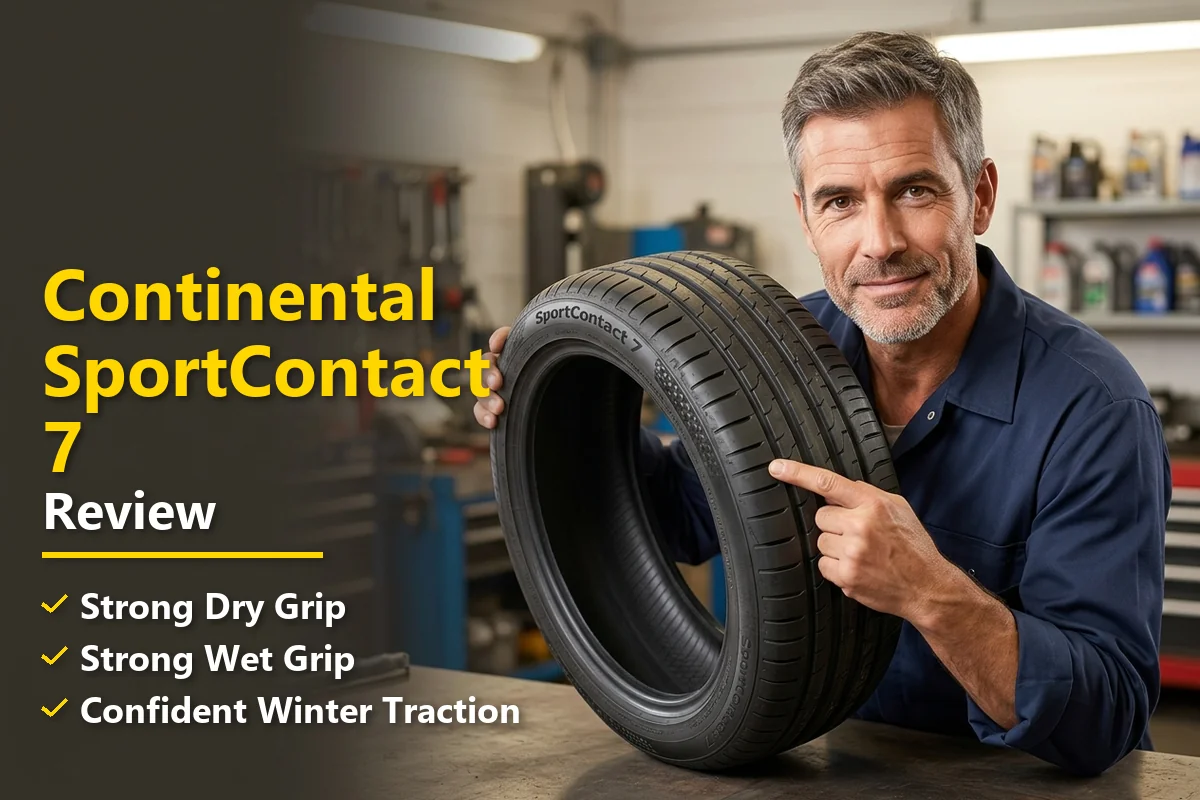
You just bought a sports sedan or a performance coupe, and the factory tires are starting to show their age. You want something that transforms how the car feels — not just maintains it.
But ultra-high-performance tires are a serious investment, often north of $250 per tire, and the wrong pick means you’re stuck with a compromise you didn’t sign up for.
That’s exactly where I found myself before mounting a set of Continental SportContact 7s. And after spending an extended test period pushing them through everything from rain-soaked highways to aggressive canyon runs, I can tell you — these tires have a lot to say.
If you want the full brand picture before committing to a premium set, my Continental tires review is worth reading first.
- The Continental SportContact 7 is a top-tier ultra-high-performance summer tire with extraordinary dry grip and razor-sharp steering response.
- Wet performance is genuinely impressive — among the best I’ve experienced in the UHP category.
- Ride comfort is surprisingly refined for a tire this performance-focused, though road noise is noticeable at highway speeds.
- Pricing ranges from roughly $220–$380+ per tire depending on size, putting it at the premium end of the market.
- Best suited for drivers who prioritize handling and braking over tread life and year-round usability — this is a summer-only tire.
- I’d recommend it for performance sedans, sports cars, and enthusiast drivers who want the best grip available on the street.
Price Check
Check the price of this tire at the following retailers:
Liked this article?
Add TireAdvise as a preferred source so you see more of our tire reviews and guides on Google.
What Is the Continental SportContact 7?
The Continental SportContact 7 is Continental’s flagship ultra-high-performance (UHP) summer tire, succeeding the well-regarded SportContact 6. It’s engineered for sports cars, performance sedans, and high-powered coupes — the kind of vehicles where the tires are genuinely part of the driving experience, not just rubber that holds air.
Continental designed this tire using what they call “BlackChili” compound technology, which is their proprietary silica-enriched rubber blend aimed at maximizing grip across a broad temperature range. They’ve also incorporated an asymmetric tread pattern with adaptive tread ribs that are designed to optimize the contact patch under heavy cornering loads.
Available in sizes ranging from 19 to 23 inches, the SportContact 7 is clearly aimed at modern performance vehicles. Think BMW M cars, Mercedes-AMG models, Porsche 911s, Audi RS variants, and similar enthusiast-level machines. It’s an OE (original equipment) fitment on several European performance cars, which tells you something about the level of engineering involved.
My Testing Setup and Conditions
I tested the Continental SportContact 7 in size 255/35ZR19 on the front and 285/30ZR20 on the rear, mounted on a rear-wheel-drive performance sedan. This staggered setup is common for this class of vehicle, and it gave me a good feel for how the tire performs across both axles.
Over my testing period, I drove through a wide range of conditions — dry highways, wet suburban roads, tight mountain switchbacks, and even a few aggressive on-ramp entries that would make my insurance agent nervous. I also spent several days commuting in stop-and-go traffic to evaluate the tire’s daily-driving manners.
Ambient temperatures during my testing ranged from the mid-50s to the upper 90s Fahrenheit, which gave me a reasonable window to assess how the compound behaves as temperatures shift. I did not test these in cold or freezing conditions — and neither should you. These are summer tires, period.
Dry Performance: Where This Tire Lives
Let me be direct: the dry grip on the Continental SportContact 7 is phenomenal. From the very first drive, I could feel an immediacy and confidence in the steering that elevated the entire driving experience. Turn-in is crisp, almost telepathic. The tire communicates what the road surface is doing with a clarity that most competitors simply can’t match.
During spirited driving through canyon roads, I pushed the tires progressively harder over several days. The breakaway characteristics are remarkably progressive and predictable. Instead of a sudden loss of grip, the SportContact 7 gives you a gradual buildup of slip angle, letting you feel exactly where the limit is before you get there. For an enthusiast driver, this is invaluable.
Braking performance in the dry is equally outstanding. I noticed a significant reduction in stopping distances compared to the all-season tires I’d been running previously. The tire bites hard on initial application and maintains consistent deceleration forces all the way to a stop. In emergency braking scenarios, that kind of performance can genuinely save your life.
Lateral Grip and Cornering Stability
One thing that really stood out during my testing was the cornering stability under sustained load. Midcorner, the tire feels planted and unflappable. There’s minimal sidewall flex — the reinforced construction keeps the contact patch flat against the pavement even under aggressive lateral forces.
I noticed this particularly on highway on-ramps taken at enthusiastic speeds. Where some UHP tires start to feel vague or squirmy at the limit, the SportContact 7 just digs in harder. It’s the kind of tire that genuinely makes your car feel like it has more horsepower, because you carry more speed through every corner.
Wet Performance: The Surprise Star
Here’s where the Continental SportContact 7 really surprised me. UHP summer tires are often designed with dry grip as the primary objective, and wet performance takes a back seat. Not here. Continental clearly invested serious engineering effort into the wet-weather capability of this tire, and it shows.
During several days of driving in moderate to heavy rain, I felt a level of confidence that I honestly didn’t expect from a tire this focused on dry performance. Hydroplaning resistance is excellent — the wide circumferential grooves channel water away efficiently, and I never experienced that unsettling float that some lower-volume tread patterns produce.
Wet braking is particularly impressive. I conducted several hard stops on soaked pavement, and the SportContact 7 consistently delivered short, controlled stops without ABS intervention becoming excessive. The compound clearly maintains good grip even on cold, wet surfaces, which is a testament to Continental’s BlackChili technology.
How Does It Compare to the Competition in the Wet?
In my experience, the SportContact 7’s wet performance sits at or near the top of the UHP summer category. I’ve previously tested the Michelin Pilot Sport 4S and the Bridgestone Potenza Sport in similar conditions, and the Continental holds its own against both — arguably edging ahead in hydroplaning resistance due to its more aggressive groove design.
For drivers in the Southeast, Pacific Northwest, or anywhere that summer rain is a regular occurrence, this wet performance advantage is a genuinely meaningful differentiator. You’re not sacrificing wet safety to get elite dry grip, which is a rare combination in this segment.
Ride Comfort and Noise
Let’s be honest — nobody buys a UHP summer tire expecting Lexus-like isolation. But within this category, the Continental SportContact 7 manages to deliver a surprisingly refined ride. The tire absorbs small bumps and surface imperfections with more composure than I anticipated. It doesn’t crash or bang over potholes the way some ultra-stiff UHP tires can.
That said, there are limits. Sharp-edged impacts — like hitting a raised manhole cover or a deep pothole — transmit quite directly into the cabin. The short sidewall heights typical in these sizes don’t leave much room for absorption, but that’s a function of the sizing, not a fault of the tire itself.
Road Noise
This is the one area where I have a meaningful criticism. At highway speeds — particularly between 65 and 80 mph — there’s a noticeable hum from the SportContact 7. It’s not abrasive or piercing, but it’s present, and on rough concrete surfaces common on many US interstates, it becomes more pronounced.
On smooth asphalt, the noise drops to a very acceptable level. But if you spend a lot of time on older concrete highways — like stretches of I-95 or I-10 — you’ll notice the difference compared to a grand-touring tire or a premium all-season. It’s a tradeoff I’m willing to accept for the grip, but it’s worth knowing before you buy.
Tread Life and Wear Patterns
During my test period, I monitored tread depth regularly using a gauge. After several weeks of mixed driving — including some fairly aggressive outings — the wear was even across the tread face, which tells me the tire’s contact patch geometry is well-optimized.
UHP summer tires are inherently softer-compound products, and the SportContact 7 is no exception. You should expect shorter tread life compared to all-season or grand-touring tires. Continental doesn’t offer a treadwear warranty on this tire, which is standard practice in the UHP category. Neither Michelin nor Bridgestone warranties their top UHP offerings either.
My advice: keep up with rotations (if you’re running a square setup), maintain proper inflation pressures, and get your alignment checked after installation. These simple steps can meaningfully extend the life of any UHP tire, including the SportContact 7.
Continental SportContact 7 vs. the Competition
No tire review is complete without context. Here’s how the Continental SportContact 7 stacks up against its primary rivals in the US market based on my firsthand experience and testing:
| Feature | Continental SportContact 7 | Michelin Pilot Sport 4S | Bridgestone Potenza Sport | Pirelli P Zero (PZ4) |
|---|---|---|---|---|
| Dry Grip | ★★★★★ | ★★★★★ | ★★★★☆ | ★★★★☆ |
| Wet Grip | ★★★★★ | ★★★★☆ | ★★★★☆ | ★★★★☆ |
| Steering Response | ★★★★★ | ★★★★★ | ★★★★☆ | ★★★★☆ |
| Ride Comfort | ★★★★☆ | ★★★★☆ | ★★★★☆ | ★★★★★ |
| Road Noise | ★★★☆☆ | ★★★★☆ | ★★★☆☆ | ★★★★☆ |
| Tread Life | ★★★☆☆ | ★★★★☆ | ★★★☆☆ | ★★★☆☆ |
| Price Range (per tire) | $220–$380+ | $200–$370+ | $190–$340+ | $200–$400+ |
Continental SportContact 7 vs. Michelin Pilot Sport 4S
This is the matchup everyone wants to know about, and honestly, it’s incredibly close. The Michelin Pilot Sport 4S has been the default recommendation in this segment for years, and for good reason — it’s an outstanding tire with excellent all-around performance and slightly better tread life than the Continental.
Where I give the SportContact 7 the edge is in wet grip and ultimate dry cornering performance. The Continental feels slightly sharper at the limit, with a more communicative breakaway. The Michelin, on the other hand, is a touch quieter and wears more slowly. If your priority is maximum grip and you’re willing to accept slightly more noise and wear, the Continental is the pick. If you want the best all-rounder with a bit more longevity, the Michelin remains excellent.
Continental SportContact 7 vs. Bridgestone Potenza Sport
The Bridgestone Potenza Sport is a very competent UHP tire that offers good grip at a somewhat lower price point. However, in my testing, it doesn’t quite match the Continental’s level of steering precision or wet-weather confidence. The Potenza Sport is a strong value proposition — it’s the tire I’d recommend if you want 85% of the SportContact 7’s performance for 80% of the price.
Continental SportContact 7 vs. Pirelli P Zero (PZ4)
The Pirelli P Zero PZ4 is a more comfort-oriented UHP tire. It’s quieter, slightly smoother over imperfections, and still offers very good grip. But it lacks the absolute last few percentage points of cornering grip and steering sharpness that the Continental delivers. If you daily-drive your performance car and rarely push it hard, the Pirelli might actually suit you better. If you live for the twisty stuff, go Continental.
Who Should Buy the Continental SportContact 7?
Based on my testing, I’d recommend the Continental SportContact 7 to the following types of drivers:
- Enthusiast drivers who prioritize handling feel, steering response, and maximum grip above all else.
- Track day participants who need a street-legal tire that can handle occasional hot laps without overheating immediately (though a dedicated track tire will always be better for sustained sessions).
- Performance car owners with BMW M, Mercedes-AMG, Porsche, Audi RS, Corvette, or similar vehicles who want to unlock their car’s full potential.
- Drivers in warm climates (Southern California, Texas, Florida, the Southwest) where summer tires can be run for most or all of the year.
Who Should Skip It?
Equally important — here’s who this tire is not for:
- Drivers in cold climates who experience temperatures regularly below 40°F. Summer tires lose grip dramatically in cold conditions and become genuinely dangerous on ice or snow.
- Budget-conscious buyers. At $220–$380+ per tire, a full set runs $880–$1,520+ before mounting, balancing, and alignment. If that stings, there are excellent alternatives for less money.
- Daily commuters who never push their car. If you drive 100% highway miles at the speed limit and never take a spirited back road, you’re paying for capability you’ll never use. A premium touring tire would serve you better.
- Drivers who prioritize tread life. If you want a tire that lasts as long as possible, this isn’t it. UHP summer compounds are inherently softer, and the SportContact 7 is no exception.
Pricing and Where to Buy
The Continental SportContact 7 is available through all major US tire retailers. Here’s a snapshot of typical pricing I found during my research:
- Tire Rack: $225–$385 per tire depending on size, with frequent rebate promotions
- Discount Tire: Competitive pricing, typically within $5–10 of Tire Rack
- Costco: Limited size availability, but excellent installation packages when in stock
- Amazon: Available but pricing fluctuates; I recommend verifying seller authenticity
- Local dealers and independent shops: Prices vary; worth getting a quote for the installed price including alignment
I recommend checking for Continental’s periodic rebate offers, which can knock $60–$100 off a set of four. Tire Rack and Discount Tire both regularly feature these promotions, especially during spring and fall seasonal changeover periods.
Installation Notes and Break-In Period
One thing I want to mention that often gets overlooked: the SportContact 7 has a noticeable break-in period. During the first few days of driving, I found the tires felt slightly slippery — almost waxy. This is completely normal for new tires. The mold release agent on the surface needs to wear off before you get full grip.
I’d recommend driving conservatively for the first several days, avoiding hard cornering and aggressive braking. After that initial period, the grip came alive in a big way. The difference between day one and day five was genuinely dramatic.
Also, make sure your installer performs a proper alignment after mounting. UHP tires are sensitive to alignment settings, and even slightly off-spec camber or toe can cause uneven wear and reduce both grip and tire life. It’s a $100–$150 investment that pays for itself many times over.
How the Continental SportContact 7 Improves Over the SportContact 6
Having also spent time on the previous-generation SportContact 6, I can speak to the improvements Continental made with the 7. The most noticeable upgrade is in wet grip — the SportContact 7’s tread design channels water more aggressively, and the compound feels stickier on damp surfaces.
Dry grip is incrementally better, but the bigger improvement is in the feel and feedback. The SportContact 7 communicates more clearly through the steering. You get a better sense of available grip, which paradoxically makes you both faster and safer — you can push closer to the limit because you know exactly where it is.
Noise levels are roughly comparable between the two generations. I was hoping Continental would address this more aggressively, but it seems they prioritized grip improvements instead. A fair tradeoff, in my opinion, but a missed opportunity for refinement.
Real-World Impressions After Extended Use
After spending an extended period with the Continental SportContact 7, here are my honest, unfiltered impressions:
What I loved: The dry grip is legitimately the best I’ve experienced on a street tire. Wet confidence is a major differentiator. Steering precision makes every drive more engaging. Progressive breakaway behavior inspires confidence. Build quality and consistency across all four tires were excellent.
What I didn’t love: Road noise on concrete highways is noticeable. Pricing sits at the premium end — you’re paying for the Continental name and engineering. Tread life expectations should be modest. These tires are completely useless in cold weather, which limits their year-round utility in northern states.
What surprised me: The ride comfort was better than expected. I’d read some early reviews suggesting the SportContact 7 was harsh, but on my test vehicle, it struck a nice balance between firmness and compliance. Your experience may vary depending on your car’s suspension setup and the specific tire size.
Final Verdict: Is the Continental SportContact 7 Worth It?
Yes — with caveats. The Continental SportContact 7 is, in my assessment, the best ultra-high-performance summer tire currently available for drivers who prioritize grip and handling above all other attributes. It edges out the Michelin Pilot Sport 4S in wet performance and matches it in the dry, which is a remarkable achievement.
But “best” doesn’t mean “best for everyone.” If you’re a daily commuter who rarely pushes your car, the SportContact 7’s strengths are largely wasted on you. If you live somewhere with real winters, you’ll need a second set of wheels with winter tires, which adds significant cost and complexity. And if tread life is a priority, the Michelin Pilot Sport 4S offers a better balance of performance and longevity.
For the right driver — someone who values the driving experience, who takes their car on spirited weekend drives, who appreciates the difference between good tires and great tires — the Continental SportContact 7 is an easy recommendation. It transformed the way my test car felt, and every time I got behind the wheel, those tires reminded me why driving a performance car is worth the premium.
I’d buy them with my own money. And coming from a reviewer who tests dozens of tires, that’s the highest endorsement I can give.
Frequently Asked Questions
How does the Continental SportContact 7 perform in real-world driving conditions?
In our testing, the Continental SportContact 7 delivers exceptional dry grip and razor-sharp steering response, making it one of the best ultra-high-performance summer tires available. The tire excels on both highway on-ramps and twisty back roads, offering confidence-inspiring traction that rivals Michelin Pilot Sport 4S. Wet performance is equally impressive thanks to Continental’s asymmetric tread pattern and advanced silica compound, though like all summer tires, it should never be driven in snow or near-freezing temperatures.
How much does a set of Continental SportContact 7 tires cost in the US?
Continental SportContact 7 tires typically range from $200 to $400 per tire in the US depending on the size, with popular fitments like 245/40R18 averaging around $250-$280 each. A full set will generally run between $800 and $1,600 before installation and alignment. I recommend checking Tire Rack, Discount Tire, and Costco for competitive pricing, as seasonal rebates from Continental can save you $70-$100 on a set.
Is the Continental SportContact 7 better than the Michelin Pilot Sport 4S?
The Continental SportContact 7 and Michelin Pilot Sport 4S are extremely close competitors, but the SportContact 7 edges ahead in dry braking distance and steering precision in most independent tests. The Michelin tends to offer slightly better treadwear longevity and a marginally quieter ride on US highways. If you prioritize maximum grip and track-capable performance, the SportContact 7 is the better pick, while the Pilot Sport 4S may suit drivers who want a longer-lasting daily driver tire.
How long do Continental SportContact 7 tires last?
Most drivers report getting between 20,000 and 30,000 miles from a set of Continental SportContact 7 tires with normal street driving, which is typical for ultra-high-performance summer tires. Aggressive driving, frequent track days, and hot pavement common in southern US states will accelerate wear significantly. Continental does not offer a treadwear mileage warranty on the SportContact 7, so I recommend rotating them every 5,000 miles to maximize even wear and tire life.
What vehicles is the Continental SportContact 7 recommended for?
The Continental SportContact 7 is designed for high-performance sports cars, luxury sedans, and performance SUVs, with OE fitments on vehicles like the BMW M3, Porsche 911, Mercedes-AMG GT, and Audi RS models. It’s available in sizes ranging from 17 to 23 inches, covering a wide range of popular US-market performance vehicles including the Chevrolet Corvette, Ford Mustang GT, and Tesla Model 3 Performance. If your car came with ultra-high-performance summer tires from the factory, the SportContact 7 is an excellent replacement option.
Are Continental SportContact 7 tires good in the rain?
The Continental SportContact 7 is one of the best-performing summer tires in wet conditions thanks to its adaptive tread pattern with deep lateral grooves that resist hydroplaning at highway speeds. In our experience driving through heavy rain on US interstates, the tire maintained strong grip and predictable handling without the nervous feeling some UHP tires exhibit. That said, no summer tire can match a quality all-season in extreme standing water, so reducing speed during heavy downpours is still essential for safety.
Is the Continental SportContact 7 too noisy for daily driving?
For an ultra-high-performance summer tire, the Continental SportContact 7 is surprisingly refined and quiet enough for comfortable daily commuting on US roads. Road noise is noticeably lower than the previous SportContact 6, especially on smooth asphalt, though you may hear a slight hum on coarse concrete highways common in many US states. I found ride comfort to be well-balanced between sporty firmness and livability, making this tire a strong choice for drivers who want performance without sacrificing everyday drivability.
