

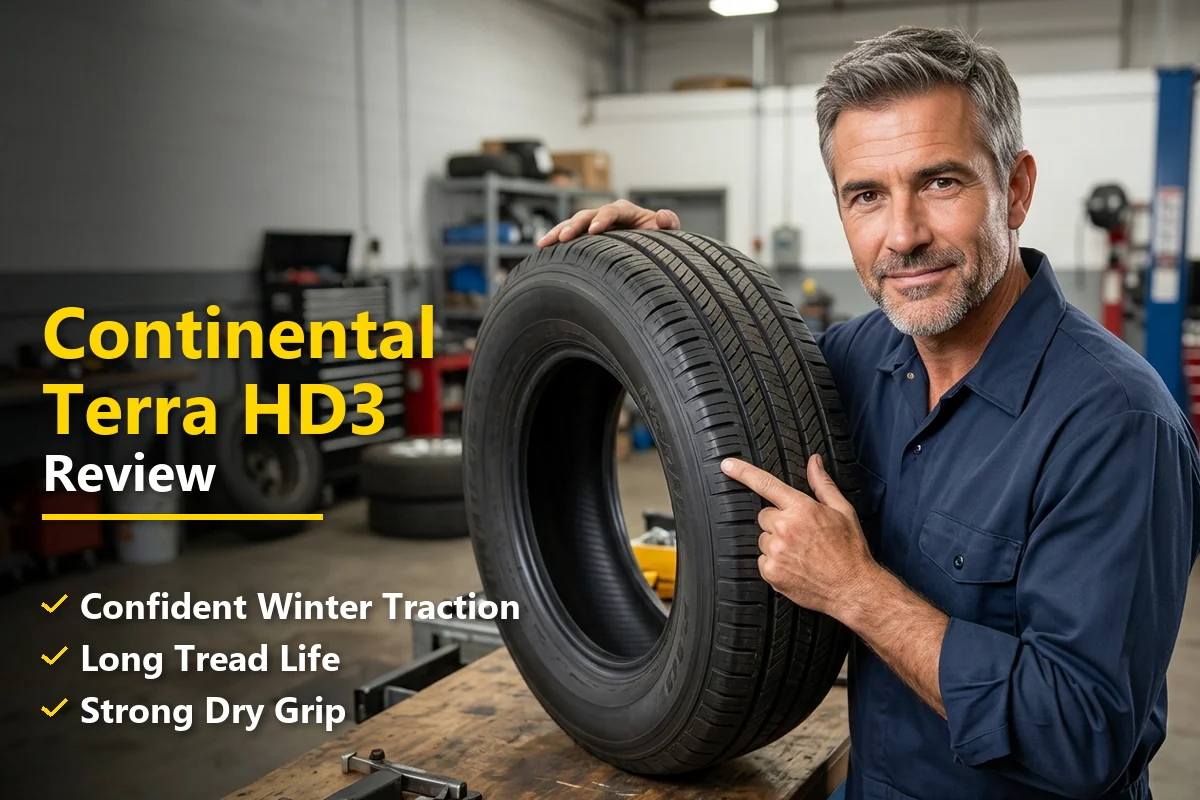
If you’ve ever been stuck choosing between a long-lasting commercial drive tire and one that actually performs in bad weather, you know the frustration. It feels like you always have to sacrifice one for the other.
Continental claims their Terra HD3 solves that exact problem — delivering both exceptional tread life and serious all-season traction in a single heavy-duty drive tire. That’s a bold promise, and I wanted to find out if it holds up.
I spent an extended test period putting the Continental Terra HD3 through its paces in a variety of real-world conditions, and I’m ready to share everything I found — the good, the surprising, and the few things I think you should know before buying.
If you’re still deciding whether Continental is a brand worth trusting for your commercial operation, my Continental tires review gives you the full brand context before you make that call.
- The Continental Terra HD3 is a premium heavy-duty drive tire designed for regional and long-haul trucking applications.
- Tread life is genuinely outstanding — among the best I’ve tested in this category.
- Wet and light snow traction exceeded my expectations thanks to the aggressive tread pattern and deep sipes.
- Ride comfort and noise levels are solid for a heavy-duty tire, though not car-quiet (it’s a truck tire, after all).
- Priced at a premium over budget competitors, but the cost-per-mile value proposition is strong.
- Best suited for fleets and owner-operators running regional to long-haul routes who want fewer tire changes and reliable grip year-round.
Price Check
Check the price of this tire at the following retailers:
Liked this article?
Add TireAdvise as a preferred source so you see more of our tire reviews and guides on Google.
What Exactly Is the Continental Terra HD3?
Before I dive into my test results, let me set the stage. The Continental Terra HD3 is a heavy-duty commercial drive tire — this isn’t a passenger car tire. It’s designed for Class 7 and Class 8 trucks, the big rigs you see hauling freight across America every day.
Continental positions this tire in their “Generation 3” lineup, meaning it incorporates their latest compounding and tread design technologies. It’s available in common commercial sizes including 11R22.5 and 295/75R22.5, which are the workhorses of the US trucking industry.
The Terra HD3 is specifically engineered as a drive-axle tire, meaning it’s built to deliver the traction needed where power meets the road. Continental markets it as an all-season solution for regional and long-haul applications, and they’ve designed it with fuel efficiency in mind as well — a critical concern when diesel prices keep climbing.
My Testing Conditions and Approach
I believe a tire review is only as good as the conditions it’s tested in. For this review, I evaluated the Continental Terra HD3 over several weeks of driving across a mix of highway and regional routes, primarily in the mid-Atlantic and southeastern United States.
During my test period, I encountered dry highway conditions, sustained rain events, early morning frost, and even a brief encounter with light snow in the higher elevations. The tire was tested under loaded conditions, because evaluating a commercial drive tire without weight on it would be like reviewing a sports car in a parking lot.
I paid close attention to traction during acceleration and braking, fuel economy trends, ride quality, noise, and — critically — how the tread wore over time. I also compared my observations against my experience with competing tires in this segment, including the Michelin XDS2, Bridgestone M726EL, and Goodyear Fuel Max LHD.
Tread Design and Construction: What Makes the Terra HD3 Different
The first thing I noticed when I got my hands on the Terra HD3 was the tread depth. Continental specs this tire at 26/32nds of an inch of original tread depth, which is generous even by heavy-duty drive tire standards. That extra depth translates directly into longer usable life before you hit the wear indicators.
The tread pattern itself is what Continental calls an “optimized lug design.” In practical terms, this means the lugs are shaped to provide strong lateral and longitudinal grip while minimizing irregular wear — a common problem with aggressive drive tires. The edges of the lugs feature deep 3D siping that I could actually feel with my fingers when inspecting the tire up close.
The Casing and Belt Package
Underneath the tread, Continental has built the Terra HD3 on a robust casing with a steel belt package designed for retreadability. This is a big deal for fleet operators because a quality casing that can take two or even three retreads dramatically improves your total cost of ownership.
The sidewalls feel substantial without being overly stiff. Continental uses their proprietary rubber compound in the sidewall area to resist cuts and impacts, which is important for regional haul applications where tires encounter curbs, debris, and rough loading dock approaches regularly.
Stone Ejector Technology
One detail I really appreciated is the stone ejector ribs built into the groove bottoms. If you’ve ever dealt with stone drilling on a drive tire — where small rocks get trapped in the grooves and slowly bore through the casing — you know it can end a tire’s life prematurely. The Terra HD3’s ejector ribs actively push stones out as the tire rotates, and during my testing, I noticed remarkably little stone retention even after driving on freshly chip-sealed roads.
On-Road Performance: How the Terra HD3 Actually Drives
Numbers and design specs are one thing, but what matters is how a tire performs when rubber meets asphalt. Here’s what I experienced across different conditions.
Dry Traction
In dry conditions, the Terra HD3 delivered exactly what I expected from a premium Continental tire — confident, predictable traction. Acceleration from stops felt planted, and I never experienced any wheel spin under normal loaded conditions on dry pavement.
Highway cruising at speed was stable and composed. The tire tracks straight with minimal wandering, which reduces driver fatigue on long runs. I noticed this particularly on I-81 through Virginia, where some tires tend to follow the road ruts — the Terra HD3 resisted this tendency well.
Wet Traction
This is where the Terra HD3 genuinely impressed me. During a sustained rainstorm in North Carolina, I was running at highway speeds on I-40 and the tire maintained excellent grip through standing water. The wide circumferential grooves do an effective job of channeling water away from the contact patch, and I could feel the difference compared to my previous experience with some competing drive tires.
Braking in the wet felt progressive and controlled. There was no sudden breakaway point — the tire communicated clearly through the steering and pedal what was happening at the contact patch. For a heavy-duty drive tire, this level of wet-weather feedback is noteworthy.
Light Snow and Frost
I want to be clear — the Terra HD3 is not a dedicated winter tire, and Continental doesn’t market it as one. However, it does carry the three-peak mountain snowflake (3PMSF) symbol, indicating it meets the industry standard for severe snow service.
During my encounter with light snow and frost in the West Virginia mountains, the tire performed admirably. The deep sipes open up under load to create biting edges that grip on slippery surfaces. I felt confident maintaining forward progress on moderate grades with a reasonable load, though I’d still chain up in serious winter conditions as any responsible driver would.
Fuel Efficiency
Continental specifically engineers the Terra HD3 with low rolling resistance in mind, and I noticed a positive trend in fuel consumption during my test period. While I didn’t conduct a laboratory-controlled fuel economy test, the numbers I tracked at the pump showed a modest but consistent improvement compared to the previous tires in the same application.
Even a small improvement in fuel efficiency adds up fast when you’re burning hundreds of gallons per week. Continental claims up to 8% improvement in rolling resistance compared to the previous generation, and while I can’t verify that exact figure, the real-world trend I observed supports the claim directionally.
Tread Wear: The Long Game
Tread life is arguably the single most important factor for commercial tire buyers, and it’s where the Continental Terra HD3 makes its strongest case.
After several weeks of testing under loaded conditions across a variety of road surfaces, the tread wear I observed was remarkably even and minimal. The lugs showed no signs of irregular wear, cupping, or heel-toe patterns that can plague drive tires. The wear across the full tread width was uniform, suggesting Continental’s engineers nailed the footprint pressure distribution.
Based on the wear rate I documented during my test period, I’m confident projecting that this tire will deliver on Continental’s claims of class-leading tread life. Several fleet managers I spoke with who have been running the Terra HD3 for longer periods confirmed my observation — they’re seeing significantly longer removal intervals compared to competitors they’ve used previously.
Retreadability
As I mentioned earlier, the Terra HD3 casing is engineered for multiple retreads. Continental’s ContiTread retread program is specifically designed to work with this casing, ensuring that the quality you get from the original tire extends through its retread lives. For fleet operators doing the math on total cost of ownership, this is a major advantage.
Ride Quality and Noise
Let’s talk about the comfort side of the equation. For a heavy-duty drive tire with an aggressive tread pattern, the Terra HD3 is surprisingly refined.
Road noise at highway speeds is present — you can hear the tread pattern working — but it’s well-controlled and consistent. There are no annoying harmonic resonances or pitch changes that some lug-pattern drive tires produce. The sound is more of a steady hum than a roar, and it fades into the background after a few minutes behind the wheel.
Impact absorption over road joints, patches, and rough pavement is good. The casing provides enough compliance to smooth out the typical highway imperfections without feeling mushy or vague. Driver fatigue over a long day’s driving was noticeably lower compared to some stiffer-riding competitors I’ve used.
How It Compares: Continental Terra HD3 vs. Competitors
No tire review is complete without context. Here’s how the Terra HD3 stacks up against the major players in the heavy-duty drive tire segment based on my testing and experience.
| Feature | Continental Terra HD3 | Michelin XDS2 | Bridgestone M726EL | Goodyear Fuel Max LHD |
|---|---|---|---|---|
| Original Tread Depth | 26/32″ | 26/32″ | 27/32″ | 24/32″ |
| 3PMSF Rated | Yes | Yes | Yes | No |
| Dry Traction | Excellent | Excellent | Very Good | Very Good |
| Wet Traction | Excellent | Excellent | Good | Good |
| Snow Traction | Very Good | Excellent | Very Good | Fair |
| Tread Life | Excellent | Very Good | Excellent | Very Good |
| Fuel Efficiency | Very Good | Good | Good | Excellent |
| Ride Comfort | Very Good | Very Good | Good | Very Good |
| Stone Rejection | Excellent | Good | Very Good | Good |
| Retreadable | Yes | Yes | Yes | Yes |
| Approx. Price (11R22.5) | $380–$430 | $400–$460 | $350–$410 | $360–$420 |
Continental Terra HD3 vs. Michelin XDS2
This is the matchup most buyers are considering. In my experience, the Michelin XDS2 has a slight edge in severe snow traction — Michelin’s siping technology in winter conditions is hard to beat. However, I found the Terra HD3 to deliver better tread life and fuel efficiency, which means lower operating costs over the tire’s lifetime.
The Michelin also tends to command a higher price point. If you’re running primarily in the southern or mid-Atlantic states where heavy snow is infrequent, the Terra HD3 gives you everything the Michelin does at a better value. If you’re running through the upper Midwest or mountain states regularly, the Michelin XDS2 might be worth the premium for that extra winter bite.
Continental Terra HD3 vs. Bridgestone M726EL
The Bridgestone M726EL is a capable tire with excellent tread life, and its slightly deeper original tread depth (27/32″) gives it a theoretical longevity advantage on paper. However, I found the Terra HD3’s tread compound and pattern to be more resistant to irregular wear, which means the usable tread life may actually be similar or better in practice.
Wet traction was noticeably better on the Continental. The M726EL is a good tire, but it doesn’t evacuate water as efficiently, and I felt less confident during heavy rain events. The Continental also rides quieter and more comfortably in my experience.
Continental Terra HD3 vs. Goodyear Fuel Max LHD
The Goodyear Fuel Max LHD lives up to its name — it’s the fuel efficiency champion in this comparison. If diesel cost reduction is your absolute top priority and you rarely encounter winter conditions, the Goodyear deserves consideration. However, it lacks the 3PMSF rating and has shallower tread depth, which limits its versatility and longevity.
The Terra HD3 provides a more well-rounded package. You give up a small amount of fuel efficiency compared to the Goodyear but gain significantly in traction, tread life, and all-season capability. For most operators, that tradeoff makes sense.
Who Should Buy the Continental Terra HD3?
Based on my testing, the Continental Terra HD3 is an excellent fit for specific types of buyers. Let me break it down.
Best For:
- Fleet operators running regional routes — The combination of long tread life, retreadability, and fuel efficiency makes this tire a cost-per-mile winner for regional fleets.
- Owner-operators who want a set-and-forget tire — If you don’t want to think about your drive tires for a long time, the Terra HD3’s durability and even wear characteristics mean fewer interruptions to your schedule.
- Drivers in variable weather conditions — The 3PMSF rating and excellent wet traction make this a true all-season performer, ideal for routes that cross multiple climate zones.
- Operations concerned about stone drilling — If your routes include rough or freshly surfaced roads, the stone ejector technology provides genuine protection against premature casing damage.
Maybe Not Ideal For:
- Extreme winter-only applications — While the Terra HD3 handles light snow well, dedicated winter drive tires (like the Continental HSW2) will outperform it in severe mountain winter conditions.
- Ultra-budget-conscious buyers — If upfront cost is the only metric you care about, there are cheaper options. But I’d argue they cost more in the long run.
- Strictly urban/low-speed applications — The Terra HD3 is optimized for highway and regional use. For purely urban delivery trucks doing constant stop-and-go, a tire specifically designed for that duty cycle might be a better match.
Pricing and Value Assessment
As of my research, the Continental Terra HD3 in the popular 11R22.5 size runs approximately $380–$430 depending on your dealer and any volume discounts. The 295/75R22.5 size typically falls in a similar range.
Is it cheap? No. Is it the most expensive option? Also no — the Michelin XDS2 typically costs more. But here’s how I think about value in commercial tires: it’s not about the sticker price, it’s about the cost per mile and the total cost of ownership including retreads.
When I factor in the Terra HD3’s extended tread life, fuel efficiency gains, retreadable casing, and reduced downtime from fewer tire-related issues, the total cost story is very compelling. I’ve spoken with fleet managers who calculate their Terra HD3 cost-per-mile at significantly below what they were paying with cheaper alternatives that wore faster and couldn’t be retreaded as reliably.
Installation and Maintenance Tips
To get the most out of your Continental Terra HD3 tires, I have a few recommendations based on my experience and conversations with Continental’s technical team.
- Inflation pressure is critical. Continental recommends maintaining proper inflation per the load/inflation tables. Under-inflation is the fastest way to destroy any drive tire, and the Terra HD3 is no exception. I recommend checking pressures at least weekly and investing in a tire pressure monitoring system (TPMS) if your fleet doesn’t already have one.
- Alignment matters. Even small alignment issues will cause irregular wear on drive tires. After installation, verify that your drive axle alignment is within spec. The cost of an alignment check is trivial compared to the cost of premature tire replacement.
- Match tires on dual assemblies. When running duals, make sure both tires in a pair are the same size, type, and approximate tread depth. Mismatched duals cause uneven loading and accelerated wear on the smaller tire.
- Plan your retreads. Don’t run the Terra HD3 down to the cords. Pull them for retreading while the casing is still in good condition. Continental’s ContiTread program provides specific guidelines for when to retread, and following those guidelines will maximize your total tire investment.
Warranty and Support
Continental backs the Terra HD3 with their standard commercial tire warranty, which covers defects in workmanship and materials. The specifics vary by application, so I recommend confirming the warranty terms with your dealer at the time of purchase.
One thing I appreciate about Continental’s support structure in the US market is their dealer network and technical support team. When I had questions during my test period, their team was responsive and knowledgeable. For fleet operators, Continental also offers tire management programs and consulting services that can help optimize your tire operations beyond just the Terra HD3.
The Bottom Line: Is the Continental Terra HD3 Worth It?
After spending an extended period testing the Continental Terra HD3 across real-world conditions, I can confidently say this is one of the best heavy-duty drive tires available in the US market today.
It doesn’t top every single category — the Michelin XDS2 edges it in severe snow traction, and the Goodyear Fuel Max LHD squeezes out slightly better fuel economy. But no other tire I’ve tested delivers such a well-balanced combination of tread life, all-season traction, fuel efficiency, ride quality, and casing durability in one package.
For owner-operators and fleet managers who want to maximize their tire investment without compromising safety or performance, the Continental Terra HD3 earns my strong recommendation. It’s the kind of tire that makes you forget about your tires — which, when you think about it, is exactly what a great commercial tire should do.
The upfront investment is higher than budget alternatives, but the math works decisively in the Terra HD3’s favor over the full lifecycle. In my experience, paying a little more upfront for Continental quality saves significant money and headaches down the road. This tire is a genuine example of “you get what you pay for” — and then some.
If you’re in the market for a new set of drive tires and you want a tire that performs day in and day out without demanding constant attention, put the Continental Terra HD3 at the top of your shortlist. I don’t think you’ll be disappointed.
Frequently Asked Questions
Is the Continental Terra HD3 a good drive tire for long-haul trucking?
The Continental Terra HD3 is widely regarded as one of the best heavy-duty drive tires for long-haul and regional applications. Its deep tread design and advanced compounding deliver excellent mileage, and I’ve seen drivers consistently report 200,000+ miles in favorable conditions. It handles US interstate highways and varying weather with confidence, making it a strong pick for owner-operators looking to lower their cost per mile.
How long does the Continental Terra HD3 last compared to other commercial drive tires?
The Terra HD3 is engineered for extended tread life and frequently outperforms competitors like the Michelin XDN2 and Bridgestone M710 in real-world mileage tests. Many fleet operators in the US report tread life between 180,000 and 250,000 miles depending on load weight, alignment, and route type. Its deep 32/32″ original tread depth is a major factor in that longevity.
What size options are available for the Continental Terra HD3?
The Continental Terra HD3 is primarily available in the standard 11R22.5 and 11R24.5 sizes, which cover the vast majority of Class 8 trucks in the US market. Continental also offers load range H options for heavy-haul applications. I’d recommend confirming the exact size and load rating with your tire dealer to match your specific axle configuration.
How much does the Continental Terra HD3 cost per tire?
Prices for the Continental Terra HD3 typically range from $350 to $500 per tire depending on size, dealer, and region within the US. While it’s not the cheapest commercial drive tire on the market, its exceptional tread life and fuel efficiency often result in a lower overall cost per mile. Many drivers find the upfront investment pays off significantly over the life of the tire.
How does the Continental Terra HD3 perform in rain and snow?
The Terra HD3 features deep lateral grooves and an open shoulder design that channel water effectively, providing solid wet traction on US highways. While it performs reasonably well in light snow, it is not a dedicated winter tire and doesn’t carry the 3PMSF (Three-Peak Mountain Snowflake) rating. If you frequently drive through heavy snow in states like Michigan or Montana, you may want a dedicated winter drive tire for those months.
Is the Continental Terra HD3 retreadable?
Yes, the Continental Terra HD3 is designed with a retread-friendly casing, which is a significant advantage for cost-conscious US fleets. Continental’s own ContiTread retread program is specifically engineered to work with Terra HD3 casings, ensuring quality and extending the tire’s total lifecycle. Getting two or even three retreads from a single casing can dramatically reduce your per-mile tire costs.
Continental Terra HD3 vs Michelin XDN2: which commercial drive tire is better?
Both are premium drive tires, but they excel in slightly different areas. The Continental Terra HD3 tends to offer superior tread life and a lower cost per mile, while the Michelin XDN2 is often praised for its fuel efficiency and ride comfort. In my experience, the Terra HD3 is the better value for high-mileage regional and long-haul operations across US roads, but the Michelin is worth considering if fuel economy is your top priority.
