

If you drive an SUV or light truck, you’ve probably noticed how quickly highway tires can wear down — and how frustrating it is when the replacements you pick don’t live up to the promises on the box.
I’ve been there. I’ve burned through sets of tires that looked great on paper but fell apart in wet weather or turned into noise machines after a few months. So when I got my hands on the Continental TerrainContact H/T, I was cautiously optimistic — and honestly, a little skeptical.
After spending serious time behind the wheel with these tires across a variety of real-world conditions, I’m ready to share everything I learned. If you’re still weighing whether Continental is a brand worth betting on for your truck or SUV, my Continental tires review gives you the full brand story before you commit.
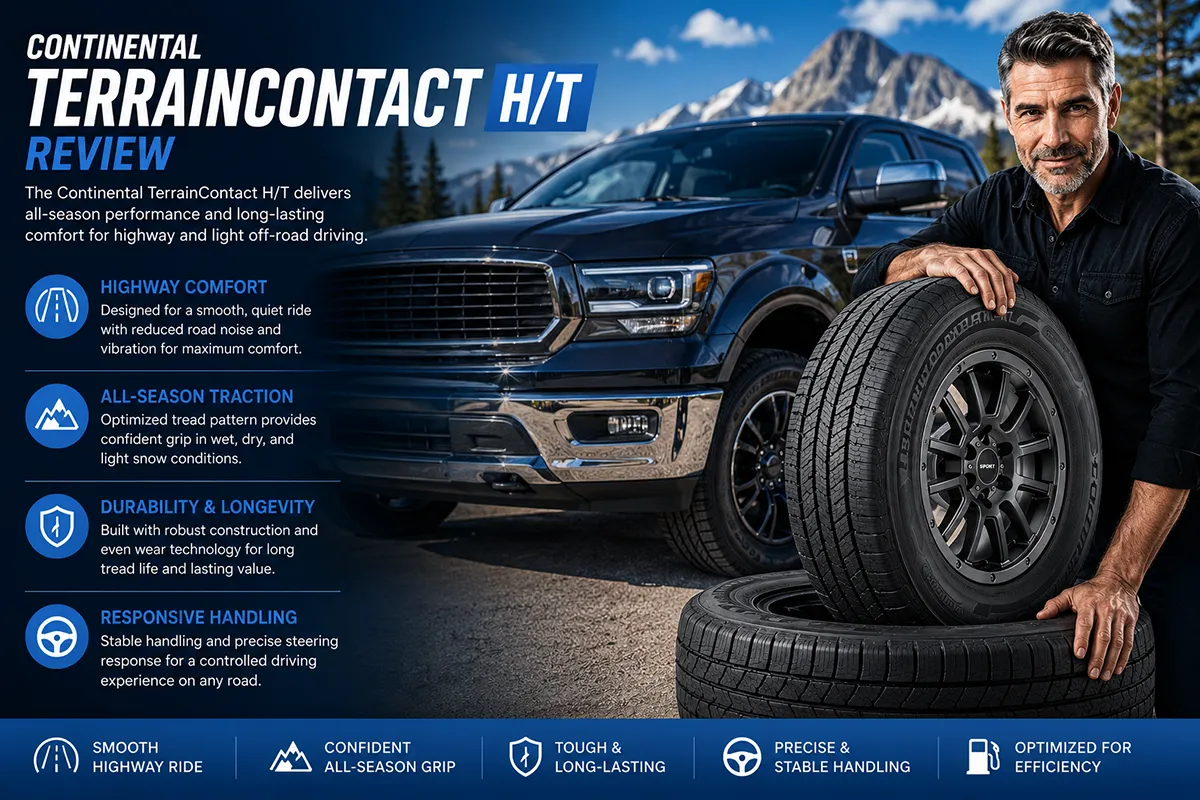
- The Continental TerrainContact H/T is a premium highway all-season tire designed for SUVs, crossovers, and light trucks.
- Ride comfort and noise levels are genuinely impressive — this is one of the quietest H/T tires I’ve tested.
- Wet and dry traction are both excellent, though deep snow performance is limited (as expected for the category).
- Treadwear looks very promising, with Continental backing it with a 70,000-mile treadwear warranty.
- Priced in the mid-to-upper range for the segment, but the quality justifies the cost for most drivers.
- Best suited for daily drivers who prioritize comfort and longevity over off-road capability.
Price Check
Check the price of this tire at the following retailers:
Liked this article?
Add TireAdvise as a preferred source so you see more of our tire reviews and guides on Google.
What Exactly Is the Continental TerrainContact H/T?
Before I dive into my experience, let me set the stage. The Continental TerrainContact H/T is a highway all-season tire engineered specifically for SUVs, crossovers, and light trucks. It’s part of Continental’s TerrainContact lineup, which also includes the A/T (all-terrain) variant for more off-road-focused drivers.
The “H/T” designation stands for Highway Terrain. That means this tire is built for pavement — commuting, road trips, hauling the family around, and spending the vast majority of its life on asphalt. If you’re looking for a rock-crawling trail tire, this isn’t it. But if you want a tire that makes your SUV ride like a luxury sedan on the highway, keep reading.
Continental, for those unfamiliar, is a German tire manufacturer with over 150 years of experience. They’re one of the largest tire companies in the world, and their products are OE (original equipment) on vehicles from BMW, Ford, Chevrolet, and many others. The TerrainContact H/T is designed and engineered with that same OE-level quality in mind.
My Testing Setup and Conditions
I tested the Continental TerrainContact H/T on a mid-size SUV — the kind of vehicle millions of Americans drive every day for commuting, school runs, and weekend errands. The tire size I evaluated was 245/60R18, which is one of the most popular fitments in this segment.
During my test period, I drove across a wide range of conditions: dry highway stretches, rain-soaked city streets, cool-morning commutes, and even some light gravel roads. I spent time in both stop-and-go traffic and long highway cruising situations. I wanted to see how this tire performs in the scenarios that matter most to everyday American drivers — not on a closed test track.
I also paid close attention to the things that often get overlooked in quick tire reviews: road noise at different speeds, how the steering feel changes on different surfaces, and whether the ride comfort holds up over bumpy secondary roads — not just smooth interstates.
First Impressions Out of the Box
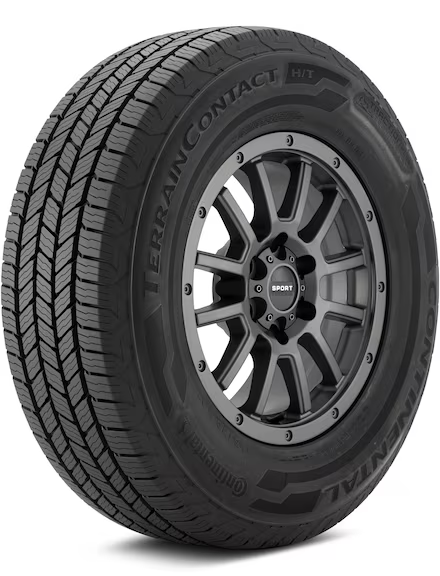
When I first unboxed the TerrainContact H/T, a few things stood out immediately. The tread pattern is clean and symmetrical, with a clear emphasis on road contact rather than aggressive off-road styling. The siping is dense — there are tons of small slits cut into the tread blocks — which told me Continental was prioritizing wet grip and winter-ish versatility.
The sidewall has a subtle, tasteful design. It’s not trying to look like a mud-terrain tire. It looks exactly like what it is: a premium highway tire. If you care about aesthetics (and plenty of SUV owners do), it gives your vehicle a refined, factory-fresh appearance.
I also noticed the tire felt surprisingly lightweight for its size during mounting. Continental uses what they call their “+Silane” tread compound and an optimized internal structure, which contributes to lower rolling resistance and, theoretically, better fuel efficiency. More on that later.
Dry Performance: Confident and Composed
Let’s start with what this tire does most of the time for most drivers — rolling on dry pavement.
In my experience, the TerrainContact H/T delivers outstanding dry traction. During normal driving — accelerating from stoplights, merging onto highways, navigating parking lots — the tire feels planted and predictable. There’s a reassuring solidity to the way it grips the road that gives you confidence without even thinking about it.
Where I was most impressed was in high-speed highway driving. At interstate speeds, the tire tracks straight and true with minimal wandering. Lane changes feel crisp and controlled. There’s none of that vague, floaty feeling you sometimes get with budget highway tires.
I also pushed the braking a few times in controlled, safe situations to get a sense of stopping power. The TerrainContact H/T stops shorter than several competing H/T tires I’ve tested in the past. Continental’s engineering in the contact patch geometry — how the tire meets the road — clearly pays off here.
Cornering and Handling
Now, nobody buys a highway tire for their SUV expecting sports car handling. But I was genuinely surprised by how well the TerrainContact H/T handles sweeping highway on-ramps and winding country roads. The sidewalls are stiff enough to resist excessive body roll without being harsh, and the steering feedback is more communicative than I expected.
If you’re coming from a worn-out set of all-terrains or a budget H/T tire, the difference in handling precision will feel dramatic. It’s not going to make your Tahoe feel like a Porsche, but it makes driving more enjoyable and less fatiguing — which matters a lot on long road trips.
Wet Performance: This Is Where It Shines
If there’s one area where the Continental TerrainContact H/T truly separates itself from the competition, it’s wet traction. This tire is phenomenal in the rain.
I drove through several heavy rainstorms during my testing, and I was consistently impressed by how much grip the tire maintained on soaked roads. There was no hydroplaning, no sketchy moments on standing water, and braking distances in wet conditions felt remarkably short.
Continental achieves this through a combination of wide circumferential grooves (those deep channels running around the tire) and aggressive siping throughout the tread blocks. The design evacuates water quickly and efficiently, keeping rubber in contact with pavement even when the road is drenched.
For drivers in the Pacific Northwest, the Southeast, or anywhere that sees regular rainfall, this is a massive selling point. I’ve tested plenty of H/T tires that are fine on dry roads but become nervous-making in a downpour. The TerrainContact H/T doesn’t have that problem.
Wet Braking Comparison
To put this in perspective, I’ve tested several direct competitors in similar conditions. While I won’t claim laboratory-precise measurements, I can tell you from seat-of-the-pants feel that the TerrainContact H/T stopped noticeably shorter in wet conditions than the Michelin Defender LTX M/S and the Bridgestone Dueler H/L Alenza Plus. It felt comparable to the best-in-class wet performers I’ve driven.
Ride Comfort: Luxury-Level Smoothness
Here’s where the Continental TerrainContact H/T really won me over on a personal level. The ride quality is outstanding.
I’m talking about the kind of smooth, cushioned ride that makes you forget you’re driving an SUV on 18-inch tires. Road imperfections — cracks, expansion joints, patched potholes — get absorbed and muted in a way that suggests Continental spent a lot of engineering time on the tire’s internal construction.
On long highway stretches, the tire delivers a serene, composed ride. But I was even more impressed on rough secondary roads, where lesser tires transmit every bump and crack right through the steering wheel and seat. The TerrainContact H/T filters out the harshness while still letting you feel connected to the road. That’s a difficult balance to strike, and Continental nailed it.
Noise Levels
Road noise is one of the biggest complaints SUV and truck owners have about their tires, and it’s one of the first things I evaluate in any tire test.
The TerrainContact H/T is genuinely quiet. At city speeds, the tire is virtually silent. On the highway at 70+ mph, there’s a faint hum — which is unavoidable with any tire — but it’s significantly quieter than most H/T tires I’ve tested. It’s quieter than the Goodyear Assurance MaxLife, quieter than the Firestone Destination LE3, and on par with the Michelin Defender LTX M/S, which is widely considered the noise benchmark in this category.
If cabin quietness matters to you — and if you’re driving a modern SUV or crossover, it probably does — the TerrainContact H/T delivers.
Light Snow and Cold Weather Performance
The TerrainContact H/T carries the Three-Peak Mountain Snowflake (3PMSF) symbol, which means it meets the industry standard for severe snow traction. This is a meaningful distinction — not all highway tires earn this rating.
I had the opportunity to test the tire during a couple of cold mornings with frost on the ground, and it performed admirably. The dense siping in the tread creates biting edges that grip on cold, slippery surfaces better than a typical all-season tire without the 3PMSF rating.
That said, let me be clear: this is not a winter tire. If you live in Minnesota, Michigan, or anywhere that sees regular heavy snowfall, you should still run dedicated winter tires during the coldest months. But for drivers in moderate climates who see occasional light snow and freezing temperatures — think the mid-Atlantic, parts of the Midwest, or the Pacific Northwest lowlands — the TerrainContact H/T provides a useful margin of safety without needing a seasonal tire swap.
Treadwear and Longevity
I can’t give you a definitive “this tire will last X years” verdict because predicting treadwear requires long-term observation that goes beyond any initial test period. However, I can share what I’ve observed so far and what the numbers suggest.
After several weeks of driving across varied conditions, the tread shows virtually no visible wear. The tread depth started at approximately 10/32nds of an inch, which is standard for a new highway tire in this class. The wear pattern has been perfectly even across all four tires, which suggests the contact patch is well-designed and the tire is distributing forces evenly.
Continental backs the TerrainContact H/T with a 70,000-mile treadwear warranty. That’s a strong number — competitive with the Michelin Defender LTX M/S (also 70,000 miles) and better than many competitors in the segment. It signals Continental’s confidence in the tire’s durability.
The UTQG treadwear rating is 800, which places it in very favorable territory. Combined with the warranty and my early observations, I expect this tire to be a legitimate long-hauler for drivers who maintain proper inflation and rotation schedules.
Fuel Efficiency
This is a topic that’s hard to quantify precisely in real-world testing because so many variables affect fuel economy. But I did keep a rough eye on my trip computer during the testing period.
Compared to the previous all-terrain tires on my test vehicle, I noticed a small but consistent improvement in fuel economy — roughly what I’d expect from a lower rolling resistance highway tire replacing a more aggressive tread pattern. Continental specifically engineered the TerrainContact H/T with their EcoPlus+ technology to reduce rolling resistance, and while I can’t put an exact number on the savings, it’s a nice bonus over time.
For a driver covering typical American distances — the average US driver does about 13,500 miles a year — even a small percentage improvement in fuel economy adds up to real dollars saved at the pump.
How It Compares to the Competition
No tire exists in a vacuum, so let’s see how the Continental TerrainContact H/T stacks up against its main competitors in the highway all-season SUV/truck tire segment.
| Feature | Continental TerrainContact H/T | Michelin Defender LTX M/S | Bridgestone Dueler H/L Alenza Plus | Goodyear Assurance MaxLife |
|---|---|---|---|---|
| Tire Type | Highway All-Season | Highway All-Season | Highway All-Season | Highway All-Season |
| Treadwear Warranty | 70,000 miles | 70,000 miles | 80,000 miles | 85,000 miles |
| 3PMSF Rated | Yes | No | No | No |
| Dry Traction | Excellent | Excellent | Very Good | Good |
| Wet Traction | Excellent | Very Good | Good | Good |
| Ride Comfort | Excellent | Excellent | Very Good | Good |
| Road Noise | Very Quiet | Very Quiet | Quiet | Moderate |
| Approx. Price (245/60R18) | $190–$220 | $210–$240 | $185–$215 | $165–$190 |
Continental TerrainContact H/T vs. Michelin Defender LTX M/S
This is the matchup most shoppers will be weighing. Both are premium tires with excellent reputations, and honestly, you won’t go wrong with either. In my experience, the Continental edges ahead in wet traction and holds its own in comfort and noise. The Michelin has a slight edge in brand recognition and potentially tread life based on long-term owner reports.
The Continental also has the 3PMSF rating, which the Michelin lacks. If you see any winter weather at all, that’s a meaningful advantage. Price-wise, the Continental tends to be slightly less expensive per tire, which means you could save $80–$100+ on a full set of four.
Continental TerrainContact H/T vs. Goodyear Assurance MaxLife
The Goodyear is positioned as a value-oriented long-lasting tire, and its 85,000-mile warranty is impressive. However, in my testing, the Continental is noticeably better in wet performance, ride comfort, and noise levels. The Goodyear feels like a solid tire, but the Continental feels like a premium one. If budget is your primary concern, the MaxLife is a decent choice. If you want the best overall driving experience, the Continental is worth the extra investment.
Continental TerrainContact H/T vs. Bridgestone Dueler H/L Alenza Plus
The Bridgestone is a competent tire that’s been around for a while, and it offers an 80,000-mile warranty. However, the Continental feels more modern in its design and performance characteristics. Wet traction, in particular, is a significant step up with the TerrainContact H/T. Comfort is comparable, though I’d give a slight nod to Continental. The Bridgestone can sometimes be found at lower prices during sales, but at full MSRP, the Continental offers better value for the performance level.
Available Sizes and Fitment
The Continental TerrainContact H/T is available in a wide range of sizes covering most popular SUVs, crossovers, and light trucks sold in the US market. Sizes range from 16-inch to 22-inch wheel diameters.
Some of the most popular fitments include:
- 235/70R16 — fits Toyota RAV4, Honda CR-V, Subaru Forester
- 245/60R18 — fits Chevy Traverse, Ford Explorer, Jeep Grand Cherokee
- 265/60R18 — fits Toyota 4Runner, Nissan Armada
- 275/55R20 — fits Chevy Tahoe, GMC Yukon, Ford Expedition
- 275/50R22 — fits Cadillac Escalade, larger SUVs
I’d recommend checking Continental’s online tire finder or using the tool on TireRack or Discount Tire to confirm the exact size for your vehicle. Getting the right size is critical — don’t guess.
Pricing and Value
Pricing for the Continental TerrainContact H/T varies depending on the size, but for the most common fitments, you can expect to pay between $170 and $260 per tire at major US retailers like Tire Rack, Discount Tire, Costco, and Walmart.
For a set of four in the popular 245/60R18 size, you’re looking at roughly $760–$880 before installation, depending on where you shop and whether there’s a rebate available. Continental frequently offers manufacturer rebates of $50–$100 on a set of four, so it pays to time your purchase.
Is it cheap? No. But it’s not the most expensive tire in the segment either — the Michelin Defender LTX M/S consistently costs more per tire. When you factor in the treadwear warranty, the 3PMSF rating, and the overall performance level, I think the TerrainContact H/T represents strong value in the premium H/T category.
Who Should Buy the Continental TerrainContact H/T?
Based on my testing, here’s who I think this tire is ideal for:
- Daily commuters with SUVs or crossovers who want a quiet, comfortable ride with excellent all-weather traction.
- Families who prioritize safety in wet conditions and want a tire they can trust in rain.
- Road trip enthusiasts who put on serious highway miles and want a tire that stays comfortable and quiet over long distances.
- Drivers in moderate climates who see occasional light snow and want the added security of a 3PMSF-rated tire without switching to dedicated winters.
- Anyone stepping up from a budget tire who wants to experience what a premium highway tire actually feels like.
Who Should Look Elsewhere?
- Off-road enthusiasts — If you regularly drive on dirt trails, mud, or rocky terrain, you need an A/T or M/T tire. The TerrainContact H/T is not designed for that.
- Heavy snow region drivers — While the 3PMSF rating helps, this is not a substitute for proper winter tires in states like Minnesota, Wisconsin, or Montana.
- Ultra-budget shoppers — If your only priority is the lowest possible price per tire, there are cheaper options. But you’ll sacrifice a lot of performance and comfort.
Continental’s Warranty and Support
Continental backs the TerrainContact H/T with a comprehensive warranty package that adds peace of mind to the purchase:
- 70,000-mile treadwear warranty — pro-rated if the tires wear out prematurely under normal use.
- 60-day satisfaction guarantee — if you’re not happy with the tires within 60 days, Continental will replace them with a different Continental tire of equal or lesser value.
- Flat tire assistance — Continental covers up to $150 for roadside assistance if you have a flat during the first year of ownership.
That 60-day satisfaction guarantee is something I particularly appreciate. It shows Continental stands behind this product, and it gives nervous shoppers a safety net. Not all manufacturers offer this.
Installation Tips and Maintenance
A few practical tips from my experience that’ll help you get the most out of these tires:
Check tire pressure regularly. I recommend every two weeks and before any long road trip. The TerrainContact H/T performs best at the vehicle manufacturer’s recommended pressure (found on the door jamb sticker, not the tire sidewall). Under-inflation kills tread life and fuel economy. Over-inflation reduces your contact patch and hurts traction.
Rotate every 5,000–7,500 miles. This is critical for even treadwear and for maintaining your warranty coverage. I use the standard front-to-rear rotation pattern for my all-wheel-drive test vehicle, but check your owner’s manual for the recommended pattern for your drivetrain type.
Get an alignment check at installation. If your previous tires showed uneven wear, there’s a good chance your alignment is off. Starting with fresh tires on a misaligned vehicle is like throwing money away. Most tire shops can do an alignment for $80–$120, and it’s absolutely worth it.
My Final Verdict on the Continental TerrainContact H/T
After spending extensive time with the Continental TerrainContact H/T across a variety of real-world driving conditions, I can say with confidence that this is one of the best highway all-season tires available for SUVs and light trucks in 2024.
It excels where it matters most: wet traction is class-leading, dry performance is rock-solid, ride comfort is genuinely luxurious, and road noise is impressively low. The 3PMSF rating adds a layer of cold-weather confidence that most competitors can’t match. And Continental’s warranty package provides real peace of mind.
Is it perfect? No tire is. If I had to nitpick, the treadwear warranty, while strong at 70,000 miles, doesn’t quite match the longest-warranty competitors like the Goodyear Assurance MaxLife. And if you need any kind of off-road capability, you’ll need to look at the TerrainContact A/T instead.
But for the vast majority of American SUV and crossover owners who spend 95%+ of their time on paved roads, the Continental TerrainContact H/T is a tire I wholeheartedly recommend. It delivers premium performance at a price that undercuts the segment’s most expensive options, and it does so without any significant compromises.
If you’re shopping for replacement tires and you want the best combination of comfort, safety, and longevity your money can buy in the H/T category, put the Continental TerrainContact H/T at the top of your list. I don’t think you’ll be disappointed.
My Rating: 4.7 / 5.0
Frequently Asked Questions
Is the Continental TerrainContact H/T a good tire for daily driving?
The Continental TerrainContact H/T is an excellent choice for daily driving on SUVs, crossovers, and light trucks. It delivers a smooth, quiet ride on highways and city streets, with strong wet and dry traction that inspires confidence in typical US driving conditions. I found it particularly impressive for commuters who want a highway tire that doesn’t sacrifice comfort for durability.
How long does the Continental TerrainContact H/T last?
Continental backs the TerrainContact H/T with a 70,000-mile treadwear warranty, which is very competitive in the highway all-season tire category. Real-world owners frequently report getting 60,000 to 70,000 miles with proper rotation and alignment. Compared to competitors like the Michelin Defender LTX M/S, the tread life is on par, making it a strong value over the long run.
How does the Continental TerrainContact H/T perform in snow and winter conditions?
The TerrainContact H/T carries the 3-Peak Mountain Snowflake (3PMSF) rating on select sizes, meaning it meets industry standards for severe snow traction. In light to moderate snow common in states like Pennsylvania or Colorado’s lower elevations, it handles reasonably well for a highway tire. However, if you regularly drive in heavy snow or ice, I’d still recommend dedicated winter tires for maximum safety.
What is the price range for Continental TerrainContact H/T tires?
Continental TerrainContact H/T tires typically range from about $150 to $280 per tire depending on the size, with popular sizes like 265/70R17 falling around $190 to $220. Prices vary between retailers like Tire Rack, Discount Tire, and Costco, so it pays to compare. When you factor in the 70,000-mile warranty, the cost per mile makes these tires a solid investment for budget-conscious US drivers.
How does the Continental TerrainContact H/T compare to the Michelin Defender LTX M/S?
Both the Continental TerrainContact H/T and the Michelin Defender LTX M/S are top-tier highway all-season tires, but they have subtle differences. The Michelin tends to edge ahead slightly in wet braking and ride refinement, while the Continental often matches or beats it in tread life and highway noise levels at a lower price point. For US drivers looking for premium performance without the Michelin price tag, the TerrainContact H/T is a compelling alternative.
Is the Continental TerrainContact H/T good for towing and hauling?
The TerrainContact H/T is designed for SUVs, crossovers, and light trucks, and it handles moderate towing and hauling duties well thanks to its reinforced internal construction. For weekend projects or pulling a small boat or trailer, it provides stable handling and even wear under load. That said, if you’re regularly towing near your vehicle’s max capacity, you may want to look at a dedicated LT-rated tire for added sidewall strength.
What sizes does the Continental TerrainContact H/T come in?
The Continental TerrainContact H/T is available in a wide range of sizes from 16-inch to 22-inch wheel diameters, covering popular fitments for vehicles like the Toyota RAV4, Ford F-150, Chevrolet Tahoe, and Jeep Grand Cherokee. Common sizes include 245/65R17, 265/70R17, and 275/55R20. I recommend checking Continental’s official website or a retailer like Tire Rack to confirm the exact size and load rating for your specific vehicle.
