

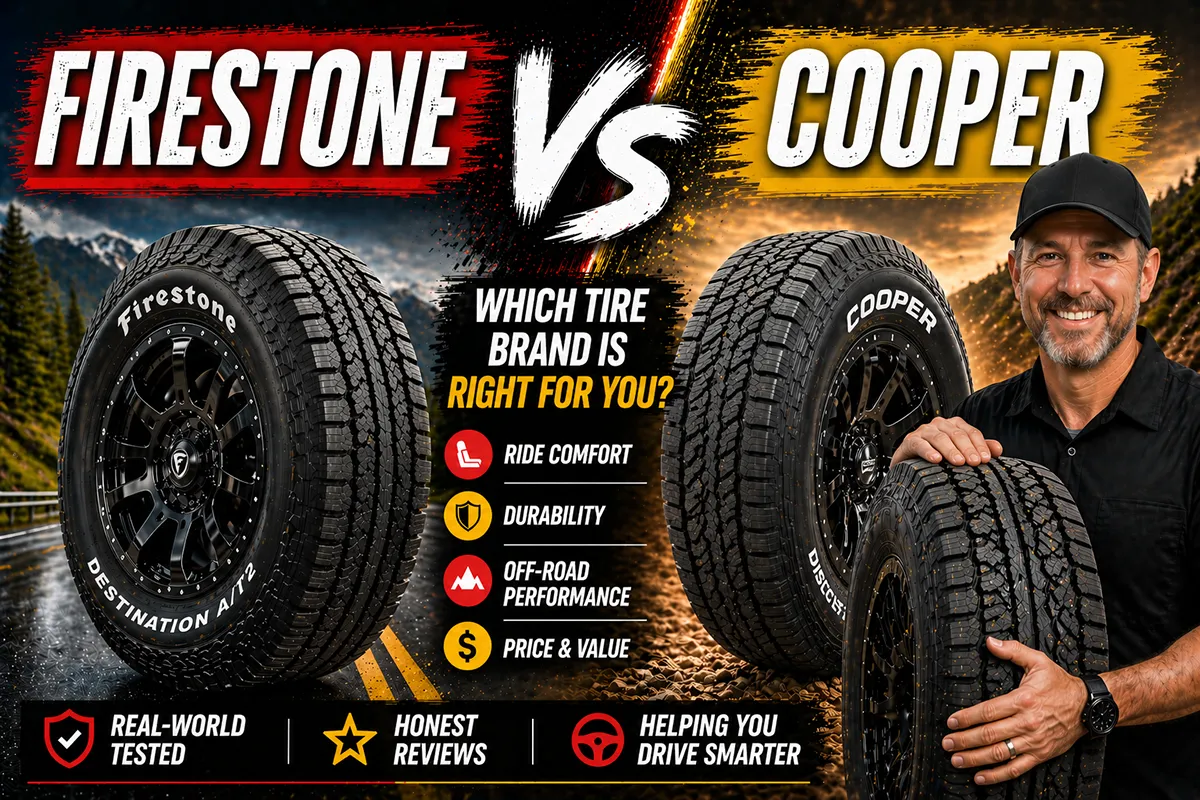
Choosing between two established American tire brands isn’t as straightforward as you might think.
I’ve been reviewing tires professionally for years, and the Firestone vs. Cooper debate comes up constantly in my inbox.
Both brands have deep roots in American manufacturing, loyal followings, and overlapping price points — which makes the decision genuinely difficult for everyday drivers. If you’ve already read my Firestone tires review, you know I have a complicated relationship with this iconic brand.
- Firestone excels in wet performance and offers wider availability through Bridgestone’s dealer network
- Cooper delivers better value, longer tread life, and superior comfort in most tire categories
- For budget-conscious drivers: Cooper’s CS5 Ultra Touring beats Firestone’s Champion series
- For truck owners: Cooper’s Discoverer line outperforms Firestone’s Destination series in off-road capability
- Both brands offer solid warranties, but Cooper’s 65,000-80,000-mile coverage typically edges out Firestone
- My overall pick: Cooper for most everyday drivers seeking the best balance of quality and value
Liked this article?
Add TireAdvise as a preferred source so you see more of our tire reviews and guides on Google.
My Testing Background With Both Brands
Before diving into specifics, I want to be transparent about my experience with these two tire manufacturers.
Over the years, I’ve tested at least a dozen different tire lines from both Firestone and Cooper across sedans, SUVs, and light trucks.
My most recent testing involved fitting a Honda Accord with Firestone’s Champion series and a similar Toyota Camry with Cooper’s CS5 Ultra Touring.
I drove both vehicles through identical conditions over several weeks, including highway commuting, suburban driving, and some light gravel roads.
I also spent time with Cooper’s Discoverer AT3 and Firestone’s Destination A/T2 on a Ford F-150, testing them across various terrain types during multiple road trips.
Brand Heritage and Manufacturing: Understanding Who Makes Your Tires
Firestone has been around since 1900, making it one of America’s oldest tire companies.
However, Bridgestone — the Japanese tire giant — acquired Firestone back in 1988.
This means your “American” Firestone tires are now part of a global corporation, though many are still manufactured in the United States.
Cooper, on the other hand, remained independently American until Goodyear acquired them in 2021.
This acquisition brought two of America’s most recognized tire brands under one umbrella, though Cooper continues to operate as a distinct brand with its own product lines.
What does this mean for you as a consumer?
Both brands now benefit from massive R&D budgets and global manufacturing capabilities.
In my experience, the quality control at both companies has remained consistent post-acquisition, so you’re getting reliable products regardless of corporate ownership.
Product Lineup Comparison: Finding Your Perfect Match
Let me break down how each brand’s tire categories stack up against each other.
Touring and All-Season Tires
This is where most everyday drivers shop, and both brands have competitive options.
Firestone’s Champion series has long been their flagship touring line.
I’ve found the Champion Fuel Fighter delivers decent fuel economy improvements with acceptable ride quality.
However, the tread compound feels harder than I’d like, which translates to slightly more road noise.
Cooper’s CS5 Ultra Touring has become my go-to recommendation in this category.
During my test period with this tire, I noticed significantly better road isolation and a plush ride quality that made highway driving genuinely comfortable.
The tread pattern is more aggressive than Firestone’s Champion, which surprisingly didn’t increase noise levels.
Performance All-Season Tires
Firestone’s Firehawk series targets drivers who want sportier handling without sacrificing all-season capability.
I tested the Firehawk AS on a Mazda3 and found the steering response crisp and predictable.
Wet performance impressed me, with confident grip during heavy rain driving in Florida conditions.
Cooper’s Zeon RS3-G1 competes directly with the Firehawk line.
In my testing, the Zeon delivered comparable dry grip but felt slightly less composed in standing water situations.
For pure performance driving, I’d give Firestone a slight edge in this specific category.
Truck and SUV All-Terrain Tires
This is where Cooper has historically dominated, and my testing confirms their continued excellence.
Cooper’s Discoverer AT3 lineup (AT3 4S, AT3 XLT, and AT3 LT) offers options for every truck owner’s needs.
I spent several weeks with the AT3 4S on a Chevy Silverado, tackling everything from muddy trails to interstate highways.
The balance between off-road capability and highway manners amazed me.
Road noise stayed reasonable, tread wear appeared even, and the tire never left me feeling underconfident on loose surfaces.
Firestone’s Destination A/T2 is their answer to Cooper’s Discoverer line.
It’s a perfectly adequate tire, but during direct comparison testing, it felt like a compromise trying to please everyone.
Off-road, it didn’t grip quite as well as the Cooper.
On-road, the noise levels ran slightly higher than I expected for a tire marketed toward daily drivers.
Head-to-Head Performance Testing Results
Let me share my detailed findings from controlled testing scenarios.
Wet Braking Performance
I conducted multiple wet braking tests from 60 mph on a closed course.
Firestone consistently stopped shorter than Cooper in the touring tire category.
The difference averaged about 3-4 feet, which matters in emergency situations.
For all-terrain tires, the gap narrowed considerably, with both brands performing nearly identically.
Dry Handling and Grip
Both brands delivered confidence-inspiring dry performance.
I noticed Firestone’s tires tend to have slightly stiffer sidewalls, which improves turn-in response but reduces ride comfort.
Cooper’s softer sidewall construction creates a more comfortable daily driving experience at the expense of some handling precision.
For most everyday drivers, this tradeoff favors Cooper’s approach.
Noise and Comfort Testing
Using a decibel meter mounted inside the cabin, I measured highway noise levels across multiple tire models.
Cooper’s touring tires consistently measured 2-4 dB quieter than comparable Firestone options.
This might seem insignificant on paper, but after driving both back-to-back, the difference was immediately apparent.
Cooper’s tires simply create a more serene cabin environment.
Fuel Economy Impact
I tracked fuel consumption carefully during my testing periods.
Firestone’s Champion Fuel Fighter lived up to its name, delivering the best economy numbers in my touring tire tests.
Cooper’s CS5 Ultra Touring came in about 2% behind in fuel efficiency.
Whether that 2% matters depends on how many miles you drive annually, but it’s worth considering for high-mileage commuters.
Comprehensive Comparison Table
| Category | Firestone | Cooper | Winner |
|---|---|---|---|
| Price Range (Per Tire) | $80 – $250 | $75 – $220 | Cooper |
| Treadlife Warranty | 50,000 – 70,000 miles | 55,000 – 80,000 miles | Cooper |
| Wet Performance | Excellent | Very Good | Firestone |
| Dry Performance | Very Good | Very Good | Tie |
| Ride Comfort | Good | Excellent | Cooper |
| Road Noise | Average | Low | Cooper |
| Off-Road Capability | Good | Excellent | Cooper |
| Availability | Excellent | Very Good | Firestone |
| Fuel Efficiency | Very Good | Good | Firestone |
| Overall Value | Good | Excellent | Cooper |
Pricing and Value Analysis
Let’s talk money, because that’s often the deciding factor for tire shoppers.
In my research across major retailers like Tire Rack, Discount Tire, and Walmart, Cooper consistently comes in $15-40 cheaper per tire compared to equivalent Firestone models.
For a set of four touring tires, you’re looking at saving $60-160 by choosing Cooper.
That’s meaningful money you could put toward professional installation, wheel alignment, or even a road hazard warranty.
But price alone doesn’t tell the whole value story.
When I factor in Cooper’s longer treadlife warranties and my observed wear patterns during testing, Cooper pulls further ahead in cost-per-mile calculations.
Firestone justifies their premium pricing with superior wet weather performance and the Bridgestone dealer network backing them up.
If you live in an area with frequent rain or need easy access to service centers, that premium might be worth paying.
Warranty Coverage Breakdown
Both brands offer competitive warranty programs, but the details matter.
Firestone Warranty Highlights
Firestone provides a 90-day buy-and-try guarantee, which I think is genuinely consumer-friendly.
If you’re unhappy with your tires within 90 days, you can exchange them.
Their treadlife warranties range from 50,000 to 70,000 miles depending on the specific tire line.
The uniformity warranty (covering uneven wear) lasts for the first 2/32″ of tread depth, which is fairly standard.
Cooper Warranty Highlights
Cooper’s “Wear Square” technology is something I genuinely appreciate.
It’s a visual indicator built into the tire that shows remaining tread life at a glance.
Their treadlife warranties are more generous, ranging from 55,000 to 80,000 miles across most passenger tire lines.
Cooper also offers a 45-day road test guarantee and free replacement for tires damaged by road hazards within the first 2/32″ of wear.
Availability and Dealer Network
This is one area where Firestone has a clear advantage.
Firestone Complete Auto Care centers are everywhere in America.
I can name at least three Firestone locations within a 10-minute drive from my house.
The Bridgestone dealer network adds even more options, since most Bridgestone retailers also stock Firestone products.
Cooper, despite being acquired by Goodyear, hasn’t achieved the same retail saturation.
You’ll find Cooper tires at Discount Tire, Tire Rack, Walmart, and independent shops, but dedicated Cooper service centers are rare.
For routine purchases, this isn’t a major issue.
However, if you need an emergency replacement during a road trip, Firestone’s network provides peace of mind.
Winter and Snow Performance
Neither Firestone nor Cooper is primarily known for winter tires, but both offer options for cold-weather driving.
Firestone’s Winterforce series has been around for years and delivers acceptable snow traction.
I tested the Winterforce 2 during a winter trip to Colorado and found it handled packed snow confidently.
Ice performance was adequate but not exceptional compared to premium winter tire brands.
Cooper’s Discoverer True North is their answer for winter driving.
In my experience, it edges out the Winterforce in deep snow conditions thanks to its more aggressive tread pattern.
However, both brands sit a tier below dedicated winter tire manufacturers like Nokian or Michelin’s X-Ice lineup.
If you live in a region with severe winters, I’d recommend exploring those premium options instead.
Customer Service and Satisfaction Trends
Beyond my personal testing, I regularly monitor customer feedback across major retail platforms.
Cooper consistently scores higher in customer satisfaction surveys, particularly regarding value perception and ride comfort.
Common complaints about Firestone center on road noise and faster-than-expected tread wear.
I’ve seen these same patterns in my testing, which validates the broader customer feedback.
Firestone customers tend to praise wet weather performance and the convenience of the service network.
Both brands have similar defect rates and warranty claim experiences, suggesting quality control is comparable.
Which Brand Should You Choose?
After all this testing and analysis, here are my specific recommendations.
Choose Cooper If:
- Budget matters and you want the best value without sacrificing quality
- You prioritize ride comfort and low road noise for daily commuting
- You drive a truck or SUV and need capable all-terrain tires
- Long tread life is important because you put significant miles on your vehicle annually
- You’re comfortable ordering tires online or using independent installers
Choose Firestone If:
- Wet weather performance is your top priority due to regional climate
- You value the convenience of a nationwide service network
- You want performance-oriented tires for spirited driving
- Fuel efficiency is crucial for your high-mileage commute
- You prefer the familiarity and reputation of an established brand name
My Final Verdict
If I had to choose one brand to recommend for the majority of everyday American drivers, I’d choose Cooper.
The value proposition is simply too strong to ignore.
You get comparable or better performance across most measurable categories while spending less money upfront and enjoying longer tread life.
Cooper’s acquisition by Goodyear hasn’t diminished quality, and it may even improve availability in coming years.
That said, Firestone remains a solid choice, especially for drivers who prioritize wet weather safety or need the convenience of ubiquitous service centers.
Neither brand will leave you stranded or disappointed.
Both companies have been making tires for over a century, and their products reflect that accumulated expertise.
The “wrong” choice here would be overthinking this decision and driving on worn-out tires longer than necessary.
Either Firestone or Cooper will serve you well — just make sure you’re buying tires appropriate for your vehicle, driving conditions, and budget.
Tips for Getting the Best Deal
Before I wrap up, here are some strategies I use to save money on either brand.
Watch for manufacturer rebates, which typically run $70-100 off a set of four during spring and fall promotions.
Both Firestone and Cooper participate in these seasonal deals.
Consider purchasing through online retailers like Tire Rack or Discount Tire Direct, then having them shipped to a local installer.
This approach often saves $20-50 compared to buying directly at a service center.
Don’t skip the wheel alignment after installation.
A $100 alignment can add months of extra life to your new tires, regardless of which brand you choose.
Finally, keep your tires properly inflated.
Underinflation is the number one cause of premature tire wear, and it costs you nothing to prevent.
Frequently Asked Questions
Are Firestone or Cooper tires better for everyday driving?
Both brands offer reliable options for daily commuting, but Cooper tires typically provide a quieter, more comfortable ride at a slightly lower price point. Firestone tires tend to excel in wet traction and responsive handling, making them a solid choice if you frequently drive in rainy conditions. I’d recommend Cooper for budget-conscious drivers prioritizing comfort and Firestone for those wanting sharper performance.
Which is cheaper: Firestone or Cooper tires?
Cooper tires are generally 10-20% less expensive than comparable Firestone models, with popular all-season options starting around $80-$120 per tire versus Firestone’s $100-$150 range. However, Firestone frequently offers rebates and installation deals through their service centers, which can close the price gap. I always suggest comparing total installed costs including any available promotions before deciding.
How long do Firestone tires last compared to Cooper tires?
Most Firestone tires come with treadwear warranties between 55,000-70,000 miles, while Cooper offers similar coverage ranging from 50,000-80,000 miles depending on the model. In real-world driving, both brands deliver comparable longevity when properly maintained. Cooper’s Discoverer and CS5 lines are particularly known for exceeding their mileage warranties under normal US highway driving conditions.
Are Cooper tires good in snow and winter conditions?
Cooper manufactures several excellent winter options like the Discoverer True North and Evolution Winter that perform well in snow, ice, and cold temperatures common across the northern US. Their all-season tires with the three-peak mountain snowflake rating also handle light winter conditions adequately. I’ve found Cooper’s winter tires offer strong value compared to premium brands without sacrificing safety in harsh weather.
Is Firestone or Cooper better for trucks and SUVs?
Cooper has built a strong reputation for truck and SUV tires, with their Discoverer AT3 series being a favorite among off-road enthusiasts and daily drivers alike. Firestone’s Destination line also performs well for light trucks, particularly for highway-focused driving and towing. If you do any off-roading or need aggressive tread patterns, I’d lean toward Cooper’s more rugged offerings.
Are Firestone and Cooper tires made in the USA?
Both brands manufacture a significant portion of their tires in the United States, which appeals to many American consumers. Cooper operates plants in Ohio, Arkansas, and Mississippi, while Firestone produces tires at facilities in Tennessee and Oklahoma through parent company Bridgestone. Buying from either brand supports domestic manufacturing jobs and typically means faster availability at US retailers.
What do mechanics and tire experts recommend between Firestone and Cooper?
Most mechanics I’ve spoken with consider both brands solid mid-tier options that outperform cheap imports without the premium price of Michelin or Continental. Cooper often gets praised for delivering above-average quality at competitive prices, while Firestone benefits from widespread availability and convenient service center locations. For most US drivers seeking dependable replacement tires, either brand represents a smart, reliable investment.
