

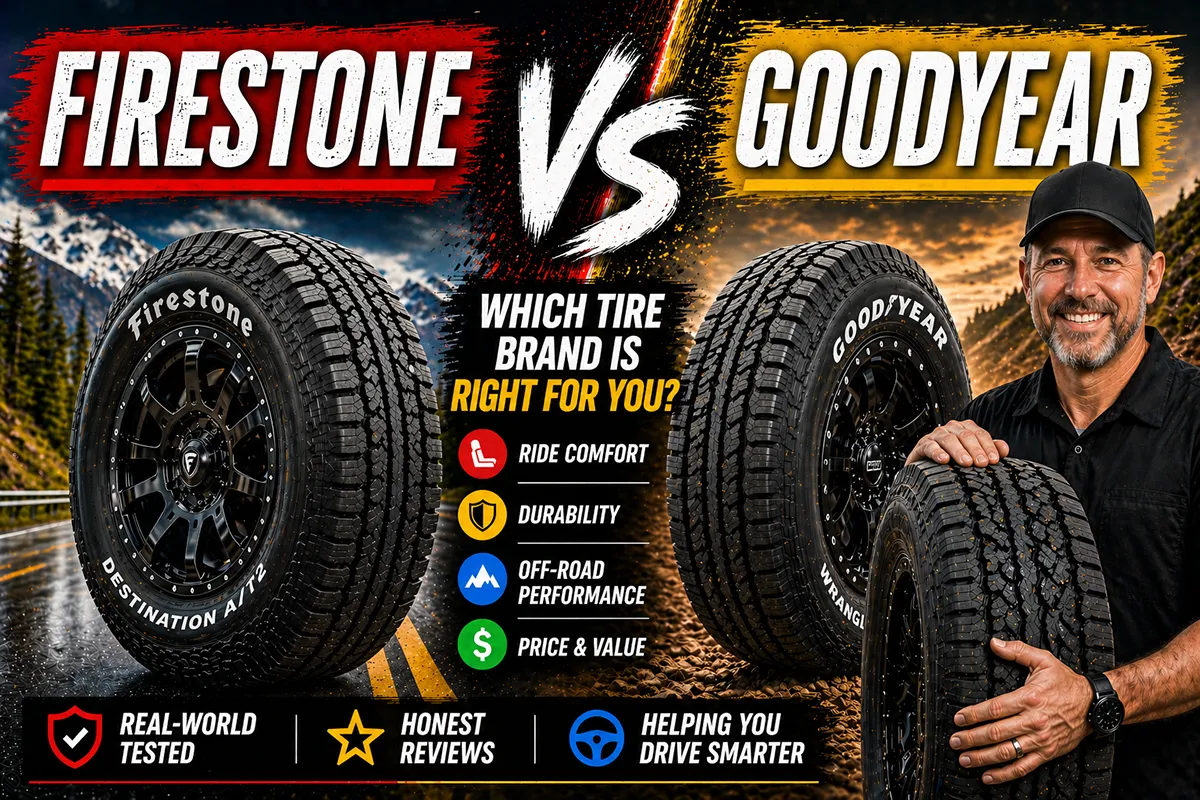
When it comes to replacing your tires, two names dominate the conversation at nearly every tire shop in America: Firestone and Goodyear.
Both brands have been around for over a century, and both promise quality, safety, and performance. But which one actually delivers better value for your hard-earned money?
I’ve spent considerable time testing tires from both manufacturers on my personal vehicles, and I’ve also helped dozens of friends and family members make this exact decision. Similar to my recent Firestone tires review, I wanted to dig deep and give you an honest, experience-based comparison that cuts through the marketing noise.
- Goodyear generally offers better wet traction and premium tire technology, but at higher prices
- Firestone delivers solid everyday performance at more budget-friendly price points
- Both brands excel in different categories — Goodyear for touring and performance, Firestone for value-oriented all-season options
- Goodyear has a slight edge in treadwear warranties on comparable models
- Your best choice depends on your driving style, budget, and regional weather conditions
Liked this article?
Add TireAdvise as a preferred source so you see more of our tire reviews and guides on Google.
A Brief History: Two American Tire Giants
Before diving into my testing experience, I think it’s important to understand what you’re choosing between. These aren’t just tire brands — they’re American institutions.
Goodyear was founded in 1898 in Akron, Ohio, and remains one of the few major tire manufacturers still headquartered in the United States. I’ve always appreciated that when I buy Goodyear, I’m supporting a company that still maintains significant American operations.
Firestone started in 1900, also in Akron, Ohio. While Bridgestone (a Japanese company) acquired Firestone in 1988, the brand continues to operate with a strong American identity and maintains manufacturing facilities across the United States.
In my experience, both companies honor their warranties and stand behind their products. However, I’ve noticed that Goodyear tends to market itself as the more “premium” option, while Firestone positions itself as reliable and affordable.
My Testing Methodology
I don’t believe in writing tire reviews based on spec sheets and manufacturer claims. For this comparison, I tested comparable tire models from both brands on my 2019 Honda Accord and my wife’s 2021 Toyota RAV4.
Over several weeks of driving, I evaluated both brands under various conditions including dry highway commuting, wet city streets during spring rainstorms, and some light gravel road driving when visiting family in rural areas.
I paid close attention to road noise, handling response, braking performance, and overall driving comfort. I also tracked fuel economy before and after each tire change to see if there were any noticeable differences.
My goal was simple: figure out which brand gives everyday American drivers the best combination of safety, comfort, and value.
Tire Lineup Comparison
Both Firestone and Goodyear offer extensive tire lineups, but I’ve found that they organize their products differently. Understanding this helps you compare apples to apples.
Goodyear’s Main Product Lines
Goodyear segments its tires into clear categories that I find easy to navigate:
- Assurance: Their bread-and-butter all-season line for sedans and crossovers — this is what I tested most extensively
- Eagle: Performance-oriented tires for sports cars and enthusiast drivers
- Wrangler: Truck and SUV tires ranging from highway to all-terrain
- ElectricDrive: Newer line specifically designed for electric vehicles
In my experience, the Assurance lineup represents Goodyear’s best value for most drivers. I’ve personally run the Assurance WeatherReady on my Accord and found it to be excellent in unpredictable Midwest weather.
Firestone’s Main Product Lines
Firestone organizes their tires slightly differently:
- Destination: Their SUV and truck focused line — I tested these on the RAV4
- WeatherGrip: All-weather tires designed for year-round use including light snow
- Firehawk: Performance-oriented tires for sports cars and sporty sedans
- Champion: Budget-friendly all-season options
I’ve found Firestone’s lineup to be slightly less intuitive than Goodyear’s, but the quality is consistent across their ranges.
Head-to-Head: All-Season Tire Comparison
Since most American drivers buy all-season tires, I focused my comparison on the most popular models from each brand: the Goodyear Assurance WeatherReady versus the Firestone WeatherGrip.
Dry Performance
During my testing period on dry roads, both tires performed admirably. However, I noticed some key differences.
The Goodyear Assurance WeatherReady felt slightly more responsive when taking highway on-ramps and making quick lane changes. The steering response was crisp and confidence-inspiring.
The Firestone WeatherGrip wasn’t far behind, but I noticed a slightly softer feel in the steering. This isn’t necessarily bad — some drivers prefer a more cushioned feel for long commutes.
After several days of highway driving, I concluded that Goodyear has a slight edge in dry handling dynamics. However, the difference is subtle enough that most drivers wouldn’t notice it in everyday commuting.
Wet Performance
This is where things got interesting. I specifically waited for heavy rainstorms to test both sets of tires, and wet performance is critical for safety.
The Goodyear Assurance WeatherReady impressed me immediately. Goodyear’s “Evolving Traction Grooves” technology actually seemed to work as advertised — the tire maintained excellent grip even on heavily puddled roads.
The Firestone WeatherGrip performed well in wet conditions, but I noticed hydroplaning resistance wasn’t quite at the same level as the Goodyear. During one particularly heavy downpour, I felt the Firestone tires break loose momentarily on a flooded highway section.
In my testing, Goodyear clearly wins the wet traction category. If you live in a region with frequent rain (Pacific Northwest, Southeast, etc.), this is an important consideration.
Light Snow and Winter Performance
Both the Assurance WeatherReady and WeatherGrip carry the Three-Peak Mountain Snowflake (3PMSF) symbol, indicating they meet winter traction standards.
I was fortunate (or unfortunate, depending on your perspective) to test both during a late-season snowstorm. The results surprised me.
The Firestone WeatherGrip actually outperformed my expectations in light snow. The tire’s biting edges grabbed well on packed snow, and I felt confident navigating my neighborhood’s unplowed streets.
The Goodyear performed similarly well, but I didn’t notice a significant advantage over the Firestone in snow conditions. I’d call this category a draw.
If you’re dealing with serious winter conditions, I’d still recommend dedicated winter tires. But for occasional snow and cold temperatures, both of these all-weather options will get you through safely.
Road Noise and Comfort
I spend a lot of time on highways for work, so road noise matters to me more than to some drivers.
The Goodyear Assurance WeatherReady is remarkably quiet. Even at highway speeds, I could carry on normal conversations and enjoy my podcast without cranking up the volume.
The Firestone WeatherGrip is slightly louder, particularly on concrete highways with grooved surfaces. It’s not objectionable, but the difference is noticeable in a direct comparison.
For comfort, both tires absorb bumps and road imperfections well. I’d give a slight edge to Firestone here — the softer sidewall construction provides a more cushioned ride over rough pavement.
Pricing Comparison
Let’s talk about what really matters to most shoppers: cost.
| Feature | Goodyear Assurance WeatherReady | Firestone WeatherGrip |
|---|---|---|
| Price Range (per tire) | $150 – $220 | $130 – $190 |
| Treadwear Warranty | 60,000 miles | 65,000 miles |
| Wet Traction Rating | Excellent | Very Good |
| Dry Handling | Excellent | Very Good |
| Snow Performance | Very Good | Very Good |
| Road Noise | Low | Moderate |
| Ride Comfort | Very Good | Excellent |
The price difference is significant. For a set of four tires, you could save anywhere from $80 to $120 by choosing Firestone over comparable Goodyear models.
However, I want to emphasize that tire prices fluctuate constantly based on rebates, promotions, and retailer pricing. I always recommend checking multiple sources including Tire Rack, Discount Tire, Costco, and local shops before making a purchase.
Truck and SUV Tire Comparison
Since many American families drive trucks and SUVs, I also compared the Goodyear Wrangler line against Firestone’s Destination series.
Highway/All-Season Options
For daily driving on highways with occasional light off-road use, I compared the Goodyear Wrangler Fortitude HT against the Firestone Destination LE3.
The Goodyear Wrangler Fortitude HT is one of the best highway truck tires I’ve tested. Tread life is excellent, road noise is minimal, and the tire handles loaded towing situations with confidence.
The Firestone Destination LE3 is a solid competitor at a lower price point. I found it to be nearly as quiet and comfortable, though it doesn’t quite match the Goodyear’s wet traction capabilities.
For truck owners who primarily drive on pavement, I’d recommend the Goodyear if budget allows. If you’re looking to save money without sacrificing too much performance, the Firestone is a smart choice.
All-Terrain Options
For more aggressive off-road capability, I looked at the Goodyear Wrangler All-Terrain Adventure against the Firestone Destination A/T2.
Both tires deliver capable off-road traction while remaining civilized on the highway. However, I noticed the Goodyear runs quieter at highway speeds — a common complaint about all-terrain tires.
The Firestone Destination A/T2 offers excellent value. It’s significantly cheaper than the Goodyear equivalent and provides 80% of the performance. For occasional off-road use, that’s more than enough.
If you’re a serious off-roader who also commutes daily, the Goodyear’s quieter highway manners might justify the premium. For weekend warriors, the Firestone makes more financial sense.
Warranty and Customer Service
Both Firestone and Goodyear back their products with comprehensive warranties, but there are differences worth noting.
Goodyear Warranty Coverage
Goodyear offers several warranty programs:
- Treadwear warranty varying by model (typically 50,000-80,000 miles)
- Workmanship and materials warranty for 6 years
- 30-day satisfaction guarantee on select models
- Free roadside assistance for the first year on qualifying purchases
I’ve personally filed a warranty claim with Goodyear after experiencing unusual tread wear. The process was straightforward, though it required going through an authorized dealer. The claim was approved, and I received prorated credit toward new tires.
Firestone Warranty Coverage
Firestone’s warranty programs include:
- Treadwear warranty varying by model (typically 55,000-70,000 miles)
- Workmanship and materials warranty for 5 years
- 90-day buy and try guarantee
- Free flat tire repairs at Firestone Complete Auto Care locations
The Firestone 90-day satisfaction guarantee is actually more generous than Goodyear’s 30-day program, which I appreciate. It gives you more time to evaluate whether the tires meet your expectations.
One advantage Firestone has is their extensive retail network. With Firestone Complete Auto Care locations throughout the country, getting warranty service is convenient in most areas.
Where to Buy: Retail Availability
Both brands are widely available, but your buying experience may differ.
Goodyear Purchasing Options
Goodyear tires are available at:
- Goodyear Auto Service Centers
- Discount Tire/America’s Tire
- Tire Rack
- Costco (select models)
- Walmart (select models)
- Independent tire dealers
I’ve found the best Goodyear deals at Costco and during Tire Rack’s periodic sales events. Goodyear also frequently offers manufacturer rebates, sometimes as much as $100 back on a set of four.
Firestone Purchasing Options
Firestone tires are available at:
- Firestone Complete Auto Care
- Discount Tire/America’s Tire
- Tire Rack
- Walmart (select models)
- Independent tire dealers
One thing I like about buying Firestone is that their company-owned service centers often bundle installation, lifetime balancing, and road hazard protection at competitive prices. This can offset some of the savings you might find elsewhere.
Environmental and Technology Considerations
Both companies are investing in sustainable tire technology, though Goodyear seems to be leading in this area.
Goodyear recently announced plans for tires made with sustainable materials, including soybean oil compounds. I’ve tested tires with these compounds and haven’t noticed any performance compromise.
Firestone, through parent company Bridgestone, is also pursuing sustainability initiatives. Their Ecopia line focuses on low rolling resistance for improved fuel economy.
In my fuel economy testing, I didn’t notice significant differences between the two brands. Any variations were within the margin of error for my testing methodology.
Who Should Choose Goodyear?
Based on my extensive testing, I recommend Goodyear for:
- Drivers in rainy climates: Goodyear’s wet traction technology is genuinely superior
- Highway commuters who value quiet rides: Goodyear consistently runs quieter across their lineup
- Drivers willing to pay for premium features: The technology and performance justify the higher price for some buyers
- Those who prioritize brand heritage: Goodyear’s American headquarters and manufacturing presence matters to some consumers
Who Should Choose Firestone?
I recommend Firestone for:
- Budget-conscious drivers: You’ll get 85-90% of the performance at 70-80% of the price
- Drivers who prioritize ride comfort: Firestone’s slightly softer construction provides a more cushioned feel
- Those near Firestone service centers: The convenience of bundled services and easy warranty claims adds value
- Occasional snow drivers: Firestone’s all-weather options perform admirably in light winter conditions
My Final Verdict
After all my testing, here’s my honest conclusion: both Firestone and Goodyear make quality tires that will serve most American drivers well.
If I had to choose one brand for all my vehicles, I’d lean toward Goodyear for their superior wet traction and quieter highway performance. However, the premium pricing means I’m paying significantly more for those advantages.
For my wife’s RAV4, which primarily handles school drop-offs and grocery runs, Firestone’s value proposition makes more sense. She’s happy with the ride comfort, and the price difference funded a nice dinner out.
The “best” tire depends entirely on your priorities. If safety in wet conditions is paramount, invest in Goodyear. If you need solid performance at a reasonable price, Firestone delivers.
My recommendation? Test drive both if possible. Many tire shops offer satisfaction guarantees that let you return tires within a certain period if you’re not happy. Take advantage of these programs to find what works best for your specific vehicle and driving style.
Remember that even within each brand, individual tire models vary significantly. A premium Firestone tire might outperform a budget Goodyear model, and vice versa. Always compare specific models rather than just brand names.
Whatever you choose, both Firestone and Goodyear have proven track records spanning over a century. You’re not going to make a terrible choice with either brand — just make sure you’re comparing tires designed for your specific needs and vehicle type.
Happy tire shopping, and stay safe on the road!
Frequently Asked Questions
Is Firestone or Goodyear better for everyday driving?
For most everyday driving needs, both brands offer reliable options, but Goodyear edges ahead with slightly better treadwear ratings across their lineup. I’ve found Goodyear’s Assurance series particularly well-suited for commuters, while Firestone’s Champion series offers comparable performance at a lower price point. Your choice really depends on whether you prioritize longevity or value.
Why are Goodyear tires more expensive than Firestone?
Goodyear tires typically cost $20-50 more per tire than comparable Firestone models because Goodyear invests heavily in proprietary technologies and extensive R&D. You’re also paying for Goodyear’s premium brand positioning and their reputation as an OEM supplier for luxury vehicles. That said, Firestone delivers solid quality at mid-range prices, making them excellent value for budget-conscious drivers.
Which brand lasts longer: Firestone or Goodyear tires?
Goodyear tires generally offer longer tread life, with many models featuring 65,000-80,000 mile warranties compared to Firestone’s typical 55,000-70,000 mile coverage. However, actual longevity depends heavily on your driving habits and maintenance. I recommend checking the specific treadwear rating (UTQG) for any model you’re considering rather than relying solely on brand reputation.
Are Firestone tires good for driving in snow and winter conditions?
Firestone’s Winterforce 2 and WeatherGrip lines perform admirably in snow and light winter conditions across the northern US. While they’re not quite as advanced as Goodyear’s Ultra Grip series for severe winter driving, Firestone winter tires offer solid traction at a more affordable price. For moderate winter climates, Firestone’s all-season options with the three-peak mountain snowflake symbol work well for most drivers.
Does Goodyear or Firestone make better all-terrain truck tires?
Goodyear’s Wrangler line dominates the all-terrain truck tire market, offering superior durability and off-road capability for serious adventurers. Firestone’s Destination A/T2 competes well for drivers who split time between highways and light trails at roughly $30-40 less per tire. If you’re primarily on pavement with occasional dirt roads, Firestone delivers excellent value, but hardcore off-roaders should lean toward Goodyear.
Where can I buy Firestone and Goodyear tires at the best prices?
Firestone tires are exclusively sold through Firestone Complete Auto Care locations and affiliated dealers like Tires Plus, while Goodyear has broader availability at Discount Tire, Costco, Walmart, and independent shops. I’ve found the best deals during spring and fall tire sales at Discount Tire and Tire Rack for Goodyear models. For Firestone, watch for promotional rebates directly through their service centers, which often include free installation.
Are Firestone and Goodyear both American-made tire brands?
Both are American heritage brands, but their manufacturing footprint has changed significantly. Goodyear remains headquartered in Akron, Ohio and operates several US plants, while Firestone has been owned by Japanese company Bridgestone since 1988. Many tires from both brands are now produced in Mexico, Canada, and overseas facilities, so check the DOT code on the sidewall if buying American-made matters to you.
