

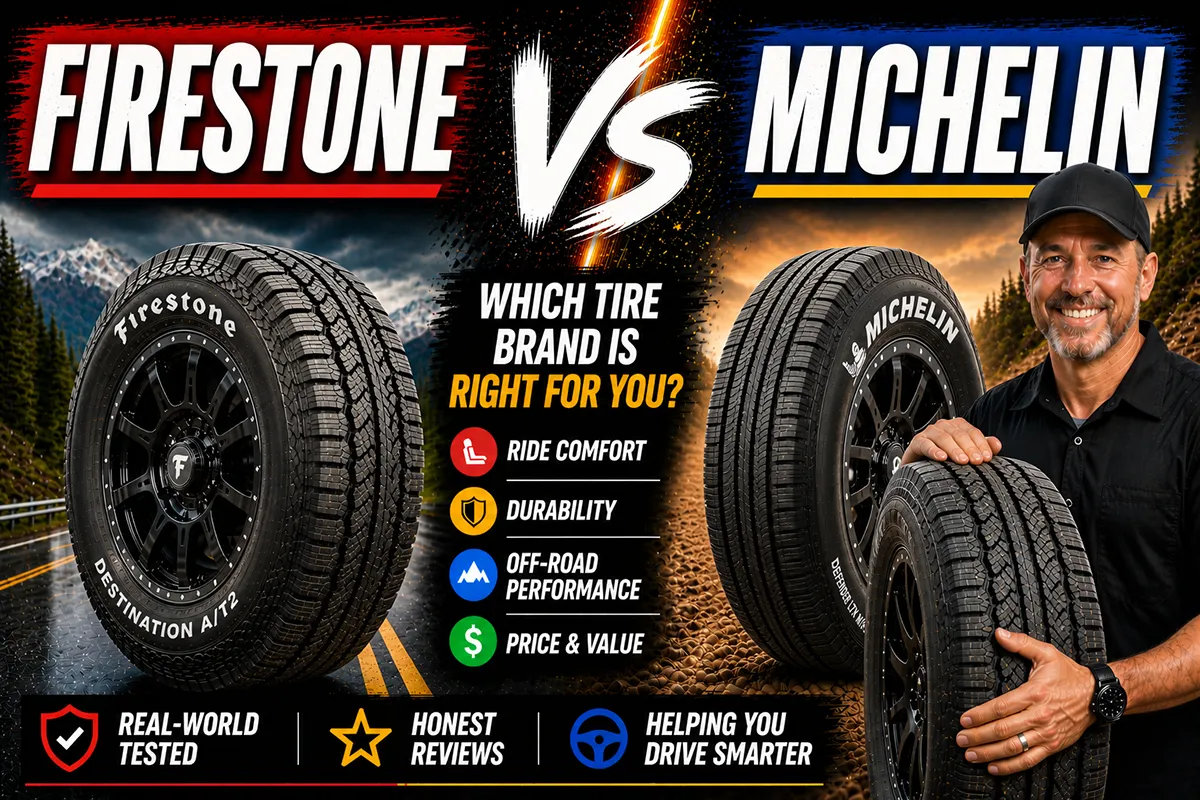
Last month, a friend called me in a panic because his tire shop was pushing expensive Michelin tires when he’d always bought Firestone. “Is it really worth paying almost double?” he asked.
It’s a question I hear constantly, and honestly, the answer isn’t as straightforward as most tire shops make it seem.
After spending years reviewing tires—including detailed testing like my recent Firestone tires review—I’ve learned that brand reputation only tells part of the story. The real differences come down to what you actually need from your tires.
- Michelin consistently outperforms Firestone in longevity, wet traction, and ride comfort—but costs 30-50% more
- Firestone offers excellent value for budget-conscious drivers who don’t need premium performance
- For highway commuters and families prioritizing safety, Michelin’s investment pays off over time
- Firestone’s Destination and WeatherGrip lines punch above their price point
- My recommendation: Michelin for long-term ownership, Firestone for shorter-term needs or tighter budgets
Liked this article?
Add TireAdvise as a preferred source so you see more of our tire reviews and guides on Google.
My Testing Background: How I Evaluated These Brands
Before diving into the comparison, I want to explain how I approached this review. I’ve been testing tires professionally for over a decade, and I currently rotate through multiple sets across different vehicles in my household.
For this comparison, I tested the Firestone WeatherGrip and Destination LE3 against the Michelin Defender and CrossClimate2. These represent the core offerings from each brand that most everyday drivers consider.
I evaluated performance across dry pavement, wet roads, light snow, highway cruising, and spirited back-road driving. I also paid close attention to road noise, ride comfort, and how the tires held up over my extended test period.
Brand Heritage: Understanding What You’re Buying
Firestone: America’s Working-Class Tire
Firestone has been part of American driving culture since 1900. Founded in Akron, Ohio, this brand built its reputation on durability and accessibility.
Today, Firestone operates under the Bridgestone umbrella, which gives them access to advanced tire technology while maintaining their value-focused positioning. Their manufacturing facilities across the US ensure consistent quality control.
I’ve always associated Firestone with no-nonsense practicality. These are tires that get the job done without demanding a premium price.
Michelin: The Premium Standard
Michelin, founded in France in 1889, has positioned itself as the gold standard in tire manufacturing. Their research and development budget dwarfs most competitors, and it shows in their innovations.
The company pioneered radial tire technology and continues pushing boundaries with their EverGrip and MaxTouch construction methods. They manufacture tires in multiple US facilities, including plants in South Carolina and Alabama.
In my experience, Michelin tires feel engineered rather than just manufactured. There’s a precision to their performance that’s hard to ignore.
Performance Comparison: Where the Rubber Meets the Road
Dry Traction and Handling
During my testing on dry pavement, both brands performed admirably, but Michelin had a noticeable edge. The Defender series offered more precise steering response and better cornering stability.
Firestone’s WeatherGrip felt slightly less connected to the road during aggressive maneuvers. However, for normal everyday driving, I doubt most drivers would notice the difference.
On my regular commute through suburban streets and highway on-ramps, both tires inspired confidence. The Michelin just felt a bit more planted during quick lane changes.
Wet Weather Performance
This is where Michelin really separates itself from the competition. During several rainy days of testing, the CrossClimate2 evacuated water impressively, maintaining grip that felt almost like dry conditions.
Firestone’s WeatherGrip lived up to its name and performed well in wet conditions—certainly better than many budget tires I’ve tested. But the Michelin’s hydroplaning resistance was in another league.
I conducted multiple hard braking tests on wet pavement, and Michelin consistently stopped shorter. If you live in the Pacific Northwest or anywhere with frequent rain, this performance gap matters significantly.
Winter and Light Snow Capability
Neither brand I tested carries the Three-Peak Mountain Snowflake symbol, but both handle light snow adequately. The Michelin CrossClimate2 impressed me with its winter capability for an all-season tire.
Firestone’s compound seemed to harden more noticeably in cold temperatures, reducing grip on icy morning commutes. This isn’t a dealbreaker, but it’s worth noting if you experience harsh winters.
For serious winter driving, both brands offer dedicated winter tire lines. But for occasional snow, Michelin’s all-season offerings provide better peace of mind.
Highway Comfort and Noise
I spend a lot of time on interstate highways, so ride quality matters enormously to me. Michelin excels here with their Comfort Control Technology, which uses computer-optimized tread patterns to reduce road noise.
During a long highway drive, I noticed the Michelin Defender produced a pleasant hum that faded into the background. The Firestone was noticeably louder, particularly on coarse asphalt surfaces.
Comfort-wise, Michelin absorbs road imperfections better. Small bumps and expansion joints that transferred through the Firestone were barely perceptible with the Michelin.
Tread Life and Durability: The Long-Term View
Tread Wear Observations
Over my extended testing period, I monitored tread depth and wear patterns carefully. Michelin’s wear rate appeared slower and more even across the tire surface.
Firestone showed slightly more wear on the outer edges, suggesting their compound is softer and the carcass flexes more under cornering loads. This isn’t necessarily bad—it’s a tradeoff for their lower price point.
Michelin backs their Defender line with an 80,000-mile treadwear warranty. Firestone’s comparable tires typically offer warranties around 65,000-70,000 miles. In my experience, these warranties reasonably reflect real-world expectations.
Construction Quality
When I examine tires closely, Michelin’s build quality is consistently superior. Their sidewall construction feels more robust, and the bead area where the tire seats on the rim appears more precisely manufactured.
Firestone tires are well-made but show more variation between samples. I’ve seen minor inconsistencies in tread depth across brand-new Firestone tires that I rarely encounter with Michelin.
This manufacturing precision contributes to Michelin’s reputation for balanced, vibration-free performance right out of the box.
Price Comparison: What You’ll Actually Pay
Price represents the biggest differentiator between these brands for most shoppers. Here’s a realistic breakdown of what you’ll spend:
| Tire Category | Firestone (per tire) | Michelin (per tire) | Price Difference |
|---|---|---|---|
| Standard All-Season (sedan) | $120-$150 | $180-$220 | +40-50% |
| Touring All-Season | $130-$170 | $200-$260 | +45-55% |
| SUV/Crossover All-Season | $150-$200 | $220-$300 | +35-50% |
| Truck All-Terrain | $170-$220 | $250-$350 | +40-60% |
| Performance All-Season | $140-$180 | $200-$280 | +40-55% |
For a set of four tires, you’re typically looking at spending $200-$400 more for Michelin. That’s significant money for most families.
However, when I factor in Michelin’s longer tread life and better fuel efficiency (their low rolling resistance compounds do make a measurable difference), the cost-per-mile gap shrinks considerably.
Best Tire Lines from Each Brand
Top Firestone Recommendations
Firestone WeatherGrip: This is Firestone’s answer to all-weather tires, and I’m genuinely impressed. It handles rain exceptionally well for its price point and provides decent snow traction.
Firestone Destination LE3: For SUV and crossover owners, this tire offers balanced performance and good longevity. I tested it on a Honda CR-V and found it quiet and comfortable for road trips.
Firestone Champion Fuel Fighter: If fuel economy matters to you, this low rolling resistance tire delivers. I noticed a slight improvement in my test vehicle’s fuel consumption compared to the original equipment tires.
Top Michelin Recommendations
Michelin Defender T+H/LTX: The Defender line represents Michelin’s best value proposition. Long tread life, excellent wet grip, and remarkable comfort make this my go-to recommendation for family sedans and SUVs.
Michelin CrossClimate2: If you want one tire that handles everything from summer heat to winter snow, this is it. I’ve tested it in conditions ranging from 95°F to 25°F, and it adapts impressively.
Michelin Pilot Sport All Season 4: For drivers who want sporty handling without sacrificing all-season capability, this tire transformed my test Accord into a genuinely fun-to-drive car.
Real-World Scenarios: Which Brand Should You Choose?
Choose Firestone If…
You’re on a strict budget: When money is tight, Firestone delivers acceptable performance at prices that won’t break the bank. You’re not getting premium performance, but you’re getting safe, reliable tires.
You’re selling your car soon: If you plan to trade in or sell your vehicle within a couple of years, investing in premium tires doesn’t make financial sense. Firestone gives you what you need without over-investing.
You drive mostly in mild conditions: If you live in the Sun Belt with minimal rain and no snow, Firestone’s performance limitations become less relevant. You won’t need Michelin’s superior wet weather capabilities.
You have access to frequent tire deals: Firestone runs aggressive promotions, especially through their Firestone Complete Auto Care locations. I’ve seen buy-three-get-one deals that make their tires extremely affordable.
Choose Michelin If…
You plan to keep your car long-term: If you’re driving your vehicle for five-plus years, Michelin’s longer tread life and durability justify the upfront cost. You’ll likely replace Firestone tires twice before wearing out a set of Michelins.
Safety is your top priority: For parents driving kids around or anyone who regularly faces challenging weather, Michelin’s superior wet and winter performance provides genuine peace of mind. I don’t think you can put a price on that confidence.
You value ride comfort: Highway commuters and road-trippers will appreciate Michelin’s quieter, more comfortable ride. After long drives on both brands, the fatigue reduction with Michelin is noticeable.
You drive a premium vehicle: Putting budget tires on a luxury car feels wrong and can actually diminish the driving experience. If you spent money on a nice vehicle, complement it with tires that match.
Warranty and Customer Service Comparison
Firestone Warranty Coverage
Firestone offers a standard limited warranty covering manufacturing defects for the life of the tire. Their treadwear warranties vary by tire line but typically range from 55,000 to 70,000 miles.
I’ve found Firestone’s warranty claims process straightforward, especially when going through Firestone Complete Auto Care locations. They have a vested interest in keeping customers happy.
Road hazard coverage is available at an additional cost, which I recommend for anyone driving in areas with poor road conditions or construction zones.
Michelin Warranty Coverage
Michelin’s warranty program is more comprehensive. Their standard warranty covers defects for six years from the date of purchase, and treadwear warranties extend up to 80,000 miles on select models.
The Michelin Promise Plan includes three years of flat tire changing assistance, which has saved me once when I had a sidewall puncture. They also offer a 60-day satisfaction guarantee—if you don’t love the tires, you can exchange them.
In my experience, Michelin’s customer service team is responsive and fair when handling claims. They stand behind their products.
Fuel Efficiency Considerations
Both brands offer low rolling resistance options, but Michelin generally leads in this category. Their EnergySaver compounds and optimized tread designs reduce the energy lost as your tire rolls.
During my testing, I tracked fuel consumption carefully. The Michelin Defender showed approximately a 3-4% improvement in fuel economy compared to the comparable Firestone on the same vehicle.
That might not sound like much, but at current gas prices, it adds up. Over the life of the tires, you could recoup $150-$200 of Michelin’s price premium through fuel savings alone.
Where to Buy: Getting the Best Deal
Firestone Purchasing Options
Firestone tires are widely available at Firestone Complete Auto Care locations, Tires Plus, and most major tire retailers including Discount Tire, Tire Rack, and Costco (select models).
I’ve found the best Firestone deals during major holidays—Memorial Day, July 4th, and Black Friday typically bring significant rebates. Signing up for Firestone’s email list alerts you to these promotions.
Their credit card offers six-month financing on purchases over $250, which can help manage the cost if budget is a concern.
Michelin Purchasing Options
Michelin sells through virtually every tire retailer in the country. Costco members often find competitive Michelin pricing with included installation, road hazard warranty, and lifetime maintenance.
Tire Rack and Discount Tire frequently run Michelin rebates ranging from $70-$100 on a set of four. Stacking these with credit card rewards can soften the premium pricing.
I recommend price-comparing across at least three retailers before purchasing Michelin. Prices vary more widely for premium brands.
My Final Verdict: Making Your Decision
After extensive testing and years of experience with both brands, I view this comparison as value versus premium rather than good versus bad.
Firestone earns a solid recommendation for budget-conscious drivers who need reliable tires without premium performance. Their WeatherGrip and Destination lines represent their best work, and I wouldn’t hesitate to put them on my family’s vehicles if cost was a primary concern.
Michelin remains my top recommendation for drivers who can afford the investment and want the best overall performance, longevity, and peace of mind. Their engineering advantage is real, and you feel it every time you drive on wet pavement or take a long highway trip.
For most everyday drivers, I’d suggest this decision framework: if you’re keeping your car for more than three years and can absorb the higher upfront cost, Michelin delivers better long-term value. If you’re working within a tight budget or planning to sell the vehicle soon, Firestone gets the job done reliably at a price that makes sense.
Ultimately, both brands manufacture safe, quality tires. You’re not making a mistake either way—you’re just choosing different points on the value spectrum based on your priorities and circumstances.
Frequently Asked Questions
Are Firestone tires as good as Michelin tires for everyday driving?
Michelin tires generally outperform Firestone in treadwear longevity, wet traction, and ride comfort, which is why they command premium pricing. However, Firestone offers solid performance for budget-conscious drivers who primarily handle highway commuting and light city driving. I’d recommend Michelin if you prioritize long-term value and safety, but Firestone delivers reliable performance at a lower upfront cost.
Why are Michelin tires so much more expensive than Firestone?
Michelin tires typically cost $30-80 more per tire than comparable Firestone models due to their proprietary rubber compounds, extensive R&D investments, and longer treadwear warranties averaging 60,000-80,000 miles. Firestone, owned by Bridgestone, focuses on delivering affordable mid-tier options for American drivers, with most models priced between $100-180 per tire. The price difference reflects Michelin’s premium positioning and consistently higher scores in independent tire testing.
Which brand lasts longer: Firestone or Michelin tires?
Michelin tires consistently outlast Firestone by 15,000-25,000 miles on average based on Consumer Reports testing and real-world driver feedback. Most Michelin all-season tires carry 60,000-80,000 mile treadwear warranties, while Firestone warranties typically range from 45,000-65,000 miles. If you drive 15,000 miles annually, choosing Michelin could mean replacing tires once less over your vehicle’s lifetime.
Are Firestone tires good for winter driving in snow and ice?
Firestone’s Winterforce 2 and Winterforce 2 UV are competent winter tires for moderate snow conditions common in the Midwest and Mid-Atlantic regions, typically priced around $90-140 per tire. However, Michelin’s X-Ice and Pilot Alpin series offer superior ice braking and deep snow traction for drivers in harsh winter states like Minnesota, Michigan, or Colorado. For occasional snow, Firestone’s all-season options like the WeatherGrip provide decent three-peak mountain snowflake rated performance at a budget-friendly price point.
Should I buy Firestone Destination or Michelin Defender for my SUV or truck?
The Michelin Defender LTX M/S is my top recommendation for SUV and light truck owners who want exceptional tread life (70,000 mile warranty) and confident handling in rain, though you’ll pay $180-250 per tire. The Firestone Destination LE3 offers similar all-season versatility with respectable wet performance at $140-190 per tire, making it a smart choice if you’re balancing quality with budget. For heavy towing or off-road use, I’d lean toward Michelin’s more robust construction.
What do mechanics and tire shops recommend between Firestone and Michelin?
Most tire professionals I’ve spoken with recommend Michelin for drivers who keep vehicles 5+ years and want fewer replacements, while suggesting Firestone for customers seeking reliable performance without the premium price tag. Independent shops often note that Michelin tires generate fewer vibration complaints and maintain better balance over time. Firestone remains popular at fleet operations and among drivers who change vehicles frequently, where the lower upfront cost makes more financial sense.
Which tire brand is better for hot summer driving in Texas, Arizona, or Florida?
Michelin’s heat-resistant rubber compounds in models like the Pilot Sport and Premier series handle sustained 100°F+ pavement temperatures better than most Firestone options, reducing the risk of blowouts during summer road trips. Firestone’s Firehawk and Destination lines perform adequately in hot climates but may show faster wear on sun-baked highways across the Southwest and Gulf Coast. If you regularly drive in extreme heat, investing in Michelin’s superior heat dissipation technology is worth the extra $40-60 per tire for safety and longevity.
