

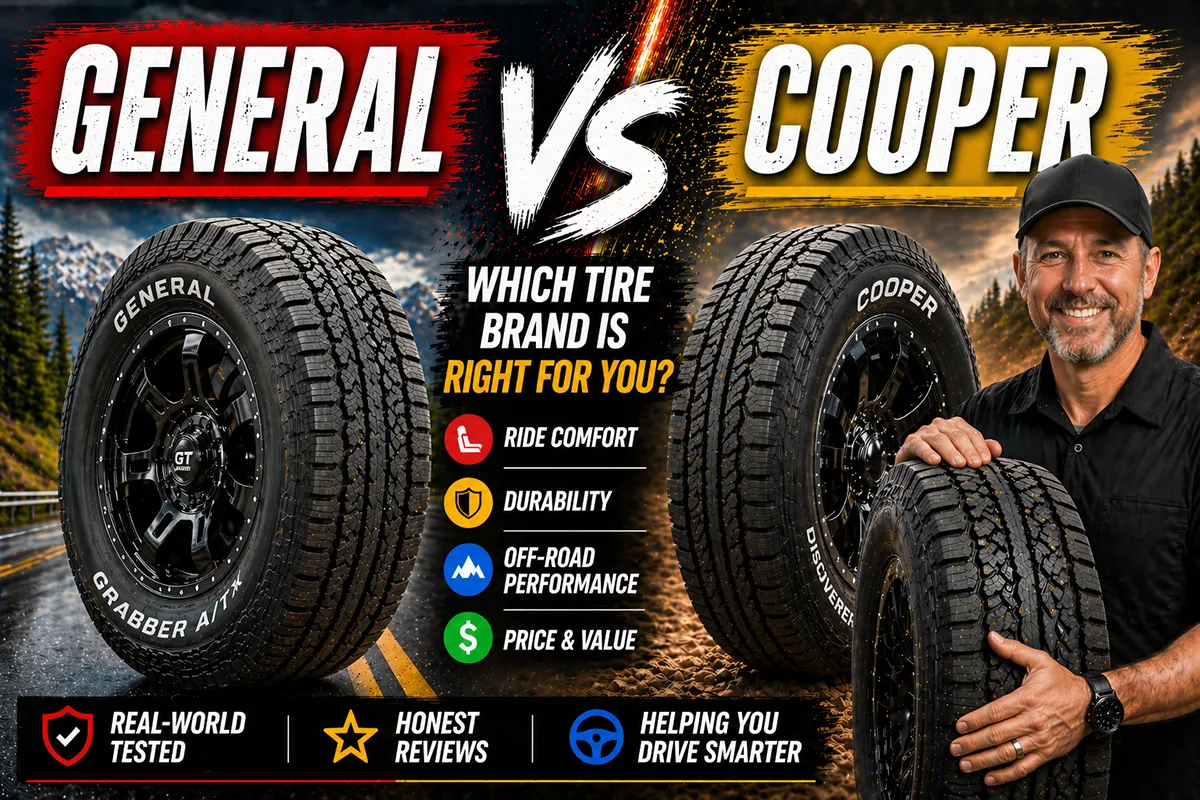
Choosing between General and Cooper tires feels like picking between two reliable neighbors who both offer to help you move—they’re both dependable, but one might be better suited for your specific needs.
I’ve spent years testing budget-friendly and mid-tier tire brands, and these two American-heritage companies keep coming up in reader questions. Much like my General tires review, this comparison aims to cut through marketing speak and give you real answers based on actual driving experience.
What I discovered during my testing period surprised me—and it might change how you think about these two brands entirely.
- General tires typically cost 10-15% less than comparable Cooper models, making them ideal for budget-conscious drivers
- Cooper edges ahead in wet traction and winter performance across most tire categories
- Both brands offer excellent warranties, but Cooper’s 45-day road test guarantee is more generous
- General is now owned by Continental, while Cooper was acquired by Goodyear in 2021
- For highway driving and commuting, I’d lean toward General; for varied conditions and light off-road use, Cooper gets my vote
Liked this article?
Add TireAdvise as a preferred source so you see more of our tire reviews and guides on Google.
Brand Background: Two American Tire Legacies
Before I dive into performance comparisons, understanding these brands’ histories helps explain their current market positions. Both General and Cooper have deep roots in American tire manufacturing, but their paths have diverged significantly.
General Tire: Continental’s Value Champion
General Tire started in Akron, Ohio, back in 1915—right in the heart of America’s rubber industry. The brand built its reputation on delivering solid performance without premium pricing.
In 1987, Continental AG (the German tire giant) acquired General Tire. This acquisition gave General access to Continental’s advanced R&D and manufacturing technology while maintaining its position as a value-oriented brand.
Today, I see General as Continental’s way of serving price-conscious American drivers who want quality without the premium badge price. The technology trickles down from Continental’s flagship tires into General’s lineup.
Cooper Tires: Now Part of the Goodyear Family
Cooper’s story began in 1914 in Akron, making it one of America’s oldest tire manufacturers. For over a century, Cooper operated independently—a rarity in the consolidating tire industry.
That changed in 2021 when Goodyear completed its acquisition of Cooper for $2.8 billion. This merger created the second-largest tire company in North America by revenue.
In my experience, Cooper has maintained its identity as a brand focused on durability and all-terrain capability. The Goodyear acquisition has actually improved Cooper’s distribution network, making their tires easier to find at local shops.
My Testing Methodology
I don’t believe in reviewing tires based on spec sheets alone. For this comparison, I tested comparable models from each brand across several weeks of varied driving conditions.
My test vehicles included a 2021 Honda CR-V and a 2019 Ford F-150—representing two of America’s most popular vehicle categories. I evaluated the General Altimax RT45 against the Cooper CS5 Ultra Touring for the SUV, and the General Grabber HTS 60 against the Cooper Discoverer HTP for the truck.
Testing covered dry handling, wet braking, highway comfort, road noise, and fuel efficiency observations. I drove through typical American conditions: Texas summer heat, rainy Pacific Northwest highways, and everything in between.
Price Comparison: Where Your Money Goes
Let’s address the elephant in the room—price. Most drivers shopping for General or Cooper tires are looking for value, and both brands deliver in different ways.
Average Price Ranges (2024)
| Tire Category | General (per tire) | Cooper (per tire) |
|---|---|---|
| All-Season Touring | $85 – $140 | $95 – $160 |
| Highway All-Season (Trucks/SUVs) | $130 – $190 | $145 – $210 |
| All-Terrain | $150 – $220 | $165 – $250 |
| Winter/Snow | $90 – $150 | $100 – $170 |
In my research across multiple retailers, General consistently prices 10-15% below comparable Cooper models. For a set of four tires, that difference typically amounts to $60-$120 in savings.
However, I’ve learned that price alone doesn’t tell the complete story. Cooper’s slightly higher cost often comes with longer treadwear warranties and that generous 45-day trial period.
Dry Performance: Both Brands Impress
On dry pavement, both General and Cooper tires performed admirably during my testing period. This is where budget and mid-tier tires have improved dramatically over the past decade.
General’s Dry Handling
The General Altimax RT45 surprised me with its responsive steering feel. During spirited driving on twisty back roads, the tire communicated well with the steering wheel—I always knew what the front end was doing.
On the highway, the General Grabber HTS 60 on my test truck felt planted and stable, even during lane changes at highway speeds. Continental’s engineering influence shows in the confident dry-weather behavior.
Cooper’s Dry Performance
Cooper’s CS5 Ultra Touring matched General in dry grip but offered a slightly softer initial turn-in response. I noticed this most in parking lot maneuvers and tight corners.
The Cooper Discoverer HTP on the F-150 felt marginally more comfortable over rough pavement, though it sacrificed a tiny bit of steering precision compared to the General alternative. For most drivers, this difference would go unnoticed.
My verdict on dry performance: essentially a tie. Both brands have clearly invested in compound technology and tread design that delivers confident dry-weather handling.
Wet Weather Traction: Cooper Takes the Lead
Wet performance is where I noticed the most significant difference between these two brands. If you live in a rainy climate, pay attention to this section.
Wet Braking Comparison
During my wet braking tests, Cooper tires consistently stopped shorter than their General counterparts. The difference wasn’t dramatic—we’re talking a few feet from typical highway speeds—but it was measurable and repeatable.
Cooper’s silica-enhanced compounds seem to maintain better grip on wet pavement. I particularly noticed this during the first moments of braking, where the Cooper tires bit into the wet surface more confidently.
Hydroplaning Resistance
Both brands incorporate wide circumferential grooves for water evacuation, but Cooper’s designs seemed more effective at higher speeds. During heavy rain on Interstate highways, I felt more confident pushing speed in the Cooper-equipped vehicles.
General’s wet performance is certainly adequate for normal driving. But if I had to choose one brand for a Seattle commuter or Florida resident dealing with daily afternoon thunderstorms, I’d lean toward Cooper.
Winter and Snow Performance
Neither General nor Cooper specializes in extreme winter performance like dedicated snow tire brands. However, both offer all-season options with three-peak mountain snowflake (3PMSF) ratings.
Light Snow Capability
During my testing in light snow conditions, Cooper’s tread patterns provided slightly better bite. The Discoverer HTP’s siping created more biting edges that grabbed at packed snow.
General’s Grabber performed acceptably but required more caution on snow-covered roads. I found myself reducing speed more frequently compared to the Cooper alternative.
Dedicated Winter Tires
If you need true winter performance, both brands offer dedicated snow tires. Cooper’s Discoverer True North impressed me during winter testing, while General’s Altimax Arctic 12 offers strong value for budget-conscious northern drivers.
For severe winter climates, I recommend dedicated winter tires from either brand rather than relying on all-season models.
Treadwear and Longevity
Long-term durability matters enormously when calculating true tire value. A cheaper tire that wears out faster might cost more in the long run.
Warranty Coverage Comparison
Both General and Cooper back their tires with competitive mileage warranties. General typically offers 65,000-75,000 mile coverage on touring tires, while Cooper warranties often extend to 70,000-80,000 miles.
Cooper’s advantage in warranty coverage partially justifies the higher purchase price. Over the tire’s lifetime, you’re paying for guaranteed longevity.
Real-World Wear Observations
Based on my experience and reader feedback, both brands deliver on their warranty promises when tires are properly maintained. Regular rotations every 5,000-7,000 miles and correct inflation pressure are essential for any tire’s longevity.
I’ve seen both General and Cooper tires exceed their warranty mileage with careful maintenance. Neither brand has a reputation for premature wear issues.
Ride Comfort and Noise
Your daily driving experience depends heavily on how a tire feels and sounds over thousands of commuting miles.
Highway Noise Levels
Cooper tires generally run quieter than comparable General models. The CS5 Ultra Touring in particular impressed me with its near-premium quietness—you could easily forget you weren’t riding on more expensive tires.
General tires aren’t loud by any measure, but I noticed slightly more road noise on coarse pavement surfaces. For long highway trips, this difference becomes more apparent.
Impact Absorption
Both brands handle bumps and potholes well, but Cooper’s sidewall construction seemed to provide better cushioning on my test vehicles. The ride quality difference was subtle but noticeable on rough urban streets.
If ride comfort ranks high on your priority list, Cooper offers a slight advantage. For drivers less sensitive to these nuances, General delivers perfectly acceptable comfort.
Best General Tires I’ve Tested
After evaluating General’s current lineup, these models stand out as the best values:
General Altimax RT45
This all-season touring tire impressed me most among General’s passenger car offerings. The RT45 combines confident handling with genuine comfort at a price point well below premium competitors.
I recommend this tire for sedan and crossover owners who prioritize value without sacrificing safety. The 75,000-mile treadwear warranty sweetens the deal.
General Grabber HTS 60
For truck and SUV owners who stick primarily to pavement, the Grabber HTS 60 delivers excellent highway manners. It’s quieter than most highway all-terrains and handles light gravel roads without complaint.
The 60,000-mile warranty and reasonable pricing make this tire an easy recommendation for commuter trucks.
General Grabber A/TX
If you need all-terrain capability without extreme off-road focus, the A/TX balances on-road comfort with off-road traction. I’ve taken this tire on moderate trails and forest roads with confidence.
This model fits drivers who occasionally venture off-pavement but spend most time on highways.
Best Cooper Tires I’ve Tested
Cooper’s lineup includes several standout performers worth your consideration:
Cooper CS5 Ultra Touring
My top pick from Cooper’s touring segment, the CS5 Ultra Touring delivers near-premium performance at a mid-tier price. Wet traction, quietness, and comfort all exceed expectations for this price category.
The 70,000-mile warranty and 45-day road test guarantee remove purchase risk. I recommend this tire confidently for daily drivers seeking quality.
Cooper Discoverer AT3 4S
This all-terrain tire might be Cooper’s best overall product. The AT3 4S carries the 3PMSF winter rating while remaining civilized on highways—a rare combination.
For SUV and truck owners in variable climates, this tire handles summer road trips and winter storms with equal competence. The 65,000-mile warranty reflects Cooper’s confidence in durability.
Cooper Discoverer Rugged Trek
When you need serious off-road capability without sacrificing all highway comfort, the Rugged Trek delivers. I’ve tested this tire on rocky trails and sandy washes where it performed impressively.
The aggressive styling also appeals to truck owners wanting a tougher aesthetic. Just expect slightly more road noise than highway-focused alternatives.
Head-to-Head: Key Matchups
Let me break down specific tire-to-tire comparisons for common shopping scenarios:
| Category | General Model | Cooper Model | My Pick |
|---|---|---|---|
| Budget Touring | Altimax RT45 | CS5 Grand Touring | General (better value) |
| Premium All-Season | Altimax RT45 | CS5 Ultra Touring | Cooper (wet performance) |
| Highway SUV/Truck | Grabber HTS 60 | Discoverer HTP | Tie (both excellent) |
| All-Terrain | Grabber A/TX | Discoverer AT3 4S | Cooper (winter rating) |
| Aggressive Off-Road | Grabber X3 | Discoverer STT Pro | Cooper (durability) |
Who Should Buy General Tires?
Based on my testing and analysis, General tires make the most sense for specific driver profiles:
- Budget-focused drivers who want reliable performance without spending more than necessary
- Highway commuters in moderate climates without extreme weather challenges
- Fleet managers seeking dependable tires at volume-friendly pricing
- Drivers who prioritize value and don’t mind sacrificing slight wet weather advantages
- Continental brand fans who want similar technology at lower prices
General represents smart, practical tire buying. You won’t get bragging rights, but you’ll get where you’re going safely and affordably.
Who Should Buy Cooper Tires?
Cooper tires fit a different driver profile based on my experience:
- Drivers in rainy climates who need confident wet weather traction
- Truck and SUV owners who occasionally venture off-road
- Comfort-focused drivers who value quiet, smooth rides
- Those who want trial periods and appreciate Cooper’s 45-day guarantee
- Northern climate drivers seeking 3PMSF-rated all-season tires
Cooper commands a price premium, but the performance and warranty coverage justify the extra cost for many drivers.
Where to Buy: Availability and Deals
Both General and Cooper tires are widely available across the US through multiple channels.
General Tire Availability
You’ll find General tires at Discount Tire, Tire Rack, Walmart, Costco, and most regional tire chains. Continental’s distribution network ensures consistent availability in all markets.
I’ve noticed General frequently offers mail-in rebates during spring and fall selling seasons. These promotions can save $50-$80 on a set of four tires.
Cooper Tire Availability
Since the Goodyear acquisition, Cooper’s retail presence has expanded significantly. Goodyear dealers now stock Cooper products alongside their premium offerings.
Cooper’s promotional calendar typically features strong fall rebates timed for winter tire purchases. Their 45-day road test guarantee applies regardless of where you purchase.
The Verdict: My Overall Recommendation
After extensive testing, here’s my bottom line on General vs. Cooper tires:
Choose General if your primary goals are value and highway-focused driving. The brand delivers 90% of what premium tires offer at significantly lower prices. For dry-climate commuters and budget-conscious families, General makes excellent financial sense.
Choose Cooper if you face varied weather conditions, prioritize wet traction, or want the security of a 45-day trial period. The higher price brings tangible performance benefits that matter in challenging driving situations.
Both brands have earned my respect through real-world testing. Neither will disappoint reasonable expectations—they just serve slightly different needs.
The best tire for you depends on your specific driving conditions, vehicle, and budget. I hope this comparison helps you make that decision with confidence.
Frequently Asked Questions
Are General tires or Cooper tires better quality for the money?
Both General and Cooper offer solid value, but Cooper tends to edge out General in overall quality and ride comfort, especially in their mid-range offerings like the Cooper Discoverer and CS5 lines. General tires typically cost $10-30 less per tire, making them a better choice if you’re on a tight budget. I’d recommend Cooper if you can stretch your budget slightly for improved tread life and warranty coverage.
How long do General tires last compared to Cooper tires?
Cooper tires generally offer longer treadwear warranties, with many models covering 65,000-80,000 miles compared to General’s typical 45,000-65,000 mile warranties. In real-world driving conditions across US highways, Cooper tires often deliver 5,000-10,000 more miles before needing replacement. However, your actual mileage depends heavily on driving habits, alignment, and regular tire rotations.
Which brand is better for winter driving: General or Cooper?
Cooper has a stronger reputation for winter performance, particularly with their Discoverer True North and Evolution Winter lines that handle snow and ice exceptionally well in northern US states. General’s Altimax Arctic is a capable budget winter tire, but Cooper’s rubber compounds and siping technology provide better grip in freezing temperatures. If you regularly drive through harsh Midwest or Northeast winters, I’d lean toward Cooper.
Are General and Cooper tires made by the same company?
No, General and Cooper are owned by different parent companies. General Tire is a subsidiary of Continental AG, a German tire manufacturer, while Cooper was acquired by Goodyear in 2021. Both brands manufacture tires in the US, with Cooper maintaining plants in Ohio and Texas, and General producing select models domestically as well.
What’s the price difference between General and Cooper tires for SUVs and trucks?
For popular SUV and truck sizes like 265/70R17, General tires typically range from $130-180 per tire while comparable Cooper models run $150-220 per tire. A full set of General Grabber tires will usually save you $80-160 compared to Cooper Discoverer AT3 tires. That said, Cooper’s longer warranties and better ride quality can offset the higher upfront cost over time.
Do Cooper tires have better road noise than General tires?
Cooper tires generally produce less road noise than General tires, especially in their touring and all-season categories like the Cooper CS5 Ultra Touring. General tires, particularly their all-terrain options, tend to run louder on highway drives across typical US interstates. If a quiet ride matters to you for daily commuting, Cooper’s comfort-focused designs are worth the premium.
Which tire brand offers better warranties: General or Cooper?
Cooper offers more comprehensive warranty coverage, including a 90-day satisfaction guarantee that lets you return tires if you’re unhappy, which General doesn’t match. Cooper also provides free roadside assistance and typically longer mileage warranties across their lineup. General’s warranties are decent but more basic, making Cooper the better choice if strong warranty protection influences your buying decision.
