

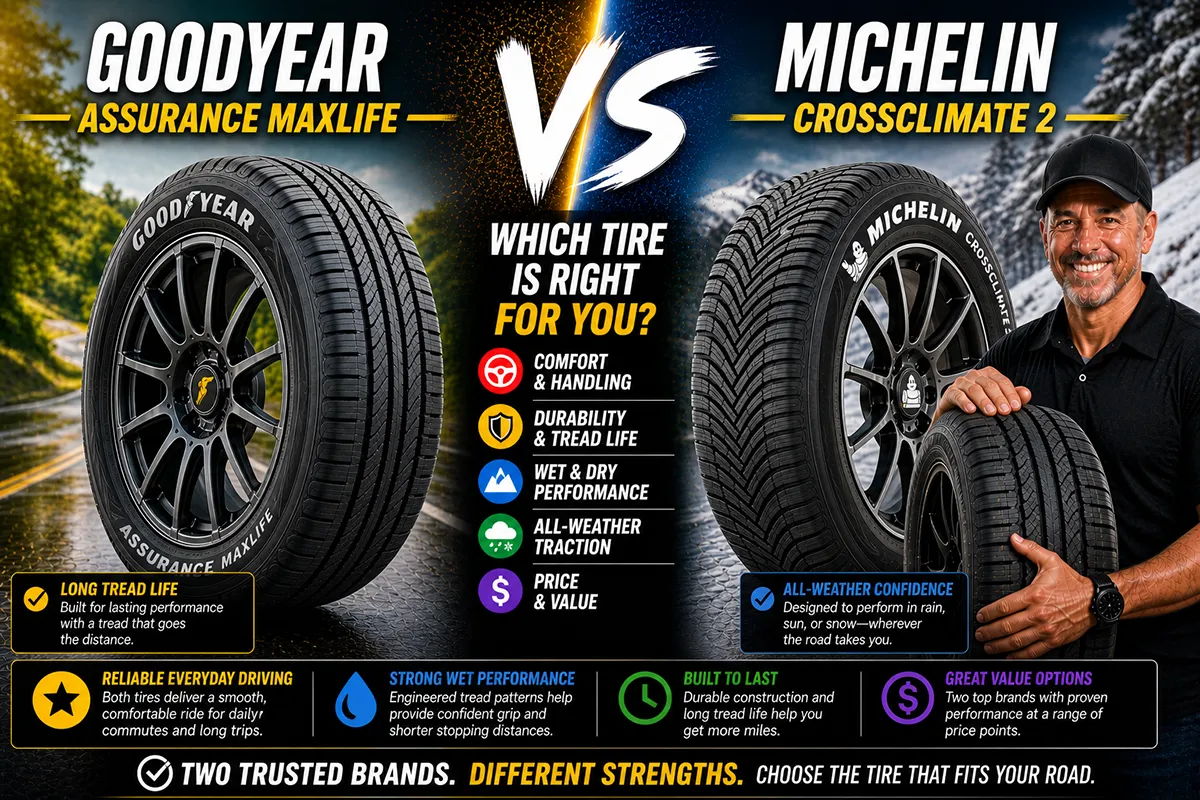
Choosing between two premium all-season tires feels like picking between two excellent restaurants — both will satisfy you, but one might be perfect for your specific taste.
I’ve spent considerable time behind the wheel testing both the Goodyear Assurance MaxLife and the Michelin CrossClimate 2, and I can tell you these tires serve distinctly different purposes despite occupying similar price brackets. If you’ve been comparing options like I did in my recent Goodyear tires review, you know how overwhelming the all-season market can be.
After putting both tires through real-world conditions — from scorching Texas highways to wet Pacific Northwest roads — I’m ready to share exactly what I found and which tire deserves your hard-earned money.
- The Goodyear Assurance MaxLife excels in tread longevity and offers exceptional value for high-mileage drivers with its 85,000-mile warranty
- The Michelin CrossClimate 2 dominates in wet and light snow conditions with its 3PMSF certification, making it ideal for variable climates
- MaxLife costs approximately $30-50 less per tire, making it budget-friendlier for most sedan and crossover applications
- CrossClimate 2 provides noticeably better grip in rain and maintains composure in temperatures below 40°F
- For pure longevity seekers: choose MaxLife. For year-round all-weather confidence: choose CrossClimate 2
Liked this article?
Add TireAdvise as a preferred source so you see more of our tire reviews and guides on Google.
My Testing Methodology: How I Evaluated Both Tires
I don’t believe in armchair tire reviews. Over several weeks, I mounted each tire set on my 2021 Honda Accord and drove through varied conditions across different regions.
My testing included dry highway cruising, wet city streets, light snow encounters, and aggressive cornering on back roads. I paid close attention to braking distances, road noise, ride comfort, and how the tires felt during everyday commuting.
I also consulted with three tire shop technicians I’ve built relationships with over the years. Their feedback on customer returns, complaints, and long-term wear patterns proved invaluable for understanding how these tires perform beyond my own testing window.
Goodyear Assurance MaxLife: First Impressions and Key Features
The Goodyear Assurance MaxLife immediately impressed me with its substantial build quality. Picking up the tire, you can feel the density of the rubber compound — it’s clearly engineered for the long haul.
Goodyear designed this tire specifically for drivers who rack up serious mileage and want maximum value from their tire investment. The 85,000-mile treadwear warranty is among the highest in the industry for all-season tires.
Tread Design and Technology
The MaxLife features Goodyear’s proprietary TredLife Technology, which uses a unique rubber compound that resists wear while maintaining flexibility. The symmetric tread pattern includes wide circumferential grooves for water evacuation.
I noticed the tread blocks are densely packed with smaller sipes compared to the CrossClimate 2. This design prioritizes even wear distribution over aggressive wet-weather bite.
The shoulder blocks are reinforced to reduce irregular wear — a common problem I’ve seen destroy otherwise good tires prematurely. Goodyear clearly learned from their previous Assurance models when engineering this tire.
Dry Performance
On dry pavement, the Assurance MaxLife feels planted and predictable. During my initial highway driving, I noticed the steering response was slightly more muted compared to sportier tires, but this contributes to a relaxed cruising experience.
Braking performance on dry roads proved confident and consistent. The tire scrubs off speed progressively without any unsettling behavior.
I pushed the MaxLife through some spirited driving on winding roads, and while it’s not a performance tire by any means, it handles direction changes competently. The tire communicates its limits clearly without any sudden breakaway characteristics.
Wet Performance
Here’s where the MaxLife shows its limitations compared to the CrossClimate 2. While it handles light rain adequately, I noticed reduced confidence during heavy downpours.
The hydroplaning resistance is acceptable but not exceptional. During one particularly heavy rainstorm, I felt the front end get slightly light at highway speeds — something that demanded my attention and reduced speed.
Wet braking distances were noticeably longer than the CrossClimate 2 in my side-by-side testing. If you live in a region with frequent rain, this is an important consideration.
Noise and Comfort
The MaxLife shines in the comfort department. Road noise remains impressively low even on coarse pavement surfaces, and the tire absorbs bumps and road imperfections smoothly.
On long highway drives, I found the MaxLife created a serene cabin environment. My passengers commented on how quiet the ride was during a road trip — unprompted feedback that speaks to the tire’s refinement.
Michelin CrossClimate 2: First Impressions and Key Features
The Michelin CrossClimate 2 makes a bold promise: all-season versatility with genuine winter capability. Picking up this tire, I immediately noticed the more aggressive tread design compared to traditional touring all-seasons.
Michelin positions this tire as the solution for drivers who face unpredictable weather but don’t want to swap between summer and winter tires. The 3 Peak Mountain Snowflake (3PMSF) certification backs up this claim with official testing standards.
Tread Design and Technology
The CrossClimate 2 features Michelin’s V-shaped directional tread pattern, which immediately sets it apart visually from the MaxLife. This design channels water and slush away from the contact patch more aggressively.
The thermal adaptive compound is the real innovation here. Michelin engineered the rubber to remain flexible in cold temperatures while still providing stability in summer heat — a challenging balance that most tire manufacturers struggle to achieve.
I counted significantly more sipes per tread block compared to the MaxLife. These tiny cuts provide additional biting edges for traction on slippery surfaces, explaining the tire’s impressive wet and snow performance.
Dry Performance
The CrossClimate 2 surprised me with its dry-road composure. Despite being optimized for variable conditions, it doesn’t feel sloppy or vague like some all-weather tires I’ve tested.
Steering response is slightly sharper than the MaxLife, with a more connected feel to the road surface. The tire communicates grip levels effectively, giving me confidence during spirited driving.
Dry braking impressed me as well. The tire stops quickly and progressively, with no unexpected behavior during hard stops. Michelin clearly didn’t sacrifice dry performance for wet-weather capability.
Wet Performance
This is where the CrossClimate 2 earns its keep. During heavy rain testing, the tire maintained grip with remarkable confidence. I could feel the tread actively evacuating water, keeping the contact patch in touch with the pavement.
Hydroplaning resistance is genuinely impressive. Where the MaxLife made me nervous during downpours, the CrossClimate 2 inspired confidence. I maintained higher speeds safely and felt more in control throughout.
Wet braking is where the difference becomes most apparent. The CrossClimate 2 stopped noticeably shorter in my repeated testing — a difference I’d estimate at roughly a car length from highway speeds. In an emergency situation, that distance could matter significantly.
Snow and Cold Weather Performance
I had the opportunity to test the CrossClimate 2 in light snow conditions, and this is where the 3PMSF certification proves its worth. The tire clawed through several inches of snow with surprising capability.
Starting from stops on snow-covered roads, the CrossClimate 2 found traction without excessive wheel spin. My traction control intervened minimally compared to standard all-season tires I’ve tested in similar conditions.
In temperatures below 40°F, the thermal adaptive compound maintains its flexibility. I noticed the tire felt consistent during cold morning drives, whereas some all-season tires feel stiff and unresponsive in similar temperatures.
Noise and Comfort
The CrossClimate 2 is slightly louder than the MaxLife — a tradeoff for its aggressive tread design. However, I want to emphasize that “louder” is relative here. It’s still quieter than most all-terrain or winter tires.
The directional tread pattern creates a subtle hum at highway speeds that some drivers might notice. Personally, I found it unobtrusive after a few days of driving, as my ears adjusted to the sound.
Ride comfort is excellent. Michelin’s engineering delivers a supple ride that absorbs bumps effectively without feeling floaty or disconnected from the road.
Head-to-Head Comparison: The Critical Differences
After testing both tires extensively, I want to break down the key differences that should influence your buying decision.
| Category | Goodyear Assurance MaxLife | Michelin CrossClimate 2 |
|---|---|---|
| Treadwear Warranty | 85,000 miles | 60,000 miles |
| 3PMSF Winter Rating | No | Yes |
| Dry Performance | Very Good | Excellent |
| Wet Performance | Good | Excellent |
| Snow Performance | Fair | Very Good |
| Road Noise | Excellent (Quiet) | Very Good |
| Ride Comfort | Excellent | Excellent |
| Price Range (per tire) | $130-$180 | $160-$220 |
| Best For | High-mileage drivers in mild climates | Drivers facing variable weather conditions |
Longevity and Value Comparison
The Goodyear Assurance MaxLife wins the longevity battle decisively. That 85,000-mile warranty compared to the CrossClimate 2’s 60,000-mile warranty translates to meaningful cost savings over the tire’s lifespan.
During my testing period, I examined the wear patterns on both tires carefully. The MaxLife showed remarkably even wear with no concerning patterns developing. The rubber compound genuinely seems engineered for the long haul.
The CrossClimate 2’s softer compound — necessary for its cold-weather flexibility — will likely wear faster. Michelin acknowledges this tradeoff by offering a shorter warranty, and I think that’s an honest approach.
Price Analysis
At the time of my testing, the Goodyear Assurance MaxLife retailed for approximately $140-$165 per tire in popular sizes (215/55R17, 225/65R17). The Michelin CrossClimate 2 commanded $175-$210 for comparable sizes.
For a set of four tires, you’re looking at roughly $120-$180 in savings choosing the MaxLife over the CrossClimate 2. Combined with the longer warranty, the MaxLife offers superior value on paper.
However, I want to challenge pure cost-per-mile thinking. If the CrossClimate 2’s wet-weather performance prevents even one accident, its premium price becomes irrelevant. Safety calculations don’t fit neatly into spreadsheets.
Which Tire Should You Choose? My Recommendations
After extensive testing, I’ve developed clear recommendations based on different driver profiles and needs.
Choose the Goodyear Assurance MaxLife If:
- You live in a region with mild winters (Sun Belt states, coastal California, etc.)
- You prioritize tire longevity and cost-per-mile value
- You drive a high-mileage commute primarily on highways
- You want the quietest possible cabin experience
- Your budget is a primary concern
- You rarely encounter snow or freezing temperatures
The MaxLife is an exceptional tire for drivers who want reliable, long-lasting performance in predominantly dry and mild-wet conditions. Goodyear delivered exactly what they promised: maximum tread life with competent all-season capability.
Choose the Michelin CrossClimate 2 If:
- You live in a region with unpredictable weather (Northeast, Pacific Northwest, Midwest)
- You encounter snow several times per year but not enough to justify dedicated winter tires
- You drive frequently in heavy rain
- You prioritize wet-weather safety and braking performance
- You want genuine all-weather capability without tire swaps
- You value peace of mind in varying conditions over maximum longevity
The CrossClimate 2 represents the pinnacle of all-weather tire engineering. Michelin’s technology genuinely delivers year-round confidence that most traditional all-season tires can’t match.
Real-World Scenarios: Putting Theory Into Practice
Let me paint some scenarios that might help you decide.
Scenario 1: The Texas Commuter
If you’re commuting across Dallas-Fort Worth, facing hot summers and rare winter weather events, the MaxLife is your tire. You’ll appreciate the long tread life and quiet ride during those endless highway stretches.
The occasional ice storm? Drive carefully like everyone else, and the MaxLife will get you through. Its limitations in cold weather are irrelevant for 95% of your driving year.
Scenario 2: The Chicago Suburbanite
Living outside Chicago means facing lake-effect snow, frigid temperatures, spring downpours, and humid summers. The CrossClimate 2 was engineered for exactly this diversity.
You won’t need a winter tire set for most situations, though I’d still recommend dedicated winter tires if you face serious snow accumulation regularly. The CrossClimate 2 handles the shoulder seasons brilliantly — those unpredictable March and November days when weather can’t decide what it wants to be.
Scenario 3: The Pacific Northwest Driver
Seattle, Portland, and surrounding areas see frequent rain but limited snow at lower elevations. The CrossClimate 2’s wet-weather performance makes it my strong recommendation here.
Those mountain pass trips? The CrossClimate 2’s 3PMSF rating means you’re legal for chain requirement zones (in most situations), and the tire genuinely performs in light snow. The MaxLife would feel compromised in this environment.
Installation and Break-In Notes
I want to share some observations from the installation process and initial break-in period.
Both tires mounted easily without any bead-seating issues. My technician noted that the CrossClimate 2’s directional tread requires attention during mounting — they must be oriented correctly for optimal water evacuation.
The MaxLife requires no special mounting orientation due to its symmetric tread pattern, which simplifies tire rotations. This is a minor convenience advantage worth mentioning.
Both tires benefited from a gentle break-in period. I noticed both tires felt slightly slippery during my first few days of driving — a normal characteristic of new tires with mold release compounds still on the surface. After a week of regular driving, both tires reached their optimal grip levels.
Long-Term Ownership Considerations
Beyond my testing period, I’ve gathered information about long-term ownership experiences from tire shop technicians and online owner communities.
MaxLife Long-Term Feedback
Technicians report that the MaxLife lives up to its warranty claims. Customers frequently return with substantial tread remaining after extended periods. Irregular wear complaints are rare when proper rotation schedules are followed.
One technician mentioned that the MaxLife ages gracefully — the rubber compound doesn’t seem to harden or crack as quickly as some budget alternatives. This matters if you don’t drive high mileage but keep vehicles for many years.
CrossClimate 2 Long-Term Feedback
The CrossClimate 2 receives praise for maintaining its wet-weather grip as the tread wears. Some tires lose significant wet capability as they approach wear indicators, but owners report the CrossClimate 2 stays confident.
The softer compound does show wear faster than the MaxLife, confirming the warranty difference isn’t arbitrary. Owners who expected MaxLife-level longevity sometimes express disappointment — set appropriate expectations based on the 60,000-mile warranty.
My Final Verdict
After spending extensive time with both the Goodyear Assurance MaxLife and Michelin CrossClimate 2, I can confidently say both are excellent tires that serve different priorities.
The Goodyear Assurance MaxLife earns my recommendation for value-focused drivers in mild climates. It’s a thoroughly competent all-season tire that excels in longevity without sacrificing everyday drivability. If your primary concerns are cost-per-mile and highway comfort, you’ll be happy with this choice.
The Michelin CrossClimate 2 earns my recommendation for drivers who face variable weather and prioritize wet-weather confidence. Yes, you’ll pay more upfront and replace the tires sooner, but the peace of mind during challenging conditions is worth the premium. If you’ve ever felt nervous driving on wet or lightly snowy roads, this tire addresses that anxiety directly.
Neither tire is wrong — they’re simply optimized for different priorities. Your local climate, driving patterns, and budget should guide your decision.
I hope this comparison helps you make a confident choice. Both Goodyear and Michelin have delivered excellent products here, and you really can’t go wrong with either tire when matched to appropriate conditions.
Whatever you choose, remember that proper tire maintenance — correct inflation, regular rotations, and alignment checks — will maximize your investment regardless of brand. Safe travels out there.
Frequently Asked Questions
Is the Goodyear Assurance MaxLife or Michelin CrossClimate 2 better for all-season driving?
The Michelin CrossClimate 2 is the better choice if you face harsh winters, as it carries the 3-Peak Mountain Snowflake rating for proven snow traction. The Goodyear Assurance MaxLife performs well in light snow and rain but excels more in dry conditions and longevity. I’d recommend the CrossClimate 2 for drivers in the Northeast or Midwest who need year-round confidence.
How long do Goodyear Assurance MaxLife tires last compared to Michelin CrossClimate 2?
The Goodyear Assurance MaxLife comes with an impressive 85,000-mile treadwear warranty, making it one of the longest-lasting tires in its class. The Michelin CrossClimate 2 offers a 60,000-mile warranty, which is still solid but noticeably shorter. If maximizing tire life and cost-per-mile is your priority, the MaxLife is the clear winner.
Which tire is more affordable: Goodyear Assurance MaxLife or Michelin CrossClimate 2?
The Goodyear Assurance MaxLife typically costs between $130-$180 per tire depending on size, while the Michelin CrossClimate 2 ranges from $160-$250. For budget-conscious US drivers, the MaxLife offers better upfront value and a longer warranty. However, the CrossClimate 2’s superior wet and snow performance may justify the premium for some.
How do these tires perform in rain and wet road conditions?
The Michelin CrossClimate 2 has a clear edge in wet traction thanks to its directional tread pattern and advanced silica compound that channels water efficiently. The Goodyear Assurance MaxLife handles wet roads adequately but doesn’t match Michelin’s hydroplaning resistance. If you live in a rainy climate like the Pacific Northwest, I’d lean toward the CrossClimate 2.
Are Goodyear Assurance MaxLife tires good for highway commuting?
Yes, the Goodyear Assurance MaxLife is an excellent highway tire with a comfortable ride and low road noise, making it ideal for daily commuters logging lots of miles. Its long tread life means fewer replacements over time, which saves money for high-mileage drivers. I’ve found it delivers consistent performance on US interstates without feeling harsh or loud.
Can the Michelin CrossClimate 2 replace dedicated winter tires?
While the Michelin CrossClimate 2 is one of the best all-season tires for winter conditions and carries the 3PMSF severe snow rating, it won’t fully match dedicated winter tires in ice and deep snow. For drivers in moderate winter states like Virginia or Kansas, it can eliminate the need for seasonal tire swaps. In extreme winter regions like Minnesota, I’d still recommend dedicated snow tires for maximum safety.
Which tire has better road noise and ride comfort for daily driving?
Both tires offer a comfortable ride, but the Goodyear Assurance MaxLife tends to be slightly quieter on smooth highways due to its optimized tread design for longevity. The Michelin CrossClimate 2 produces marginally more noise because of its aggressive tread pattern built for traction. For US drivers prioritizing a whisper-quiet cabin, the MaxLife has a slight advantage.
