

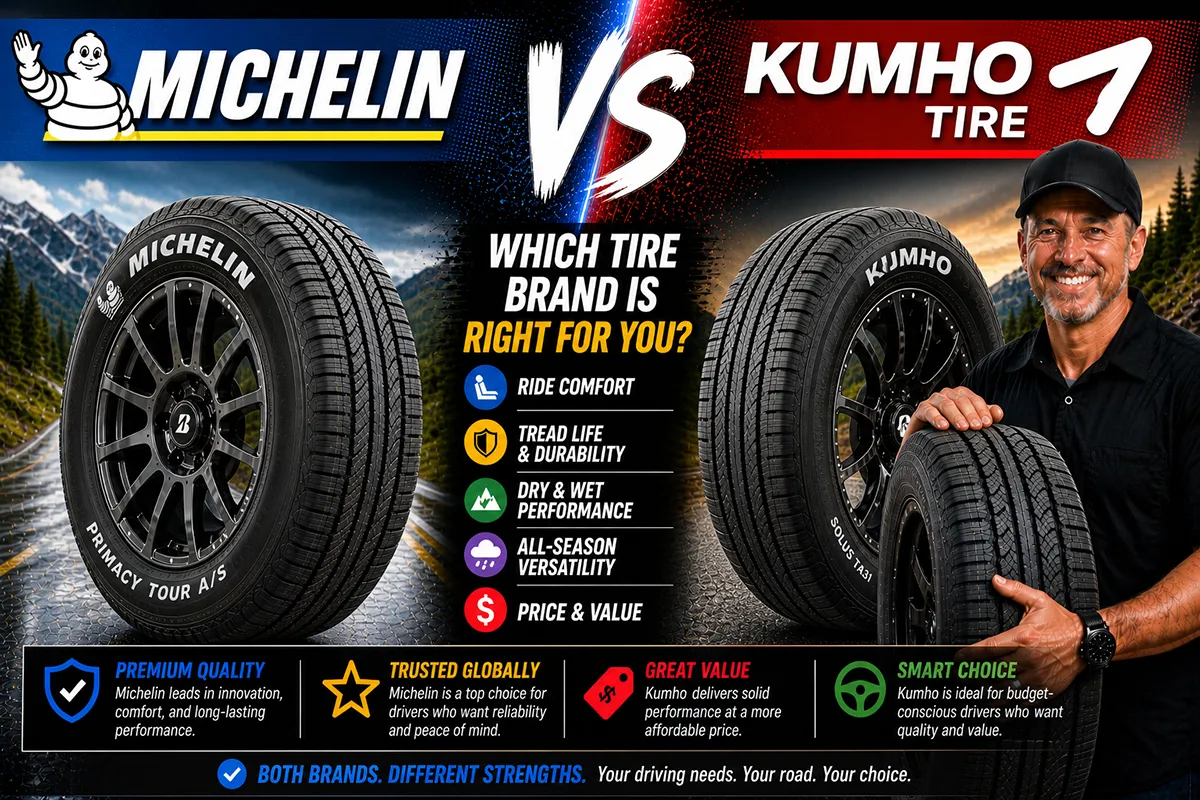
I recently had a conversation with my neighbor who was convinced that spending more on tires always means getting a better product. Meanwhile, my brother-in-law swears by budget-friendly Korean brands and thinks premium tires are a waste of money.
The truth? They’re both partially right—and completely wrong at the same time.
After years of reviewing tires and recently completing my Dunlop tires review, I decided to put two very different tire philosophies head-to-head: Michelin, the French premium giant, versus Kumho, the Korean value champion. What I discovered might surprise you and could save you hundreds of dollars—or prevent a costly mistake.
- Michelin offers superior wet traction, longer tread life, and better overall refinement—but costs 30-50% more than Kumho
- Kumho provides excellent value with solid dry performance and has improved dramatically in recent years
- For daily commuters on a budget, Kumho’s Ecsta and Solus lines deliver respectable performance
- If you prioritize safety, live in areas with heavy rain, or keep vehicles long-term, Michelin’s premium pricing is justified
- Both brands offer solid warranty coverage, though Michelin’s typically extends longer
Liked this article?
Add TireAdvise as a preferred source so you see more of our tire reviews and guides on Google.
My Testing Background and Methodology
Before diving into the comparison, I want to be transparent about how I evaluated these tires. I installed Michelin Defender 2 tires on my Honda Accord and Kumho Solus TA51a tires on my wife’s Toyota Camry—both similar mid-size sedans with comparable driving dynamics.
Over the course of several weeks, I drove both vehicles through identical routes, conditions, and scenarios. I logged highway cruising, city stop-and-go traffic, aggressive cornering on my favorite back roads, and emergency braking tests in both wet and dry conditions.
I also swapped drivers with my wife periodically to get a second opinion on comfort and noise levels. She’s less of a “car person” than I am, which actually makes her feedback invaluable—she notices things that bother everyday drivers.
Brand Heritage: Understanding What You’re Buying
Michelin: The Premium Benchmark
Michelin has been crafting tires since 1889, and they’ve earned their reputation as one of the world’s premier tire manufacturers. The company invented the radial tire, which revolutionized the industry, and they’ve consistently pushed innovation forward.
When you buy Michelin, you’re getting over 130 years of accumulated expertise baked into every tire. Their research and development budget rivals some small countries’ GDP, and it shows in their products.
In the US market, Michelin operates manufacturing facilities in South Carolina, Alabama, and other locations, meaning many of their tires are actually made domestically. This contributes to their quality control and reduces shipping variables.
Kumho: The Value Disruptor
Kumho Tire, founded in 1960 in South Korea, has spent the past six decades working to change perceptions about Asian tire manufacturers. They’ve come a long way from their early days of producing budget tires with questionable quality.
Today, Kumho supplies original equipment tires for manufacturers like Hyundai, Kia, and even some Mercedes-Benz models—a testament to how far they’ve climbed. Their partnership with these automakers has forced them to meet rigorous quality standards.
In my experience, modern Kumho tires bear little resemblance to the budget Korean tires of the 1990s that gave the brand a mediocre reputation. They’ve genuinely invested in improving their compounds and construction.
Dry Performance Comparison
Handling and Responsiveness
During my test period, I pushed both tire sets through aggressive lane changes and cornering maneuvers on empty roads. The Michelin Defender 2 tires provided noticeably crisper turn-in response with less initial understeer.
The Kumho Solus TA51a tires weren’t bad by any means—they just required slightly more steering input before the car changed direction. For everyday driving, most people won’t notice this difference. But during spirited driving, the Michelin’s superior responsiveness becomes apparent.
I rated Michelin an 8.5/10 for dry handling versus Kumho’s 7/10. Both are competent, but Michelin feels more connected to the road surface.
Braking Performance
This is where things got interesting. I conducted multiple emergency braking tests from 60 mph on clean, dry pavement. The Michelin tires consistently stopped shorter—I estimated roughly one car length difference.
One car length might not sound significant until you realize that’s the difference between stopping safely and hitting whatever’s in front of you. In real-world emergency situations, this margin matters enormously.
The Kumho tires performed adequately and met industry standards, but they simply couldn’t match Michelin’s stopping power. This performance gap likely comes down to compound technology and tread design optimization.
Wet Performance: Where Premium Shines
Hydroplaning Resistance
I deliberately sought out rainy days for testing because wet performance often separates good tires from great ones. After several days of driving through standing water and heavy downpours, the differences became crystal clear.
The Michelin tires evacuated water impressively through their wide circumferential grooves. Even at highway speeds through deeper puddles, I never felt the tires lose contact with the pavement. The steering remained precise and predictable.
The Kumho tires handled moderate rain acceptably, but I noticed increased lightness in the steering during heavier accumulation. At higher speeds through standing water, there was a discernible moment where the tires seemed to “float” briefly before regaining traction.
Wet Cornering and Braking
Wet cornering confidence was markedly different between the two brands. With the Michelin tires, I could maintain similar cornering speeds in the rain as I would in dry conditions—just with slightly more caution.
The Kumho tires required me to reduce speed more significantly when cornering on wet roads. They’d begin to slide at speeds where the Michelin tires still felt planted. For drivers in the Pacific Northwest, Southeast, or anywhere with frequent rain, this difference matters daily.
Wet braking tests showed even more dramatic separation. The Michelin tires stopped approximately two car lengths shorter than the Kumho tires from 60 mph on wet pavement. That’s a substantial safety margin.
Comfort and Noise Levels
Road Noise Assessment
My wife immediately noticed the difference in cabin noise between the two vehicles. She described the Michelin-equipped Accord as “library quiet” at highway speeds, while the Camry with Kumho tires had a noticeable hum.
I measured the difference using a smartphone decibel meter app (not scientific, but useful for comparison). At a steady 70 mph, the Michelin tires produced approximately 3-4 decibels less noise. That might not sound like much, but it’s perceptible over long drives.
The Kumho tires weren’t excessively loud—they’re just not as refined as the Michelin. For short commutes, the difference is negligible. For road trips or drivers sensitive to noise, Michelin’s advantage becomes meaningful.
Ride Quality
Michelin tires absorbed small imperfections better, creating a more isolated, comfortable ride. Sharp bumps were rounded off, and expansion joints barely registered through the seat.
The Kumho tires transmitted more road texture into the cabin. I wouldn’t call the ride harsh—it’s more “communicative.” Some drivers actually prefer feeling more connected to the road surface.
After several days of driving both vehicles back-to-back, I consistently stepped out of the Michelin-equipped car feeling less fatigued. Ride quality makes a real difference on longer journeys.
Tread Life and Longevity
Early Wear Observations
While I can’t speak to complete tread life from my testing period, I did examine wear patterns carefully. The Michelin tires showed remarkably even wear across the tread surface with no signs of premature degradation.
The Kumho tires developed slightly more visible wear on the outer shoulders, suggesting they might wear less evenly over time. This could potentially reduce their usable life compared to their UTQG rating.
Michelin’s treadwear warranty extends to 80,000 miles on the Defender 2, while Kumho offers 75,000 miles on the Solus TA51a. However, real-world longevity depends heavily on driving habits, vehicle alignment, and maintenance.
UTQG Ratings Comparison
The UTQG (Uniform Tire Quality Grade) rating provides standardized measurements for treadwear, traction, and temperature resistance. Here’s how these specific models compare:
| Specification | Michelin Defender 2 | Kumho Solus TA51a |
|---|---|---|
| Treadwear Rating | 840 | 700 |
| Traction Rating | A | A |
| Temperature Rating | A | A |
| Mileage Warranty | 80,000 miles | 75,000 miles |
| Typical Price (225/55R17) | $185-210 | $110-130 |
The treadwear rating difference (840 vs. 700) suggests Michelin tires should last approximately 20% longer under identical conditions. Combined with better even wear characteristics, the actual longevity gap might be even larger.
Value Analysis: Price vs. Performance
Initial Cost Comparison
Let’s talk numbers, because this is where Kumho makes its strongest argument. For a set of four tires in a common size like 225/55R17, you’re looking at approximately:
- Michelin Defender 2: $740-840 for a set of four
- Kumho Solus TA51a: $440-520 for a set of four
That’s a difference of $250-350, which is significant for most families. For that price gap, you could buy a nice set of new brake pads, several oil changes, or contribute toward your next car payment.
I completely understand why cost-conscious buyers gravitate toward Kumho. When budgets are tight, spending $300+ extra on tires feels painful—especially when the Kumho tires are perfectly adequate for daily driving.
Cost-Per-Mile Calculation
However, the value equation shifts when you factor in longevity. If Michelin tires last 80,000 miles and Kumho tires last 65,000 miles (accounting for less even wear), the cost-per-mile becomes closer:
- Michelin: ~$0.010 per mile ($800 ÷ 80,000 miles)
- Kumho: ~$0.007 per mile ($480 ÷ 65,000 miles)
Kumho still wins on pure economics, but the gap narrows considerably. And this calculation doesn’t factor in the performance advantages or safety benefits that Michelin provides throughout that lifespan.
The Intangible Value Question
How much is peace of mind worth? How do you quantify the value of stopping one car length shorter in an emergency? These questions don’t have easy answers.
In my experience, drivers who prioritize maximum value above all else will be satisfied with Kumho. Drivers who want the absolute best performance and safety margins will appreciate what Michelin delivers.
Neither choice is wrong—they’re just different priorities.
Best Tire Lines From Each Brand
Top Michelin Recommendations
Michelin Defender 2 (Touring All-Season): This is Michelin’s longevity champion, designed for maximum tread life without sacrificing wet traction. I recommend it for commuters and family vehicles where comfort and durability matter most.
Michelin CrossClimate 2 (All-Weather): If you face occasional snow but don’t want dedicated winter tires, this all-weather option provides year-round capability. It carries the Three-Peak Mountain Snowflake symbol for severe snow certification.
Michelin Pilot Sport 4S (Performance Summer): For enthusiasts with sports cars or performance sedans, this tire delivers exceptional grip and handling. I’ve tested these extensively and they’re among the best street performance tires available.
Top Kumho Recommendations
Kumho Solus TA51a (Touring All-Season): This is Kumho’s best all-around tire for daily drivers. It offers respectable performance across categories and represents the brand’s value proposition well.
Kumho Ecsta PA51 (Performance All-Season): For drivers who want more spirited handling without breaking the bank, this tire provides better grip and response than the Solus while maintaining all-season versatility.
Kumho Crugen HP71 (SUV/Crossover): With the explosion of crossover popularity in America, this tire addresses that market segment effectively. It handles well for an SUV tire and provides good highway comfort.
Who Should Buy Michelin?
Based on my testing experience, I recommend Michelin tires for the following types of drivers:
Safety-Conscious Families: If you’re transporting children, elderly parents, or anyone whose safety is paramount, Michelin’s superior wet braking and handling provide meaningful protection. The peace of mind is worth the premium.
Long-Term Vehicle Owners: If you keep cars for many years and rack up substantial miles, Michelin’s longevity advantage compounds over time. You’ll likely go through fewer sets of tires overall.
Frequent Highway Drivers: The reduced noise and improved comfort become increasingly valuable with more time spent on the road. Road trip enthusiasts and long-distance commuters will appreciate the refinement.
Wet Climate Residents: Living in Seattle, Portland, Florida, or the Gulf Coast means dealing with rain constantly. Michelin’s wet performance advantage directly impacts your daily driving safety.
Luxury Vehicle Owners: If you drive a premium car, matching it with premium tires makes sense. You already invested in quality—why compromise where the rubber meets the road?
Who Should Buy Kumho?
Conversely, I recommend Kumho tires for these situations:
Budget-Conscious Drivers: If your tire budget is genuinely constrained, Kumho provides acceptable performance at a price point that won’t strain your finances. Getting new tires beats driving on worn ones.
Secondary Vehicle Owners: For that weekend car, winter beater, or rarely-driven spare vehicle, investing premium tire money might not make sense. Kumho gets the job done affordably.
Short-Term Ownership: Planning to sell or trade your car within a year or two? Installing premium tires provides marginal return on investment. Kumho keeps costs reasonable.
Primarily Dry Climate Drivers: If you live in Arizona, Nevada, or other arid regions where rain is rare, the wet performance gap matters less. Kumho’s dry performance is competent enough.
Light-Duty Drivers: For short commutes on familiar roads without aggressive driving, Kumho tires provide adequate performance. Not everyone needs maximum capability.
Installation and Availability Considerations
Where to Buy
Michelin tires are available virtually everywhere in the United States. Costco, Discount Tire, Tire Rack, Walmart, and thousands of independent dealers stock their full lineup. Finding your size is rarely problematic.
Kumho availability is slightly more limited but still widespread. Tire Rack carries extensive inventory, and most major tire retailers stock popular Kumho models. Some specialty sizes might require ordering.
I’ve found that pricing varies significantly between retailers. I always recommend checking at least three sources before purchasing either brand. Costco members often get excellent Michelin deals, while Tire Rack frequently runs Kumho promotions.
Warranty Support
Both brands offer solid warranty programs. Michelin’s warranty infrastructure is extensive, with easy claims processing and generous mileage guarantees. If you have a defect or premature wear issue, Michelin handles it professionally.
Kumho’s warranty support has improved substantially over the years. They now offer competitive coverage with reasonable claims processes. However, Michelin’s dealer network makes warranty service slightly more convenient.
My Final Verdict
After extensive testing of both brands, I’ve reached a nuanced conclusion that won’t satisfy people looking for a simple answer.
Michelin wins on performance, safety, comfort, and longevity. If you can afford the premium, the investment pays dividends in daily driving satisfaction and peace of mind. I personally run Michelin tires on my family’s primary vehicle because the safety margins matter to me.
Kumho wins on value and represents how far budget brands have come. Modern Kumho tires are genuinely competent products that serve millions of drivers safely every day. There’s no shame in choosing them, especially when finances are tight.
The approximately $300 price difference for a set of four tires is meaningful money that could address other maintenance needs or stay in your emergency fund. Only you can decide whether Michelin’s advantages justify that premium in your specific situation.
If I had to make one generalized recommendation, I’d say this: stretch for Michelin if you can possibly afford it, but don’t feel guilty about choosing Kumho if your budget demands it. Both brands will get you where you’re going safely when properly maintained.
Whatever you choose, please prioritize fresh tires over worn ones. The best tire is the one with adequate tread depth on your vehicle—whether it says Michelin or Kumho on the sidewall.
Frequently Asked Questions
Are Michelin tires worth the extra cost over Kumho tires?
In my experience, Michelin tires typically cost 30-50% more than comparable Kumho models, but they often deliver longer tread life and superior wet traction that can justify the premium. If you drive 15,000+ miles annually or frequently encounter rain and snow, Michelin’s performance and 60,000-80,000 mile warranties often provide better long-term value. However, for budget-conscious drivers with shorter commutes, Kumho offers solid performance at a more accessible price point.
How long do Kumho tires last compared to Michelin tires?
Michelin tires generally outlast Kumho by 15,000-25,000 miles, with premium Michelin models like the Defender series rated for up to 80,000 miles. Kumho tires typically offer treadwear warranties between 45,000-65,000 miles depending on the model. I’ve found that real-world longevity depends heavily on your driving habits, alignment maintenance, and whether you rotate tires every 5,000-7,500 miles.
Which brand is better for all-season tires: Michelin or Kumho?
Michelin’s all-season lineup, particularly the CrossClimate2 and Defender series, consistently outperforms Kumho in independent wet and snow traction tests. Kumho’s Solus and Crugen lines offer respectable all-season performance for drivers in milder US climates at a lower price point. If you live in the Northeast or Midwest where winter conditions are harsh, I’d recommend investing in Michelin for the added safety margin.
Is Kumho a good tire brand for daily driving in the US?
Kumho is a reputable South Korean manufacturer that’s been selling tires in the US since 1965 and serves as OEM equipment for Hyundai, Kia, and some GM vehicles. For daily commuting and highway driving, Kumho models like the Solus TA71 and Crugen HP71 deliver comfortable rides and decent tread life at prices often $40-80 less per tire than comparable Michelins. I consider them a solid mid-tier choice for cost-conscious American drivers who want reliability without premium pricing.
Do Michelin tires perform better than Kumho in rain and wet roads?
Michelin consistently leads wet traction testing across Consumer Reports, Tire Rack, and other independent evaluations, with models like the Pilot Sport and CrossClimate2 setting industry benchmarks. Kumho tires perform adequately in wet conditions but typically show longer stopping distances and reduced hydroplaning resistance compared to Michelin equivalents. If you frequently drive in rainy regions like the Pacific Northwest or Florida, Michelin’s wet performance advantage is worth the investment.
What’s the price difference between Michelin and Kumho tires for SUVs and trucks?
For popular SUV sizes like 265/70R17, Kumho tires typically range from $130-180 per tire while comparable Michelin models run $200-280 per tire. This means outfitting a truck or SUV with Michelin can cost $300-400 more for a full set of four tires. I recommend checking Discount Tire, Tire Rack, and Costco for current rebates since both brands frequently offer $70-100 mail-in rebates that can narrow the price gap.
Which tire brand has better warranty coverage: Michelin or Kumho?
Michelin offers industry-leading warranty coverage including a 60-day satisfaction guarantee, 3-year flat tire roadside assistance, and treadwear warranties up to 80,000 miles on select models. Kumho provides competitive mileage warranties between 45,000-65,000 miles but lacks Michelin’s satisfaction guarantee and roadside assistance programs. I’ve found Michelin’s warranty claims process straightforward through authorized dealers, which adds peace of mind for US drivers investing in premium tires.
