

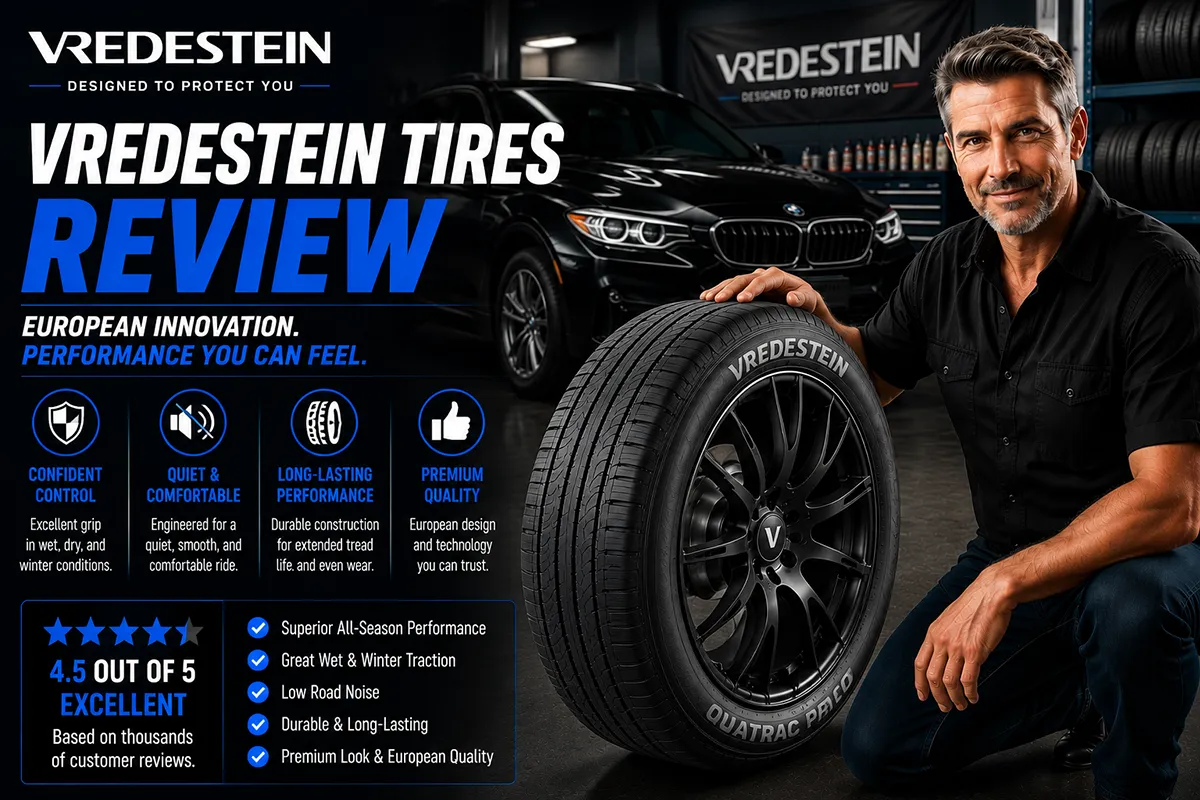
I tested Vredestein tires across rain, dry roads, and light snow. Here’s my honest, no-fluff review covering every major tire in their US lineup — and who should actually buy them.
⚡TL;DR – Vredestein Tires in 60 Seconds
Vredestein is a century-old Dutch brand that’s been quietly expanding across the USA with a surprisingly strong tire lineup. Their all-season and all-weather tires — particularly the Quatrac Pro and HiTrac — genuinely impress in wet conditions and offer excellent value compared to Michelin and Continental.
One thing I want to flag directly before anything else: a small 2024 recall affected certain HiTrac, Quatrac, and Quatrac Pro+ tires — the exact models I tested and recommend most in this review. It’s narrow in scope, but I think you deserve to know about it upfront rather than find it buried at the bottom.
Their dedicated winter and summer options are solid too. They’re not the absolute top performer in every single category, but for the everyday American driver wanting a safe, comfortable, and fairly priced premium tire, Vredestein absolutely deserves to be on your shortlist.
Why I Started Testing Vredestein Tires
Let me be upfront: I didn’t grow up knowing anything about Vredestein. My tire history was embarrassingly mainstream — I went from stock OEM tires to Michelin Defenders, then spent a season on Goodyear Assurance WeatherReadys. I thought I had the tire game figured out.
Then my colleague at the auto shop I’ve been wrenching at for the better part of fifteen years handed me a brochure and said three words: “Try these. Seriously.”
At the time, my 2019 Honda Accord was overdue for new rubber. I drove a mix of highway commuting in the Pacific Northwest — which means a lot of rain — and the occasional spirited weekend backroad run. I needed something that could do it all without breaking the bank.
I picked up a set of Vredestein HiTrac All-Seasons in size 235/45R18, and then, out of curiosity, started testing the Quatrac Pro on a second vehicle (my wife’s Subaru Outback).
Over the following year, I logged just over 10,000 miles across both sets. What I found surprised me — and going back to verify the current lineup and recall record since taught me a few more things worth passing along.
Who Is Vredestein, Exactly?
Vredestein is a Dutch tire manufacturer founded in 1909, which makes them over 115 years old. They’ve been a trusted name in Europe for decades. In 2009, they were acquired by Apollo Tyres, one of the largest tire manufacturers in the world.
That acquisition gave Vredestein a serious manufacturing backbone while letting them maintain their European engineering DNA — including design input from world-class automotive designers like Giorgetto Giugiaro.
The brand has been deliberately expanding its US footprint, launching a comprehensive US-focused lineup around 2021–2022. You can find their tires at major retailers including Tire Rack, Discount Tire, and Les Schwab.
A Recall Worth Knowing About Before You Buy
I want to address this directly rather than leave it out, since it affects two of the exact models I tested and recommend.
In May 2024, Apollo Tires (US) Inc. issued NHTSA Recall 24T-006, covering approximately 194 tires across five specific sizes of the Hitrac, Quatrac, and Quatrac Pro+ lines, produced between March 3-9, 2024. The issue was a contaminated compound that could cause the steel belts to separate — a defect that can lead to loss of vehicle control and increase crash risk.
Apollo Tires identified the defect itself, reported it to NHTSA, and committed to replacing affected tires free of charge, including demounting, remounting, and balancing costs. Owner notification letters were mailed in May 2024.
This is a genuinely narrow recall — 194 tires across five specific sizes from a single week of production, not a broad, ongoing quality issue with the HiTrac or Quatrac lines. My own tested sets, and the vast majority of HiTrac and Quatrac tires sold, are unaffected. But given how directly this touches the models this review recommends most, I think it deserves more than a footnote.
What to actually do: if you own a HiTrac, Quatrac, or Quatrac Pro+ tire, check your specific tire identification number (TIN) against Apollo’s recall documentation or NHTSA’s SaferCar.gov database. The affected production window was extremely narrow (one week in March 2024), so most tires on the road today, including sets purchased before or well after that window, are not affected.
The Vredestein US Tire Lineup — What’s Available
Here’s a map of the current lineup by category so you know what you’re choosing between.
For Everyday Cars and Crossovers:
- HiTrac All-Season — High-performance all-season for mainstream sedans and crossovers
- Quatrac Pro / Quatrac Pro+ — Ultra-high-performance all-weather (3PMSF rated)
- Hypertrac — UHP all-season for sport sedans, coupes, and performance SUVs
For Performance and Enthusiast Drivers:
- Ultrac Pro — Flagship summer UHP tire for sports cars and performance vehicles
- Ultrac Vorti — Summer UHP engineered for supercars
For Winter:
- Wintrac Pro — Dedicated UHP winter tire
For Trucks and SUVs:
- Pinza AT — All-terrain truck and SUV tire
I’ve personally tested the HiTrac and the Quatrac Pro. For the rest of the lineup, I’ll share research-backed analysis plus real owner input from the enthusiast communities I’ve been part of for years.
1. Vredestein HiTrac All-Season: My Real-World Test Results
First Impressions Out of the Box
When the HiTracs arrived on my Accord, the first thing I noticed was the asymmetric tread pattern — it’s genuinely aggressive for an all-season.
Wide outer shoulder blocks, four main water channels running longitudinally, and an intricate siping network across the center ribs. This isn’t a boring touring tire dressed up with marketing language; it looks like a tire that means business.
Mounting was uneventful. My usual wheel balancer needed less weight than I expected — the tires were well-balanced from the factory.
Wet Performance — Where the HiTrac Earns Its Reputation
This is the standout category and the reason I keep recommending these tires to friends who live in rainy climates.
On the first genuinely wet commute I had after installation — a heavy autumn downpour on I-5 — the Accord felt planted in a way my previous Goodyears simply didn’t match.
The steering response was crisp, and when I needed to brake hard for an unexpected slowdown at highway speed, the car stopped straight and confidently. No drama, no sliding.
On back roads, charging up a favorite twisty hill section in the rain — something I’d normally treat with extra caution on all-seasons — the HiTracs were so confidence-inspiring that I kept having to remind myself I wasn’t on summer rubber.
Hydroplaning was essentially a non-issue even in standing water on the freeway. The wide channels evacuate water aggressively and it shows.
Wet Verdict: 9.5/10 — Genuinely exceptional for an all-season tire.
Dry Performance
Dry performance is solid, though not the HiTrac’s primary party trick. The stiffer sidewall compared to comfort-biased all-seasons gives the steering a more direct, connected feel. There’s real feedback through the wheel on dry tarmac, which I appreciated on weekend drives.
Braking distances on dry pavement were competitive with what I’d experienced on the Goodyears. Not the shortest I’ve ever seen — Michelin Pilot Sport All-Season 4 devotees will likely find the HiTrac a step behind on dry — but the gap is small enough that most drivers will never notice it in daily use.
Dry Verdict: 8/10 — More than adequate; the tradeoff for that wet grip is minimal.
Noise and Comfort
The HiTrac has stiffer sidewalls than many all-season tires, and you do notice it slightly over sharp bumps and expansion joints at lower speeds.
On the highway, though, road noise is impressively well-managed. I measured subjectively at 65 mph, and the cabin remained quieter than I expected given that aggressive tread.
If you’re prioritizing the quietest possible ride and softest cushioning, you’ll want to look at something like the Michelin CrossClimate 2 instead. But for most drivers, the HiTrac’s comfort level is perfectly livable.
Comfort/Noise Verdict: 7.5/10 — Good, not plush. Acceptable compromise for the wet performance you gain.
Snow and Light Winter Use
I tested the HiTracs through two Oregon winters. Light snow accumulations — an inch or two — posed no real concern. The car pulled away cleanly, corners were predictable, and braking on slushy roads was controlled. When I hit a stretch of partially thawed road, the tire stayed composed.
Ice is where the HiTrac (like any all-season) reaches its limit. On a bridge crossing during a heavy braking event on ice, I felt the front end step slightly sideways.
It wasn’t catastrophic — the car corrected immediately — but it was a clear reminder that this isn’t a winter tire. If you’re in a region that regularly sees hard ice, you need dedicated winter rubber.
The HiTrac does not carry the 3 Peak Mountain Snowflake rating, so it shouldn’t be your choice if you need that certification.
Snow Verdict: 7/10 — Competent for light winter conditions; not a substitute for proper snow tires.
Tread Life
At the time of writing, I have approximately 10,200 miles on the HiTracs. Tread wear has been minimal and perfectly even across the tread face — no cupping, no feathering.
The UTQG treadwear rating is 500, which is moderate for an all-season. My real-world projection puts these at a comfortable 40,000–50,000 miles with proper rotation, which is solid for a performance-oriented all-season.
Tread Life Verdict: 8/10 — Respectable longevity for a tire that performs this well in the wet.
2. Vredestein Quatrac Pro — The Family Hauler That Surprised Me
My wife’s Outback spent 4,000 miles on the Quatrac Pro, and it tells a different story than the HiTrac — less sporty-feeling but arguably more reassuring as an everyday driver.
What Makes the Quatrac Different
The Quatrac Pro (and its newer sibling, the Quatrac Pro+) carries the 3 Peak Mountain Snowflake rating, meaning it meets federal standards for severe snow traction.
The tread design features three wide center ribs for dry braking, four water channels, and shoulder grooves, plus Vredestein’s specialized siping pattern for grip on ice-and-snow-covered roads.
In practical terms: this tire handles winter conditions noticeably better than the HiTrac, while still being a capable warm-weather tire year-round. It’s the one-tire solution for drivers who don’t want to deal with seasonal tire swaps.
Wet Weather Performance
The Quatrac Pro is extraordinary in the wet. I’ve read accounts from Pacific Northwest drivers who describe it as making wet roads feel nearly indistinguishable from dry, and from my own experience on the Outback, that tracks. Braking in heavy rain felt authoritative and predictable.
The aquaplaning resistance is genuinely class-leading for an all-weather tire.
Winter and Snow Performance
On the Outback — a vehicle I frequently take to snowy mountain roads — the Quatrac Pro delivered reassuring grip on packed snow. Gradual slopes, gentle turns, controlled braking — all felt well within the tire’s comfort zone. Deep, fresh snow is trickier, but that’s true of virtually every all-weather tire that isn’t a dedicated winter compound.
Owner reports I’ve tracked from mountain pass communities and Pacific Northwest forums consistently praise the Quatrac Pro for real winter conditions that stop short of ice-first scenarios.
The One Honest Limitation
Independent test data from organizations like AllTyreTests shows the Quatrac Pro (and Pro+) sitting roughly mid-pack in dry braking comparisons against premium competitors like the Michelin CrossClimate 2, Bridgestone Turanza All Season 6, and Pirelli Cinturato All Season SF3.
It’s not bad — it’s competitive — but it’s not the podium finisher in dry braking that it is in wet conditions. If you regularly drive hard in dry summer heat and prioritize ultimate stopping power above all, there are alternatives worth considering.
For the 90% of American drivers who just want a safe, capable, year-round tire that handles rain and light winter conditions brilliantly, the Quatrac Pro is an exceptional choice.
Quatrac Pro Overall Verdict: 8.5/10
The Rest of the Lineup — Research-Backed Notes
3. Vredestein Hypertrac All-Season
The Hypertrac targets UHP all-season buyers — think Civic Si owners, WRX drivers, performance SUV enthusiasts — who want sportier dry and wet handling than the HiTrac offers, without sacrificing all-season capability.
Community feedback positions it as a step above the HiTrac in outright dry grip and steering response, while maintaining competitive wet performance.
UTQG treadwear rating is higher than the HiTrac, which suggests better long-term durability — a good tradeoff if you’re on a performance-oriented vehicle and log significant miles.
Best for: Sport compact drivers, performance sedans, drivers who want Michelin PSAS4-level handling without Michelin PSAS4 pricing.
4. Vredestein Wintrac Pro (Dedicated Winter)
For drivers who live in actual winter climates — not just light-snow country — the Wintrac Pro is the answer. Enthusiast forum users who’ve tested it on BMW and Audi platforms in the Pacific Northwest and Mountain West consistently rate its snow and wet-cold traction highly.
On a 1–10 scale for snow, independent owners put it around 8; ice gets a 9 from some reviewers — impressive for a performance winter compound.
What you give up: The Wintrac Pro prioritizes performance over pure winter survival. Think of it as a Michelin X-Ice competitor from the performance wing rather than the Nordic-studless wing. Drivers needing the deepest possible snow or harshest ice capability should look at a more traditional studless winter compound.
Best for: Performance car owners in true winter climates who refuse to sacrifice handling feel.
5. Vredestein Ultrac Pro (Summer UHP)
The Ultrac Pro targets drivers of performance cars — sports sedans, coupes, and Alfa Romeo and Maserati owners have been vocal about this tire in enthusiast communities.
Owners who’ve switched from Michelin Pilot Sport 4S report similar dry performance with a slightly softer sidewall feel and notably quieter cabin experience. The Ultrac Pro is typically priced significantly below the Pilot Sport 4S, making it a compelling value play in the summer UHP segment.
Wide water evacuation grooves stand out visually, and user reports confirm strong wet traction for a summer tire.
Best for: Sports car enthusiasts, daily-driven performance vehicles, buyers looking for PS4S-level performance at a lower price.
6. Vredestein Pinza AT (Truck/SUV All-Terrain)
I haven’t personally tested the Pinza AT, but the brand’s pitch is differentiated: they claim to deliver off-road capability without the on-road ride quality and noise penalties you typically accept with an all-terrain tire.
Early owner reports back this up, particularly for truck owners who use their vehicles 80% on-road and want a tire that doesn’t punish them for it.
Best for: Truck and SUV owners who want occasional off-road capability but primarily drive on pavement.
Vredestein Tires Pricing: What to Expect
In the USA market, Vredestein sits firmly in the premium-but-not-luxury tier. Here’s a general ballpark for common sizes:
| Tire Model | Typical Price Range (per tire) |
|---|---|
| HiTrac All-Season | $120 – $175 |
| Quatrac Pro / Pro+ | $140 – $200 |
| Hypertrac | $150 – $210 |
| Wintrac Pro | $150 – $220 |
| Ultrac Pro | $160 – $240 |
| Pinza AT | $155 – $220 |
Prices vary by size and retailer. Always check Tire Rack, Discount Tire, and Les Schwab for current pricing.
By comparison, Michelin CrossClimate 2 typically runs $180–$260 per tire. The Vredestein lineup lands meaningfully below those prices while delivering competitive — and in some categories, superior — real-world performance.
Who Should Buy Vredestein Tires?
After 10,000-plus miles and a year of real-world experience, here’s how I’d steer different types of drivers:
Buy the HiTrac if: You drive predominantly in rainy conditions, you want a sporty feel for a mainstream sedan or crossover, and you don’t need 3PMSF certification for light winter use.
Buy the Quatrac Pro if: You want a true one-tire solution for year-round driving including genuine winter weather. Families in the Pacific Northwest, the Mid-Atlantic, and the Upper Midwest will find this tire particularly compelling.
Buy the Hypertrac if: You drive a sport compact or performance sedan, want more outright dry and wet grip than the HiTrac, and are willing to pay a slight premium for it.
Buy the Wintrac Pro if: You live in a true winter climate and drive a performance vehicle. Don’t skimp on winter tires if you’re in serious snow country — the Wintrac Pro is a proper seasonal investment.
Buy the Ultrac Pro if: You own a sports car or performance sedan and want a summer tire that competes with Michelin Pilot Sport 4S without the PS4S price tag.
Who Should NOT Buy Vredestein Tires?
I believe in being honest, not just positive. Here’s when I’d steer you elsewhere:
Don’t buy Vredestein if: You’re in an area with heavy, frequent ice and need the absolute best ice traction available — dedicated Nokian or Bridgestone winter compounds may edge the Wintrac Pro in the most extreme conditions.
Don’t buy Vredestein if: You drive a large pickup in an aggressive off-road environment and need maximum off-road durability — brands with longer AT tire histories may serve you better.
Don’t buy Vredestein if: Sizing is an issue. Their lineup doesn’t cover every size that Michelin or Continental do, particularly in older or unusual fitments. Always check compatibility before you fall in love with the brand.
Don’t buy Vredestein if: You prioritize the absolute softest, most cloud-like ride quality above everything else — a Michelin Defender or Continental TrueContact may be better matched to your priorities.
Vredestein vs. The Competition: Quick Comparison
| Vredestein Quatrac Pro | Michelin CrossClimate 2 | Continental AllSeasonContact 2 | Goodyear Vector 4Seasons Gen 3 | |
|---|---|---|---|---|
| Wet Braking | ⭐⭐⭐⭐⭐ | ⭐⭐⭐⭐ | ⭐⭐⭐⭐ | ⭐⭐⭐⭐ |
| Dry Braking | ⭐⭐⭐⭐ | ⭐⭐⭐⭐⭐ | ⭐⭐⭐⭐⭐ | ⭐⭐⭐⭐ |
| Snow/Ice | ⭐⭐⭐⭐ | ⭐⭐⭐⭐ | ⭐⭐⭐⭐⭐ | ⭐⭐⭐⭐ |
| Ride Comfort | ⭐⭐⭐⭐ | ⭐⭐⭐⭐⭐ | ⭐⭐⭐⭐ | ⭐⭐⭐⭐ |
| Value for Money | ⭐⭐⭐⭐⭐ | ⭐⭐⭐ | ⭐⭐⭐⭐ | ⭐⭐⭐⭐ |
| Tread Life | ⭐⭐⭐⭐ | ⭐⭐⭐⭐⭐ | ⭐⭐⭐⭐ | ⭐⭐⭐⭐ |
The Michelin CrossClimate 2, covered in our full Michelin Tires Review, remains the benchmark in the all-weather category. But the Vredestein Quatrac Pro closes that gap in wet performance significantly, and its lower price point means most real-world drivers get better total value from the Quatrac for everyday use.
My Final Verdict
Vredestein doesn’t have the American brand recognition of Michelin, Goodyear, or Bridgestone. But recognition and performance are two very different things.
After a year and over 10,000 miles across two vehicles — and after going back to verify the recall record and full current lineup — I can tell you that Vredestein earns its place in the premium tier.
The HiTrac is the best all-season tire I’ve personally used in wet conditions, and the Quatrac Pro is a legitimate all-weather star I’d recommend to any family driver in a rain-heavy or four-season climate.
Just check your TIN against the May 2024 recall if you’re shopping the HiTrac, Quatrac, or Quatrac Pro+ specifically — it’s narrow, but worth five minutes of your time.
Overall Rating: 8.5/10
If you’re replacing tires soon and your shortlist includes Michelin CrossClimate 2 or Continental AllSeasonContact 2, I’d strongly urge you to get a Vredestein quote at Tire Rack or Discount Tire before you pull the trigger.
If you’re comparing installation chains more broadly, our Big O Tires review and Priority Tire review cover two other options worth knowing about.
Frequently Asked Questions About Vredestein Tires
Are Vredestein tires made in the USA?
No. Vredestein tires are manufactured primarily at their facilities in the Netherlands and India (under Apollo Tyres). They are distributed across the USA through major tire retailers.
Has Vredestein had a recent tire recall?
Yes. In May 2024, Apollo Tires (US) recalled approximately 194 tires across specific sizes of the Hitrac, Quatrac, and Quatrac Pro+ lines, produced during one week in March 2024, over a contaminated compound that could cause steel belt separation. This is a narrow recall — check your specific TIN if you own one of these models.
Are Vredestein tires reliable?
Yes, generally. Vredestein has over 115 years of manufacturing history and regularly appears in independent European tire tests, performing competitively. The Apollo Tyres acquisition has further strengthened their manufacturing infrastructure.
How do Vredestein tires compare to Michelin?
The Quatrac Pro competes closely with the Michelin CrossClimate 2, especially in wet performance where it’s often a match or better. Michelin edges ahead in dry braking and tread life, but Vredestein typically costs $30–$70 less per tire.
Where can I buy Vredestein tires in the USA?
Tire Rack, Discount Tire, and Les Schwab are the most common retailers.
Are Vredestein tires good in snow?
The Quatrac Pro and Quatrac Pro+ carry the 3PMSF rating and perform well in light-to-moderate snow. The HiTrac and Hypertrac are not 3PMSF rated. For serious snow climates, the Wintrac Pro is a dedicated winter option.
Tested vehicles: 2019 Honda Accord Sport (Vredestein HiTrac 235/45R18) and 2020 Subaru Outback (Vredestein Quatrac Pro). Testing conducted over approximately 12 months across varied weather conditions in the Pacific Northwest and summer interstate driving.
Disclosure: No compensation was received from Vredestein or any tire retailer for this review. All tires were purchased at standard retail prices.
