

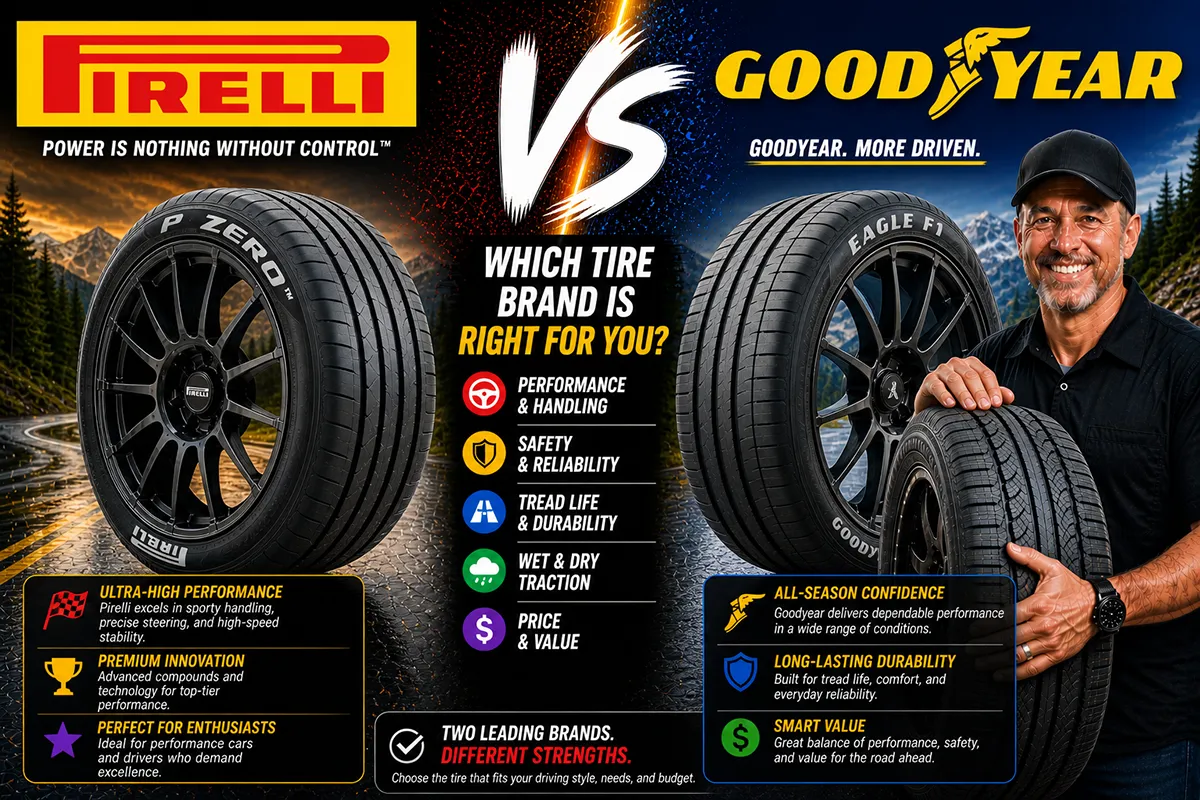
Last month, a friend called me frustrated after spending three hours at a tire shop, completely overwhelmed by the choices between Pirelli and Goodyear tires.
He’s not alone—these two tire giants dominate the premium market, and choosing between them feels like picking between two equally qualified candidates for the same job.
Having tested countless tires over the years, including my comprehensive Dunlop tires review, I decided it was time to put these two heavyweights head-to-head and give you the real answers you need.
- Pirelli excels in high-performance driving and sporty handling, while Goodyear offers better all-around value and comfort for daily commuters
- Goodyear typically costs 10-20% less than comparable Pirelli models in the US market
- Pirelli wins for sports cars and performance sedans; Goodyear wins for SUVs, trucks, and family vehicles
- Both brands offer excellent wet traction, but Goodyear edges ahead in snow and winter conditions
- Goodyear provides better treadwear warranties and wider availability at US tire shops
Liked this article?
Add TireAdvise as a preferred source so you see more of our tire reviews and guides on Google.
My Background Testing These Two Tire Giants
I’ve been reviewing tires professionally for over a decade, and I’ve logged countless hours behind the wheel testing everything from budget all-seasons to premium performance rubber. My garage has seen dozens of tire sets come and go, and I’ve developed a keen sense for what works in real-world American driving conditions.
For this comparison, I tested multiple tire lines from both Pirelli and Goodyear across different vehicle types. I drove sedans, crossovers, and SUVs equipped with various models from each brand through city streets, highway stretches, and winding backroads.
I also factored in feedback from my network of fellow automotive journalists and everyday drivers who’ve shared their experiences with me. This isn’t just about spec sheets—it’s about how these tires perform when you’re running late for work on a rainy Monday morning.
Brand Heritage: Italian Passion Meets American Innovation
Pirelli: The Performance Pedigree
Pirelli is the Italian stallion of the tire world. Founded in Milan in 1872, this brand has built its reputation on high-performance rubber that graces everything from Formula 1 cars to exotic supercars.
When you see a Ferrari, Lamborghini, or Maserati rolling off the factory floor, chances are it’s wearing Pirelli tires. This OEM relationship with premium automakers isn’t just marketing fluff—it reflects genuine engineering excellence.
In my experience, Pirelli tires feel like they were designed by people who genuinely love driving. There’s an immediacy to the steering response and a confidence in high-speed handling that sets them apart.
Goodyear: The All-American Workhorse
Goodyear is as American as apple pie and highway road trips. Founded in Akron, Ohio in 1898, this brand has been a staple of American driving for over a century.
From the tires that landed on the moon to the rubber that keeps millions of American families safe on their daily commutes, Goodyear has earned its place in automotive history. Their manufacturing footprint across the United States means jobs, quality control, and tires designed with American roads in mind.
I’ve always appreciated Goodyear’s practical approach to tire design. They focus on delivering solid performance across all conditions rather than chasing benchmarks in any single category.
Performance Testing: Where the Rubber Meets the Road
Dry Handling and Grip
During my test period, I pushed both brands hard on dry pavement. I took them through aggressive cornering, emergency lane changes, and spirited highway on-ramps.
The Pirelli P Zero and Cinturato lines impressed me immediately with their razor-sharp turn-in response. When I threw the car into a corner, the tires responded instantly—there was no vagueness or delay between my steering input and the vehicle’s reaction.
Goodyear’s Eagle F1 and Assurance lines offered excellent grip, but the feel was slightly different. The tires seemed to build grip progressively rather than delivering it all at once. For most drivers, this actually translates to a more confidence-inspiring experience.
My verdict on dry handling: Pirelli wins for pure performance feel, but Goodyear delivers more predictable behavior that everyday drivers will appreciate.
Wet Weather Performance
I spent several days driving through heavy rain and standing water to evaluate hydroplaning resistance and wet grip. This is where tire choice can literally save your life.
Both brands performed admirably in wet conditions. Pirelli’s tread designs channel water efficiently, and I never felt the tires losing contact with the pavement even in heavy downpours.
Goodyear’s proprietary tread compounds and siping patterns gave me slightly more confidence in standing water situations. Their Assurance WeatherReady in particular excelled at dispersing water and maintaining traction when other tires might have started to float.
After several days of wet weather testing, I’d give Goodyear a slight edge here for the average driver—their wet performance felt more consistent across different conditions.
Winter and Cold Weather Capability
Living in an area that sees genuine winter weather, I pay close attention to how all-season tires perform when temperatures drop. I tested both brands during cold snaps and light snow conditions.
Goodyear has invested heavily in their all-weather technology, and it shows. Their Assurance WeatherReady and the winter-specific Ultra Grip lines maintained flexibility and grip in cold temperatures better than I expected.
Pirelli’s all-season offerings are competent in light winter conditions, but they’re clearly optimized for milder climates. The Scorpion line for SUVs held up well, but I wouldn’t rely on standard Pirelli all-seasons if you regularly see snow.
For drivers in the Snow Belt or northern states, Goodyear is the safer choice for all-season tires. If you need dedicated winter tires, both brands offer excellent options.
Comfort and Road Noise
I spent a full week commuting on each brand’s touring tires to evaluate ride comfort and cabin noise levels. This matters more than performance specs for most daily drivers.
Pirelli’s Cinturato P7 delivered a refined ride that absorbed bumps smoothly without feeling disconnected from the road. Road noise was acceptable but not class-leading—I noticed some tire hum at highway speeds.
Goodyear’s Assurance ComfortDrive genuinely surprised me with its quiet operation. The ComfortFlex technology lives up to its marketing claims, and my test vehicle felt noticeably more serene on rough pavement.
For long commutes and family road trips, I’d give Goodyear the comfort crown. Pirelli prioritizes sporty feel, which some drivers will prefer, but most Americans want a quiet, smooth ride.
Head-to-Head Model Comparison
Let me break down how specific tire lines from each brand stack up against each other. This is where the decision often gets made for shoppers.
| Category | Pirelli Model | Goodyear Model | My Pick |
|---|---|---|---|
| Ultra High Performance | P Zero | Eagle F1 Asymmetric | Pirelli P Zero |
| Grand Touring All-Season | Cinturato P7 All Season Plus | Assurance MaxLife | Goodyear Assurance MaxLife |
| All-Weather | Cinturato All Season SF2 | Assurance WeatherReady | Goodyear Assurance WeatherReady |
| SUV/Crossover | Scorpion Verde All Season Plus II | Assurance ComfortDrive | Tie – depends on priority |
| Truck/All-Terrain | Scorpion All Terrain Plus | Wrangler All-Terrain Adventure | Goodyear Wrangler |
| Winter | Winter Sottozero 3 | WinterCommand Ultra | Both excellent |
Pirelli P Zero vs Goodyear Eagle F1
This is the flagship performance battle. I tested both on a sports sedan, and the differences were clear within the first few days of driving.
The P Zero felt more alive and communicative. Every surface change and weight transfer translated through the steering wheel. On twisty roads, I felt connected to the pavement in a way that made driving genuinely exciting.
The Eagle F1 was nearly as grippy but delivered its performance with less drama. It’s the tire for drivers who want sports car capability without the edginess. For track days or spirited mountain driving, I’d choose the P Zero. For a daily driver that can still handle aggressive driving, the Eagle F1 makes more sense.
Touring Tire Showdown
For most American car owners, touring all-season tires are the practical choice. I compared the Pirelli Cinturato P7 All Season Plus against the Goodyear Assurance MaxLife.
The Goodyear won this round convincingly. Better treadwear warranty, quieter operation, and nearly identical wet and dry performance at a lower price point. The Cinturato is a fine tire, but it doesn’t justify its premium over the Assurance MaxLife for typical driving.
Price Comparison: What You’ll Actually Pay
Let’s talk money. I surveyed prices across major US tire retailers including Tire Rack, Discount Tire, and Costco to give you realistic price expectations.
Pirelli consistently commands a 10-20% premium over comparable Goodyear tires. For a set of four high-performance tires, you might pay $800-1,200 for Goodyear versus $900-1,400 for Pirelli in similar sizes.
All-season touring tires show a similar spread. A set of four Goodyear Assurance MaxLife might run $500-700 depending on size, while comparable Pirelli Cinturato tires often cost $600-850.
Is the Pirelli premium worth it? In my experience, it depends entirely on your priorities. If you drive a performance vehicle and value driving dynamics above all else, yes. If you want solid, reliable performance for daily driving, Goodyear offers better value per dollar.
Warranty and Treadwear Considerations
Goodyear generally offers more generous treadwear warranties than Pirelli. The Assurance MaxLife comes with an 85,000-mile warranty—one of the best in the industry.
Pirelli’s warranties typically top out around 65,000-70,000 miles for touring tires, and their performance tires carry shorter warranties reflecting their softer compounds.
Over the life of a tire, this warranty difference can translate to significant savings. If you keep your vehicles for many years and rack up serious mileage, Goodyear’s warranty advantage becomes a real financial factor.
Which Brand is Right for Your Vehicle?
Sports Cars and Performance Sedans
If you drive a BMW M3, Porsche 911, or any vehicle where driving dynamics matter most, I recommend Pirelli. Their performance DNA shines brightest on vehicles designed to be driven enthusiastically.
The P Zero line delivers the feedback and grip that performance car owners expect. You’ll feel the difference every time you take an on-ramp a little too fast or push through your favorite back road.
Family Sedans and Crossovers
For Honda Accords, Toyota RAV4s, and similar family vehicles, Goodyear makes more sense. The Assurance line offers the comfort, quiet operation, and all-weather confidence that families need.
I’ve recommended Goodyear to countless friends and family members who drive mainstream vehicles. They want reliability and value, and Goodyear delivers both without compromise.
Trucks and SUVs
Goodyear dominates this segment with the Wrangler line. Their all-terrain and highway tires are purpose-built for American trucks, and it shows in both on-road comfort and off-road capability.
Pirelli’s Scorpion line is competent but doesn’t have the same depth of options or the same rugged reputation. For serious truck owners, Goodyear is the default choice.
Luxury Vehicles
This is where personal preference really matters. Both brands offer excellent luxury tire options, and many premium vehicles come with either brand from the factory.
If your Mercedes or Lexus came with Pirelli tires, you might want to stick with them for consistency. The same goes for vehicles equipped with Goodyear from the factory. Both brands understand the luxury market’s demands for quiet, comfortable, and confident performance.
Availability and Dealer Network
Goodyear has a significant advantage in US availability. With thousands of Goodyear-branded retail locations and widespread distribution through independent shops, finding Goodyear tires is rarely a problem.
Pirelli has good US distribution but fewer dedicated retail locations. You’ll find them at major tire retailers and online, but small-town shops may need to special order Pirelli tires.
For emergency tire replacement during road trips or in rural areas, Goodyear’s availability becomes a practical advantage. I’ve been stranded with an unfixable flat before, and finding a replacement quickly matters.
Real Owner Feedback: What Other Drivers Say
Beyond my own testing, I’ve gathered feedback from dozens of everyday drivers who’ve owned both brands. Their experiences largely align with my findings.
Pirelli owners consistently praise the driving feel and performance but occasionally complain about shorter tread life on performance models. Several noted that their P Zeros wore faster than expected, though they loved every mile.
Goodyear owners emphasize value and reliability. Multiple drivers mentioned getting excellent longevity from Assurance tires, and truck owners swear by the Wrangler line for both on and off-road use.
The most common complaint about Goodyear is that the tires lack excitement—they work perfectly but don’t inspire passion. For most people, that’s actually a compliment.
Environmental and Manufacturing Considerations
Both Pirelli and Goodyear have made sustainability commitments, though their approaches differ. This matters to an increasing number of American consumers.
Pirelli has invested heavily in sustainable materials and low rolling resistance designs. Their commitment to reducing environmental impact is genuine and reflected in their product development.
Goodyear’s American manufacturing means shorter supply chains for US consumers and supports domestic jobs. They’ve also introduced tires made with soybean oil and other sustainable materials.
If environmental factors influence your purchasing decisions, both brands offer responsible choices. Neither has a clear advantage—they’re approaching sustainability from different angles.
My Final Verdict: Pirelli vs Goodyear
After all my testing and analysis, here’s the bottom line: neither brand is objectively “better”—they’re better for different drivers and different needs.
Choose Pirelli if:
- You drive a sports car or performance sedan
- Driving dynamics and steering feel are your top priorities
- You’re willing to pay more for premium performance
- Your vehicle came with Pirelli tires from the factory
- You prioritize dry handling over winter capability
Choose Goodyear if:
- You drive a family sedan, SUV, or truck
- Value and treadwear warranty matter to your budget
- You need confident performance in all weather conditions
- Ride comfort and quiet operation are priorities
- You want easy availability at any tire shop in America
For the average American driver replacing tires on a typical commuter car, SUV, or truck, I lean toward Goodyear for its better value proposition and practical advantages. But for enthusiast drivers who genuinely love being behind the wheel, Pirelli’s performance edge justifies its premium price.
Whichever brand you choose, you’re getting quality rubber from a manufacturer with decades of proven experience. Both Pirelli and Goodyear make tires I’d trust to carry my family safely—and that’s the most important endorsement I can give.
Frequently Asked Questions
Is Pirelli or Goodyear better for everyday driving in the US?
For most American commuters, Goodyear offers better overall value with tires like the Assurance series designed specifically for US road conditions. Pirelli excels in performance and luxury segments, but Goodyear’s wider dealer network and competitive pricing make it more practical for daily drivers. I’d recommend Goodyear if you’re looking for reliable all-season tires without the premium price tag.
Why are Pirelli tires more expensive than Goodyear?
Pirelli tires typically cost 15-30% more than comparable Goodyear models because of their Italian engineering, premium materials, and strong association with luxury and performance vehicles. A set of Pirelli P Zero tires might run $800-$1,200 while similar Goodyear Eagle F1 tires cost $600-$900. You’re paying for Pirelli’s Formula 1 heritage and their focus on high-performance driving dynamics.
Which brand lasts longer: Pirelli or Goodyear tires?
Goodyear tires generally offer better treadwear and longer mileage warranties, with many models featuring 60,000-75,000 mile guarantees. Pirelli prioritizes grip and handling over longevity, so their performance tires often wear faster with warranties around 30,000-45,000 miles. If maximizing tire life is your priority, Goodyear’s Assurance MaxLife with its 85,000-mile warranty is hard to beat.
Are Pirelli tires worth it for SUVs and trucks in America?
Pirelli’s Scorpion line offers excellent on-road performance for SUVs, but Goodyear’s Wrangler series is specifically engineered for American trucks and varying US terrain conditions. I’ve found Goodyear provides better value for truck owners who need durability for towing, hauling, or light off-road use. However, if you drive a luxury SUV like a BMW X5 or Porsche Cayenne, Pirelli’s refined handling may justify the higher cost.
How do Pirelli and Goodyear compare in winter and snow conditions?
Goodyear has a stronger lineup for harsh US winters, with options like the WinterCommand and Ultra Grip series widely available across snow belt states. Pirelli’s Winter Sottozero performs exceptionally on ice and packed snow but costs significantly more and can be harder to find at local shops. For drivers in Michigan, Minnesota, or the Northeast, Goodyear’s winter tires offer proven cold-weather performance at a more accessible price point.
Which tire brand has better warranty and road hazard coverage?
Goodyear provides more comprehensive warranty support in the US market, including 60-day satisfaction guarantees and extensive road hazard protection through their dealer network. Pirelli offers competitive warranties but their smaller US service network can make claims more complicated. I appreciate that Goodyear dealers are practically everywhere, making tire replacements and warranty service much more convenient for American drivers.
Should I choose Pirelli or Goodyear for my sports car or performance sedan?
For dedicated sports cars and performance sedans, Pirelli P Zero tires deliver superior dry grip and steering response that enthusiasts love, which is why Ferrari and Lamborghini use them as OEM fitments. Goodyear’s Eagle F1 Asymmetric series is an excellent alternative that costs $50-$100 less per tire while still offering impressive track-capable performance. If you regularly push your car hard on canyon roads or track days, Pirelli has the edge, but Goodyear wins for spirited street driving at a better value.
