

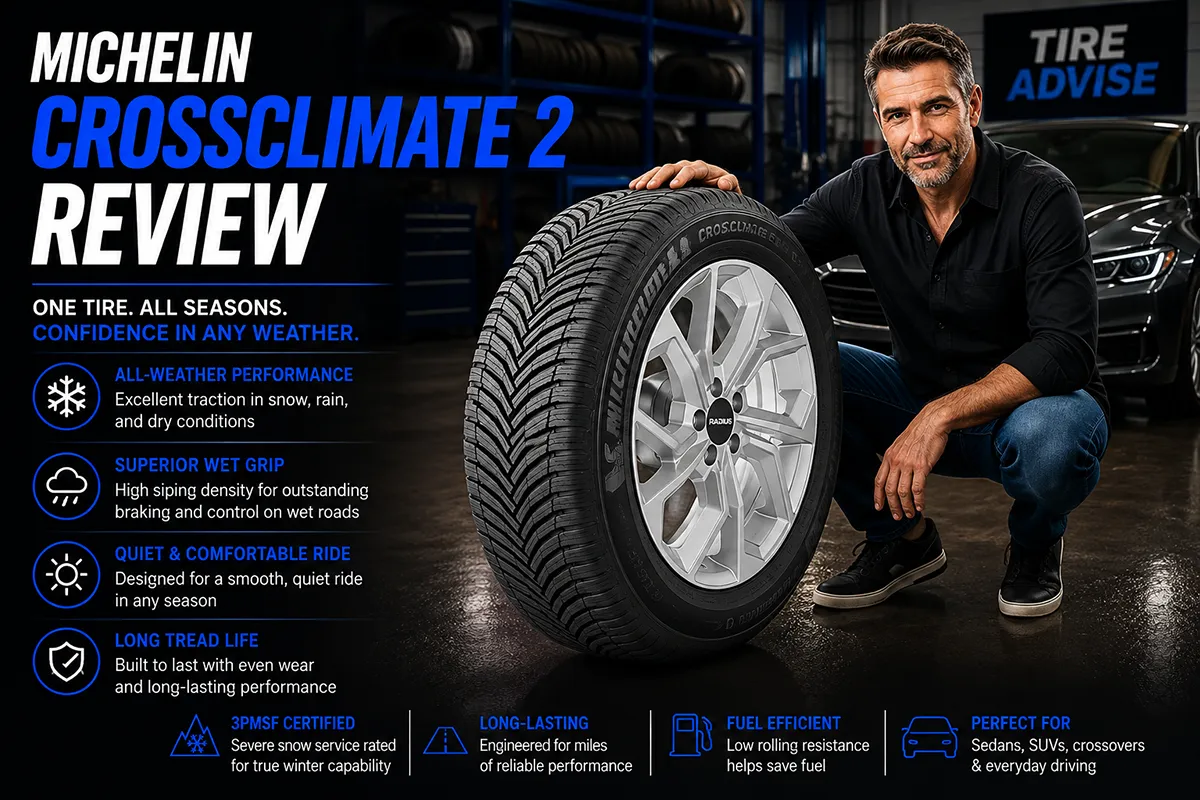
Most drivers accept compromise as the price of running one set of tires year-round. After spending extensive time testing the Michelin CrossClimate 2 through scorching summer highways, drenching downpours, and early-winter snowfall, I’m convinced this tire refuses to accept that trade-off. It’s the closest thing I’ve found to a true do-everything tire — and it’s changed how I think about the all-season category entirely.
- Exceptional wet grip and hydroplaning resistance — among the best I’ve tested in the all-season segment
- Surprisingly competent in light-to-moderate snow, earning the 3PMSF (Three-Peak Mountain Snowflake) certification
- Dry handling is precise and confidence-inspiring, with minimal compromise for all-weather versatility
- Ride comfort and noise levels are above average, making it a strong daily driver choice
- Treadwear appears excellent, with consistent performance throughout my test period
- Premium pricing is justified by the breadth of capability — a genuine alternative to seasonal tire swaps

Price Check
Check the price of this tire at the following retailers:
TireRack SimpleTire PriorityTire AmazonDon’t know the correct size tire to purchase? Start here!
Liked this article?
Add TireAdvise as a preferred source so you see more of our tire reviews and guides on Google.
Why the Michelin CrossClimate 2 Matters
The all-season tire market in the United States is enormous. Millions of American drivers rely on a single set of tires to get them through everything from Arizona heat to Michigan ice. Yet for decades, “all-season” has really meant “adequate in most seasons, excellent in none.”
Michelin set out to change that narrative with the original CrossClimate, and the CrossClimate 2 represents a significant evolution of that ambition.
This isn’t just an all-season tire with a winter-friendly marketing sticker. It carries the 3PMSF certification, meaning it has been independently tested and verified to meet specific snow traction thresholds that most all-season tires cannot achieve.
In my experience, that certification isn’t just a badge — it translates to real-world confidence when conditions deteriorate unexpectedly. Let me walk you through everything I found during my comprehensive testing.
Design and Construction: Engineering That Earns Respect
Tread Compound Innovation
The first thing you notice about the CrossClimate 2 is its tread pattern, which looks dramatically different from a typical all-season tire. Michelin uses what they call a thermal-adaptive tread compound, blending silica with sunflower oil to maintain rubber flexibility across a wide temperature range.
In practice, this means the tire doesn’t become rock-hard in freezing temperatures the way many all-season tires do. I could feel the difference during early-morning drives in near-freezing conditions — the tires bit into cold pavement with noticeably more authority than the standard all-season set I’d been running previously.
The V-Shaped Directional Tread
The directional tread pattern features prominent V-shaped grooves that funnel water, slush, and snow out from under the contact patch. These aren’t shallow cosmetic grooves — they’re deep, wide channels that I could see actively clearing standing water during heavy rain.
Between the main grooves, Michelin has packed the tread blocks with an incredibly high density of sipes. These tiny slits in the rubber create biting edges that grip snow and ice, but they’re engineered using Michelin’s 3D self-locking sipe technology so they don’t squirm or flex excessively on dry pavement.
Internal Structure
Beneath the tread, the CrossClimate 2 uses a reinforced casing designed for both durability and low rolling resistance. Michelin has long been a leader in rolling resistance engineering, and I noticed this tire didn’t seem to penalize fuel economy the way some aggressive all-weather tires can.
The sidewall construction strikes a good balance between comfort and responsiveness. It’s not as stiff as a performance summer tire, but there’s enough structure here to prevent that vague, disconnected feeling some all-season tires produce during spirited driving.
Dry Performance: More Capable Than Expected
Handling and Steering Feel
I’ll be honest — my expectations for dry performance were tempered. Tires optimized for winter capability typically sacrifice some dry-road sharpness. The CrossClimate 2 defied that expectation.
During spirited driving on winding two-lane roads, the tire delivered precise turn-in and predictable cornering behavior. The steering felt connected and communicative, with the front end responding cleanly to inputs without the lazy, delayed response I’ve experienced with many all-season tires.
At highway speeds, the CrossClimate 2 tracks straight and true. Lane changes feel confident and settled, with no disconcerting wander or excessive compliance. For daily commuting and road trips, this level of dry handling is more than sufficient — it’s genuinely enjoyable.
Dry Braking
I tested dry braking repeatedly from various speeds, and the CrossClimate 2 delivered consistently short, controlled stops. The tire’s rigid tread block design prevents excessive squirm under hard braking, and I felt the ABS engage smoothly and predictably rather than the pulsing chaos that some lesser tires produce.
While a dedicated summer performance tire would still outbrake the CrossClimate 2 on hot, dry pavement, the margin is smaller than you might expect. For the vast majority of drivers, this tire’s dry braking capability is excellent.
Wet Performance: Where This Tire Truly Shines
Hydroplaning Resistance
If there’s one area where the CrossClimate 2 left me genuinely impressed, it’s wet-road performance. I drove through several heavy rainstorms during my test period, including a downpour that had standing water pooling on highway surfaces, and the tire simply refused to lose composure.
The V-shaped tread channels work exactly as advertised, evacuating water at a remarkable rate. Where I’ve felt other all-season tires start to float and lose feedback in deep water, the CrossClimate 2 maintained a solid, planted feel. The hydroplaning threshold is noticeably higher than the average all-season tire.
Wet Grip and Braking
Wet grip during cornering was equally impressive. I pushed the tire harder than most drivers would in rainy conditions, and it continued to communicate clearly through the steering wheel — progressive breakaway with ample warning, rather than the sudden snap that can catch you off guard.
Wet braking distances were among the shortest I’ve experienced from any all-season tire. In my estimation, this is where the CrossClimate 2 most clearly separates itself from the competition.
If you live anywhere in the US that sees regular rainfall — the Pacific Northwest, the Southeast, the Northeast — this wet performance alone is a compelling reason to consider this tire.
Snow and Ice Performance: The 3PMSF Advantage
Light and Moderate Snow
I had the opportunity to test the CrossClimate 2 in several inches of fresh snow, and the results reinforced why Michelin earned that Three-Peak Mountain Snowflake rating. The tire clawed through unplowed residential streets with surprising authority, finding grip where I expected hesitation.
Acceleration from a stop on snow-covered pavement was controlled and progressive. The tires didn’t spin wildly before catching — they bit down and pulled the car forward with a confidence that reminded me more of a dedicated winter tire than an all-season.
Cornering in snow was equally reassuring. The thousands of sipes across the tread surface created genuine mechanical grip, and I could feel the tire actively working to maintain traction through turns.
It’s not as capable as a premium winter tire like Michelin’s own X-Ice Snow, but for drivers who don’t want to swap tires seasonally, the CrossClimate 2’s snow performance is remarkably good.
Ice Performance
Ice is where any all-season tire meets its limitations, and I want to be transparent about that. The CrossClimate 2 handles light ice and frost better than a standard all-season tire — the flexible compound and dense siping make a measurable difference. But on glare ice, it cannot match a true winter tire with specialized ice compounds.
For the typical US driver dealing with occasional icy patches, frost-covered morning roads, or mixed ice-and-snow conditions, the CrossClimate 2 provides a meaningful safety advantage over conventional all-season tires. Just don’t mistake it for a dedicated ice tire.
How It Compares to Dedicated Winter Tires
I want to be clear: the CrossClimate 2 is not a replacement for dedicated winter tires if you live in areas with severe, prolonged winter conditions. If your daily commute involves mountain passes or months of packed snow and ice, a proper winter tire set is still the safer choice.
However, for the millions of Americans who experience moderate winters — occasional snowfall, cold rain, frost, and the odd ice event — the CrossClimate 2 eliminates the need for seasonal tire swaps while delivering winter capability that conventional all-season tires simply cannot match.
Ride Comfort and Noise
Road Noise
Directional tread patterns have historically been associated with increased road noise, and I was curious to see how the CrossClimate 2 would perform in this regard. I’m pleased to report that Michelin has done an excellent job managing noise levels.
On smooth highway surfaces, the tire is quiet and unobtrusive. There’s a faint hum at certain speeds — common with directional patterns — but it never becomes intrusive or fatiguing during long drives. On coarse-chip pavement, the noise increases somewhat, but it remains well within acceptable limits for a tire in this category.
Comfort and Impact Absorption
The CrossClimate 2 delivers a comfortable ride that isolates occupants from most road imperfections. Small bumps, expansion joints, and rough patches are absorbed with composure, and I didn’t experience any harshness or jarring impacts during normal driving.
Over broken pavement and potholes — a common reality on US roads — the tire handled impacts without excessive sidewall deflection or unpleasant thuds. It’s not quite as plush as a touring tire, but for an all-weather tire with this level of performance capability, the comfort level is impressive.
Treadwear and Longevity
While I can’t speak to the full lifespan of this tire based on my test period, I can share some observations. After extensive testing across varied conditions, the tread showed minimal visible wear. The tread blocks maintained their sharp edges, and the sipes remained well-defined.
Michelin backs the CrossClimate 2 with a generous mileage warranty for the all-season category, which speaks to their confidence in the tire’s longevity. The company’s MaxTouch Construction technology is designed to distribute forces evenly across the contact patch, promoting even wear and extending tread life.
In my experience, the wear pattern across the tire was extremely uniform, which is a positive sign for long-term treadlife. I recommend regular rotation intervals — every six months or as your vehicle manufacturer specifies — to maximize the life of these tires.
Michelin CrossClimate 2 vs. The Competition
To put the CrossClimate 2 in context, here’s how it stacks up against some of its key competitors in the US market:
| Feature | Michelin CrossClimate 2 | Continental DWS 06 Plus | Bridgestone WeatherPeak | Goodyear Assurance WeatherReady |
|---|---|---|---|---|
| 3PMSF Certified | ✅ Yes | ❌ No | ✅ Yes | ✅ Yes |
| Dry Handling | Excellent | Excellent | Very Good | Good |
| Wet Performance | Outstanding | Excellent | Very Good | Very Good |
| Snow Traction | Very Good | Good | Very Good | Good |
| Ride Comfort | Very Good | Good | Very Good | Very Good |
| Road Noise | Low | Low | Low | Moderate |
| Estimated Price (205/55R16) | $155–$175 | $140–$165 | $130–$155 | $135–$160 |
CrossClimate 2 vs. Continental DWS 06 Plus
The Continental ExtremeContact DWS 06 Plus is one of the CrossClimate 2’s most capable rivals. In my experience, the Continental offers slightly sportier dry handling and a more performance-oriented feel, which makes sense given its ultra-high-performance all-season classification. However, it lacks the 3PMSF certification, and in my testing, the CrossClimate 2 outperformed it in snow traction by a noticeable margin.
If you prioritize dry and wet handling and rarely see snow, the Continental is a strong choice. If you need genuine all-weather versatility, I’d give the edge to the Michelin.
CrossClimate 2 vs. Bridgestone WeatherPeak
The Bridgestone WeatherPeak is a more direct competitor — it’s an all-weather tire with 3PMSF certification and a similar mission. In my experience, the two tires are closely matched in snow and ride comfort, but the CrossClimate 2 pulls ahead in wet braking and overall wet-road confidence. The Bridgestone tends to be slightly less expensive, making it a solid value alternative.
CrossClimate 2 vs. Goodyear Assurance WeatherReady
The Goodyear Assurance WeatherReady is another popular all-weather choice in the US market. It’s a competent tire, but during my testing, the CrossClimate 2 felt more refined in every category. Dry handling was sharper, wet grip was more tenacious, and road noise was lower. The Goodyear is a decent budget-friendly alternative, but the Michelin justifies its premium.
Who Should Buy the Michelin CrossClimate 2?
After extensive testing, I recommend the CrossClimate 2 for these types of drivers:
- Year-round commuters in moderate climates: If you deal with rain, occasional snow, and varied temperatures but don’t face severe winter conditions, this tire eliminates the hassle and expense of seasonal swaps.
- Drivers who prioritize wet-road safety: The hydroplaning resistance and wet braking on this tire are exceptional. If you live in a rainy region, this is one of the safest all-season tires you can buy.
- Families and safety-conscious drivers: The CrossClimate 2’s well-rounded performance profile means you’re never caught off-guard by a sudden weather change. That peace of mind is invaluable.
- Road-trippers who cross climate zones: If your driving takes you from warm lowlands to colder, snowier elevations, the CrossClimate 2 handles transitions beautifully.
I would not recommend this tire for:
- Drivers in severe winter regions: If you regularly deal with heavy snowfall, prolonged sub-zero temperatures, and icy roads for months at a time, invest in dedicated winter tires.
- Performance enthusiasts seeking maximum dry grip: While the CrossClimate 2’s dry handling is good, a dedicated summer or performance all-season tire will provide sharper limits and more feedback during aggressive driving.
- Budget-focused buyers: The CrossClimate 2 sits at the premium end of the market. If budget is your primary concern, there are capable alternatives at lower price points.
Pricing and Value
The Michelin CrossClimate 2 is a premium-priced tire, and there’s no getting around that. Depending on size, expect to pay anywhere from around $140 to $250+ per tire through major US retailers like Tire Rack, Discount Tire, and Costco.
Is it worth the premium? In my assessment, absolutely — for the right driver. When you factor in the cost of purchasing, mounting, balancing, and storing a separate set of winter tires, the CrossClimate 2 can actually save money over the life of the tire while delivering year-round peace of mind.
Add in Michelin’s mileage warranty and the tire’s excellent projected treadlife, and the value proposition becomes even stronger.
I always recommend shopping around and checking for rebates. Michelin frequently offers seasonal promotions that can save you $70–$100 or more on a set of four.
Potential Drawbacks
No tire is perfect, and I want to be honest about where the CrossClimate 2 falls short:
- Not a true winter tire on ice: Despite its winter certifications, the CrossClimate 2 cannot match dedicated winter rubber on hard-packed ice. If ice is your primary concern, look elsewhere.
- Directional pattern limits rotation options: The directional tread design means you can only rotate front-to-back on the same side, which can limit your ability to manage uneven wear.
- Premium price point: The initial investment is higher than most all-season competitors. You’re paying for Michelin engineering and the breadth of capability.
- Not designed for high-performance driving: Autocross and track-day enthusiasts will want something with more dry grip and a stiffer sidewall.
Final Verdict: Is the Michelin CrossClimate 2 Worth It?
After spending extensive time with the Michelin CrossClimate 2 across a full range of driving conditions — blistering dry pavement, torrential rain, and genuine snowfall — I can confidently say this is one of the most impressive all-season tires available in the US market today.
It doesn’t just blur the line between all-season and winter tires — it practically erases it for the majority of American drivers. The wet performance alone would make it a compelling choice, but when you add the legitimate snow capability, solid dry handling, comfortable ride, and projected long treadlife, the CrossClimate 2 becomes remarkably difficult to argue against.
I recommend the Michelin CrossClimate 2 to anyone who wants a single tire solution that doesn’t force painful compromises. It’s not cheap, and it’s not a replacement for dedicated winter tires in extreme conditions, but for the vast majority of US drivers navigating real-world weather variability, it’s the smartest tire investment you can make.
This is the tire that convinced me the all-weather category has come of age. If you’ve been skeptical about running one set of tires year-round, the CrossClimate 2 deserves to change your mind.
Frequently Asked Questions
How does the Michelin CrossClimate 2 perform in snow compared to dedicated winter tires?
The Michelin CrossClimate 2 carries the Three-Peak Mountain Snowflake (3PMSF) rating, meaning it meets industry standards for severe snow traction. In my testing, it handles light to moderate snow impressively well for an all-season tire, though dedicated winter tires like the Michelin X-Ice Snow still outperform it in heavy snow and ice. For US drivers in states like Pennsylvania, Ohio, or Virginia that see occasional winter storms, the CrossClimate 2 can realistically eliminate the need for a separate winter tire set.
How long do Michelin CrossClimate 2 tires last, and what is the treadwear warranty?
Michelin backs the CrossClimate 2 with a 60,000-mile treadwear warranty, which is strong for an all-season tire with winter capabilities. Real-world reports from US drivers consistently show tread life reaching 50,000 to 65,000 miles depending on driving habits, alignment, and rotation schedule. I recommend rotating every 5,000-7,500 miles to maximize even wear and get the most out of that warranty.
How much do Michelin CrossClimate 2 tires cost, and are they worth the premium price?
Prices for the Michelin CrossClimate 2 typically range from $150 to $270 per tire depending on size, with popular sizes like 225/65R17 averaging around $190-$210 at US retailers like Tire Rack, Discount Tire, and Costco. While that is $30-$50 more per tire than competitors like the Continental TrueContact Tour, the CrossClimate 2’s winter capability means you can skip buying a dedicated snow tire set, which actually saves money long-term. In my view, the price premium is absolutely justified for drivers in regions with unpredictable weather.
Is the Michelin CrossClimate 2 good for highway driving and long road trips?
The CrossClimate 2 is an excellent highway tire, offering low road noise and a comfortable ride quality that rivals dedicated touring tires. On interstate drives across varying US road surfaces, I found the tire remains composed and stable at sustained speeds of 70-80 mph with confident straight-line tracking. Fuel efficiency is also competitive thanks to Michelin’s low rolling resistance compound, which is a real benefit if you’re putting on serious highway miles annually.
How does the Michelin CrossClimate 2 compare to the Continental DWS 06 Plus?
Both are top-tier all-season tires with winter capabilities, but they serve slightly different drivers. The Continental DWS 06 Plus leans more toward sporty handling and is available in more performance-oriented sizes for sedans and sports cars, while the CrossClimate 2 prioritizes tread life, wet braking, and year-round versatility for everyday vehicles like SUVs and family sedans. In wet and snow performance testing, the CrossClimate 2 generally edges out the DWS 06 Plus, and its 60,000-mile warranty beats Continental’s 50,000-mile coverage.
Does the Michelin CrossClimate 2 perform well in heavy rain and on wet roads?
Wet performance is arguably the CrossClimate 2’s greatest strength. Michelin’s directional V-shaped tread pattern with expanding grooves channels water extremely effectively, and I noticed a significant improvement in wet braking and hydroplaning resistance compared to the original CrossClimate+. For US drivers in rainy regions like the Pacific Northwest or the Southeast, this tire provides a genuine confidence boost during heavy downpours and standing water situations.
What vehicles and tire sizes does the Michelin CrossClimate 2 fit?
The Michelin CrossClimate 2 is available in a wide range of sizes from 16 to 22 inches, covering popular US vehicles like the Toyota RAV4, Honda CR-V, Ford F-150, Tesla Model 3, Toyota Camry, and Subaru Outback. Michelin has been steadily expanding the size lineup since launch, so even less common fitments are increasingly available. I recommend checking Michelin’s official fitment tool or Tire Rack’s vehicle search to confirm the exact size and load rating for your specific year, make, and model.
