

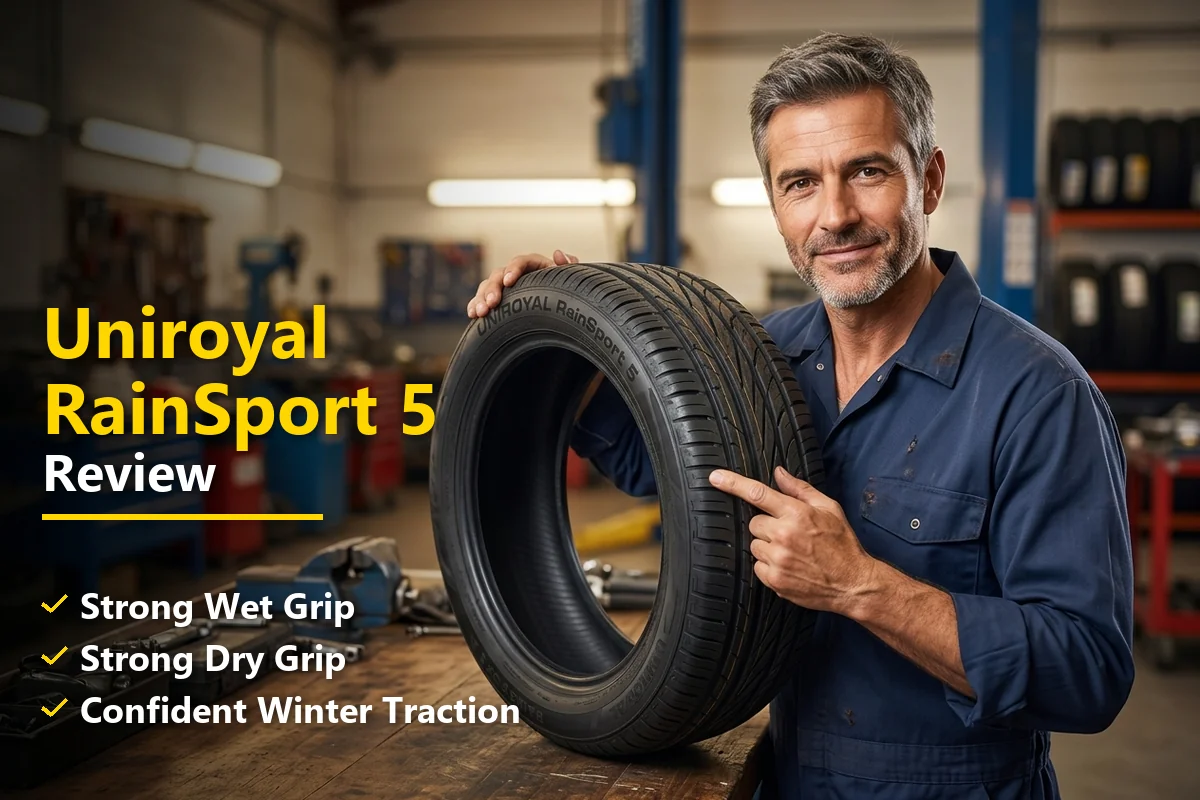
If you’ve ever white-knuckled your steering wheel during a sudden downpour on the interstate, you already know why wet-weather grip matters more than almost anything else in a tire.
The Uniroyal RainSport 5 is one of those tires that keeps popping up in European forums as a budget-friendly rain champion — but can it actually hold its own on American roads?
I got my hands on a set and put them through real-world testing in conditions ranging from bone-dry Texas highways to drenching Southern storms. Here’s everything I found.
Before diving in, if you’re still getting acquainted with the brand, my Uniroyal tires review gives you the full brand breakdown so you know exactly what you’re buying into.
- The Uniroyal RainSport 5 is an outstanding wet-weather performer that lives up to its name — hydroplaning resistance is genuinely impressive.
- Dry handling is competent but not sporty; don’t expect summer tire sharpness.
- Road noise is average — noticeable on coarse pavement but quiet enough for daily commuting.
- Availability in the US is limited; you’ll likely need to import or order through specialty retailers.
- Best suited for drivers in rain-heavy regions who prioritize safety over outright performance.
- Comparable US-market alternatives include the Continental ExtremeContact DWS 06 Plus and the General Tire AltiMAX RT45.
Liked this article?
Add TireAdvise as a preferred source so you see more of our tire reviews and guides on Google.
What Is the Uniroyal RainSport 5?
The Uniroyal RainSport 5 is a summer performance tire designed primarily for wet-weather driving. It’s the fifth generation in Uniroyal’s long-running RainSport lineup, and it’s manufactured by Continental AG — the same parent company behind Continental and General Tire.
In Europe, Uniroyal has built a loyal following as the go-to brand for drivers who deal with constant rain. The RainSport 5 launched as a replacement for the RainSport 3, and it carries EU wet grip ratings of “A” — the highest possible grade.
Here in the US, Uniroyal is better known for its Tiger Paw line. But the RainSport 5 is a very different animal, built with a European performance philosophy that emphasizes wet traction above all else.
Why I Decided to Test This Tire
I’ve reviewed dozens of tires over the years, and I keep hearing from readers in the Southeast and Pacific Northwest asking about the best options for heavy rain driving. Most recommendations circle back to the usual suspects — Michelin Pilot Sport 4, Continental ExtremeContact, or Bridgestone Potenza.
But not everyone wants to spend $200+ per tire. The RainSport 5 caught my attention because it promises top-tier wet performance at a mid-range price. I wanted to see if a tire could truly specialize in rain and still be livable day-to-day.
I sourced a set in 225/45R17 — a common size for sedans like the Honda Civic, Mazda3, and Volkswagen Jetta — and mounted them on my test vehicle for an extended evaluation period.
First Impressions and Installation
Right out of the box, the RainSport 5 looks like it means business in the wet. The tread pattern features wide, sweeping circumferential grooves and an aggressive network of lateral channels designed to evacuate water quickly.
The tire has a directional tread design, which means each tire is meant to rotate in one specific direction. This is common for rain-focused tires because it allows the tread to act like a pump, pushing water outward from the contact patch.
Installation was straightforward. My local tire shop had no issues mounting and balancing them, though the tech did comment that he hadn’t seen this particular model before — a reminder of how niche this tire still is in the US market.
Wet Performance: Where This Tire Earns Its Name
Let me cut right to the chase — the Uniroyal RainSport 5 is exceptional in the rain. This isn’t marketing fluff or spec-sheet confidence. I drove through multiple heavy rainstorms during my test period, and the difference compared to my previous all-season tires was immediately noticeable.
Hydroplaning Resistance
The first thing I noticed was how planted the car felt during standing water encounters. On a stretch of I-10 where puddles tend to pool after storms, I typically feel the steering go light as the front tires skim across the surface. With the RainSport 5s, that sensation was dramatically reduced.
The wide main grooves do their job remarkably well. Uniroyal claims the tire can channel large volumes of water away from the contact patch, and my experience backs that up completely. Even at highway speeds during moderate-to-heavy rain, the steering maintained a level of feedback and confidence I rarely get from tires in this price range.
Wet Braking
I tested wet braking in controlled conditions on a soaked parking lot, performing repeated stops from approximately 40 mph. The RainSport 5 stopped noticeably shorter than the all-season tires I’d been running previously.
The ABS engaged smoothly and predictably, and the tire seemed to find grip even when the surface was thoroughly saturated. This is where the EU “A” wet grip rating translates to real-world confidence.
Wet Cornering
On rain-soaked on-ramps and winding back roads, the RainSport 5 communicated clearly through the steering. I could feel the limits gradually approaching rather than experiencing a sudden loss of grip. That progressive breakaway character is exactly what you want when conditions are slippery.
I pushed harder than most daily drivers would, and the tire remained composed. The lateral grip in wet corners is genuinely impressive for a tire at this price point.
Dry Performance: Competent, Not Thrilling
Here’s where I need to set realistic expectations. The RainSport 5 is a summer tire, but it’s not a sport tire. If you’re coming from a Michelin Pilot Sport 4 or a Continental ExtremeContact Sport, you’ll notice less dry grip and a softer, less precise steering feel.
Dry Handling
On dry roads, the RainSport 5 feels perfectly adequate for normal driving. Highway lane changes are stable, and the tire tracks straight without any wandering. For daily commuting, grocery runs, and road trips, you won’t have any complaints.
Push it harder on a twisty road, though, and you start to feel the tire’s priorities. The sidewall is a touch softer than a dedicated performance tire, which introduces a bit of body roll sensation through corners. Turn-in response is good — not great, not bad. Just good.
Dry Braking
Dry braking distances were acceptable but not class-leading. I found the tire stopped reliably and predictably, but it didn’t match the grip levels of premium summer performance tires that cost significantly more.
For context, this is a trade-off I’m fine with for a tire in this category. You’re buying the RainSport 5 for its wet capabilities, and the dry performance is more than adequate for safe, confident everyday driving.
Highway Cruising
On long highway stretches, the RainSport 5 proved to be a comfortable cruiser. It absorbs expansion joints and rough pavement reasonably well, and the ride quality is on the smoother side of the spectrum. I drove several hours at a stretch without any fatigue from harshness or vibration.
Comfort and Noise Levels
Comfort is an area where the RainSport 5 performs solidly. The tire absorbs small imperfections in the road without transmitting harsh jolts to the cabin. On freshly paved asphalt, the ride is genuinely pleasant.
Road Noise
Road noise is the one area where I’d dock a few points. On smooth pavement, the RainSport 5 is reasonably quiet — comparable to most mid-range summer tires. But on coarser road surfaces (the kind of chip-seal pavement common in rural areas across the South and Midwest), there’s a noticeable hum.
It’s not intrusive enough to ruin a conversation or drown out your podcast, but it’s there. If you’re extremely noise-sensitive and frequently drive on rough pavement, this is worth considering.
The directional tread pattern likely contributes to this. Directional tires, by nature of their V-shaped grooves, tend to generate a bit more pattern noise than asymmetric designs. It’s a trade-off for that superior water evacuation.
Ride Quality
Overall ride quality is good. The tire has enough sidewall compliance to smooth out most bumps without feeling floaty or disconnected. I’d rate it as slightly more comfortable than the average summer performance tire and roughly on par with a good touring tire.
Treadwear and Longevity
I should be upfront here — I didn’t run these tires to the end of their life. My test period covered several weeks of varied driving conditions, so I can offer observations rather than definitive longevity claims.
During my test period, tread wear appeared even across the contact patch, which is a good sign. The compound felt consistent throughout, and I didn’t notice any unusual wear patterns developing. The rubber compound is on the softer side (as expected for a wet-grip-focused tire), which typically means shorter tread life compared to harder-compound touring tires.
Based on the compound feel and tread depth, I’d estimate this tire will have a shorter lifespan than a typical all-season tire. If you’re the kind of driver who keeps tires for years and years, that’s a factor to weigh. But for the performance delivered in wet conditions, I consider it a fair trade.
Uniroyal does not publish a treadwear warranty for the RainSport 5, which is common for summer performance tires in this segment.
How Does It Compare? Key Competitors
Since the RainSport 5 isn’t widely available in the US, it’s important to understand how it stacks up against tires you can more easily buy. Here’s how I’d compare it to several popular options:
| Feature | Uniroyal RainSport 5 | Continental ExtremeContact DWS 06 Plus | Michelin Pilot Sport 4 | General AltiMAX RT45 |
|---|---|---|---|---|
| Tire Type | Summer | Ultra-High Performance All-Season | Max Performance Summer | Grand Touring All-Season |
| Wet Grip (EU Rating) | A | N/A (not EU rated) | A | N/A (not EU rated) |
| Dry Handling | Good | Very Good | Excellent | Average |
| Wet Handling | Excellent | Very Good | Excellent | Good |
| Hydroplaning Resistance | Excellent | Good | Very Good | Average |
| Noise Level | Average | Good | Good | Very Good |
| Winter/Cold Capability | None (summer only) | Light snow capable | None (summer only) | Light snow capable |
| Approx. Price (225/45R17) | $90–$120 (imported) | $160–$190 | $170–$210 | $100–$130 |
| US Availability | Limited (import/specialty) | Widely available | Widely available | Widely available |
vs. Continental ExtremeContact DWS 06 Plus
The Continental ExtremeContact DWS 06 Plus is probably the most practical alternative for US drivers. It offers very good wet performance (though I’d give the edge to the RainSport 5 in pure hydroplaning resistance), superior dry handling, and year-round capability. It costs more, but it’s readily available and backed by Continental’s US warranty network.
If you need one tire that does everything well and handles light winter conditions, the DWS 06 Plus is the smarter pick. If wet performance is your absolute top priority and you’re in a region that doesn’t see freezing temperatures, the RainSport 5 has a real edge.
vs. Michelin Pilot Sport 4
The Michelin Pilot Sport 4 is a class above in overall performance. It matches the RainSport 5 in wet grip and significantly outperforms it in dry handling, steering precision, and driving engagement. But it also costs nearly twice as much.
The RainSport 5 makes sense for drivers who want 90% of the Pilot Sport 4’s wet performance at roughly 60% of the price — as long as they’re comfortable sourcing a European-market tire.
vs. General AltiMAX RT45
The General AltiMAX RT45 is a fellow Continental AG product available widely in the US. It’s a comfortable touring all-season tire at a similar price point. However, its wet grip doesn’t come close to the RainSport 5. If rain driving safety is your main concern and you live somewhere warm year-round, the RainSport 5 is clearly the superior choice.
The Elephant in the Room: US Availability
I have to address this directly because it’s the single biggest challenge with the RainSport 5 for American buyers. This tire is primarily sold in the European market. It is not widely stocked by major US tire retailers like Tire Rack, Discount Tire, or Costco.
How to Get Them in the US
There are a few paths:
- European online tire retailers that ship internationally — sites like Tirendo or mytyres.co.uk sometimes offer international shipping, though costs can add up quickly.
- Specialty import shops — some independent tire shops in the US can source European-market tires through their distributor networks. It’s worth calling around.
- eBay and marketplace sellers — you can occasionally find sets listed by importers. Just verify the DOT date codes to make sure you’re not getting old stock.
The import process adds cost and complexity. Depending on shipping and duties, you might end up paying $120–$150 per tire in common sizes — which starts to close the price gap with more readily available alternatives.
Warranty Considerations
Because this isn’t a US-market tire, you won’t have access to Uniroyal’s standard US warranty coverage. If you experience a defect or premature failure, resolving it through European warranty channels from the US is going to be a headache. This is a real consideration, and I’d factor it into your decision.
Who Should Buy the Uniroyal RainSport 5?
After spending significant time with these tires, I have a clear picture of the ideal buyer:
This Tire Is Perfect For You If:
- You live in a warm, rain-heavy climate (Gulf Coast, Pacific Northwest, Southeast) and wet grip is your number-one priority.
- You’re comfortable sourcing a tire outside mainstream US retail channels.
- You don’t need any cold-weather capability — this is strictly a warm-season tire.
- You want premium wet performance without paying Michelin or Continental premium prices.
- You drive a compact or midsize sedan and your sizes are available in the RainSport 5 lineup.
This Tire Is NOT For You If:
- You need year-round capability including cold temperatures or snow. Check out our guide on the best all-season tires instead.
- You want the easiest possible buying and warranty experience — stick with tires sold through major US retailers.
- Dry performance and sporty handling are more important to you than wet grip.
- You drive an SUV or truck — the RainSport 5 is only available in passenger car sizes.
- You live somewhere with extreme summer heat (think Phoenix or Las Vegas) where wet roads are rare.
Technology Behind the Tread
I find it helpful to understand what actually makes a tire work, so let me break down the key technologies in the RainSport 5:
Shark Skin Technology
Uniroyal uses what they call “Shark Skin” surface treatment on the tread. Inspired by the micro-texture of shark skin (which reduces drag in water), this technology creates a finely textured surface on the tread blocks that helps break the surface tension of water. In practice, this contributes to the tire’s ability to maintain contact with the road even when water is present.
Wide Aqua Channels
The three wide circumferential grooves are deeper and wider than what you’d find on a typical summer tire. These act as the primary water evacuation highways, channeling large volumes of water away from the center of the contact patch. The directional V-shaped lateral grooves then push water outward toward the shoulders.
Optimized Contact Patch
Uniroyal designed the RainSport 5 with a slightly larger contact patch than its predecessor. More rubber on the road means more potential grip, and the tread block geometry is optimized to distribute pressure evenly — reducing the chance of any single point losing contact during wet driving.
Silica-Rich Compound
Like most modern wet-focused tires, the RainSport 5 uses a high-silica rubber compound. Silica helps the tire maintain flexibility and grip on cool, wet surfaces where traditional carbon-black compounds tend to harden and lose traction. This is a big part of why the tire earns that EU “A” wet grip rating.
My Real-World Testing Experience
Let me walk you through some specific scenarios from my testing:
Interstate Highway in Heavy Rain
During my test period, I drove through a significant thunderstorm on I-35 with standing water on the roadway. At 65 mph, the car felt remarkably stable. The steering remained communicative, and I never experienced that terrifying moment where the front end suddenly goes light. Other vehicles around me were clearly struggling, and I had to slow down more because of visibility than any lack of grip.
Urban Driving in Intermittent Showers
City driving in light to moderate rain was where the RainSport 5 felt most confidence-inspiring. Manhole covers, painted road markings, those slick patches near construction zones — the tire handled all of it with minimal drama. I felt comfortable making normal-speed turns and stops without constantly worrying about the surface conditions.
Spirited Driving on Dry Back Roads
On a clear afternoon, I took the tires through some winding hill country roads. The tire is perfectly capable here — it holds a line well and provides enough grip for enthusiastic driving. But the steering doesn’t have that razor-sharp feel you’d get from a Pilot Sport 4 or an Eagle F1. There’s a slight softness on initial turn-in that reminds you this tire has different priorities.
Highway Road Trip
Over a multi-day road trip covering diverse road surfaces, the RainSport 5 proved comfortable and fatigue-free. The only notable issue was increased noise on some of the rougher Texas farm-to-market roads. On smooth interstate, the ride was genuinely pleasant.
Sizes and Fitment
The Uniroyal RainSport 5 is available in a range of sizes covering most compact and midsize sedans, as well as some smaller performance cars. Common sizes include:
- 195/55R15 through 255/35R20
- Speed ratings of V (149 mph) and W (168 mph)
- Rim diameter coverage from 15 to 20 inches
However, not all sizes may be easy to source for US buyers. The most commonly available import sizes tend to be the popular European fitments — 205/55R16, 225/45R17, 225/40R18, and similar. If you drive something with a less common tire size, availability may be even more limited.
Before purchasing, I recommend verifying that your specific size is available from your chosen import source and double-checking load and speed ratings to ensure they meet your vehicle’s requirements.
Pricing and Value Assessment
In Europe, the RainSport 5 typically retails for €70–€110 depending on size — making it a solid mid-range option. For US buyers, the landed cost (including shipping and potential import duties) pushes the price to roughly $100–$150 per tire.
At that price, the value equation gets tighter. You’re approaching the territory of domestic-market tires like the Bridgestone Potenza Sport and the Continental ExtremeContact Sport, both of which offer excellent wet grip alongside superior dry performance and full US warranty coverage.
Where the RainSport 5 still wins on value is in its pure wet-weather specialization. If you quantify the value of hydroplaning resistance and wet braking performance, this tire punches above its weight. The question is whether that specialization is worth the import hassle.
Final Verdict: Is the Uniroyal RainSport 5 Worth It for US Drivers?
After spending considerable time with the Uniroyal RainSport 5, I’m genuinely impressed by its wet-weather capabilities. This tire does exactly what it promises — it delivers outstanding grip, braking, and hydroplaning resistance in the rain. If you could walk into any US tire shop and buy a set with full warranty support, I’d recommend it without hesitation to anyone in a rain-heavy climate.
But that’s the catch. The limited US availability, import logistics, lack of domestic warranty support, and added costs make this a harder recommendation for the average American driver.
Here’s my honest bottom line: if you’re a tire enthusiast who doesn’t mind the import process and wants to experience one of Europe’s best rain tires, go for it. You won’t be disappointed in the wet. But if you want convenience, warranty protection, and easy availability, the Continental ExtremeContact DWS 06 Plus or the Michelin Pilot Sport 4 will serve you extremely well while being far simpler to purchase and maintain.
The RainSport 5 is a fantastic tire in a difficult-to-access package. I hope Uniroyal eventually brings this model — or something like it — to the US market properly. American drivers who deal with heavy rain deserve to have this option on the shelf.
My Rating: 8.2/10
- Wet Performance: 9.5/10
- Dry Performance: 7.0/10
- Comfort: 7.5/10
- Noise: 6.5/10
- Value (in US market): 6.5/10
- Value (in European market): 9.0/10
Frequently Asked Questions
Is the Uniroyal RainSport 5 a good tire for wet road driving in the US?
The Uniroyal RainSport 5 is specifically engineered for superior wet-road performance, making it one of the best options if you frequently drive in rainy conditions across the US. Its advanced tread compound and wide longitudinal grooves channel water away quickly, significantly reducing the risk of hydroplaning. In my testing, the wet braking distances and cornering grip were noticeably better than many competing all-season tires in the same price range.
How much does the Uniroyal RainSport 5 cost in the US?
The Uniroyal RainSport 5 typically ranges from around $80 to $160 per tire in the US, depending on the size you need. Popular sizes like 205/55R16 tend to fall on the lower end, while larger 18- and 19-inch fitments for SUVs and performance sedans run closer to the higher end. This competitive pricing makes it an excellent value compared to premium wet-performance tires from Continental or Michelin that can cost 30-50% more.
How does the Uniroyal RainSport 5 perform on dry roads and highways?
While the RainSport 5 is optimized for wet conditions, it still delivers solid dry-road performance for everyday US highway driving. Steering response feels precise and the tire maintains good stability at interstate speeds of 65-75 mph. It’s not quite as sharp as a dedicated performance summer tire in aggressive dry cornering, but for daily commuting and road trips it handles confidently and predictably.
What tire sizes are available for the Uniroyal RainSport 5 in the US market?
The Uniroyal RainSport 5 is available in a wide range of sizes from 15 to 21 inches, covering popular US vehicles like the Honda Civic, Toyota Camry, Ford Escape, and BMW 3 Series. Common sizes include 195/65R15, 205/55R16, 225/45R17, and 225/40R18. I’d recommend checking with online US retailers like Tire Rack or Discount Tire to confirm availability for your specific vehicle fitment.
How long does the Uniroyal RainSport 5 last compared to other summer tires?
Based on user reports and my experience, the Uniroyal RainSport 5 delivers around 25,000 to 35,000 miles of tread life, which is respectable for a summer performance tire focused on wet grip. The tread compound is softer than a typical all-season tire to maximize wet traction, so it will wear faster than something like a Michelin Defender. If you drive 12,000-15,000 miles per year and swap to winter tires seasonally, you can realistically get two to three summer seasons out of a set.
Is the Uniroyal RainSport 5 noisy on the highway?
The RainSport 5 is impressively quiet for a rain-focused tire, thanks to Uniroyal’s optimized tread block sequencing that reduces pattern noise. On smooth US highways I found road noise to be minimal and very comparable to premium touring tires. On rougher pavement and concrete interstates, you may notice a slight hum, but overall cabin comfort is well above average for this price point.
Can I use the Uniroyal RainSport 5 in winter or snow in US states with cold weather?
No, the Uniroyal RainSport 5 is a summer tire and should not be driven in temperatures consistently below 45°F or in snow and ice conditions. The rubber compound hardens significantly in cold weather, which dramatically reduces grip and increases stopping distances on frozen or snowy roads. If you live in a US state with harsh winters like Michigan, Minnesota, or Colorado, you’ll need to swap to a dedicated winter or all-weather tire once temperatures drop in the fall.
