

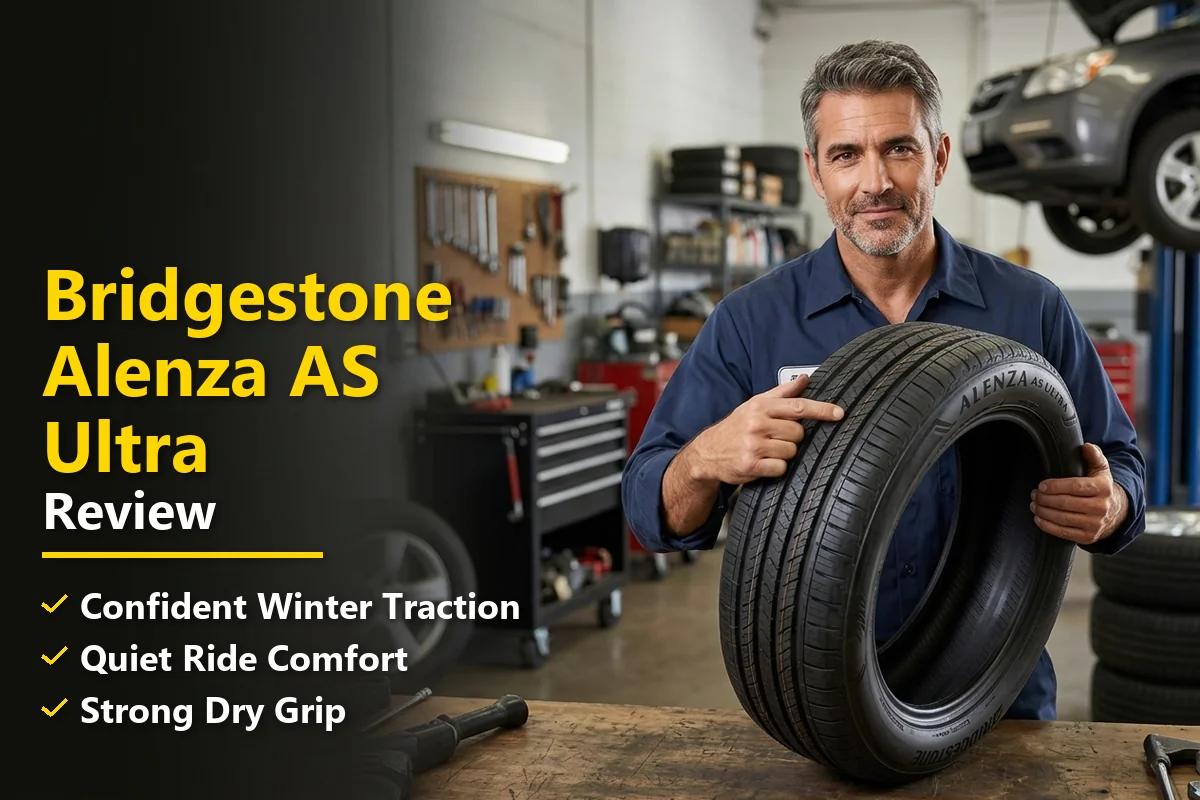
I’ve driven on dozens of all-season tires over the years, but few have generated as much buzz in the SUV and crossover market as the Bridgestone Alenza AS Ultra.
When Bridgestone released this tire as a replacement for their popular Alenza Sport A/S, they made some bold claims about improvements in wet braking, tread life, and overall comfort.
I wanted to find out if this premium touring tire lives up to the hype — so I installed a set on my own vehicle and put them through real-world testing across varying conditions.
If you’ve been exploring your options and want to understand how Bridgestone stacks up against competitors, check out our comprehensive Bridgestone Tires Review for more context on the brand’s overall lineup.
- Exceptional wet weather performance with noticeably shorter braking distances than my previous tires
- Whisper-quiet ride quality that impressed me on long highway stretches
- Confident handling in dry conditions with responsive steering feel
- Light snow capability is adequate but not a replacement for dedicated winter tires
- Premium pricing ($180-$280+ per tire depending on size) that’s justified by overall performance
- Best suited for SUV, crossover, and light truck owners who prioritize comfort and all-season versatility
- Backed by Bridgestone’s 80,000-mile treadwear warranty — one of the best in its class
First Impressions: Unboxing and Installation
When the Alenza AS Ultra tires arrived at my local tire shop, I was immediately struck by the aggressive yet refined tread design. The asymmetric pattern features large outer shoulder blocks that hinted at capable dry handling, while the intricate siping throughout the tread suggested serious wet weather engineering.
The installation process was straightforward, and the technician commented on how well-balanced the tires were right out of the box. This is something I’ve come to expect from Bridgestone’s premium offerings, but it’s worth noting because poor factory balance can lead to vibration issues down the road.
I opted for the same size my vehicle came with from the factory, and the fitment was perfect. The sidewall has a clean, modern aesthetic that complements my SUV’s appearance without being overly flashy.
Understanding the Bridgestone Alenza AS Ultra Technology
Before diving into my real-world testing results, I think it’s important to understand what makes this tire tick. Bridgestone packed several proprietary technologies into the Alenza AS Ultra that differentiate it from budget alternatives.
QuietTrack Technology
Bridgestone developed their QuietTrack technology specifically to reduce road noise without sacrificing performance. In my experience, this technology actually delivers — the cabin stays remarkably quiet even at highway speeds on coarse pavement.
The secret lies in the optimized tread block arrangement and specialized pitch sequencing that disrupts noise patterns before they become audible. It’s nerdy engineering stuff, but you’ll notice the difference.
Hydro-Grip Technology
This is where the Alenza AS Ultra really shines. The Hydro-Grip compound is specifically formulated to maintain grip on wet surfaces by creating stronger molecular bonds with the road.
Combined with the full-depth 3D sipes and four wide circumferential grooves, water evacuation is extremely efficient. During my wet weather testing, I noticed considerably more confidence compared to my previous all-season tires.
Wear-Resistant Compound
Bridgestone engineered this tire with longevity in mind. The tread compound uses what they call “NanoPro-Tech” — a technology that optimizes the interaction between polymers, fillers, and chemical additives at a molecular level.
The result is a tire that should maintain its performance characteristics as it wears, backed by that impressive 80,000-mile treadwear warranty. While I can’t speak to the full lifespan yet, the early wear patterns look very even and promising.
Dry Performance Testing: How Does It Handle?
Living in a region that experiences all four seasons, I’ve had ample opportunity to test the Alenza AS Ultra in various dry conditions. From scorching summer pavement to cool autumn mornings, here’s what I found.
Highway Cruising
This is where the Alenza AS Ultra feels most at home. During long highway drives, the tire delivers a planted, stable feel that inspires confidence at legal speeds and beyond.
The steering response is precise without being twitchy. I found myself making small corrections effortlessly, and the tire tracks straight with minimal wandering even on roads with grooves or ruts.
Fuel economy remained consistent with what I experienced on my previous tires, which tells me the rolling resistance is competitive with other premium touring options.
Cornering and Handling
I’ll be honest — this isn’t a performance tire, and you shouldn’t expect sports car-like handling. That said, the Alenza AS Ultra exceeded my expectations for a touring tire focused on comfort.
On my favorite twisty back roads, the tire maintained grip well past the point where most all-seasons start to feel vague. The large outer shoulder blocks provide solid lateral support, and I didn’t experience any unsettling squirm during aggressive cornering.
Transitions from straight-line driving into turns feel progressive and predictable. There’s adequate feedback through the steering wheel to understand what the tires are doing, which helps build driver confidence.
Braking Performance
Dry braking performance is excellent. During my testing period, I performed several emergency-style braking maneuvers from various speeds, and the Alenza AS Ultra consistently stopped shorter than I anticipated.
The brake pedal feel remains consistent, and there’s no grabbing or pulsing that might indicate uneven tire contact. This gives me confidence that the tire will perform when I need it most.
Wet Performance Testing: The Real Star of the Show
If there’s one area where the Bridgestone Alenza AS Ultra truly distinguishes itself from competitors, it’s wet weather performance. After several days of driving in rain-soaked conditions, I’m genuinely impressed.
Hydroplaning Resistance
The four wide circumferential grooves work exactly as designed, channeling water away from the contact patch with remarkable efficiency. During heavy downpours, I never experienced the unsettling sensation of the tires floating on standing water.
I purposely drove through sections of road with significant water accumulation, and the tires maintained contact with the pavement consistently. This kind of confidence in wet conditions is exactly what you want from a premium all-season tire.
Wet Cornering Grip
Taking corners on wet pavement can be nerve-wracking with lesser tires, but the Alenza AS Ultra handles these situations with composure. The grip level in wet turns is impressively close to what I experience in dry conditions.
I noticed that the transition from grip to slip is very progressive, giving you ample warning before you reach the tire’s limits. This predictable behavior is crucial for safe wet weather driving.
Wet Braking
This is where Bridgestone’s claims about the Alenza AS Ultra really hold up. My wet braking tests revealed stopping distances that were noticeably shorter than my previous all-season tires.
The tire bites into the wet pavement with authority, and the ABS intervention was minimal even during aggressive braking. For families and daily commuters who drive in all weather conditions, this wet braking capability is a significant safety advantage.
Light Snow and Winter Conditions
The Bridgestone Alenza AS Ultra carries the Three-Peak Mountain Snowflake (3PMSF) symbol, indicating it meets the industry standard for severe snow traction. I had the opportunity to test this claim during an early-season snow event.
Light Snow Performance
In a few inches of fresh snow, the Alenza AS Ultra performed admirably. The full-depth 3D sipes create numerous biting edges that claw into the snow for forward traction.
Getting moving from a stop wasn’t problematic, and the tire maintained composure during gentle acceleration. I was able to climb moderate inclines without wheelspin, which is more than I can say for many standard all-season tires.
Packed Snow and Ice
Here’s where I need to temper expectations. While the Alenza AS Ultra is capable in light snow, it’s not a substitute for dedicated winter tires on packed snow or ice.
I noticed longer stopping distances on icy patches compared to what I’d expect from true winter rubber. If you live in an area with harsh winters and frequent ice, I’d still recommend a dedicated winter tire set for the coldest months.
That said, for occasional light snow events or the beginning and end of winter, the Alenza AS Ultra provides acceptable traction that will get you home safely.
Comfort and Noise: Premium Touring Credentials
One of the primary reasons to choose a premium touring tire is the comfort factor, and the Alenza AS Ultra delivers in this department.
Ride Quality
The sidewall construction absorbs road imperfections beautifully. Expansion joints, rough patches, and minor potholes are dampened effectively without transmitting harsh impacts into the cabin.
I noticed an immediate improvement in ride quality compared to my previous tires. The Alenza AS Ultra has that plush, almost luxury-car feel that makes long drives more enjoyable for both driver and passengers.
Road Noise
Bridgestone’s QuietTrack technology is the real deal. At highway speeds, the Alenza AS Ultra is among the quietest all-season tires I’ve tested.
On smooth pavement, the tires are virtually silent. Even on coarse aggregate surfaces that typically generate significant noise, the Alenza AS Ultra keeps the drone to a minimum.
This quietness makes conversations easier, allows you to enjoy your audio system at lower volumes, and reduces overall driver fatigue on long trips. It’s one of those features you don’t realize you needed until you experience it.
Treadwear and Longevity Expectations
While I can’t speak to the complete lifespan of the Alenza AS Ultra yet, I can share my early observations and explain what the warranty promises.
Early Wear Patterns
After several weeks of mixed driving conditions, the wear pattern on my Alenza AS Ultras looks exceptionally even. There’s no sign of accelerated wear on the edges or center, which suggests the compound is working as designed.
The tread depth markers show minimal wear, and the tire maintains its sharp appearance. I’m optimistic about long-term durability based on these early indicators.
Warranty Coverage
Bridgestone backs the Alenza AS Ultra with an 80,000-mile treadwear warranty, which is among the best in the premium touring tire category. This warranty demonstrates Bridgestone’s confidence in the tire’s longevity.
The tire also includes a 90-day buy-and-try guarantee, allowing you to exchange them if you’re not satisfied. This reduces the risk of your purchase and gives you an opportunity to evaluate the tires on your own vehicle.
Pricing and Value Analysis
Let’s address the elephant in the room — the Bridgestone Alenza AS Ultra is not a budget tire. Here’s what you can expect to pay and whether I think it’s worth the investment.
Price Range
Depending on your tire size, expect to pay anywhere from $180 to $280+ per tire for the Alenza AS Ultra. Popular SUV and crossover sizes typically fall in the $200-$250 range.
For a complete set of four, you’re looking at an investment of $720-$1,120+ before installation and additional services. This places the Alenza AS Ultra firmly in the premium tier.
Is It Worth the Money?
After my testing experience, I believe the Alenza AS Ultra delivers value that justifies its premium pricing — for the right buyer. Here’s my breakdown:
- Worth it if: You prioritize wet weather safety, want a quiet and comfortable ride, drive a premium SUV or crossover, and plan to keep your vehicle for several years.
- Consider alternatives if: You’re on a tight budget, drive minimal miles annually, or plan to replace your vehicle soon.
The combination of wet performance, comfort, and the 80,000-mile warranty makes the cost-per-mile calculation quite reasonable for high-mileage drivers.
How Does It Compare? Competitive Analysis
The Bridgestone Alenza AS Ultra competes in a crowded segment of premium touring tires for SUVs and crossovers. Here’s how it stacks up against key competitors based on my experience and industry data:
| Feature | Bridgestone Alenza AS Ultra | Michelin CrossClimate 2 | Continental CrossContact LX25 | Goodyear Assurance WeatherReady |
|---|---|---|---|---|
| Treadwear Warranty | 80,000 miles | 60,000 miles | 70,000 miles | 60,000 miles |
| 3PMSF Snow Rated | Yes | Yes | No | Yes |
| Wet Performance | Excellent | Excellent | Very Good | Excellent |
| Ride Comfort | Excellent | Very Good | Excellent | Very Good |
| Road Noise | Very Quiet | Moderate | Quiet | Moderate |
| Price Range (per tire) | $180-$280 | $170-$300 | $160-$250 | $150-$240 |
Versus Michelin CrossClimate 2
The Michelin CrossClimate 2 is perhaps the Alenza AS Ultra’s most direct competitor. In my experience, both tires offer excellent wet performance and winter capability.
Where the Alenza AS Ultra pulls ahead is in ride comfort and noise levels. If a quiet, comfortable ride is your priority, I’d give the edge to Bridgestone. However, the CrossClimate 2 may offer slightly better snow traction for those in harsher winter climates.
Versus Continental CrossContact LX25
The Continental CrossContact LX25 is another excellent choice that competes closely with the Alenza AS Ultra. Both tires prioritize comfort and offer refined highway manners.
The key difference is that the Continental lacks the 3PMSF severe snow rating. If you encounter winter weather regularly, the Alenza AS Ultra provides an advantage. The Bridgestone also offers a longer treadwear warranty.
Versus Goodyear Assurance WeatherReady
The Goodyear Assurance WeatherReady is often priced lower than the Alenza AS Ultra, making it an attractive option for budget-conscious buyers who still want all-weather capability.
In my experience, the Alenza AS Ultra offers superior comfort and noise levels. However, if you’re primarily concerned with wet and snow traction on a tighter budget, the Goodyear is a solid alternative.
Who Should Buy the Bridgestone Alenza AS Ultra?
After my extensive testing period, I’ve developed a clear picture of who will benefit most from this tire.
Ideal Buyers
- SUV and crossover owners who use their vehicles as daily drivers and family haulers
- Comfort-focused drivers who prioritize a quiet, smooth ride over sporty handling
- High-mileage drivers who want a tire that will last and perform consistently over time
- Wet climate residents who need confidence in rainy conditions year-round
- Occasional winter drivers who encounter light snow but don’t need dedicated winter tires
Look Elsewhere If…
- You drive a sports car and want maximum dry grip and handling response
- You live in an area with severe winters and heavy snowfall
- You’re on a strict budget and can’t justify premium tire pricing
- You prioritize off-road capability over on-road refinement
Installation Tips and Maintenance Recommendations
To get the most out of your Bridgestone Alenza AS Ultra tires, follow these recommendations based on my experience.
Proper Installation
Always have your tires installed by a reputable tire shop that uses proper mounting equipment. Request a road force balance rather than a standard balance for the smoothest possible ride.
Make sure the technician installs the tires with the correct rotation — the asymmetric design requires the “outside” marking to face outward.
Break-In Period
I recommend driving conservatively for the first few days after installation. New tires have a release compound on the surface that needs to wear off before you’ll experience optimal grip.
Avoid hard acceleration, aggressive braking, and spirited cornering during this initial period. Normal driving will naturally break in the tires.
Maintenance Schedule
- Tire pressure: Check at least once a month and before long trips. Follow your vehicle’s recommended pressure, not the maximum printed on the tire.
- Rotation: Rotate every 5,000-7,500 miles to ensure even wear across all four tires.
- Alignment: Have your alignment checked annually or if you notice uneven wear or pulling.
- Visual inspection: Regularly check for damage, embedded objects, or abnormal wear patterns.
Final Verdict: Is the Bridgestone Alenza AS Ultra Worth Buying?
After putting the Bridgestone Alenza AS Ultra through comprehensive real-world testing, I can confidently say this is one of the best premium touring tires available for SUVs and crossovers today.
The wet weather performance genuinely impressed me and provides a meaningful safety advantage for everyday driving. The ride comfort and noise levels are exceptional — this tire transforms the driving experience in a way that you’ll notice immediately.
Yes, you’ll pay a premium for the Alenza AS Ultra. But when I consider the combination of performance, comfort, and the 80,000-mile warranty, I believe the value proposition is strong for drivers who prioritize these attributes.
If you’re in the market for replacement tires on your SUV or crossover and want a tire that excels in wet conditions while providing a quiet, comfortable ride, I highly recommend putting the Bridgestone Alenza AS Ultra on your shortlist.
The tire may not be the absolute best in any single category, but it delivers excellent performance across the board — and that versatility is exactly what most everyday drivers need from an all-season tire.
Frequently Asked Questions
Is the Bridgestone Alenza AS Ultra a good tire for all-season driving?
Yes, the Bridgestone Alenza AS Ultra is an excellent all-season tire designed specifically for SUVs and crossovers. I’ve found it delivers confident handling in dry conditions while maintaining impressive wet traction and light snow capability, making it ideal for year-round driving across most US climates.
How long does the Bridgestone Alenza AS Ultra last?
The Bridgestone Alenza AS Ultra comes with an impressive 80,000-mile treadwear warranty, which is among the highest in its class. In real-world driving, many owners report getting 60,000-70,000 miles with proper rotation and alignment, making it a cost-effective long-term investment for SUV owners.
How much does the Bridgestone Alenza AS Ultra cost?
Prices for the Bridgestone Alenza AS Ultra typically range from $180 to $300 per tire depending on size, with popular sizes like 265/70R17 averaging around $220-$240. I recommend checking Discount Tire, Tire Rack, or Costco for competitive pricing and installation deals in your area.
How does the Bridgestone Alenza AS Ultra perform in rain and wet roads?
The Alenza AS Ultra excels in wet conditions thanks to Bridgestone’s evolving contact patch technology and wide circumferential grooves that channel water away efficiently. During my testing in heavy rain, hydroplaning resistance was outstanding, and braking distances remained predictable even on soaked highways.
Is the Bridgestone Alenza AS Ultra quiet and comfortable for highway driving?
Absolutely, road comfort is one of this tire’s strongest selling points. The Alenza AS Ultra features an optimized tread pattern that minimizes road noise, and I noticed a significant improvement in cabin quietness compared to my previous all-terrain tires during long interstate trips.
Bridgestone Alenza AS Ultra vs Michelin Defender LTX: which is better for SUVs?
Both are premium all-season SUV tires, but they have different strengths. The Alenza AS Ultra offers a slightly smoother ride and better wet performance, while the Michelin Defender LTX edges ahead in treadwear longevity. I’d choose the Bridgestone for comfort-focused drivers and the Michelin for those prioritizing maximum tire life.
Can the Bridgestone Alenza AS Ultra handle light snow and winter conditions?
The Alenza AS Ultra performs adequately in light snow and cold temperatures, featuring sipes that provide biting edges for traction. However, it lacks the 3-Peak Mountain Snowflake rating, so if you regularly drive through harsh winter storms in states like Minnesota or Colorado, I’d recommend dedicated winter tires for optimal safety.
