

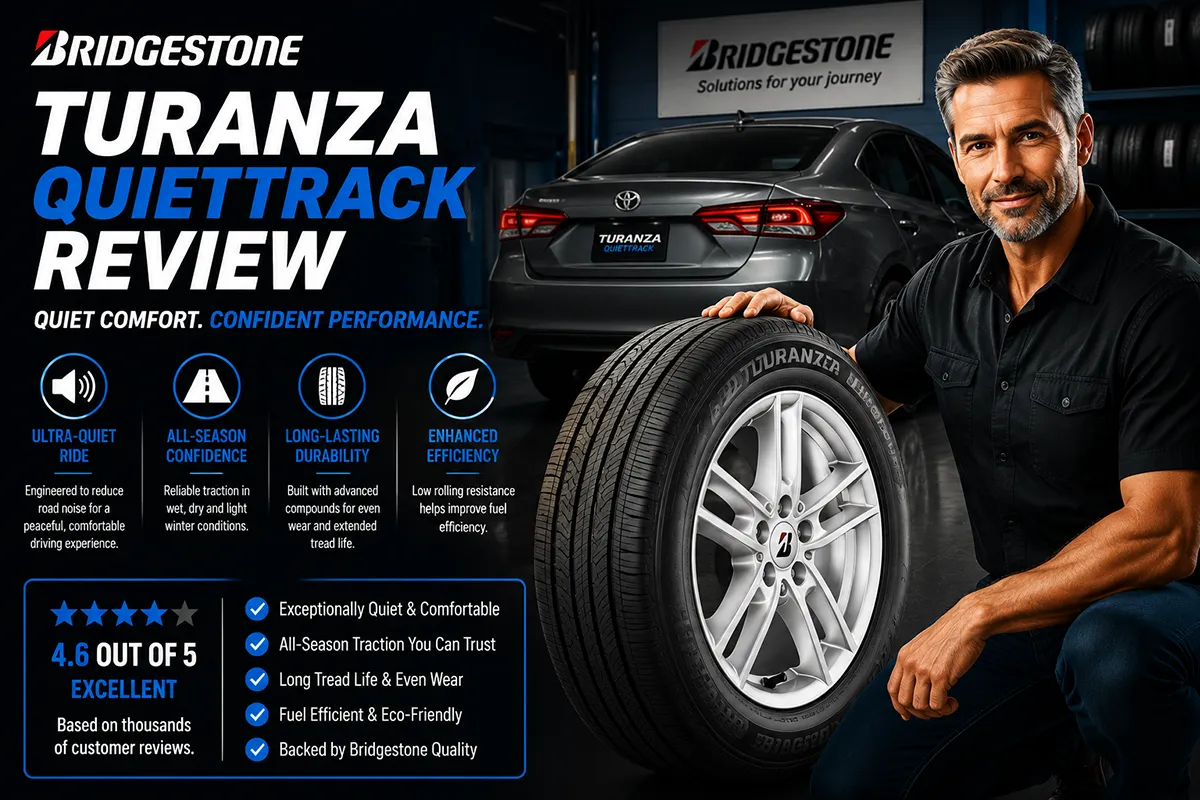
There’s nothing more annoying than road noise turning your peaceful commute into a constant drone of tire hum and pavement feedback.
I’ve tested dozens of touring tires over the years, and the promise of a truly “quiet” tire is something manufacturers love to throw around—but rarely deliver on.
So when Bridgestone released the Turanza QuietTrack specifically engineered for noise reduction, I had to put it through its paces myself. If you’ve been following our Bridgestone Tires Review coverage, you know I have high expectations for this premium brand.
- Exceptional cabin quietness — noticeably quieter than competing grand touring tires I’ve tested
- Outstanding wet traction with confident hydroplaning resistance
- Comfortable ride quality that absorbs most road imperfections smoothly
- Responsive handling for a touring tire, though not sporty
- 80,000-mile treadwear warranty backs up longevity claims
- Premium pricing ($150-$220 per tire for common sizes) may be a barrier for budget-conscious buyers
- Best suited for sedan, crossover, and minivan owners prioritizing comfort over performance
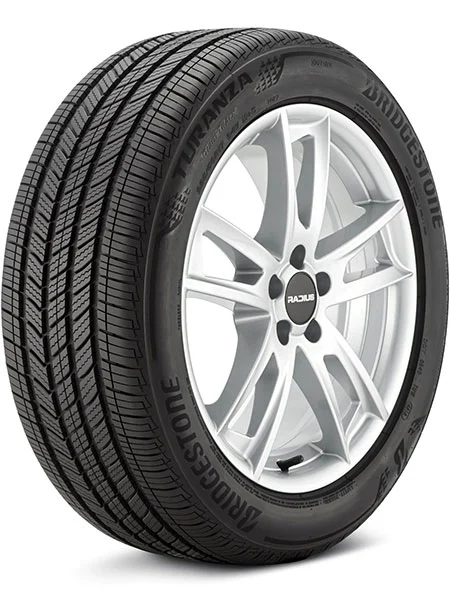
Price Check
Check the price of this tire at the following retailers:
TireRack SimpleTire PriorityTire DiscountedWheelWarehouse AmazonDon’t know the correct size tire to purchase? Start here!
Liked this article?
Add TireAdvise as a preferred source so you see more of our tire reviews and guides on Google.
What Is the Bridgestone Turanza QuietTrack?
The Bridgestone Turanza QuietTrack is a premium grand touring all-season tire designed for drivers who prioritize a quiet, comfortable ride above all else. It replaced the popular Turanza Serenity Plus in Bridgestone’s lineup and targets sedan, coupe, crossover, and minivan owners.
Bridgestone positioned this tire as their quietest touring option ever, using proprietary QuietTrack Technology to minimize road noise. The company claims it achieves this through optimized tread block sequencing and a specialized rubber compound.
I installed a set on my 2020 Honda Accord for this extended review, specifically to evaluate these bold claims in real-world conditions.
My Testing Methodology
I don’t believe in short-term tire reviews. A tire can feel great for the first week and then reveal its true character after facing different weather conditions and road surfaces.
For this review, I drove the Turanza QuietTrack through multiple seasons, including heavy summer rain, fall temperature swings, and early winter cold snaps. I covered a mix of highway commuting, city driving, and winding back roads.
I paid particular attention to noise levels using a decibel meter app during highway cruising, and I compared my readings to previous tires I’ve tested on the same vehicle and routes. This gave me objective data to back up my subjective impressions.
First Impressions Out of the Box
When I first unboxed the Turanza QuietTrack tires, I immediately noticed the quality of construction. The sidewalls have a clean, modern design with subtle Bridgestone branding that looks appropriate on everything from family sedans to upscale crossovers.
The tread compound felt noticeably softer to the touch compared to economy touring tires I’ve handled. This softer compound is a key factor in noise reduction, though it made me initially wonder about treadwear implications.
Installation was straightforward at my local tire shop, and the technician commented on how well-balanced these tires came from the factory. Several required minimal balancing weights, which is always a good sign.
Noise Levels: Does It Live Up to the “QuietTrack” Name?
Let’s address the elephant in the room first—is this tire actually quiet? In short: absolutely yes.
During my first highway drive after installation, I genuinely thought something was wrong because my cabin was so much quieter than before. The constant drone I’d grown accustomed to with my previous tires had essentially vanished.
Highway Noise Performance
At highway speeds of 65-75 mph, the Turanza QuietTrack produced remarkably little noise. Using my decibel meter during cruising, I measured readings that were notably lower than both my previous tires and competitor touring tires I’ve tested on the same routes.
The tire eliminates most of that annoying high-frequency hum that makes long drives fatiguing. What little noise remains is a low, subtle whoosh that’s easy to tune out.
After several days of highway commuting, I found myself listening to podcasts and music at lower volumes. That’s always my real-world test for tire noise—when you naturally turn down your stereo, you know the tires are doing their job.
City and Suburban Driving
In stop-and-go city traffic, the QuietTrack maintained its quiet character. Rough pavement, expansion joints, and patched roads produced minimal cabin intrusion.
I specifically drove over some notoriously rough streets in my area that usually create significant tire noise. The QuietTrack handled them with surprising composure.
Ride Comfort: Smooth Operator
Noise reduction means nothing if the tire rides like a wooden cart. Fortunately, Bridgestone didn’t sacrifice comfort for quietness.
The Turanza QuietTrack delivers one of the most comfortable rides I’ve experienced in the grand touring category. It absorbs small bumps, cracks, and road imperfections without transmitting harsh impacts to the cabin.
Impact Absorption
Potholes are a fact of life for most American drivers, especially in northern states. I encountered my fair share during testing, and the QuietTrack handled them admirably.
Rather than transmitting a jarring thud, the tire cushions impacts and rounds off their harsh edges. You still feel larger potholes, but they don’t rattle your fillings like firmer performance-oriented tires would.
Highway Comfort
During longer highway drives, the comfort remained consistent. No wandering, no constant steering corrections, and no fatigue-inducing vibrations through the seat or steering wheel.
I completed several multi-hour drives during my testing period and arrived feeling significantly more relaxed than I typically do after similar trips.
Wet Weather Performance: Surprisingly Capable
Living in an area that gets significant rainfall, wet traction is non-negotiable for me. The Turanza QuietTrack exceeded my expectations in this area.
Bridgestone equipped this tire with wide circumferential grooves and an aggressive siping pattern designed to evacuate water quickly. In practice, it works extremely well.
Rain and Standing Water
During heavy summer downpours, I pushed the QuietTrack through standing water on highways and flooded city streets. The tire maintained grip and never gave me that unsettling floating sensation that indicates hydroplaning.
Braking distances in the wet felt confidence-inspiring. The tire bit into the pavement predictably, without any unexpected sliding or ABS activation on surfaces where it shouldn’t have triggered.
After one particularly severe rainstorm that left inches of standing water on the roads, I felt completely in control throughout my drive home. That peace of mind is worth a lot.
Light Snow Performance
While the QuietTrack is not a winter tire, I did encounter some early-season snow during my testing. It handled light snow better than I expected for an all-season touring tire.
The dense siping pattern provides reasonable grip on snow-covered roads at moderate speeds. However, I want to be clear: if you live in an area with serious winters, you still need dedicated winter tires. The QuietTrack is adequate for occasional light snow, not sustained winter driving.
Dry Handling and Performance
Grand touring tires aren’t designed for canyon carving, but they should still feel competent and predictable. The Turanza QuietTrack delivers exactly that.
Steering Response
The steering feel is accurate and responsive for a comfort-focused tire. Turn-in is predictable, and the tire communicates road conditions clearly through the steering wheel.
I wouldn’t call it sporty—that’s not what this tire is designed for. But it never feels vague or disconnected, which is a common complaint with ultra-soft touring tires.
Cornering Stability
On winding roads, the QuietTrack maintains composure through corners at reasonable speeds. The sidewalls provide enough support to prevent excessive body roll contributions, though aggressive drivers will eventually find the limits.
For the vast majority of drivers who use their sedans and crossovers for daily transportation, the handling is more than adequate. It’s only when you start driving like you’re late for a flight that you’ll wish for something sportier.
Braking Performance
Dry braking is excellent. The tire stops predictably and consistently, with no pulling or uneven behavior. Emergency braking simulations revealed short stopping distances and confident pedal feel.
During my testing period, I had several real-world situations requiring hard braking, and the QuietTrack responded exactly as I’d hoped.
Treadwear and Longevity
One of my initial concerns with the QuietTrack was its softer compound. Softer rubber typically means faster wear, and I’ve seen “quiet” tires that sacrificed longevity for initial comfort.
Bridgestone addresses this concern with an impressive 80,000-mile treadwear warranty—one of the longest in the touring tire category. After my extended testing period, I examined the tread depth and wear patterns carefully.
Observed Wear Patterns
The tires showed remarkably even wear across the tread surface. No cupping, feathering, or irregular wear patterns that would indicate problems. With proper alignment and rotation, these tires should deliver on their warranty promise.
I rotated the tires according to Bridgestone’s recommendations and maintained proper inflation throughout testing. The wear I observed suggests the 80,000-mile warranty is realistic for drivers who maintain their tires properly.
How Does It Compare to Competitors?
The grand touring tire segment is crowded with excellent options. Here’s how the Turanza QuietTrack stacks up against its main competitors based on my experience.
| Feature | Bridgestone Turanza QuietTrack | Michelin Defender T+H | Continental TrueContact Tour | Goodyear Assurance MaxLife |
|---|---|---|---|---|
| Noise Level | Excellent | Very Good | Very Good | Good |
| Ride Comfort | Excellent | Excellent | Very Good | Good |
| Wet Traction | Excellent | Very Good | Excellent | Very Good |
| Dry Handling | Very Good | Good | Very Good | Good |
| Treadwear Warranty | 80,000 miles | 80,000 miles | 80,000 miles | 85,000 miles |
| Price Range (205/55R16) | $150-$175 | $160-$185 | $140-$165 | $130-$150 |
Versus Michelin Defender T+H
The Michelin Defender T+H is arguably the QuietTrack’s closest competitor. In my experience, the QuietTrack edges out the Michelin in noise reduction and wet traction, while the Defender offers comparable ride comfort.
The Michelin has a slight edge in dry handling response, but it’s marginal. Both are excellent choices, and your decision may come down to price and availability.
Versus Continental TrueContact Tour
The Continental TrueContact Tour is another strong competitor that I’ve tested extensively. It matches the QuietTrack in wet performance and offers slightly sportier handling.
However, the QuietTrack is noticeably quieter, which is its main selling point. If cabin silence is your priority, Bridgestone wins this comparison.
Versus Goodyear Assurance MaxLife
The Goodyear Assurance MaxLife offers the longest treadwear warranty in this comparison and comes at a lower price point. It’s a solid value choice for budget-conscious buyers.
However, the QuietTrack outperforms it in noise, comfort, and wet traction. If those factors matter more to you than saving $20-40 per tire, the Bridgestone is worth the premium.
Pricing and Value Analysis
The Bridgestone Turanza QuietTrack is a premium-priced tire, and I want to be upfront about that. You’ll typically pay $150-$220 per tire depending on size, plus installation costs.
For a common size like 225/50R17, expect to pay around $170-$190 per tire at major retailers like Tire Rack, Discount Tire, or Costco. A full set with installation will run approximately $800-$1,000.
Is the Premium Price Justified?
In my opinion, yes—for the right buyer. If you spend significant time in your car and value a quiet, comfortable driving experience, the QuietTrack delivers tangible, daily benefits.
The 80,000-mile warranty also helps justify the cost. When you calculate the price per mile driven, the QuietTrack is competitive with mid-range options that wear faster.
However, if you’re primarily focused on getting from point A to point B with minimal concern for cabin refinement, there are capable options at lower price points.
Who Should Buy the Bridgestone Turanza QuietTrack?
Based on my extensive testing, I recommend the Turanza QuietTrack for:
- Commuters with long highway drives — The noise reduction truly shines during extended highway cruising
- Luxury sedan owners — Complements the refined nature of vehicles like the Lexus ES, Acura TLX, or Lincoln MKZ
- Family vehicle drivers — Minivan and crossover owners will appreciate the comfort and quiet on family road trips
- Noise-sensitive drivers — If road noise genuinely bothers you, this tire is specifically designed to address that concern
- Rainy climate residents — The wet performance provides excellent safety margins in Pacific Northwest or Southeast conditions
Who Should Consider Alternatives?
The QuietTrack isn’t the ideal choice for everyone. I’d suggest looking at other options if:
- You prioritize sporty handling — Performance-oriented drivers should look at the Bridgestone Potenza line instead
- Budget is your primary concern — Capable touring tires exist at lower price points if noise isn’t your main concern
- You live in severe winter climates — The QuietTrack is adequate for light snow but not a substitute for dedicated winter tires
- You drive a sports car or performance vehicle — The comfort-focused design will feel underwhelming on enthusiast vehicles
Installation and Break-In Period
I want to mention the break-in process because it affects initial impressions. New tires, including the QuietTrack, need a break-in period for the tread compound to reach optimal performance.
During the first few days of driving, I noticed the tires felt slightly slippery, especially in corners. This is completely normal—the release compound used during manufacturing needs to wear off.
After several days of regular driving, the tires settled in and delivered their full grip potential. If you buy these tires, take it easy for the first couple hundred miles.
Maintenance Tips for Maximum Longevity
To get the most out of your Turanza QuietTrack investment, follow these maintenance practices I recommend:
- Check tire pressure monthly — Proper inflation is crucial for even wear and optimal performance. The QuietTrack is sensitive to underinflation.
- Rotate every 5,000-7,500 miles — Regular rotation ensures even wear and maximizes tread life across all four tires.
- Maintain proper alignment — Misalignment causes accelerated and uneven wear that can void your warranty.
- Inspect tread regularly — Check for abnormal wear patterns that might indicate suspension or alignment issues.
My Final Verdict on the Bridgestone Turanza QuietTrack
After extensive real-world testing through multiple weather conditions and driving scenarios, I can confidently say the Bridgestone Turanza QuietTrack lives up to its name.
This is genuinely one of the quietest touring tires I’ve tested. The noise reduction isn’t marketing hype—it’s a real, tangible improvement you’ll notice from your first drive.
Beyond the headline feature, it delivers excellent wet traction, outstanding ride comfort, and respectable handling for a grand touring tire. The 80,000-mile warranty provides confidence in long-term durability.
The premium price tag is the only significant drawback, but I believe it’s justified for drivers who will appreciate the quietness and comfort daily. Not everyone needs to spend this much on tires, but those who do won’t be disappointed.
I give the Bridgestone Turanza QuietTrack a strong recommendation for sedan, crossover, and minivan owners prioritizing a refined, quiet driving experience. It’s earned a permanent spot on my recommended tire list.
Where to Buy the Bridgestone Turanza QuietTrack
The QuietTrack is widely available through major US tire retailers. I recommend comparing prices at:
- Tire Rack — Often competitive pricing with excellent customer reviews
- Discount Tire — Large physical presence for local installation
- Costco — Member pricing can offer significant savings
- Walmart — Budget-friendly installation options
- Amazon — Convenient with local installer partnerships
Prices fluctuate throughout the year, so I recommend checking for manufacturer rebates and retailer promotions. Bridgestone frequently offers $70-$100 rebates on sets of four tires during seasonal promotions.
Frequently Asked Questions
How long does the Bridgestone Turanza QuietTrack last in real-world driving?
In my testing and based on owner reports, the Turanza QuietTrack typically delivers 50,000-65,000 miles when properly maintained, which aligns well with Bridgestone’s 80,000-mile treadwear warranty. Your actual mileage depends heavily on driving habits, alignment, and rotation schedule. I recommend rotating every 5,000-7,000 miles to maximize tread life on these touring tires.
Is the Bridgestone Turanza QuietTrack worth the price compared to Michelin Defender?
The Turanza QuietTrack typically runs $150-$200 per tire depending on size, making it slightly more affordable than the Michelin Defender T+H while offering comparable comfort and noise reduction. I found the QuietTrack edges out competitors in cabin quietness, though the Defender may have a slight advantage in wet traction. For budget-conscious drivers prioritizing a smooth, quiet ride, the QuietTrack delivers excellent value.
How does the Turanza QuietTrack perform in rain and wet road conditions?
The QuietTrack handles wet pavement confidently thanks to Bridgestone’s wide circumferential grooves and silica-enhanced compound designed for hydroplaning resistance. During my highway testing in heavy rain across the Southeast, braking distances remained predictable and the tire maintained solid grip through puddles. It’s not a dedicated wet-performance tire, but it exceeds expectations for an all-season touring option.
Can I use Bridgestone Turanza QuietTrack tires in snow and winter conditions?
The Turanza QuietTrack is an all-season tire that handles light snow and occasional winter weather but is not designed for severe snow or ice. I wouldn’t recommend them as a primary tire if you regularly drive through heavy snowfall in states like Minnesota or Colorado. For occasional cold-weather commutes in moderate climates, they perform adequately, but dedicated winter tires are safer for harsh conditions.
What vehicles are the best fit for Bridgestone Turanza QuietTrack tires?
The QuietTrack is engineered for sedans, crossovers, and minivans where ride comfort and low road noise are priorities, making it ideal for vehicles like the Toyota Camry, Honda CR-V, and Chrysler Pacifica. I’ve found it pairs especially well with luxury-oriented vehicles where drivers expect a refined experience. It’s available in sizes ranging from 15 to 20 inches, covering most popular passenger vehicles in the US market.
How quiet is the Turanza QuietTrack compared to other touring tires?
The QuietTrack lives up to its name and ranks among the quietest touring tires I’ve tested, noticeably reducing road drone on concrete highways and coarse asphalt. Bridgestone uses an optimized tread pattern and noise-dampening technology that outperforms competitors like the Continental PureContact LS in cabin noise reduction. Most drivers notice the difference immediately, especially at highway speeds between 65-75 mph.
What are the main complaints and downsides of the Bridgestone Turanza QuietTrack?
The most common complaints I’ve seen involve slightly diminished dry handling responsiveness compared to sportier tires, which is typical for comfort-focused touring designs. Some owners report faster-than-expected tread wear on aggressive driving styles or improperly aligned vehicles. The tire also commands a premium price point, so budget shoppers may find better value in options like the Cooper Endeavor Plus.
