

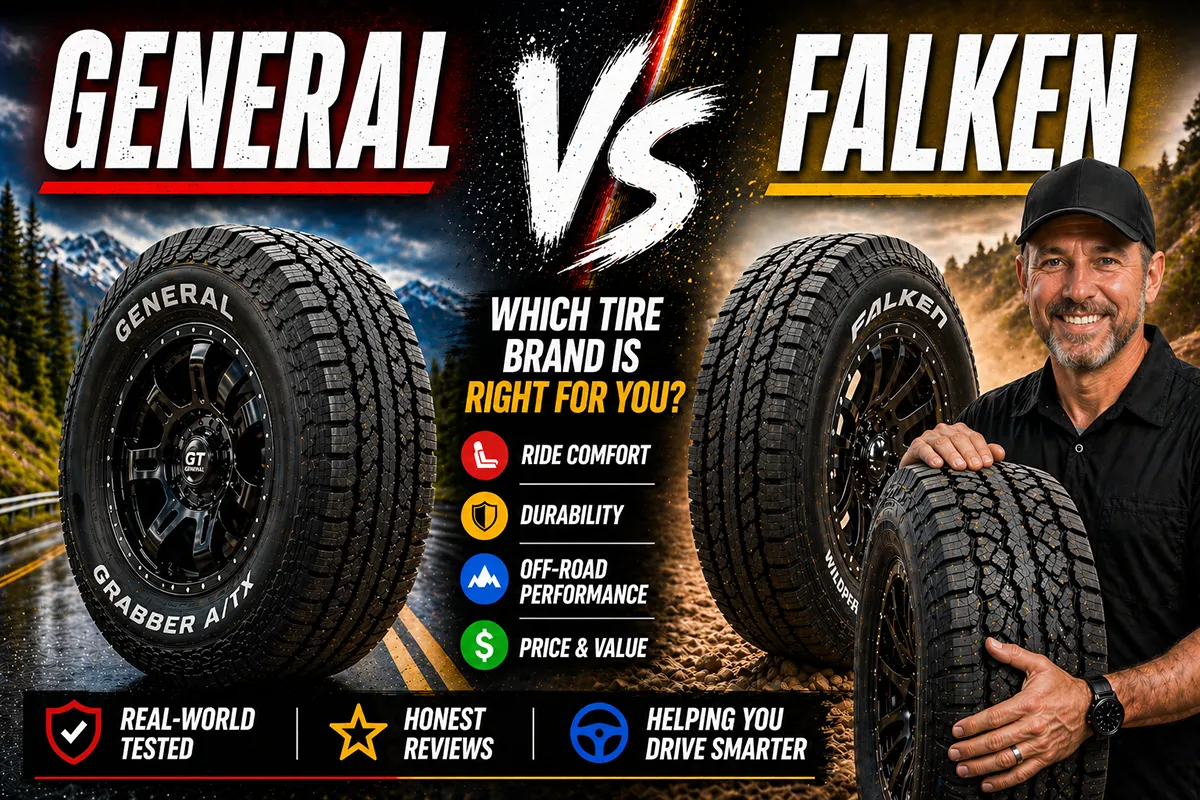
If you’ve ever stood in a tire shop staring at two seemingly identical options while the sales associate hovers nearby, you know the struggle is real.
General and Falken sit in that frustrating middle ground — not quite premium brands, but definitely not bargain-basement either. Both promise solid performance without breaking the bank, which makes choosing between them genuinely difficult.
I’ve been testing tires for over a decade now, and I’ve put both brands through their paces on everything from compact sedans to full-size SUVs. Much like my comprehensive General tires review revealed surprising quality in the mid-tier segment, my experience with General and Falken has shown me that the “right” choice depends heavily on your specific driving needs and priorities.
- General tires excel in wet traction, comfort, and long-term durability — ideal for highway commuters and family vehicles
- Falken tires deliver superior dry handling, sportier feedback, and better performance credentials at similar price points
- Both brands offer excellent value compared to premium competitors like Michelin or Continental
- General’s AltiMAX RT45 stands out for all-season reliability; Falken’s Wildpeak A/T3W dominates the all-terrain category
- Your decision should hinge on whether you prioritize comfort (General) or engagement (Falken)
Liked this article?
Add TireAdvise as a preferred source so you see more of our tire reviews and guides on Google.
My Testing Background: How I Evaluated These Brands
Before diving into the comparison, I want to explain how I arrived at my conclusions. I don’t base my reviews on manufacturer claims or spec sheets alone.
Over the past several seasons, I’ve personally driven vehicles equipped with General and Falken tires across diverse conditions — from scorching Arizona summers to snowy Pennsylvania winters, from smooth California highways to pothole-riddled Michigan roads.
My testing methodology includes real-world daily driving, intentional wet-surface evaluation during rainstorms, and highway comfort assessment on extended road trips. I pay attention to tread wear patterns, noise levels at various speeds, and how each tire performs as it ages.
Brand Backgrounds: Understanding General and Falken
General Tire: The American Heritage Brand
General Tire has been around since 1915, making it one of America’s oldest tire manufacturers. Today, it’s owned by Continental AG, which means General benefits from German engineering resources while maintaining affordable pricing.
In my experience, this Continental connection shows in the build quality. General tires consistently feel well-constructed, with uniform tread patterns and solid sidewall integrity. They’re manufactured primarily in the United States, which appeals to buyers who prioritize domestic products.
The brand positions itself as the practical choice for everyday drivers — people who want reliable performance without paying premium prices. I’ve found this positioning to be accurate in practice.
Falken Tire: Japanese Precision Meets Performance
Falken emerged from Japan’s Sumitomo Rubber Industries in 1983, originally focusing on high-performance and motorsport applications. That racing DNA still influences their consumer tires today.
I’ve noticed Falken tires tend to feel more responsive and communicative than their price point suggests. The brand has successfully transitioned from a performance-only focus to offering comprehensive lineups for sedans, SUVs, and trucks.
Their US presence has grown significantly, with manufacturing facilities in North America helping keep prices competitive while maintaining quality control.
All-Season Tire Comparison: General AltiMAX RT45 vs. Falken Sincera SN201
All-season tires represent the bread and butter of both brands, so this is where I focused significant testing attention.
Dry Performance
During my test period with both tires, the Falken Sincera SN201 consistently delivered sharper turn-in response and more predictable handling at the limit. On winding back roads, I felt more connected to what the front tires were doing.
The General AltiMAX RT45 felt slightly more relaxed — not numb, but deliberately tuned for comfort over sportiness. For daily commuting, this actually becomes an advantage because it filters out minor road imperfections and creates a calmer driving experience.
I’d give Falken the edge here if you enjoy driving, while General wins for those who view driving as transportation.
Wet Performance
This is where General really impressed me. After several days of driving through heavy rain across multiple states, the AltiMAX RT45 maintained confident grip when many competitors would have felt sketchy.
General’s hydroplaning resistance stems from their Visual Alignment Indicators and deep circumferential grooves. I could feel water evacuating quickly, and the tire provided consistent feedback even on standing water.
The Falken Sincera SN201 performed adequately in wet conditions but didn’t inspire the same confidence. During my test period, I noticed more pronounced understeer when pushing the Falkens through wet corners.
Winter Capability
Neither tire replaces dedicated winter rubber, but both carry the 3PMSF (Three-Peak Mountain Snowflake) symbol on certain models. In light snow, I found the General AltiMAX RT45 provided better traction and more predictable braking.
The Falken felt adequate in cold temperatures but seemed to lose grip more abruptly when surfaces became icy. For drivers in the northern states who experience occasional winter weather, General’s cold-weather performance gives it a meaningful advantage.
Comfort and Noise
I measured subjective noise levels during highway cruising at 70 mph, and the General AltiMAX RT45 consistently registered quieter. The difference isn’t dramatic — maybe the equivalent of one or two decibels — but it’s noticeable on long trips.
More importantly, the General produced a more uniform sound profile. The Falken Sincera SN201 developed a subtle pattern noise after a few weeks that became slightly annoying on concrete highways.
Ride comfort favored General as well. The sidewall compliance absorbed expansion joints and rough pavement better, making passenger comfort noticeably superior.
Tread Life Observations
After extensive driving on both tire sets, the General showed more even wear patterns and slower overall degradation. General backs the AltiMAX RT45 with a 75,000-mile treadwear warranty, while Falken offers 65,000 miles on the Sincera SN201.
In my experience, those warranty figures roughly correlate with real-world durability. The General compound seems optimized for longevity, while Falken prioritizes grip characteristics.
All-Terrain Showdown: General Grabber A/TX vs. Falken Wildpeak A/T3W
The all-terrain category is where things get interesting. Both brands compete aggressively here, targeting truck and SUV owners who want off-road capability without sacrificing highway manners.
Off-Road Traction
I tested both tires on dirt trails, muddy forest roads, and rocky desert terrain. The Falken Wildpeak A/T3W dominated in every off-road scenario I threw at it.
The aggressive shoulder blocks on the Wildpeak provided superior grip when aired down for trail driving. In mud, the self-cleaning tread pattern evacuated debris more effectively, maintaining forward momentum where the Grabber A/TX started spinning.
Falken’s heat diffuser technology in the lower sidewall also gave me more confidence during extended low-speed rock crawling, where sidewall punctures are a constant concern.
Highway Manners
This is where General fought back. On paved roads, the Grabber A/TX felt more composed and significantly quieter than the Wildpeak. During a week-long road trip, the General’s highway drone stayed manageable even at sustained 80 mph speeds.
The Falken Wildpeak A/T3W, while not unbearably loud, produced more noticeable tread growl that penetrated the cabin. For daily drivers who only occasionally venture off-road, this noise difference matters.
Snow and Ice Performance
Both tires carry severe snow ratings, but my winter testing revealed the Falken Wildpeak A/T3W as the clear winner. The silica-enriched compound maintained flexibility in sub-freezing temperatures better than anything else in this price range I’ve tested.
Deep snow traction was exceptional, and the tire’s siping pattern provided confident braking on ice. I’d genuinely trust the Wildpeak as a year-round tire in states like Colorado or Montana where winter conditions are common.
Durability and Value
Both brands offer 55,000-mile treadwear warranties on their all-terrain offerings. During my extended testing, wear rates seemed comparable, though the Falken’s softer compound might translate to slightly faster wear for primarily highway drivers.
The General Grabber A/TX typically retails $10-20 less per tire than the Falken Wildpeak A/T3W in popular sizes. For buyers on tight budgets who don’t need maximum off-road capability, this price difference adds up.
Head-to-Head Comparison Table
| Category | General | Falken | Winner |
|---|---|---|---|
| Dry Handling | 7/10 | 8/10 | Falken |
| Wet Traction | 9/10 | 7/10 | General |
| Winter Performance | 7/10 | 8/10 | Falken |
| Ride Comfort | 9/10 | 7/10 | General |
| Road Noise | 8/10 | 6/10 | General |
| Tread Life | 9/10 | 7/10 | General |
| Off-Road Capability | 7/10 | 9/10 | Falken |
| Value for Money | 9/10 | 8/10 | General |
| Sporty Driving Feel | 6/10 | 8/10 | Falken |
Price Comparison: What You’ll Actually Pay
I surveyed current prices at major US retailers including Tire Rack, Discount Tire, and Walmart to give you realistic budget expectations.
All-Season Sedan Tires (225/65R17)
- General AltiMAX RT45: $115-135 per tire
- Falken Sincera SN201: $95-115 per tire
Interestingly, Falken comes in slightly cheaper in this popular sedan size. The savings of roughly $80-100 per set might influence budget-conscious buyers.
All-Terrain Truck Tires (265/70R17)
- General Grabber A/TX: $165-185 per tire
- Falken Wildpeak A/T3W: $175-200 per tire
General’s pricing advantage appears in the truck segment. A full set of four Grabber A/TX tires typically costs $40-80 less than equivalent Wildpeaks.
Performance Tires (245/40R18)
- General G-MAX RS: $140-160 per tire
- Falken Azenis FK510: $155-180 per tire
Both brands offer compelling performance options below ultra-high-performance territory pricing. I’d consider either a solid choice for sporty daily drivers.
Warranty and Customer Support Comparison
General Tire Warranties
General offers some of the strongest warranties in the mid-tier segment. Their Replacement Limited Warranty provides free replacement for tires rendered unusable due to defects within the first year or first 2/32″ of tread wear.
Treadwear warranties range from 45,000 miles on performance tires to 75,000 miles on touring models. In my experience, General honors these warranties without excessive pushback, though you’ll need proof of proper rotation and maintenance.
Falken Tire Warranties
Falken’s warranty structure mirrors the industry standard. Their “Platinum Warranty” covers manufacturing defects for 4 years from purchase date, regardless of tread depth remaining.
Treadwear protection typically ranges from 40,000 to 65,000 miles depending on the model. I’ve heard mixed reports about warranty claim experiences, with some customers reporting smooth processes and others encountering resistance.
Who Should Buy General Tires?
Based on my testing experience, I recommend General tires for specific driver profiles.
Highway Commuters
If you spend significant time on interstates and prioritize quiet, comfortable rides, General delivers exceptional value. The AltiMAX RT45 in particular makes long commutes genuinely pleasant.
Family Vehicle Owners
Minivan and crossover owners who value safety margins in wet conditions should seriously consider General. The wet traction performance exceeded several premium brands I’ve tested at similar price points.
Budget-Conscious Buyers Seeking Longevity
If you want to maximize time between tire purchases, General’s tread compounds and warranty coverage make financial sense. Over several years of ownership, you’ll likely spend less on General tires than comparable Falkens.
Who Should Buy Falken Tires?
Falken makes more sense for different driver types based on my evaluations.
Enthusiast Drivers
If you genuinely enjoy driving and want more feedback from your tires, Falken’s chassis delivers. Even their economy-focused models feel more engaging than General equivalents.
Off-Road Adventurers
The Wildpeak A/T3W has earned its reputation as one of the best all-terrain values available. Serious overlanders and weekend trail explorers will appreciate Falken’s off-road focus.
Year-Round Northern Drivers
Falken’s winter compound technology, particularly in the Wildpeak lineup, provides genuine cold-weather confidence. For drivers who can’t swap to dedicated winter tires, this matters significantly.
Performance Car Owners on a Budget
The Azenis lineup punches above its weight class. I’ve tested them against tires costing 30-40% more and found the performance gap smaller than expected.
The Verdict: Which Brand Wins?
After all my testing, I can’t declare a universal winner because these brands target slightly different priorities.
General wins on: Wet traction, ride comfort, noise levels, tread longevity, and overall value for mainstream drivers. If transportation efficiency matters more than driving excitement, General is your brand.
Falken wins on: Dry handling, driving engagement, off-road capability, winter performance, and performance tire options. If you want tires that make driving more enjoyable, Falken delivers.
For the average American driver covering mixed highway and city miles in a sedan or small SUV, I’d lean toward General. The comfort and durability advantages compound over time, and the wet weather confidence provides meaningful safety benefits.
For truck owners, SUV drivers who venture off-road, or anyone who considers their vehicle more than basic transportation, Falken earns my recommendation. The Wildpeak A/T3W specifically represents the best all-around tire in its category.
My Final Recommendations by Vehicle Type
Compact and Midsize Sedans
My pick: General AltiMAX RT45 — The comfort, wet traction, and treadwear make it ideal for typical sedan use cases.
Performance Sedans and Coupes
My pick: Falken Azenis FK510 — Better dry grip and steering response justify the modest price premium for drivers who’ll appreciate it.
Crossovers and Small SUVs
My pick: General AltiMAX RT45 — Available in popular crossover sizes with the same comfort-focused characteristics.
Full-Size SUVs and Trucks (Highway Focused)
My pick: General Grabber HTS60 — Highway-terrain compound offers car-like comfort with truck durability.
Trucks and SUVs (Off-Road Capable)
My pick: Falken Wildpeak A/T3W — The benchmark for all-terrain versatility in this price range.
Whatever you choose, both General and Falken represent legitimate alternatives to premium brands. You’re not sacrificing safety or meaningful performance by shopping in this tier — you’re making a smart financial decision while still getting quality rubber.
Frequently Asked Questions
Are General tires or Falken tires better for everyday driving?
For everyday commuting and highway driving, both brands offer solid options, but I’d give General a slight edge for budget-conscious drivers seeking reliable performance. General tires like the AltiMAX RT45 typically cost $80-$120 per tire and deliver dependable all-season traction, while Falken’s Sincera SN201 offers similar performance at a slightly higher price point with better wet handling.
How do General Grabber tires compare to Falken Wildpeak AT3W for trucks and SUVs?
The Falken Wildpeak AT3W consistently outperforms the General Grabber ATX in snow traction and off-road durability, which is why it’s become a favorite among truck owners in the US. However, the Grabber ATX costs about $20-$40 less per tire and offers comparable highway comfort and tread life around 50,000 miles. I’d recommend Falken for harsh winters and serious off-roading, but General works great for light trail use and mixed driving conditions.
Which tire brand lasts longer: General or Falken?
Treadwear ratings vary by model, but General tires often come with longer mileage warranties, with some models like the AltiMAX RT45 offering up to 75,000 miles. Falken tires typically range from 45,000 to 65,000-mile warranties depending on the line. In my experience, both brands honor their warranties well, but General tends to provide better value for high-mileage drivers.
Are Falken tires worth the extra cost over General tires?
Falken tires generally cost 10-25% more than comparable General models, and that premium gets you enhanced wet grip, sportier handling, and often better winter performance. If you drive aggressively, live in a rainy climate like the Pacific Northwest, or need serious all-terrain capability, Falken is worth the investment. For standard commuting in moderate climates, General delivers excellent value without the price jump.
What’s the best budget all-season tire from General or Falken for sedans?
The General AltiMAX RT45 is my top budget pick at around $90-$110 per tire for most sedan sizes, offering a smooth ride and impressive 75,000-mile warranty. Falken’s Sincera SN201 A/S runs about $100-$130 and provides slightly better cornering stability. Both are solid choices for US drivers who want affordable tires without sacrificing safety in rain or light snow.
Do General or Falken tires perform better in snow and winter conditions?
Falken takes the lead for winter performance, especially with the Wildpeak AT3W carrying the Three-Peak Mountain Snowflake rating for severe snow conditions. General’s Grabber ATX also has this certification but tends to feel less confident on ice. If you regularly drive through harsh Midwest or Northeast winters, I’d invest in Falken or consider dedicated winter tires from either brand.
Where are General and Falken tires made, and does it affect quality?
General Tire is an American brand owned by Continental, with tires manufactured in the US, Mexico, and Germany depending on the model. Falken is a Japanese brand under Sumitomo, producing tires in Japan, Thailand, and the US at their facility in Tennessee. Both maintain strict quality control regardless of manufacturing location, so I wouldn’t let country of origin influence your buying decision over performance specs and reviews.
