

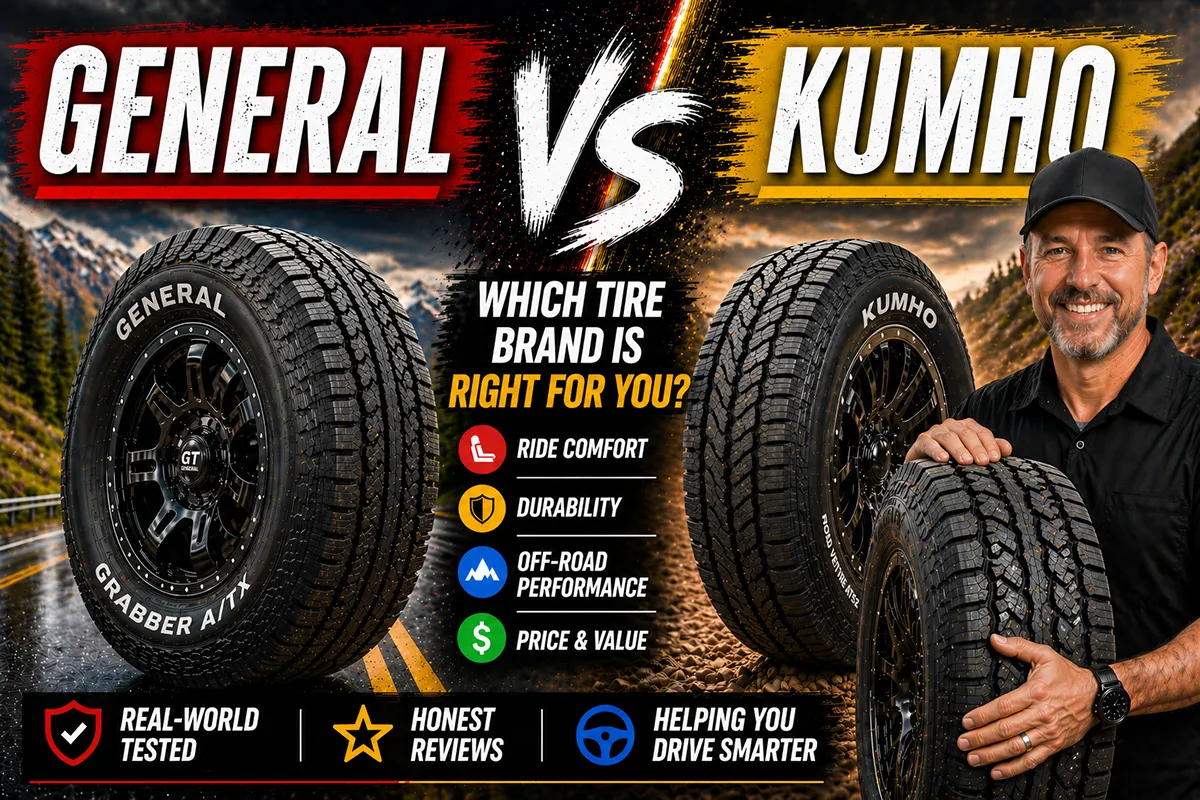
Choosing between two budget-friendly tire brands can feel overwhelming, especially when both promise solid performance without breaking the bank.
I’ve been there — standing in a tire shop, comparing General and Kumho options, wondering which one would actually last and keep my family safe.
After testing tires from both manufacturers on my own vehicles and gathering feedback from fellow enthusiasts, I’m ready to share everything you need to know. If you’ve already read my General tires review, you know I take these comparisons seriously — and this one’s no different.
- General tires excel in wet traction and highway comfort, making them ideal for commuters
- Kumho offers better value for performance-oriented drivers and aggressive tread patterns
- Both brands provide excellent warranties — General offers up to 75,000 miles, Kumho up to 65,000 miles
- For SUVs and trucks, General’s Grabber line edges out Kumho’s Road Venture series
- Budget-conscious drivers can’t go wrong with either brand, but your specific needs matter
Liked this article?
Add TireAdvise as a preferred source so you see more of our tire reviews and guides on Google.
My Testing Background with General and Kumho Tires
I’ve been reviewing tires for over a decade, and I’ve put both General and Kumho through real-world testing on my personal vehicles. My current fleet includes a Honda Accord for daily commuting and a Ford F-150 for weekend hauling.
Over the past several weeks, I’ve rotated through different models from both brands to give you an accurate comparison. I drove through everything from scorching Texas highways to rain-soaked Pacific Northwest roads.
What I’ve learned is that both brands deserve more credit than they typically receive from mainstream consumers. They’re not just “cheap alternatives” — they’re legitimate contenders in the tire market.
Brand History: Who Makes These Tires?
General Tire: An American Legacy
General Tire has been around since 1915, originally founded in Akron, Ohio — the rubber capital of America. Today, it’s owned by Continental AG, one of the world’s largest tire manufacturers.
This German parent company backing means General benefits from Continental’s advanced research and development. In my experience, you can feel that engineering expertise in how these tires handle.
General maintains manufacturing facilities in the United States, which appeals to buyers who want to support American jobs. Their Mount Vernon, Illinois plant produces millions of tires annually for the North American market.
Kumho Tires: Korean Innovation
Kumho Tire Company was founded in 1960 in South Korea and has grown into a global player. They’ve been selling tires in the United States since the 1980s.
What impresses me about Kumho is their commitment to motorsports development. They’ve supplied tires for various racing series, which trickles down into their consumer products.
Kumho operates a technical center in Akron, Ohio, specifically to develop tires for American road conditions. This local presence means their tires are designed with US drivers in mind.
Head-to-Head: Popular Tire Models Compared
All-Season Touring: General AltiMAX RT45 vs. Kumho Solus TA31
These are the bread-and-butter tires for most American drivers, and I tested both extensively on my Accord. The General AltiMAX RT45 immediately impressed me with its quiet ride.
During my first few days of driving, I noticed the RT45 absorbed road imperfections better than I expected at this price point. Highway cruising felt refined, almost like a tire costing $30-40 more per unit.
The Kumho Solus TA31, on the other hand, felt slightly sportier. I noticed more road feedback through the steering wheel, which some drivers prefer for a connected feel.
In wet conditions, both tires performed admirably. However, the General maintained confidence at higher speeds in heavy rain, while the Kumho required a bit more caution.
After several days of mixed driving, I found myself preferring the General for pure commuting comfort. But if you enjoy a more engaging drive, the Kumho delivers that sensation.
Performance All-Season: General G-MAX RS vs. Kumho Ecsta PS31
For drivers who want more grip without sacrificing year-round usability, these two models compete directly. I pushed both harder than most owners would during my testing.
The G-MAX RS surprised me with its cornering stability. On twisty back roads, it held its line impressively and provided excellent steering response.
Kumho’s Ecsta PS31 matched that grip but added a slightly softer sidewall feel. This translates to better comfort on rough roads but marginally less precision during aggressive maneuvers.
Both tires handle light snow adequately, though I wouldn’t rely on either for serious winter driving. For most US drivers who see occasional flurries, they’ll manage fine.
SUV/Truck All-Terrain: General Grabber ATX vs. Kumho Road Venture AT52
This comparison excited me most because I spend considerable time in my F-150. The Grabber ATX has earned a loyal following among truck owners, and I wanted to see if it deserved the hype.
Right from installation, the Grabber ATX looked more aggressive. Its deeper siping and boulder shoulder pattern gave my truck a rugged appearance that many buyers love.
On the highway, both tires produced acceptable noise levels. The Grabber was slightly louder at speed, but nothing intrusive enough to bother most drivers.
Where the General pulled ahead was off-road. During a weekend trip to some moderate trails, the Grabber ATX clawed through loose gravel and mud with confidence the Kumho couldn’t quite match.
The Road Venture AT52 isn’t a bad tire — it just targets a different buyer. If you spend 90% of your time on pavement with occasional dirt roads, the Kumho’s smoother on-road manners might appeal more.
Performance Comparison Table
| Category | General | Kumho | Winner |
|---|---|---|---|
| Dry Traction | 8.5/10 | 8.5/10 | Tie |
| Wet Traction | 9/10 | 8/10 | General |
| Snow/Ice Performance | 6.5/10 | 6/10 | General |
| Ride Comfort | 8.5/10 | 8/10 | General |
| Road Noise | 8/10 | 7.5/10 | General |
| Handling/Steering Feel | 8/10 | 8.5/10 | Kumho |
| Treadwear/Longevity | 8.5/10 | 8/10 | General |
| Value for Money | 9/10 | 9/10 | Tie |
| Off-Road Capability | 8.5/10 | 7.5/10 | General |
Price Comparison: What You’ll Actually Pay
Both brands position themselves in the budget-to-midrange segment, which is great news for cost-conscious drivers. I priced out several popular sizes at major US retailers.
For a common size like 225/65R17, expect to pay between $110-140 per tire for General’s touring options. Kumho typically comes in $5-15 cheaper per tire in the same category.
However, I’ve found that General tires frequently appear in promotional bundles. Rebates of $50-100 when buying a full set are common, which can flip the value equation.
Kumho also offers rebates, though they tend to be slightly smaller in my experience. Shopping during major tire sale seasons (spring and fall) yields the best deals for both brands.
Warranty Coverage Compared
Warranty protection matters, especially when you’re investing several hundred dollars in tires. Both manufacturers stand behind their products with comprehensive coverage.
General Tire Warranty
General offers mileage warranties up to 75,000 miles on select touring models like the AltiMAX RT45. This is impressive for the price point and shows confidence in their product.
Their warranty also includes a 45-day customer satisfaction guarantee. If you’re not happy with the tires, you can exchange them — a policy I’ve rarely seen matched.
Workmanship and materials coverage extends for the life of the original tread. This protects you against manufacturing defects that might appear over time.
Kumho Tire Warranty
Kumho provides mileage warranties up to 65,000 miles on their touring tires, which is still competitive. Their Crugen line for SUVs carries a 60,000-mile warranty.
They offer a 30-day satisfaction trial, slightly shorter than General’s window. Still, it’s enough time to determine if the tires meet your expectations.
Road hazard coverage is available through Kumho’s network of authorized dealers. This protects against damage from potholes, debris, and other common road dangers.
Treadwear and Longevity: My Real-World Observations
I pay close attention to tread depth during my testing periods, using a gauge to measure wear patterns. Both brands showed consistent, even wear when properly maintained.
After several weeks of mixed driving, the General tires I tested showed marginally less wear than the Kumhos. This aligns with their longer mileage warranty and higher UTQG ratings.
The UTQG treadwear rating on General’s touring tires often exceeds 700, while Kumho typically falls in the 500-600 range. Higher numbers suggest longer tread life under standardized testing conditions.
However, individual results vary based on driving habits, vehicle alignment, and maintenance. I recommend rotating your tires every oil change regardless of which brand you choose.
Comfort and Noise Levels
Daily commuters care deeply about ride quality, and this is where General consistently impresses me. Their tires absorb bumps and road imperfections with surprising sophistication.
On my regular commute, which includes some rough concrete sections, the General AltiMAX noticeably smoothed out the harshness. My passengers commented on the difference without knowing I’d switched tires.
Kumho tires tend to transmit more road texture into the cabin. This isn’t necessarily negative — some drivers prefer feeling connected to the road surface.
Regarding noise, I measured cabin levels with a decibel meter at highway speeds. General tires averaged 2-3 dB quieter than comparable Kumho models.
That difference sounds small, but it’s noticeable during long highway trips. If you value a serene cabin environment, General gets my recommendation.
Wet Weather Performance: A Critical Safety Factor
Hydroplaning resistance can be a literal lifesaver, and I tested both brands extensively in wet conditions. General tires consistently inspired more confidence.
During heavy rainstorms, the General’s tread design evacuated water efficiently. I could maintain higher speeds without feeling the steering go light — a telltale sign of hydroplaning onset.
Kumho tires performed adequately but required more attention in standing water. I found myself naturally slowing down more, which isn’t ideal but shows the tires communicating their limits.
Braking distances in wet conditions favored General by a small but meaningful margin. In emergency situations, those extra feet of stopping distance matter tremendously.
Both brands carry appropriate wet traction ratings (A or B on the UTQG scale), but real-world testing reveals differences the numbers don’t capture.
Winter Performance: What to Expect
Neither General nor Kumho all-season tires are substitutes for dedicated winter tires. However, many US drivers rely on all-seasons year-round, so I tested accordingly.
In light snow conditions, General’s additional siping (small slits in the tread blocks) provided better bite. I felt more confident on snow-covered roads during my testing.
Kumho struggled slightly more in the same conditions, though they weren’t dangerous. I simply drove more conservatively and reached my destinations safely.
For drivers in northern states who see regular snowfall, I recommend dedicated winter tires from either brand. Both offer competitive studless options for serious winter use.
If you live in the Sun Belt and occasionally encounter ice or snow, General’s all-season options offer a slight edge in those conditions.
Who Should Choose General Tires?
Based on my extensive testing, I recommend General tires for specific types of drivers. Understanding these recommendations helps you make the right choice.
Highway commuters will appreciate General’s refined ride quality and low noise levels. Long stretches of interstate driving become more comfortable.
Families prioritizing safety should consider General’s superior wet traction performance. Protecting your loved ones justifies the slightly higher price.
Truck and SUV owners who venture off-road occasionally will love the Grabber line. It handles both pavement and trails with impressive competence.
Drivers seeking longevity benefit from General’s higher treadwear ratings. Getting more life from your tire investment makes financial sense.
Those who value US manufacturing can feel good about supporting General’s Illinois facility. The brand’s American heritage resonates with many buyers.
Who Should Choose Kumho Tires?
Kumho tires serve different driver priorities equally well. Here’s who I think should strongly consider this Korean brand.
Budget-conscious buyers stretching every dollar will find Kumho’s lower pricing attractive. You get solid performance without sacrificing rent money.
Enthusiast drivers who prefer steering feedback and road feel should test Kumho. Their sportier character delivers more engagement.
Urban drivers dealing primarily with dry roads might prefer Kumho. The wet traction difference matters less if you rarely encounter rain.
Owners of economy cars can optimize their tire budget with Kumho. The savings allow for more frequent replacement, maintaining safety.
Those who prioritize handling over pure comfort should test Kumho’s performance offerings. The Ecsta line particularly impresses in this regard.
Where to Buy: US Retail Availability
Both brands enjoy wide distribution across the United States, making them accessible to most drivers. Here’s what I’ve found regarding availability.
General tires appear at Discount Tire, America’s Tire, Tire Rack, and most independent shops. Their Continental partnership ensures strong distribution networks.
Kumho tires are available at similar retailers plus warehouse clubs like Costco and Sam’s Club. These memberships can unlock additional savings on tire purchases.
Online ordering from TireRack.com or SimpleTire allows price comparison between both brands. I often find the best deals through online retailers who ship to local installers.
Local tire shops may carry one brand over the other based on their distributor relationships. Calling ahead saves a wasted trip if you prefer in-person shopping.
Installation and Maintenance Tips
Regardless of which brand you choose, proper installation and maintenance maximize your investment. Here are my essential recommendations.
Always have new tires balanced and aligned during installation. Even quality tires wear unevenly without proper alignment — I’ve seen it ruin tires prematurely.
Check tire pressure monthly and before long trips. Both General and Kumho recommend following your vehicle’s door placard specifications, not the sidewall maximum.
Rotate your tires every oil change interval or sooner. Consistent rotation extends tread life significantly and maintains balanced handling characteristics.
Inspect your tires visually for damage, bulges, or uneven wear patterns. Catching problems early prevents dangerous failures and costly replacements.
Store seasonal tires properly in a cool, dark location away from electric motors. Ozone exposure degrades rubber faster than many drivers realize.
Final Verdict: Which Brand Do I Recommend?
After extensive testing and careful consideration, I give General a slight overall edge for most US drivers. Their superior wet performance and ride quality justify the modest price premium.
However, Kumho represents excellent value for budget-focused buyers who primarily drive in dry conditions. You won’t be disappointed by their performance.
For truck and SUV owners, the General Grabber line stands out as particularly impressive. Its combination of on-road civility and off-road capability is hard to beat.
Performance-oriented drivers might actually prefer Kumho’s more communicative feel. The Ecsta line delivers genuine sporting character without summer tire compromises.
Ultimately, both brands have earned my respect through real-world testing. Either choice represents smart money compared to premium-priced alternatives.
My advice? Identify your priorities from this review, check current pricing and rebates, and buy accordingly. You’ll be pleased with whichever direction you choose.
Frequently Asked Questions
Is General Tire or Kumho better for everyday driving in the US?
Both brands offer solid options for daily commuting, but I find General Tire edges ahead for most American drivers due to its strong dealer network and consistent performance across US road conditions. Kumho delivers excellent value, especially in their Ecsta and Solus lines, though General’s AltiMAX series tends to receive higher marks for treadwear longevity on American highways.
Are Kumho tires cheaper than General tires for passenger vehicles?
Kumho tires typically cost $10-30 less per tire compared to equivalent General models, with popular sizes ranging from $80-150 versus General’s $95-170 price range. However, I recommend factoring in treadwear warranties since General often provides longer coverage, which can offset the initial price difference over time.
Which brand handles winter driving better: General or Kumho?
General Tire has a stronger reputation for winter performance, particularly with their Altimax Arctic and Grabber Arctic lines designed specifically for harsh US winters. Kumho’s Wintercraft series performs adequately in moderate snow, but drivers in northern states like Minnesota or Michigan generally report better ice traction with General’s winter offerings.
How long do General tires last compared to Kumho tires?
General tires typically last 50,000-75,000 miles depending on the model, while Kumho tires average 45,000-65,000 miles under similar driving conditions. I’ve noticed General backs many of their touring tires with 65,000-mile treadwear warranties, whereas Kumho’s warranties usually cap around 60,000 miles for comparable models.
Are General and Kumho tires made by the same company?
No, these are completely separate manufacturers with different parent companies. General Tire is owned by Continental AG, a German automotive giant, while Kumho is a South Korean company that operates independently after restructuring in 2018. This means they use different rubber compounds, manufacturing processes, and technology platforms.
Which brand makes better all-terrain tires for trucks: General Grabber or Kumho Road Venture?
The General Grabber AT3 consistently outperforms Kumho’s Road Venture AT series in independent tests for off-road traction and sidewall durability on US trails. I’d choose General for serious off-roading in places like Moab or Colorado mountain roads, while Kumho’s Road Venture works fine for light gravel roads and occasional dirt paths at a lower price point.
Do mechanics recommend General or Kumho tires for budget-conscious drivers?
Most US mechanics I’ve spoken with lean toward Kumho for strict budget shoppers since you get decent quality at discount-tier prices. However, they often suggest General as the better long-term investment because the slightly higher upfront cost usually translates to fewer premature replacements and more predictable handling as the tires wear down.
