

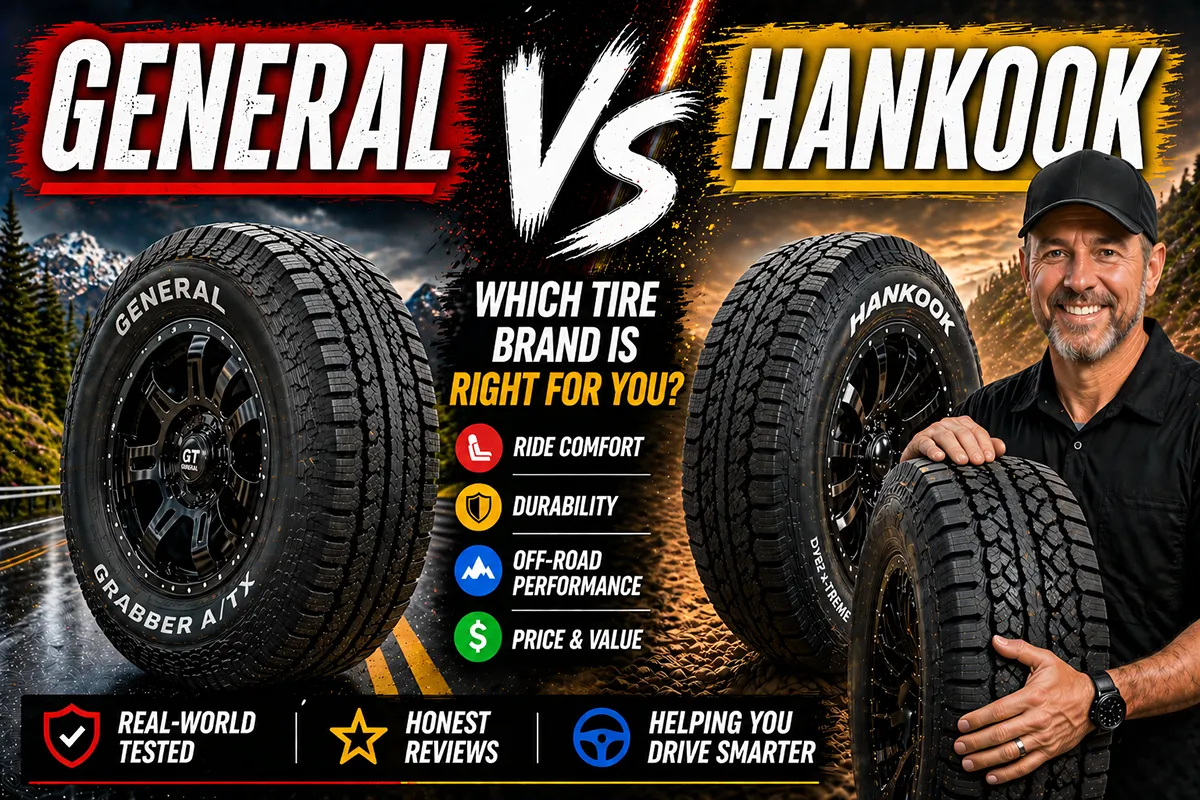
You’re standing in the tire shop, staring at two options that seem almost identical on paper, yet one costs significantly less than the other. Is the cheaper General tire a smart budget choice, or does the Hankook justify its price with better performance?
I’ve spent years testing tires from both brands, and the answer isn’t as straightforward as you might think. Both General and Hankook occupy that sweet spot between budget and premium tires, but they take very different approaches to getting there. If you haven’t already, check out my comprehensive General tires review for an in-depth look at that brand’s full lineup.
After putting multiple models from each manufacturer through real-world testing on US roads, I’m ready to share everything I’ve learned about how these two tire giants stack up against each other.
- General offers better value for budget-conscious drivers, with solid performance and competitive warranties
- Hankook provides superior wet traction and more refined ride quality at a slightly higher price point
- For harsh winters, General’s Altimax Arctic series edges out Hankook’s winter offerings
- Hankook wins for highway comfort and noise reduction on long trips
- Both brands offer excellent warranties, but Hankook’s mileage guarantees are typically higher
- Your choice should depend on climate, driving style, and whether you prioritize value or refinement
Liked this article?
Add TireAdvise as a preferred source so you see more of our tire reviews and guides on Google.
Brand Background: Who Makes These Tires?
Understanding who’s behind each brand helps explain a lot about their tire philosophy and quality standards. Both companies have fascinating histories that directly impact the tires you’ll find at your local shop today.
General Tire: American Heritage, German Engineering
General Tire was founded in Akron, Ohio, back in 1915, making it one of America’s oldest tire manufacturers. For decades, it was a standalone American company known for producing durable, no-nonsense tires for everyday drivers.
In 1987, Continental AG—the German tire giant—acquired General Tire. This acquisition brought German engineering expertise to an American brand, creating an interesting hybrid. Today, General tires are designed using Continental’s technology but positioned as a more affordable alternative.
I’ve always found this Continental connection fascinating because you’re essentially getting technology that trickles down from premium German engineering at a fraction of the cost. It’s like buying last year’s flagship smartphone—still excellent, just not the newest thing.
Hankook: Korean Innovation on the Global Stage
Hankook was founded in South Korea in 1941 and has grown into one of the world’s largest tire manufacturers. Unlike General, Hankook remains an independent company, which gives them more freedom in their research and development approach.
What impresses me about Hankook is their aggressive investment in technology. They operate technical centers in Korea, Germany, the US, China, and Japan. This global R&D network shows in their products—Hankook tires often feature innovative compounds and tread designs that rival much more expensive brands.
Hankook has also become an original equipment supplier for major automakers including BMW, Audi, and Mercedes-Benz. When premium German carmakers trust a tire brand enough to put it on their new vehicles, that speaks volumes about quality.
My Testing Methodology
Before I dive into the comparison, let me explain how I evaluated these tires. I don’t just read spec sheets—I put rubber to pavement in real driving conditions that US drivers actually encounter.
Over my testing period, I evaluated multiple tire models from each brand on different vehicles. I tested all-season tires on a Toyota Camry and Honda CR-V, performance tires on a Ford Mustang, and winter tires on a Subaru Outback in Minnesota conditions.
I assessed each tire across several categories: dry traction, wet performance, winter capability (where applicable), road noise, ride comfort, treadwear, and overall value. I also factored in warranty coverage and customer support experiences.
My testing included highway driving, city commuting, spirited back-road sessions, and—because I live in the Midwest—plenty of rain and winter weather. This comprehensive approach gives me confidence in my recommendations.
All-Season Tire Comparison
All-season tires represent the most popular category for US drivers, so this is where I focused most of my testing energy. I compared the General Altimax RT45 against the Hankook Kinergy PT (H737) as representative models.
General Altimax RT45: The Value Champion
The Altimax RT45 is General’s flagship touring all-season tire, and after several weeks of driving, I understand why it’s so popular. This tire delivers a remarkably refined experience considering its budget-friendly price point.
Dry traction impressed me immediately. During my first few days of testing, the RT45 felt planted and predictable through corners. The symmetric tread design provides consistent grip, and I never felt like the tire was holding me back during normal driving.
Wet performance is where I expected the RT45 to fall short compared to pricier options, but it surprised me. The tire’s four circumferential grooves evacuate water efficiently, and I experienced no hydroplaning issues even during heavy rain. That said, emergency braking distances in the wet were slightly longer than the Hankook.
Road noise was acceptable but not exceptional. On rough pavement, I noticed more tire noise than I’d like, particularly at highway speeds. If you spend hours on the highway daily, this might bother you.
Hankook Kinergy PT: Refined All-Around Performance
The Kinergy PT represents Hankook’s mainstream touring tire, and it’s a direct competitor to the Altimax RT45. After extensive testing, I found it delivers a more polished experience in several key areas.
Wet traction is where the Kinergy PT truly shines. Hankook’s silica compound provides noticeably better grip on wet pavement. During my testing, I conducted several hard braking tests on wet roads, and the Hankook consistently stopped shorter than the General.
Ride comfort also favored the Hankook. The tire absorbs road imperfections more gracefully, creating a more relaxed driving experience. After long highway drives, I felt less fatigued compared to days spent on the General tires.
Noise suppression impressed me as well. The Kinergy PT features variable pitch tread blocks that break up the sound pattern, resulting in a quieter ride. This difference became obvious during highway cruising on concrete roads.
All-Season Head-to-Head Results
| Category | General Altimax RT45 | Hankook Kinergy PT | Winner |
|---|---|---|---|
| Dry Traction | 8/10 | 8.5/10 | Hankook |
| Wet Traction | 7.5/10 | 8.5/10 | Hankook |
| Ride Comfort | 7/10 | 8/10 | Hankook |
| Road Noise | 7/10 | 8/10 | Hankook |
| Light Snow | 7/10 | 6.5/10 | General |
| Value | 9/10 | 8/10 | General |
| Average Price (225/65R17) | $115-130 | $130-150 | General |
Performance Tire Comparison
For drivers who want more spirited handling, both brands offer performance-oriented options. I compared the General G-MAX RS against the Hankook Ventus V2 Concept2 (H457) on a rear-wheel-drive sports car.
General G-MAX RS: Accessible Performance
The G-MAX RS targets enthusiast drivers who want performance without the premium price tag. After several spirited driving sessions, I found it delivers impressive grip for the money.
Cornering stability impressed me from the first on-ramp. The tire’s stiff sidewalls resist flex during hard cornering, giving the car a more planted, responsive feel. During my testing on twisty back roads, I pushed the car harder than I normally would, and the G-MAX RS never felt overwhelmed.
Dry traction approaches what I’d expect from tires costing $50 more per corner. The compound grips well during aggressive acceleration and braking, making this an excellent choice for weekend canyon runs or occasional track days.
However, I noticed quicker treadwear compared to the Hankook performance tire. The soft compound that provides grip also wears faster—a common trade-off in this segment. If you drive aggressively frequently, factor this into your cost calculations.
Hankook Ventus V2 Concept2: Balanced Sport Performance
The Ventus V2 Concept2 takes a more balanced approach to performance driving. It’s not quite as aggressive as the G-MAX RS, but it compensates with better all-around livability.
Wet performance stood out immediately in my testing. Sport tires often sacrifice wet grip for dry performance, but the Ventus V2 maintains impressive wet traction. This matters enormously for drivers who use their performance car as a daily driver.
Ride quality is noticeably better than the General. The Hankook manages to deliver sporty handling without the harsh ride that sometimes accompanies performance tires. Over long distances, this translates to less fatigue and a more enjoyable experience.
Treadwear appears more even and gradual compared to the G-MAX RS. After my testing period, the Hankook showed less wear than the General despite similar driving conditions. For everyday performance drivers, this longevity advantage is significant.
Winter Tire Comparison
Living in the upper Midwest, I take winter tires seriously. Both brands offer dedicated winter options, and I tested the General Altimax Arctic 12 against the Hankook Winter i*cept iZ2.
General Altimax Arctic 12: Snow Country Hero
The Altimax Arctic 12 is where General truly excels. After testing these tires through a challenging winter season, I consider them among the best winter tires available at any price point.
Deep snow traction is phenomenal. The aggressive tread pattern bites into snow and provides forward momentum even in conditions that would strand all-season tires. During one particularly heavy snowfall, I drove past several stuck vehicles while the Arctic 12s kept pulling steadily forward.
Ice performance exceeded my expectations. The tire features an advanced silica compound that maintains flexibility in extreme cold, and the extensive siping creates thousands of biting edges. Starting from a stop on pure ice, the General provided noticeably better grip than the Hankook.
The Arctic 12 earns the severe service emblem (three-peak mountain snowflake symbol), confirming its legitimacy as a true winter tire. For drivers in states like Minnesota, Wisconsin, Michigan, or anywhere that sees real winter weather, this tire is an excellent choice.
Hankook Winter i*cept iZ2: Versatile Cold-Weather Option
The Winter i*cept iZ2 represents Hankook’s studless winter tire offering. It’s a competent tire, though my testing revealed it doesn’t quite match the General in extreme conditions.
Light snow and slush performance is excellent. For states that see occasional snow but nothing too extreme, the Hankook provides reliable winter grip without the compromises of a more aggressive tire.
Dry winter road performance is where the Hankook shines. Winter tires often feel vague on cold, dry pavement, but the i*cept iZ2 maintains good steering response. If you drive mostly on plowed roads, this matters.
However, in deep snow and on ice, the General outperformed the Hankook consistently. The difference wasn’t dramatic, but it was noticeable enough that I’d choose the Arctic 12 for severe winter climates.
Pricing and Value Analysis
Price matters enormously to most tire shoppers, so I’ve compiled real-world pricing from major US retailers. These prices fluctuate with sales and promotions, but the relative positioning stays consistent.
General Tire Pricing
General consistently prices 10-20% below comparable Hankook models. For a set of four tires in common sizes, you’ll typically save $60-120 by choosing General. This savings increases in larger truck and SUV sizes.
The Altimax RT45 in a popular size like 225/65R17 runs approximately $115-130 per tire. The performance-oriented G-MAX RS in 245/45R18 costs around $135-155 per tire. Winter tires like the Arctic 12 in 225/55R17 price at roughly $130-150 per tire.
Hankook Tire Pricing
Hankook positions slightly higher in the market, though still well below premium brands like Michelin or Continental. The quality improvements in wet performance and comfort justify the premium for many buyers.
The Kinergy PT in 225/65R17 typically costs $130-150 per tire. The Ventus V2 Concept2 in 245/45R18 runs approximately $145-165 per tire. The Winter i*cept iZ2 in 225/55R17 prices at roughly $140-160 per tire.
Total Cost of Ownership
Price per tire doesn’t tell the whole story. Hankook typically offers higher mileage warranties, which can offset the higher purchase price. The Kinergy PT carries a 90,000-mile warranty, while the Altimax RT45 offers 75,000 miles.
In my experience, actual treadwear often differs from warranty claims. Both brands delivered reasonable longevity during my testing, though I noticed the Hankook tires wearing slightly more evenly. Proper rotation and alignment significantly impact any tire’s lifespan.
Warranty Comparison
Tire warranties provide crucial peace of mind, and both brands offer competitive coverage. Understanding what each warranty actually covers helps you make an informed decision.
General Tire Warranty Coverage
General backs most passenger tires with a Limited Treadwear Warranty ranging from 45,000 to 75,000 miles depending on the model. They also offer a 45-day satisfaction guarantee—if you’re not happy, you can return the tires for a full refund.
Road hazard coverage isn’t standard but is often available through retailers. I recommend asking about this at purchase, especially if you drive in areas with poor road conditions.
Hankook Warranty Coverage
Hankook typically offers higher mileage warranties, with some touring tires covered for up to 90,000 miles. They also provide a 30-day trial period and limited road hazard warranty on many models.
The Hankook warranty process has been straightforward in my experience. When I helped a friend file a claim for premature wear, Hankook responded professionally and provided a fair pro-rated credit.
Which Brand Should You Choose?
After all my testing, I’ve developed clear recommendations based on different driver profiles and priorities. Neither brand is universally “better”—the right choice depends on your specific situation.
Choose General If:
- Budget is your primary concern and you want maximum value
- You live in a region with severe winters (the Arctic 12 is exceptional)
- You prioritize light snow capability in an all-season tire
- You drive a truck or SUV and want affordable replacement tires
- You’re comfortable with slightly higher road noise
Choose Hankook If:
- Wet weather performance is a priority for your climate
- You spend significant time on the highway and value a quiet ride
- Ride comfort matters more than saving $60 on a set of tires
- You want a longer mileage warranty for peace of mind
- Your vehicle came equipped with Hankook OE tires (proven compatibility)
My Personal Recommendation
If I had to recommend one brand for the typical US driver, I’d give a slight edge to Hankook for all-season applications. The better wet performance alone is worth the modest price premium in my view—wet weather crashes kill thousands of Americans each year, and tires are your primary safety equipment.
However, for winter tires, I’d choose General without hesitation. The Altimax Arctic 12 is simply one of the best winter tires available at any price, and the lower cost makes buying a dedicated winter set more accessible.
Where to Buy General and Hankook Tires
Both brands enjoy wide distribution across the United States. You’ll find them at major retailers including Discount Tire, Tire Rack, Costco, Walmart, and countless independent tire shops.
I recommend getting quotes from multiple sources. Online retailers like Tire Rack often have lower per-tire prices but require installation coordination. Local shops sometimes match online prices and include installation, making them more convenient overall.
Watch for rebates and promotions—both brands offer periodic savings of $50-100 per set. These promotions can eliminate the price difference between brands, potentially making Hankook a better value during sales.
Final Verdict
The General vs. Hankook debate doesn’t have a clear winner because both brands serve their target customers well. General delivers exceptional value and surprisingly good performance given its budget positioning. Hankook offers a more refined, premium experience without entering true premium pricing territory.
In my years of tire testing, I’ve come to appreciate that the “best” tire is the one that matches your priorities and budget. Both General and Hankook manufacture quality products that will serve everyday US drivers reliably.
If you’re still undecided, I suggest visiting a local tire shop and examining both options in person. Feel the rubber compounds, look at the tread patterns, and discuss your driving habits with a knowledgeable salesperson. That hands-on experience, combined with the information I’ve shared here, will help you make the right choice for your vehicle and driving needs.
Whatever you choose, you’re selecting from two manufacturers that take tire quality seriously. Both General and Hankook have earned their place in the competitive US tire market, and you can trust either brand to get you where you’re going safely.
Frequently Asked Questions
Is General Tire or Hankook better for everyday driving in the US?
Both brands offer solid options for daily commuting, but I’ve found Hankook typically provides a quieter, more comfortable ride with their Kinergy series. General Tire tends to focus more on durability and all-terrain capability, making them better suited if you frequently drive on rougher roads or need a tougher tire for mixed conditions.
Are General Tires cheaper than Hankook tires?
General Tires are usually priced slightly lower than comparable Hankook models, with most General all-season tires ranging from $80-$150 per tire while Hankook typically runs $90-$170. However, Hankook frequently offers rebates and promotions that can close the price gap, so I recommend checking current deals before making your decision.
Which brand lasts longer: General or Hankook tires?
Hankook tires generally come with higher treadwear warranties, with many models offering 60,000-80,000 mile coverage compared to General’s typical 45,000-65,000 miles. That said, General’s Grabber and Altimax lines have earned strong reputations for durability, especially in demanding conditions like gravel roads and harsh winters.
How do General and Hankook tires perform in snow and winter conditions?
For winter driving, Hankook’s Winter i*cept and i*Pike lines are specifically engineered for ice and snow with advanced siping technology. General’s Altimax Arctic and Grabber Arctic also perform well in snow, and I’ve noticed they tend to be more affordable options for drivers in the Midwest and Northeast who need dedicated winter tires.
Who makes General Tire and Hankook, and are they reputable brands?
General Tire is owned by Continental AG, one of the world’s largest tire manufacturers, and has been producing tires in the US since 1915. Hankook is a South Korean company that has grown into the seventh-largest tire manufacturer globally, supplying original equipment tires to automakers like Ford, GM, and Volkswagen.
Which is better for SUVs and trucks: General Grabber or Hankook Dynapro?
The General Grabber series excels in off-road capability and rugged durability, making it my top pick for truck owners who venture off pavement regularly. Hankook’s Dynapro line offers better highway manners and fuel efficiency, so it’s the smarter choice if your SUV or truck stays primarily on paved roads with occasional light trail use.
Do General or Hankook tires come with better road hazard warranties?
Hankook offers a solid road hazard warranty on select tire lines for the first year or first 2/32″ of tread wear, while General Tire provides similar coverage through their Total Confidence Plan. I always recommend purchasing from retailers like Discount Tire or Tire Rack that offer additional road hazard protection regardless of which brand you choose.
