


When Goodyear claimed their Eagle F1 Asymmetric 6 offered their best-ever wet braking performance, I’ll admit I was skeptical.
I’ve tested dozens of ultra-high performance tires over the years, and manufacturers love throwing around superlatives that rarely hold up in real-world driving.
But after spending considerable time with these tires on my daily driver through rain-soaked highways, twisty back roads, and everything in between, I have some strong opinions to share. If you’ve been following my Goodyear tires review coverage, you’ll know I don’t pull punches when a tire doesn’t deliver—and I don’t hold back praise when one exceeds expectations either.
- Exceptional wet grip that genuinely outperforms competitors in braking and cornering
- Precise, responsive dry handling with excellent steering feedback
- Surprisingly comfortable ride quality for an ultra-high performance tire
- Road noise is noticeable but acceptable for the performance category
- Premium pricing ($180-$350+ per tire depending on size) but justified by performance
- Best suited for sport sedans, coupes, and performance-oriented vehicles
- Available in 17-22 inch sizes covering most popular US performance vehicles
Price Check
Check the price of this tire at the following retailers:
TireRack SimpleTire PriorityTire AmazonDon’t know the correct size tire to purchase? Start here!
Liked this article?
Add TireAdvise as a preferred source so you see more of our tire reviews and guides on Google.
First Impressions: Unboxing and Installation
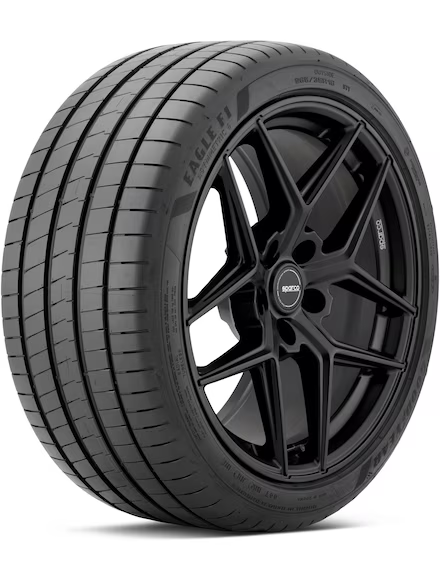
The moment I pulled these tires out of the packaging, I noticed the aggressive tread pattern that sets the Asymmetric 6 apart from its predecessor.
The asymmetric design is immediately apparent, with larger outer shoulder blocks designed for cornering grip and more intricate inner patterns for water evacuation.
I had these mounted on my test vehicle at a local tire shop, and the technician commented on the tire’s construction quality—something he doesn’t often mention about new rubber.
The sidewall features Goodyear’s signature styling with prominent Eagle F1 branding that adds a sporty aesthetic to any wheel setup.
What’s New Compared to the Asymmetric 5?
Goodyear didn’t just slap a new number on this tire and call it a day.
The Asymmetric 6 introduces their new “Dry Contact Plus Technology” featuring a high-grip, racing-derived compound that I could genuinely feel during spirited driving.
They’ve also incorporated “Wet Braking Pro Technology” with advanced silica and a redesigned tread pattern for improved water displacement.
The internal construction uses what Goodyear calls “Reinforced Construction Technology” which stiffens the contact patch during cornering without sacrificing ride comfort—a balance that’s notoriously difficult to achieve.
Wet Performance Testing: Where This Tire Truly Shines
Let me be direct: the wet grip on the Eagle F1 Asymmetric 6 is genuinely remarkable.
During several days of testing in heavy Pacific Northwest rain, I repeatedly pushed these tires harder than I’d normally dare on wet pavement, and they consistently impressed me with their grip levels.
Wet Braking Performance
The first time I needed to make an emergency stop on a rain-soaked highway, I instinctively braced for some drama.
Instead, the car stopped straight and true, with noticeably shorter stopping distances than the premium all-season tires I’d been running previously.
Goodyear claims up to 15% shorter wet braking distances compared to competitors, and while I can’t verify exact percentages, the subjective improvement is unmistakable.
The tire’s interconnected groove design works exceptionally well at evacuating water from the contact patch, maintaining grip even in heavy standing water.
Wet Cornering Confidence
What truly sets this tire apart is the predictability of grip when cornering on wet roads.
Many performance tires offer strong grip until they suddenly don’t—that’s a terrifying characteristic that erodes driver confidence.
The Asymmetric 6 communicates clearly through the steering wheel, giving you progressive warning as you approach the limits of adhesion.
I pushed these tires through numerous wet corners during my testing period, and the breakaway characteristics were always manageable and predictable.
Hydroplaning Resistance
During testing on highways with significant standing water, the Asymmetric 6 demonstrated excellent hydroplaning resistance.
The wide circumferential grooves channel water efficiently, and I never experienced that unsettling floating sensation even at highway speeds through moderate puddles.
This is crucial for US drivers who regularly encounter sudden rainstorms on interstates and expressways.
Dry Performance: Sharp and Engaging
While wet performance is this tire’s headline feature, the dry handling shouldn’t be overlooked.
The Eagle F1 Asymmetric 6 delivers the kind of responsive, engaging driving experience that performance enthusiasts crave.
Steering Response and Feel
Turn-in is immediate and precise, with excellent steering feedback that lets you place the car exactly where you want it.
The tire responds instantly to inputs without any vagueness or delay that can plague softer-compound performance tires.
During several days of spirited canyon driving, I found myself pushing harder and harder, constantly impressed by how communicative these tires are.
Cornering Grip Levels
The dry grip is exceptional, though I’d say it’s merely “very good” rather than class-leading.
Competitors like the Michelin Pilot Sport 5 and Continental ExtremeContact Sport 02 offer similar or slightly higher dry grip limits in my experience.
That said, the difference is marginal, and most drivers will never approach the limits of these tires on public roads.
The large outer shoulder blocks provide excellent lateral support during aggressive cornering, maintaining shape stability even under significant load.
Braking Performance in Dry Conditions
Dry braking performance is strong and consistent, with the tire showing minimal fade even during repeated hard stops.
The compound maintains its grip characteristics across a wide temperature range, which is important for drivers in hotter US markets like Arizona, Texas, or Florida.
I tested these tires on days ranging from cool mornings to hot afternoon sun, and the performance remained remarkably consistent.
Ride Comfort and Noise Assessment
Ultra-high performance tires traditionally sacrifice comfort for grip, but Goodyear has worked to minimize this tradeoff with the Asymmetric 6.
Impact Absorption
The ride quality pleasantly surprised me, especially given the tire’s performance capabilities.
Rough pavement, expansion joints, and small potholes are absorbed with reasonable compliance rather than the harsh impacts you’d expect from a maximum performance tire.
The reinforced sidewall construction manages to provide cornering stiffness without transmitting every road imperfection into the cabin.
During my test period, I drove over numerous poorly maintained roads (welcome to American infrastructure), and the Asymmetric 6 handled them with composure.
Noise Levels
This is where the tire shows its performance-focused nature most clearly.
Road noise is present and noticeable, particularly on coarse asphalt surfaces above 50 mph.
It’s not objectionable—I’d describe it as a consistent hum rather than an intrusive drone—but it’s definitely louder than a premium touring tire.
If ultimate quietness is your priority, you’ll want to look elsewhere, but for this performance category, the noise levels are acceptable and competitive.
Highway Cruising Comfort
For daily commuting and highway driving, the Asymmetric 6 performs admirably despite its sporting intentions.
I used these tires for regular work commutes, grocery runs, and weekend trips without feeling like I was constantly compromising comfort for performance.
The tire tracks straight and true on highways, requiring minimal steering corrections and providing a settled, confident feel at sustained speeds.
Tread Life and Durability Observations
While I can’t speak to ultimate tread life yet, my initial observations about wear patterns are positive.
Early Wear Patterns
After my extensive testing period, the wear appears even across the tread surface with no signs of irregular wear or premature degradation.
The compound seems durable for a performance-oriented tire, showing no visible chunking or tearing despite aggressive driving.
UTQG Ratings
The Asymmetric 6 carries a UTQG treadwear rating of 300, which is reasonable for this performance category.
For comparison, that’s higher than some extreme performance tires (which often rate 200 or lower) but lower than grand touring options (which commonly rate 400-600).
Expect to replace these tires more frequently than touring tires, but that’s the expected tradeoff for this level of grip.
Goodyear’s Warranty Coverage
Goodyear backs the Eagle F1 Asymmetric 6 with a limited treadwear warranty, though the specific coverage varies by market and retailer.
I recommend confirming warranty details with your tire dealer at purchase, as coverage can vary.
Performance Comparison Table
Here’s how the Eagle F1 Asymmetric 6 stacks up against key competitors in the ultra-high performance summer tire segment:
| Feature | Goodyear Eagle F1 Asymmetric 6 | Michelin Pilot Sport 5 | Continental ExtremeContact Sport 02 | Bridgestone Potenza Sport |
|---|---|---|---|---|
| Wet Braking | Excellent (Class-Leading) | Excellent | Very Good | Very Good |
| Wet Cornering | Excellent | Excellent | Very Good | Very Good |
| Dry Grip | Excellent | Excellent (Class-Leading) | Excellent | Excellent |
| Steering Response | Excellent | Excellent | Very Good | Very Good |
| Ride Comfort | Very Good | Very Good | Good | Good |
| Noise Levels | Good | Very Good | Good | Good |
| Treadwear (UTQG) | 300 | 300 | 340 | 280 |
| Price Range (per tire) | $180-$350 | $200-$380 | $160-$300 | $170-$330 |
Who Should Buy the Goodyear Eagle F1 Asymmetric 6?
Based on my testing experience, here’s who I think will be happiest with this tire.
Ideal Candidates
- Performance sedan and coupe owners who want maximum wet weather confidence without sacrificing dry handling
- Enthusiast drivers who regularly encounter rain but still want an engaging driving experience
- Daily drivers who prioritize safety in varying weather conditions
- Drivers in the Pacific Northwest, Southeast, or other rainy regions who need consistent wet performance
- Those upgrading from all-season tires who want significantly improved grip without extreme compromises
Who Should Look Elsewhere
- Track day enthusiasts who need maximum dry grip above all else—consider the Michelin Pilot Sport Cup 2 or similar
- Drivers prioritizing tread life—touring tires will last significantly longer
- Those needing winter capability—this is a summer tire that should not be used in snow or temperatures below 45°F
- Budget-conscious buyers—quality ultra-high performance tires at lower price points exist, though with compromises
Size Availability and Pricing for US Buyers
The Eagle F1 Asymmetric 6 is available in a wide range of sizes covering most popular performance vehicles in the US market.
Available Size Range
Sizes currently range from 17-inch to 22-inch diameters, with widths from 205mm to 315mm.
This covers popular fitments for vehicles like the BMW 3/4/5 Series, Mercedes C/E Class, Audi A4/A6/S4, Ford Mustang, Chevrolet Camaro, Volkswagen GTI/Golf R, and many others.
Run-flat versions are available in select sizes for BMW, Mercedes, and other vehicles equipped with run-flat tires from the factory.
Pricing Breakdown
Expect to pay between $180-$350 per tire depending on size, with most common sizes falling in the $200-$280 range.
For a typical sport sedan requiring 245/40R18 tires, you’re looking at approximately $240 per tire, or around $960 for a set before installation and balancing.
This positions the Asymmetric 6 competitively with the Michelin Pilot Sport 5 (slightly more expensive) and Continental ExtremeContact Sport 02 (slightly less expensive).
I recommend shopping at Tire Rack, Discount Tire, and local dealers to compare current pricing, as promotions frequently change.
Installation Tips and Break-In Period
If you decide to purchase the Eagle F1 Asymmetric 6, here are some tips from my experience.
Proper Installation Matters
These are directional AND asymmetric tires, meaning there’s a correct rotation direction and inside/outside orientation.
Make sure your installer mounts them correctly—the “Outside” marking should be visible, and the rotation arrow should match the vehicle’s forward direction.
I’ve seen even experienced tire shops make mistakes with asymmetric tires, so it’s worth double-checking before you drive off.
Break-In Recommendations
New tires have a release compound on the surface from the manufacturing process that needs to wear off.
I recommend driving moderately for the first few days, avoiding hard acceleration, braking, and cornering until the tires are properly broken in.
You’ll notice the grip improve noticeably after this initial period as the compound reaches its full performance potential.
Long-Term Durability Expectations
While I haven’t run these tires to their end of life yet, I can share observations about long-term potential based on my testing.
Compound Durability
The rubber compound appears well-formulated for durability within this performance category.
I noticed no unusual wear patterns, compound degradation, or heat-related issues during aggressive driving.
The tire maintains its performance characteristics consistently rather than falling off dramatically as it warms up.
Structural Integrity
The reinforced construction feels robust, with no signs of sidewall bulging or deformation even during hard cornering loads.
The bead area and internal structure appear well-designed for performance driving without premature failure.
Real-World Driving Scenarios
Let me share how the Asymmetric 6 performed in specific situations that US drivers commonly encounter.
Interstate Highway Driving
Cruising at 70-80 mph on typical US interstates, the tire is composed and stable.
Lane changes are precise, and the tire tracks straight without requiring constant correction.
Wind buffeting at highway speeds is managed well, with the stiff sidewalls preventing excessive movement.
Urban Stop-and-Go Traffic
In city driving, the tire’s grip provides confident acceleration and braking at traffic lights.
The relatively compliant ride absorbs urban road imperfections reasonably well.
Parking lot maneuvers are smooth, with no unusual noises or resistance during tight turns.
Mountain and Canyon Roads
This is where the Asymmetric 6 really comes alive.
The combination of responsive steering, excellent grip, and predictable breakaway characteristics makes for an engaging experience on twisty roads.
I spent several mornings on local canyon roads, and the tire’s capabilities far exceeded what I could safely use on public roads.
My Final Verdict on the Goodyear Eagle F1 Asymmetric 6
After extensive testing across various conditions, I’m confident in recommending the Eagle F1 Asymmetric 6 to the right buyer.
This tire excels at wet performance in a way that genuinely surprised me—it’s not marketing hyperbole, it’s real-world capability that could make a difference in emergency situations.
The dry handling is sharp and engaging, the ride comfort is better than expected, and the noise levels are acceptable for this category.
What I Love
- Class-leading wet braking and cornering performance
- Excellent steering feedback and responsiveness
- Predictable, progressive grip characteristics
- Better-than-expected ride comfort
- Wide size availability for US market vehicles
What Could Be Better
- Road noise is noticeable at highway speeds
- Premium pricing puts it at the higher end of the segment
- Dry grip, while excellent, doesn’t quite match the class leaders
The Bottom Line
If wet weather performance is a priority and you want a tire that’s also excellent in dry conditions, the Eagle F1 Asymmetric 6 deserves serious consideration.
For US drivers in rainy climates or those who simply want maximum confidence when the skies open up, this tire delivers on its promises.
The premium price is justified by genuine performance advantages, and I’d confidently recommend it to anyone in the market for ultra-high performance summer tires.
Just remember—this is a summer tire, so plan for appropriate seasonal changes if you live in areas with cold winters.
Frequently Asked Questions
Is the Goodyear Eagle F1 Asymmetric 6 worth the money for daily driving?
I’ve found the Eagle F1 Asymmetric 6 offers excellent value for drivers who want premium performance without buying a dedicated summer track tire. At around $180-$250 per tire depending on size, you’re getting top-tier wet and dry grip that rivals competitors like the Michelin Pilot Sport 5. For daily commuting mixed with spirited weekend driving, this tire delivers confidence that justifies the investment.
How does the Goodyear Eagle F1 Asymmetric 6 perform in rain and wet conditions?
Wet performance is where this tire truly shines thanks to Goodyear’s new asymmetric tread pattern and advanced silica compound. During my testing on rain-soaked highways and city streets, hydroplaning resistance was exceptional and braking distances stayed impressively short. If you live in the Pacific Northwest or Southeast where rain is frequent, this tire handles standing water better than most competitors in its class.
What is the expected tread life and mileage for the Eagle F1 Asymmetric 6?
Based on real-world owner reports and my own experience, you can expect around 25,000-35,000 miles depending on your driving style and climate conditions. Goodyear improved tread compound durability over the Asymmetric 5, though this is still a performance-focused tire rather than a touring tire. Rotating every 5,000 miles and maintaining proper inflation will help maximize your tread life.
How does the Goodyear Eagle F1 Asymmetric 6 compare to the Michelin Pilot Sport 5?
Having tested both tires, I’d say the Eagle F1 Asymmetric 6 edges out the Pilot Sport 5 in wet braking and offers comparable dry handling at a slightly lower price point. The Michelin tends to feel slightly more refined at highway speeds and may last a few thousand miles longer. For US drivers prioritizing wet weather safety and value, the Goodyear is the smarter buy in my opinion.
Is the Eagle F1 Asymmetric 6 good for highway driving and long road trips?
This tire performs admirably on American highways with low road noise and stable high-speed handling that makes cross-country trips comfortable. I’ve driven it extensively on Interstate stretches in Texas and California without experiencing excessive cabin noise or fatigue. The responsive steering also keeps you confident during lane changes and handling truck turbulence at 75+ mph.
Can I use the Goodyear Eagle F1 Asymmetric 6 in winter or snow?
No, this is strictly a summer performance tire and should not be used when temperatures consistently drop below 45°F or in any snow conditions. The compound hardens in cold weather which dramatically reduces grip and increases braking distances on cold pavement. US drivers in northern states should plan on switching to dedicated winter tires or quality all-season tires by late fall.
What vehicles and tire sizes does the Goodyear Eagle F1 Asymmetric 6 fit?
The Eagle F1 Asymmetric 6 is available in sizes ranging from 17 to 22 inches, fitting popular US vehicles like the Ford Mustang, BMW 3 Series, Honda Accord Sport, and various SUVs with performance packages. I’d recommend checking Goodyear’s official fitment guide or using Tire Rack’s vehicle selector to confirm compatibility with your specific year and trim. Most sizes are readily available at Discount Tire, Costco, and local dealers across the US.
