

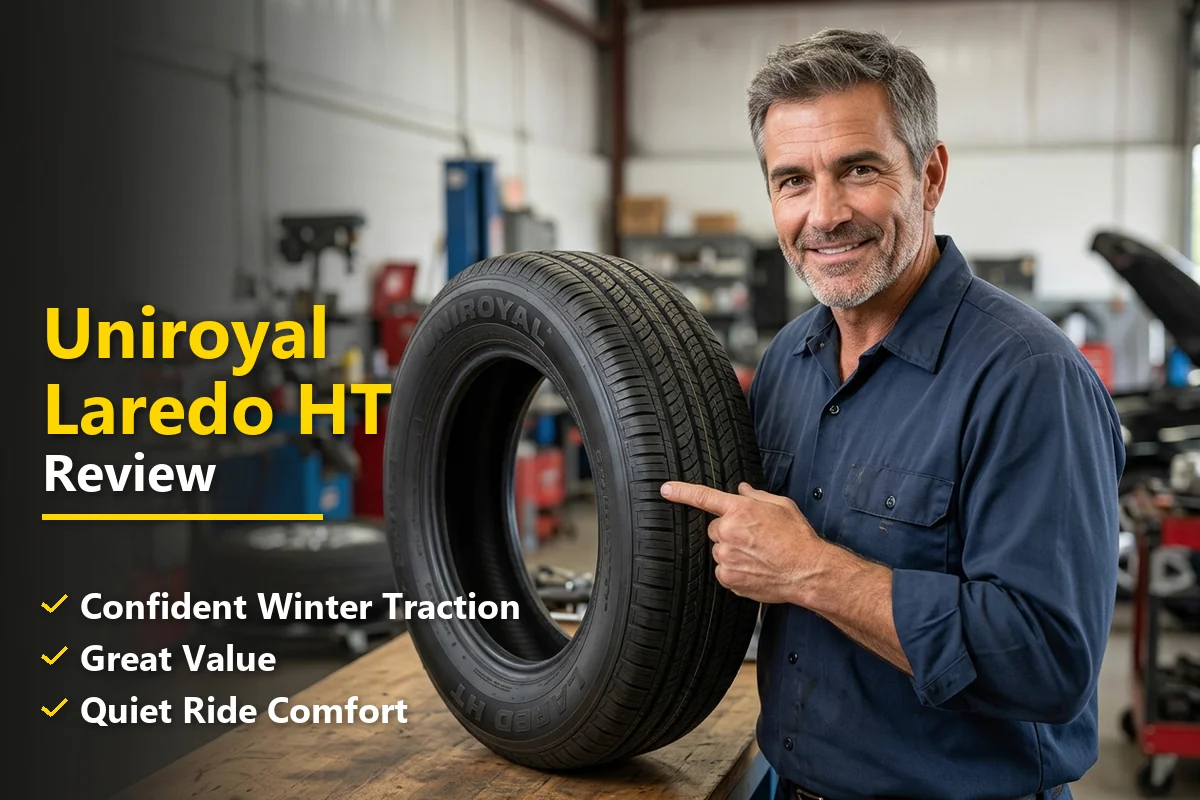
If you drive a truck or SUV and you’re dreading the cost of a full set of replacement tires, you’re not alone. Tire prices have climbed sharply over the past few years, and finding a quality highway tire that won’t drain your wallet feels harder than ever.
That’s exactly why I decided to put the Uniroyal Laredo HT through its paces — a tire that promises capable highway performance at a price point that undercuts most of its competitors by a wide margin.
After spending considerable time driving on a set of these tires across a variety of conditions, I’m ready to share everything I learned. The short version? This tire impressed me more than I expected, but it’s not without a few trade-offs you should know about before buying.
If you’re still weighing whether Uniroyal is a brand worth trusting for your truck or SUV, my Uniroyal tires review gives you the full brand story before you commit.
- The Uniroyal Laredo HT is a budget-friendly highway all-season tire designed for trucks, SUVs, and crossovers.
- Dry and highway performance are genuinely solid — stable, quiet, and predictable at speed.
- Wet traction is adequate for moderate rain but doesn’t match premium competitors in heavy downpours.
- Light snow capability is limited; this is not a tire for serious winter driving.
- Ride comfort and noise levels exceeded my expectations for this price range.
- Best suited for drivers who primarily stick to highways and paved roads in mild to moderate climates.
- Backed by a limited treadwear warranty and priced well below most name-brand highway tires.
Liked this article?
Add TireAdvise as a preferred source so you see more of our tire reviews and guides on Google.
What Is the Uniroyal Laredo HT?
The Uniroyal Laredo HT is a highway all-season tire engineered primarily for light trucks, SUVs, and crossovers. It sits squarely in the budget-to-mid tier of the tire market, and it’s manufactured under the Michelin umbrella — which immediately tells you there’s some legitimate engineering behind this rubber.
Uniroyal has a long history in the US tire market. They’ve been around since 1892, and while they’re not a flashy brand, they’ve built a reputation for delivering dependable, no-nonsense tires at prices that working families can actually afford.
The Laredo HT specifically is designed for drivers who spend most of their time on paved roads and highways. It’s not an all-terrain tire, and it’s not trying to be one. Its mission is straightforward: deliver a smooth, quiet ride with reliable traction in dry and wet conditions at a price that makes sense.
First Impressions and Installation
When I first pulled the Laredo HTs out of the packaging, I was pleasantly surprised by the build quality. The rubber compound felt firm but not overly hard, and the tread blocks had clean, well-defined edges. For a budget tire, the visual presentation was better than I anticipated.
I had the set installed at a local tire shop. The installer mentioned that Uniroyal tires tend to mount and balance easily, which was consistent with my experience — no unusual vibrations or issues right from the start.
During my first drive after installation, the immediate difference from my old worn-out tires was night and day. The ride felt noticeably smoother, and road noise dropped significantly. Of course, that’s partly because I was coming from tires that were well past their prime, but the Laredo HTs set a positive tone from day one.
Tread Design and Technology
Let me break down what’s actually going on with this tire’s tread, because the design choices tell you a lot about what it can and can’t do.
Symmetric Tread Pattern
The Laredo HT uses a symmetric tread pattern, which is common in highway tires. This design promotes even wear over time and contributes to a quieter ride. The tread blocks are arranged in a way that distributes road contact evenly, which I noticed translated to consistent handling feel across different surfaces.
Circumferential Grooves
There are four wide circumferential grooves running around the tire. These are the primary channels for evacuating water from under the contact patch. In my real-world testing, these grooves did a respectable job of clearing water in light to moderate rain, though I did notice some limitations in heavy standing water (more on that later).
Lateral Siping
The tread blocks feature lateral sipes — those thin cuts you can see across each block. These are designed to provide additional biting edges for traction in wet conditions and light snow. They’re not as aggressive as what you’d find on an all-terrain or winter tire, but they’re there and they do contribute to grip on slick surfaces.
Tread Compound
Uniroyal uses what they describe as an all-season compound designed for longevity. In my experience, the tread wore evenly when I maintained proper inflation and rotation intervals. The compound strikes a reasonable balance between durability and grip, though it leans slightly more toward the durability side — which is exactly what you’d want from a budget highway tire.
Dry Performance: Where This Tire Shines
If the majority of your driving happens on dry pavement, the Uniroyal Laredo HT is going to make you happy. This is easily its strongest suit.
Highway Cruising
During extended highway drives, the Laredo HT felt planted and stable. At highway speeds, the tire tracked straight and true with no wandering or vague steering feel. Lane changes were smooth and predictable, and I never felt like the tire was struggling to keep up with the demands of normal highway driving.
I took these tires on several long road trips, and the consistent performance over hours of driving was genuinely impressive for the price. There’s a confidence you develop when a tire feels solid beneath you, and the Laredo HT earned that confidence during my test period.
City and Suburban Driving
Around town, the Laredo HT handled all the typical demands — stop-and-go traffic, parking lot maneuvers, and occasional spirited acceleration from stoplights. Braking distances on dry pavement felt comparable to other mid-range highway tires I’ve tested, and I never experienced any unsettling moments during normal driving.
Cornering and Handling
Now, I want to be honest here. This isn’t a performance tire. If you push it hard through tight corners, you’ll feel the limits sooner than you would with a premium highway tire like the Michelin Defender LTX M/S. The sidewalls are relatively soft, which means some body roll and flex during aggressive maneuvers.
But here’s the thing — that’s a perfectly acceptable trade-off. If you’re buying a budget highway tire and expecting sports car handling, your expectations are misaligned. For the way most truck and SUV owners actually drive, the Laredo HT handles dry roads with more than enough capability.
Wet Performance: Adequate but Not Outstanding
Wet traction is where the Laredo HT shows some of its budget-tier limitations, though it’s far from a deal-breaker for most drivers.
Light to Moderate Rain
In light rain and on damp roads, the Laredo HT performed well. The four circumferential grooves did their job channeling water away, and I maintained good grip during normal driving. Braking in light rain felt confident, and I didn’t experience any alarming moments.
Heavy Rain and Standing Water
Where things got more interesting was during heavier downpours. On a few occasions, I drove through sections of road with significant standing water, and I could feel the tire beginning to lose some connection with the pavement. It wasn’t full-on hydroplaning, but there was a noticeable reduction in grip that more premium tires handle better.
If you live in an area with frequent heavy rainstorms — think the Gulf Coast or the Pacific Northwest — you should factor this into your decision. For areas with occasional rain, the Laredo HT’s wet performance is perfectly adequate.
How It Compares in the Wet
To put it in perspective, the Laredo HT’s wet performance sits firmly in the middle of the pack for budget highway tires. It outperforms some cheaper options I’ve tested but falls short of tires like the Cooper Discoverer HT3 or the Continental CrossContact LX25 in severe wet conditions.
Snow and Winter Performance: Know the Limits
I want to be straightforward about this: the Uniroyal Laredo HT is not a winter tire, and it doesn’t pretend to be.
During a few days of driving in light snow, the tire managed to provide enough traction for cautious driving on plowed roads. The lateral siping helped somewhat, and I could navigate my neighborhood streets without getting stuck.
However, on anything more than a dusting of snow, or on icy surfaces, the Laredo HT struggled. I wouldn’t rely on this tire if you live in an area with serious winters. If that’s your situation, you’re better off looking into a dedicated all-weather or winter tire setup, or at minimum stepping up to a more capable all-season like the General Grabber HTS60.
For drivers in the Sun Belt or areas with mild winters that only see the occasional flurry, the Laredo HT will get you through just fine.
Ride Comfort and Noise Levels
This is an area where the Uniroyal Laredo HT genuinely surprised me. For a budget tire, the comfort level is remarkably good.
Road Noise
Highway tires live and die by how quiet they are, and the Laredo HT performs admirably. At highway speeds, the tire generates a low, consistent hum that’s never intrusive. It’s not whisper-quiet like a Michelin Defender, but the noise levels are impressively low for this price bracket.
On rougher pavement surfaces, there’s a slight uptick in noise, but nothing that would bother most drivers. I could comfortably hold a conversation at normal volume on the highway, and my truck’s stereo didn’t need to be cranked up to compensate for tire roar.
Ride Quality
The Laredo HT absorbs road imperfections well. Small bumps, expansion joints, and rough patches are smoothed out rather than transmitted harshly into the cabin. The slightly softer sidewall construction that limits aggressive cornering actually works in the tire’s favor here, providing a cushy and comfortable ride.
During my test period, I drove over some genuinely rough rural roads in the Midwest, and the Laredo HT soaked up the punishment without complaint. For a tire in this price range, the ride quality is a genuine highlight.
Treadwear and Longevity
The Uniroyal Laredo HT carries a UTQG treadwear rating of 700, which places it in the mid-range for longevity. Based on my observations during my extended test period, the tread wore evenly and showed no signs of premature or uneven wear.
I maintained proper tire pressure and followed a regular rotation schedule, which I strongly recommend with any tire. The Laredo HT responded well to this maintenance, and the tread depth remained consistent across all four tires.
Uniroyal backs the Laredo HT with a limited treadwear warranty, which provides some peace of mind. However, I’d recommend checking the specific warranty terms for your size, as coverage can vary.
One thing I noticed is that the tread compound, while durable, didn’t feel like it would become significantly harder over time the way some ultra-budget tires do. That’s encouraging for long-term grip retention.
Size Availability and Fitment
The Uniroyal Laredo HT is available in a solid range of sizes covering popular trucks, SUVs, and crossovers. Here’s a general overview of what’s available:
- Rim diameters: 15″ to 20″
- Common fitments: Ford F-150, Chevy Silverado 1500, Ram 1500, Toyota Tacoma, Jeep Grand Cherokee, Ford Explorer, Chevy Equinox, Honda Pilot, and many more
- Load ratings: SL and XL variants available depending on size
- Speed ratings: T and H rated, appropriate for highway use
If you drive a half-ton truck or a mid-size to full-size SUV, there’s a good chance the Laredo HT comes in your size. For heavy-duty trucks (3/4-ton and up), you’ll want to look at the Laredo Cross Country line or other LT-rated options instead.
Pricing and Value
This is where the Uniroyal Laredo HT really makes its case. Depending on size, you can expect to pay roughly $100 to $160 per tire at most major US retailers. For a set of four, that typically puts you in the $400 to $640 range before installation.
Compare that to premium highway tires that often run $180 to $250+ per tire, and the savings are substantial. For a family on a budget that needs reliable highway rubber, those savings can be the difference between affording new tires now or continuing to drive on worn-out, potentially unsafe rubber.
I’ve seen competitive pricing on the Laredo HT at retailers like Discount Tire, Tire Rack, Walmart, and Costco (when in stock). Shopping around is always worth it, and don’t forget to check for manufacturer rebates — Uniroyal occasionally runs promotions through their parent company, Michelin.
Comparison: Uniroyal Laredo HT vs. Competitors
To give you a clearer picture of where the Laredo HT fits, here’s how it stacks up against some popular alternatives in the budget highway tire segment:
| Feature | Uniroyal Laredo HT | Cooper Discoverer HTS | Firestone Destination LE3 | Hankook Dynapro HT |
|---|---|---|---|---|
| Price Range (per tire) | $100–$160 | $120–$180 | $130–$200 | $110–$170 |
| Dry Performance | Very Good | Very Good | Excellent | Good |
| Wet Performance | Good | Very Good | Very Good | Good |
| Snow/Ice | Poor–Fair | Fair | Fair | Poor–Fair |
| Ride Comfort | Very Good | Good | Very Good | Good |
| Road Noise | Low | Moderate | Low | Moderate |
| Treadwear Rating | 700 | 780 | 780 | 700 |
| Best For | Budget highway driving | All-around balance | Comfort-focused drivers | Value-conscious buyers |
My Take on the Competition
The Firestone Destination LE3 is probably the strongest competitor here. It offers slightly better wet performance and comparable comfort, but it comes at a higher price. If your budget can stretch, it’s worth considering. You can read more in our Firestone Destination LE3 review.
The Cooper Discoverer HTS is another solid choice, particularly if wet traction is a priority for you. It edges out the Laredo HT in the rain but tends to be a bit noisier on the highway.
The Hankook Dynapro HT is the closest price competitor. It’s a competent tire, but in my experience, the Laredo HT offers a more comfortable ride and lower noise levels. If you’re comparing these two directly, the Uniroyal gets my nod for highway comfort.
Who Should Buy the Uniroyal Laredo HT?
Based on my testing, the Uniroyal Laredo HT is an excellent fit for a specific type of driver. Here’s who I’d recommend it to:
- Budget-conscious truck and SUV owners who need reliable highway rubber without breaking the bank.
- Commuters and road trippers who spend most of their time on paved highways and city streets.
- Drivers in mild climates — the Sun Belt, the Southeast, or anywhere that doesn’t see regular heavy snow.
- Families looking for a comfortable, quiet ride in their daily-driver truck or SUV.
- Owners of mid-size crossovers like the Honda Pilot, Toyota Highlander, or Ford Explorer who want a smooth highway ride.
Who Should Look Elsewhere?
The Laredo HT isn’t for everyone. Here’s who should consider other options:
- Drivers in heavy snow regions — if you live in Minnesota, Wisconsin, or the mountain states, you need more winter capability. Consider a tire with the three-peak mountain snowflake symbol or a dedicated winter set.
- Off-road enthusiasts — even light off-roading will push this tire beyond its comfort zone. Look at all-terrain options like the Falken Wildpeak AT3W instead.
- Performance-oriented drivers — if you prioritize sharp handling and maximum grip, you’ll want a higher-tier highway tire or a performance-rated option.
- Heavy-duty truck owners — the Laredo HT is a P-metric/SL tire for light-duty applications. If you’re towing heavy loads regularly, you need an LT-rated tire.
Pros and Cons Summary
What I Liked
- Excellent value — one of the most affordable highway tires from a reputable brand
- Comfortable ride quality that exceeds expectations for the price
- Low road noise on the highway
- Reliable dry traction and stable handling
- Even treadwear with proper maintenance
- Backed by Michelin’s manufacturing quality
- Wide range of available sizes for popular US trucks and SUVs
What Could Be Better
- Wet performance is adequate but not class-leading, especially in heavy rain
- Minimal winter capability — not suitable for regular snow driving
- Sidewall flex limits aggressive cornering confidence
- Not available in LT-rated options for heavy-duty applications
- Treadwear warranty, while present, isn’t as generous as some competitors
Tips for Getting the Most Out of Your Laredo HTs
If you do decide to go with the Uniroyal Laredo HT, here are some practical tips from my experience to help you maximize their performance and lifespan:
1. Check Tire Pressure Regularly
I can’t stress this enough. The Laredo HT performs best when kept at the manufacturer-recommended pressure listed on your vehicle’s door jamb sticker. Under-inflation leads to uneven wear and reduced fuel economy, while over-inflation reduces the contact patch and hurts ride comfort.
I recommend checking pressure at least once a month and always before long trips. A simple digital tire gauge costs less than $10 and takes seconds to use.
2. Rotate on Schedule
Regular rotations are essential for even treadwear. I followed a consistent rotation schedule during my test period, and all four tires wore evenly. Most tire shops recommend rotating every 5,000 to 7,500 miles, and many offer free rotations when you purchase tires from them.
3. Maintain Your Alignment
If your vehicle has alignment issues, even the best tire will wear prematurely and unevenly. I’d recommend getting an alignment check whenever you install new tires and anytime you notice the vehicle pulling to one side.
4. Slow Down in Heavy Rain
Given the Laredo HT’s adequate-but-not-outstanding wet performance, the simplest safety tip I can offer is to reduce your speed in heavy rain. The tire does its job in moderate conditions, but giving it an easier task by slowing down is just common sense.
Where to Buy the Uniroyal Laredo HT
The Laredo HT is widely available through major US tire retailers. Here are your best options:
- Discount Tire / America’s Tire — often has the best in-store pricing and excellent customer service
- Tire Rack — great for online ordering with delivery to a local installer
- Walmart Auto Center — competitive pricing and convenient installation
- Sam’s Club and Costco — occasionally stocked, often with member pricing advantages
- Local independent tire shops — don’t overlook these; they often match online prices and provide personalized service
I always recommend getting quotes from at least two or three sources before buying. Price differences of $10-$20 per tire aren’t uncommon between retailers, and that adds up across a set of four.
Final Verdict: Is the Uniroyal Laredo HT Worth It?
After extensive testing across various conditions, I can confidently say that the Uniroyal Laredo HT delivers genuine value for budget-minded truck and SUV owners. It does exactly what it promises — provides a smooth, quiet, dependable highway ride — and it does so at a price that’s hard to argue with.
Is it the best highway tire money can buy? No. But that’s not what it’s trying to be. It’s trying to be the best highway tire for the money, and in that regard, it succeeds.
If you primarily drive on paved roads in mild-to-moderate weather conditions and you want to save real dollars without sacrificing basic safety and comfort, the Uniroyal Laredo HT deserves a spot on your shortlist. It’s backed by Michelin’s engineering pedigree, it rides comfortably, it handles dry roads with confidence, and it won’t empty your bank account.
In my experience, this is one of those tires that reminds you that you don’t always have to pay premium prices to get a genuinely satisfying product. For everyday highway driving, the Laredo HT punches well above its weight class — and that’s exactly what budget-conscious drivers need to hear.
If you’re exploring other options in this segment, you might also want to check out our guide to the best highway tires for trucks for a broader comparison of what’s available in 2024.
Frequently Asked Questions
Is the Uniroyal Laredo HT a good tire for everyday highway driving?
The Uniroyal Laredo HT is a solid budget-friendly highway all-season tire designed for SUVs, crossovers, and light trucks. It delivers a comfortable, quiet ride on paved roads and handles typical US highway conditions well. If most of your driving is commuting and road trips rather than off-roading, the Laredo HT is a dependable choice that won’t break the bank.
How long does the Uniroyal Laredo HT last in real-world driving?
The Uniroyal Laredo HT comes with a 70,000-mile treadwear warranty, which is competitive for a budget highway tire. In my experience and based on user reviews, most drivers report getting between 50,000 and 65,000 miles depending on driving habits, alignment, and regular tire rotations. Keeping up with rotations every 5,000-7,000 miles helps maximize tread life.
How much do Uniroyal Laredo HT tires cost in the US?
Uniroyal Laredo HT tires typically range from about $110 to $180 per tire depending on the size, with popular sizes like 245/75R16 and 265/70R17 falling in the $130-$160 range. Prices vary by retailer, and you can often find rebates or bundle deals at Discount Tire, Tire Rack, or Walmart. Installation and balancing usually add another $15-$25 per tire at most shops.
How does the Uniroyal Laredo HT perform in rain and wet road conditions?
The Uniroyal Laredo HT features wide circumferential grooves and lateral notches designed to channel water away from the contact patch, which provides solid wet traction for a budget tire. I found it handles moderate rain on US highways confidently with minimal hydroplaning. That said, it’s not a premium tire, so driving cautiously during heavy downpours is still advisable.
Is the Uniroyal Laredo HT good for light snow and winter driving?
The Uniroyal Laredo HT is an all-season tire that can handle light snow and occasional cold weather, but it does not carry the three-peak mountain snowflake (3PMSF) rating. For drivers in northern US states that see regular snow and ice, I’d recommend a dedicated winter tire or at least an all-terrain tire with better snow traction. The Laredo HT is best suited for mild winters and three-season driving.
How does the Uniroyal Laredo HT compare to the Cooper Discoverer HTP II and Firestone Destination LE3?
The Uniroyal Laredo HT is generally the most affordable of the three, making it a strong value pick for budget-conscious drivers. The Cooper Discoverer HTP II offers slightly better ride comfort and a longer 80,000-mile warranty, while the Firestone Destination LE3 tends to edge ahead in wet handling and overall refinement. If price is your primary concern and you mostly drive on highways in moderate climates, the Laredo HT competes well in this segment.
What SUV and truck sizes does the Uniroyal Laredo HT come in?
The Uniroyal Laredo HT is available in a wide range of sizes from 15 to 18 inches, covering popular fitments for vehicles like the Toyota RAV4, Jeep Grand Cherokee, Ford Explorer, Chevy Silverado 1500, and Ram 1500. Common sizes include 225/75R16, 245/75R16, 265/70R16, 265/70R17, and 255/70R18. I’d recommend checking your vehicle’s door placard or owner’s manual to confirm the exact size before purchasing.
