I’ve watched a $1,200 set of tires get chewed to bare metal in under 18,000 miles — all because the owner skipped a $99 alignment check. Don’t be that guy.
- Tire alignment (also called wheel alignment) is the adjustment of your vehicle’s suspension angles so all four tires make proper, even contact with the road.
- It does NOT mean straightening your tires themselves — it means calibrating the geometry of the entire suspension system.
- A proper alignment prevents uneven tire wear, fixes a pulling car, improves fuel economy, and keeps your steering precise.
- Most cars need an alignment check every 12–15,000 miles or once a year, whichever comes first — and always after hitting a major pothole or curb.
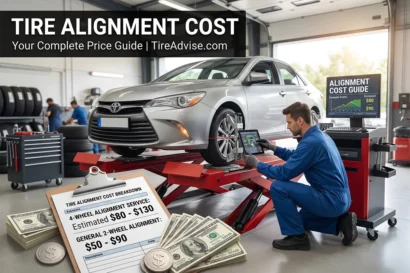
- Cost typically runs $75–$150 for a standard four-wheel alignment.
For a broader look at keeping your tires in shape, bookmark our tire buying and maintenance guide — it covers everything from reading tire wear patterns to knowing when it’s time for a replacement.
What Is Tire Alignment, Exactly?
Let me start with what tire alignment is not — because this trips up a surprising number of people.
Alignment does not mean physically straightening your tires or wheels. Your tires are already round. Your wheels are (hopefully) already straight.
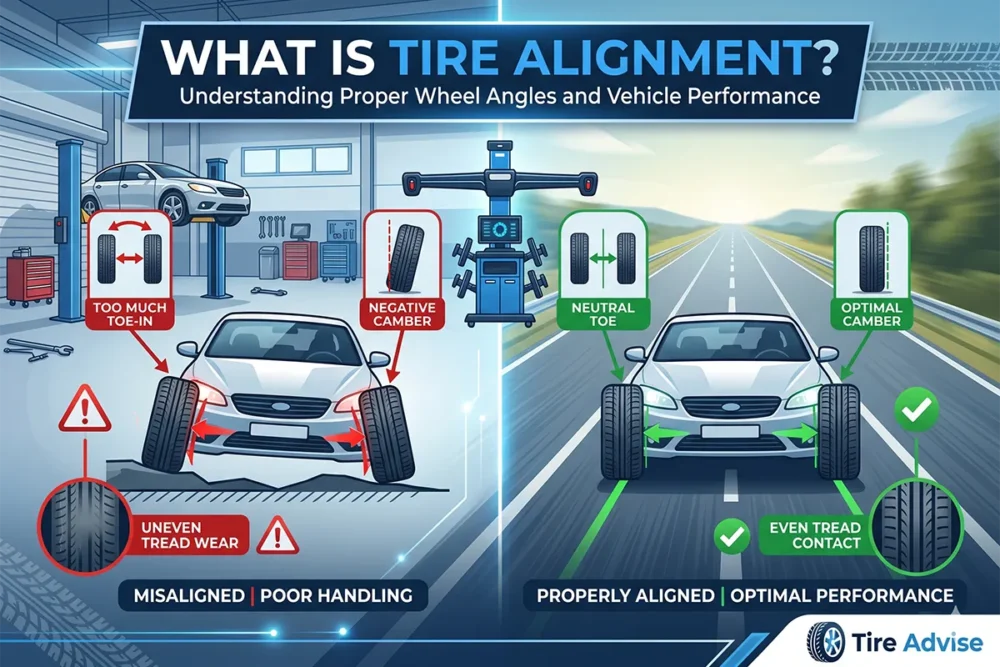
What alignment actually refers to is the angles at which your tires contact the road, and how those angles relate to each other, to the vehicle’s centerline, and to the road surface itself.
These angles are controlled by your suspension system — the collection of arms, struts, ball joints, and tie rods that connect your wheels to the rest of the car.
Over time, and thanks to the everyday brutality of American roads, those components shift. Potholes, curbs, worn bushings, minor accidents — all of it gradually moves your suspension out of spec.
Alignment is the process of measuring those deviations and adjusting the components back to the manufacturer’s specified settings.
When I say “alignment,” I’m really talking about three primary angle measurements:
The Three Alignment Angles
1. Camber Camber is the inward or outward tilt of your tire when viewed from the front of the car. A perfectly vertical tire has zero camber. If the top of the tire leans outward (away from the car), that’s positive camber. If it leans inward, that’s negative camber. For most passenger cars and trucks, manufacturers specify very slight negative camber — just a fraction of a degree — to improve straight-line stability and even contact under load. Too much camber in either direction wears the inner or outer edge of your tread dramatically fast.
2. Toe Toe describes whether your tires point slightly inward (toe-in) or outward (toe-out) when viewed from above, like duck feet vs. pigeon feet. This is the most common alignment issue I see, and it’s the one that destroys tires fastest if ignored. Even a few millimeters of toe misalignment causes your tires to scrub sideways against the road with every foot you travel. The wear pattern it creates looks like feathering or sawtoothing across the tread face — a dead giveaway during a visual inspection.
3. Caster Caster is the forward or rearward tilt of the steering axis when viewed from the side. Positive caster (top of the steering axis tilted toward the rear of the car) is what gives your steering its self-centering feel and directional stability at highway speeds. Most vehicles run positive caster from the factory. Caster rarely changes on its own unless you’ve been in a collision or have bent suspension components — but when it’s off, the car either pulls to one side or feels eerily light and vague on the highway.
What Does Tire Alignment Do for Your Car?
The short answer: alignment makes your car drive the way it was designed to. But let me break that down into real-world consequences you’ll actually notice.
It Prevents Catastrophic Tire Wear
This is the big one. A misaligned vehicle is, at a mechanical level, constantly fighting itself. Your tires want to roll forward cleanly; misalignment forces them to scrub sideways at the same time.
The result is uneven tread wear that no rotation schedule can fix once it sets in. I’ve personally inspected tires that had 50% of their tread remaining on one side and were worn to the wear bars on the other — entirely due to camber that was off by less than a degree. Those tires had maybe 8,000 miles on them.
Proper alignment ensures your tires wear evenly from edge to edge, which means you get the full rated mileage out of every set you buy.
It Fixes a Car That Pulls to One Side
If you let go of the wheel on a flat, straight road and your car drifts left or right, you almost certainly have an alignment issue (or different tire pressures — check those first).
Most commonly it’s a toe or caster discrepancy between the left and right sides. After an alignment, that drift disappears and the car tracks dead straight with minimal steering input.
It Improves Fuel Economy
This one surprises people. A tire that’s constantly scrubbing sideways creates rolling resistance. It’s not huge — we’re not talking dramatic MPG swings — but studies have shown that a vehicle with significantly misaligned wheels can suffer a 10% reduction in fuel efficiency.
On a car that normally gets 30 MPG, that’s 3 MPG gone. Over a year of driving, that adds up to real money, especially at current gas prices.
It Sharpens Steering Response
A well-aligned car tracks intuitively. You point it where you want to go, and it goes there. When alignment drifts — especially caster — you start to notice a looseness or vagueness in the steering, particularly at highway speeds. The car doesn’t feel connected to the road the same way. After a proper alignment, that tightness returns, and driving honestly becomes more enjoyable.
Signs Your Car Needs an Alignment Right Now
I always tell people: don’t wait for the scheduled interval if any of these are happening. Go sooner.
Your steering wheel is off-center. When driving straight, the steering wheel logo should be level. If it’s rotated even slightly left or right while you’re going straight, something has shifted.
The car pulls to one side. As mentioned above — straight road, flat surface, hands off the wheel, car drifts. That’s not normal.
Uneven or rapid tire wear. Check your tires regularly. If one edge is significantly more worn than the other, or if you see feathering across the tread blocks, alignment is the first suspect.
Squealing tires during normal turns. A small amount of tire chirp is normal in tight parking lot turns. But if your tires are squealing during normal highway on-ramps or gentle curves, that toe misalignment is likely causing your tires to slide rather than roll.
The car feels loose or wandery at highway speeds. This one’s a caster issue more often than not. The car requires constant, small steering corrections to hold a lane.
You recently hit something hard. Curbs, potholes, parking barriers — any hard impact can knock your alignment out of spec immediately. If you’ve had one of those “well, that wasn’t great” moments on the road recently, schedule an alignment check regardless of where you are in your maintenance cycle.
How Is Tire Alignment Done?
When you bring your car in for an alignment, here’s what actually happens. I’ve watched this process dozens of times, and it’s worth understanding so you can evaluate whether a shop is doing it right.
Step 1: Mount the alignment sensors. The technician attaches a set of electronic sensors (or cameras, at more modern shops using 3D alignment systems) to each wheel. These sensors communicate with a computer that reads the current angles of all four wheels simultaneously.
Step 2: Take initial measurements. The car is rolled onto the alignment rack and the computer takes a baseline reading of where all four wheels currently sit relative to each other and to the vehicle’s thrust line (the direction the rear axle is actually pushing the car). The screen shows current values alongside the manufacturer’s target specs, with anything out of range flagged in red.
Step 3: Make the adjustments. On most modern vehicles, toe is adjusted by turning the tie rod ends — threaded components that physically move the wheel inward or outward. Camber may be adjustable via eccentric bolts in the strut mount or control arm, though on many newer cars it’s fixed from the factory (a key reason some shops will upsell you on “camber kits” — but that’s a separate conversation). Caster is generally not adjustable without aftermarket components unless collision damage is involved.
Step 4: Verify and print. A good shop will print the before-and-after alignment spec sheet and hand it to you. This is your proof of work. The numbers should show red values from before and green values afterward. If a shop can’t or won’t give you this printout, that’s a red flag.
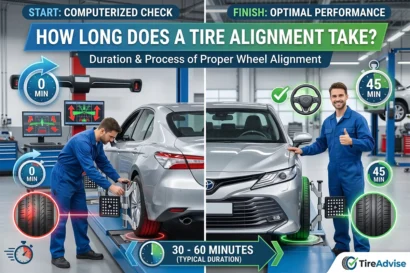
The whole process takes anywhere from 30 minutes to an hour for a straightforward four-wheel alignment on a passenger car. If there are worn components (tie rod ends, control arm bushings) that need replacing before the alignment can hold, add time accordingly.
For a full breakdown of the timeline, see our guide on how long a tire alignment takes.
Two-Wheel vs. Four-Wheel Alignment: Which Do You Need?
Front-end alignment (2-wheel): Only the front wheels are adjusted. This used to be standard on rear-wheel-drive vehicles where the rear axle is a solid beam with fixed geometry. Some light trucks and older vehicles still fall into this category.
Four-wheel alignment: All four wheels are measured and adjusted. This is what the vast majority of modern front-wheel-drive, all-wheel-drive, and independent rear suspension vehicles need. If your car has independent rear suspension — which includes almost every passenger car sold in the last 20 years — you need a four-wheel alignment. Doing only the front on one of these cars is like putting new tires on only one axle: incomplete and potentially counterproductive.
When in doubt, always go for the four-wheel. The price difference is usually small, and the completeness of the adjustment is not.
How Often Should You Get a Tire Alignment?
The standard recommendation is every 12–15,000 miles or once a year, whichever comes first. I follow the 12,000-mile interval personally, which roughly maps to my oil change schedule — it’s easy to remember and keeps everything on one visit.
That said, frequency depends on your specific situation:
- You drive on rough roads frequently: Every 6,000–8,000 miles. Rural routes, construction zones, and pothole-heavy urban driving are hard on suspension geometry.
- You have a lowered or modified vehicle: More often. Modified suspension components can be more sensitive to changes in geometry.
- You just got new tires: Always check alignment with new tires. Putting a fresh set on a misaligned car is one of the most expensive mistakes a tire buyer can make.
- You’ve been in any collision, even minor: Get an alignment check before driving any significant distance.
For the full breakdown, our article on how often you need a tire alignment covers all the variables in detail.
Is Tire Alignment Necessary? (The Honest Answer)
Yes. Full stop. I say this not as someone who benefits from recommending services, but as someone who has seen what misalignment does to a set of tires over 20,000 miles.
Is it urgent if you’re slightly out of spec? Depends on the severity. Minor deviation won’t destroy tires overnight. But here’s the thing: by the time you notice the symptoms — the pull, the wear pattern, the wandery feel — you’ve often already sacrificed meaningful tread life.
The math is simple. A four-wheel alignment runs $75–$150 at most shops. A set of decent all-season tires costs $400–$800 installed. If bad alignment cuts your tire life by 30%, that’s $120–$240 in rubber lost per set. The alignment pays for itself twice over, just in tire savings.
The one situation where alignment isn’t strictly urgent: if your car drives perfectly straight, your tires are wearing evenly, you haven’t hit anything, and your last alignment was recent. But that’s not “alignment is unnecessary” — that’s “your alignment is probably still in spec.”
Do you need an alignment with new tires? Almost always yes, especially if you can’t document a recent alignment. More on that in our article on signs you need a tire alignment.
Tire Alignment vs. Tire Rotation: Not the Same Thing
I get this question constantly. They are completely different services that accomplish different things.
Tire rotation moves tires between positions on your vehicle (front-left to rear-right, etc.) to equalize wear across all four tires. It works with an aligned suspension.
Tire alignment adjusts the suspension angles so tires wear evenly in the first place. It works regardless of which position a tire is mounted in.
If your alignment is bad, rotating your tires will just move the damage around. You need to fix the root cause first, then rotate. For a full comparison, see our article on tire rotation vs. alignment.
Where to Get a Tire Alignment (And Who to Trust)
Most tire shops (Discount Tire, Firestone, Mavis, etc.) offer alignment services, and they’re often well-equipped because their core business depends on tires lasting. I generally prefer tire shops over quick-lube chains for alignment work because the techs tend to be more experienced with suspension geometry.
Dealerships are reliable but typically more expensive. If your car is still under warranty and you’re concerned about alignment-related tire wear impacting a warranty claim, the dealership alignment records can be useful documentation.
Independent alignment specialists — shops that specifically focus on alignment and suspension — often have the newest 3D alignment equipment and the most experienced techs. If you have a lowered car, a truck with a lift, or an unusual suspension setup, find one of these.
Things to avoid: Discount oil change chains that offer alignment as an add-on. The equipment is often older and the technicians are generalists. For an $80 ticket that affects how your $600 tire set wears, I want a specialist, not an upsell.
Frequently Asked Questions About Tire Alignment
What is tire alignment?
Tire alignment (or wheel alignment) is the process of adjusting your vehicle’s suspension system so that all four tires make proper, even contact with the road at the correct angles. It involves calibrating three main angles — camber, toe, and caster — to the manufacturer’s specifications.
What does tire alignment do?
Alignment prevents uneven tire wear, stops a car from pulling to one side, improves fuel economy by reducing rolling resistance, and makes steering feel precise and responsive. Essentially, it makes the car drive the way it was designed to.
How do I know if my car needs an alignment?
Look for these signs: the car pulls left or right on a straight road, the steering wheel is off-center while driving straight, your tires are wearing unevenly (especially one edge faster than the other), or you’ve recently hit a hard pothole or curb.
How often should I get a tire alignment?
For most drivers, once a year or every 12,000–15,000 miles is a solid baseline. Increase frequency if you drive rough roads regularly, have recently been in a collision, or just mounted new tires.
How long does a tire alignment take?
A standard four-wheel alignment on a passenger car typically takes 30–60 minutes. If worn suspension parts need to be replaced first, add another 30–90 minutes depending on the component.
How much does a tire alignment cost?
Expect to pay $75–$100 for a front-end (2-wheel) alignment and $100–$150 for a four-wheel alignment at most tire shops and independent garages. Dealer pricing is typically higher. For a full price breakdown by vehicle type and region, see our guide on how much a tire alignment costs.
Is tire alignment the same as tire rotation?
No. Rotation physically moves tires between positions on your car to equalize wear. Alignment adjusts the suspension angles so tires wear evenly regardless of position. They’re complementary services — both matter.
Do I need an alignment with new tires?
Yes, in most cases. Putting new tires on a misaligned car will cause them to wear unevenly from the start. Unless you have documented proof of a recent alignment, always pair new tires with an alignment check.
Is tire alignment necessary?
For any vehicle you plan to drive more than a few thousand miles, yes. It directly affects tire longevity and fuel economy — both of which cost you real money when alignment is neglected.
Final Thoughts
Tire alignment is one of those maintenance items that quietly saves you a lot of money when you stay on top of it, and costs you a lot when you don’t. It’s not glamorous. Nobody posts about their alignment appointment on social media. But after writing about tires for years and personally logging tens of thousands of miles across everything from economy cars to lifted trucks, I can tell you: the cheapest tires with a perfect alignment will outlast the most expensive tires on a neglected suspension every single time.
Add it to your calendar. Check it every 12,000 miles. And definitely check it the next time you hear that unmistakable thud from a pothole.
Explore more on the site: