

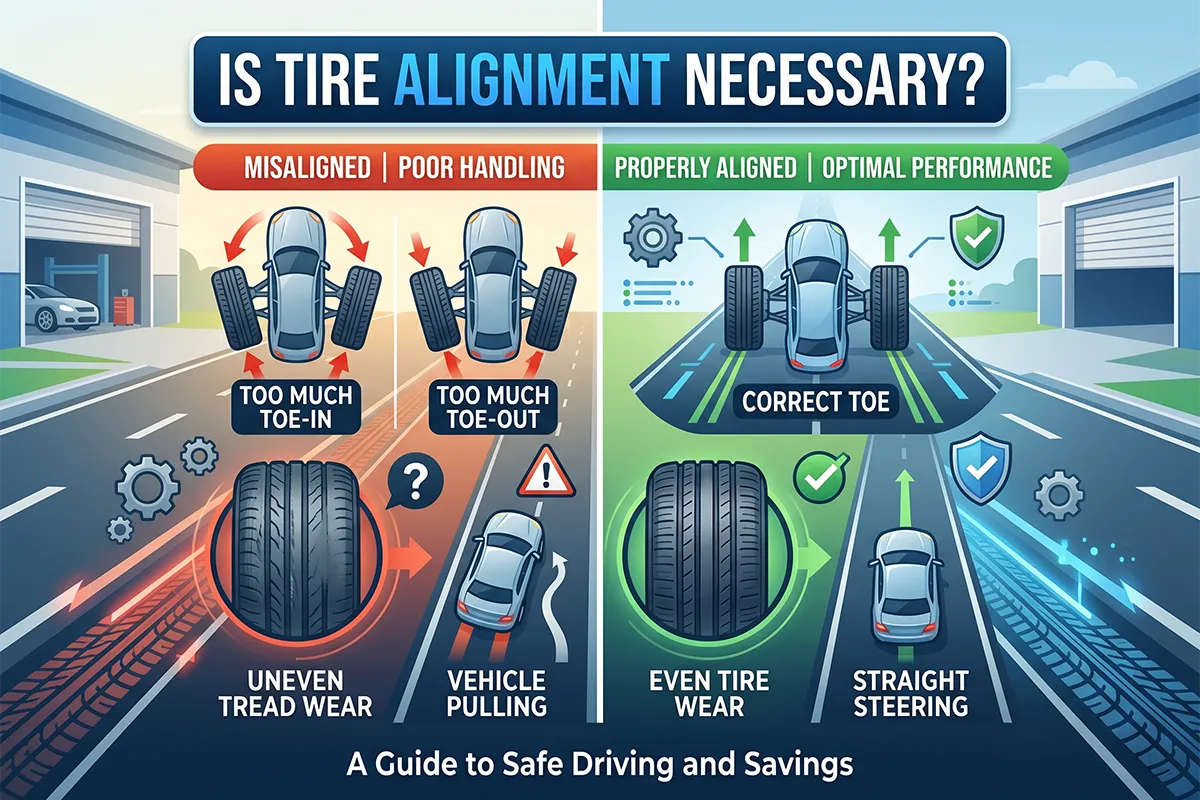
A reader once emailed me frustrated after a shop told him he needed an alignment — his car drove fine, he’d never had a complaint, and he suspected it was just an upsell. He asked me straight: is tire alignment actually necessary, or is this one of those services that gets pushed on everyone regardless? I told him what I’ll tell you here — and the answer is more nuanced than a flat yes.
- Yes, tire alignment is necessary — but “necessary right now” and “you need one eventually” are different things.
- Alignment directly protects tire life, fuel economy, and handling.
- Neglecting it long enough guarantees uneven tire wear, and uneven wear cannot be reversed.
- That said, not every car needs an alignment at every service visit, and not every shop recommendation is urgent.
- This article gives you the diagnostic tools to know for yourself whether your car actually needs one — starting with the physical symptoms your tires and steering will show you before any technician says a word.
If you want the full technical picture of what alignment involves and why it affects your car the way it does, our complete tire alignment guide covers the mechanics in depth. Here we’re focused on the practical question most drivers actually face: does my car need one right now, and how do I know?
Liked this article?
Add TireAdvise as a preferred source so you see more of our tire reviews and guides on Google.
The Direct Answer: Is Tire Alignment Necessary?
Yes — for any vehicle you intend to drive more than a handful of miles on, tire alignment is a necessary service. Not optional, not merely cosmetic, not a manufactured upsell category. It is a foundational part of how your tires wear, how your car handles, and how much fuel it consumes.
The reason it gets dismissed by some drivers is that misalignment is largely invisible in its early stages. The car doesn’t throw a warning light. No unusual noise announces itself the morning your toe drifts a few millimeters out of spec.
For the first few thousand miles after alignment slips, the car may drive and feel completely normal. The damage accumulates quietly, in the tread, where you’d need to look closely to catch it early.
By the time misalignment becomes obvious — a pronounced pull, a steering wheel that’s noticeably off-center, tread worn to the indicator bars on one edge while the other edge still has 60% life — the tires have already sustained damage that no subsequent alignment can undo.
You can realign the car and stop the ongoing damage, but the uneven wear already recorded in the rubber is permanent. That means a tire replacement is coming sooner than it should.
That’s the core reason alignment is necessary: it isn’t protecting the alignment itself. It’s protecting the much more expensive set of tires mounted on that suspension.
Why Do You Need Tire Alignment? The Mechanical Case
To understand why alignment is necessary rather than optional, it helps to understand what it’s actually doing for your car every mile you drive.
Your tires are designed to roll forward in a straight line, making flush, even contact with the road across the full width of their tread face.
When alignment angles — camber, toe, and caster — fall outside manufacturer specifications, your tires are no longer rolling cleanly. They’re scrubbing sideways to some degree with every revolution, fighting the geometry that’s supposed to let them roll freely.
Toe misalignment is the worst offender for tire wear. Even a few millimeters of toe deviation causes your tires to drag slightly sideways as they roll forward — imagine trying to walk efficiently with your feet pointed 10 degrees in or out. The friction that creates doesn’t stop the car, but it steadily grinds away at one edge of the tread in a pattern that becomes unmistakable once you know what you’re looking at.
Camber misalignment concentrates the vehicle’s weight on one edge of the contact patch rather than distributing it evenly. Over thousands of miles, the overloaded edge wears faster, producing the classic one-sided wear pattern that often goes unnoticed until it’s severe.
Caster misalignment primarily affects steering stability rather than tire wear directly, but it causes the car to require constant steering correction to hold a lane — which fatigues the driver and, over time, creates its own uneven loading patterns.
The compounding effect of all three working against each other on a neglected suspension is why a $600 tire set can be destroyed in under 25,000 miles on a car where a $120 alignment service would have kept things right. That’s the mechanical case for why tire alignment is necessary — it isn’t theoretical, it’s arithmetic.
Signs You Need a Tire Alignment Right Now
This is the section that matters most for drivers who aren’t sure whether to book an appointment. These are the specific, observable symptoms your car will show when alignment has drifted enough to need attention.
I’ve seen every one of these in person on cars that came in for other work and left with a surprise alignment bill — because the owners had adapted to the symptoms gradually without registering them as problems.
Sign 1: The Car Pulls to One Side
The most straightforward test you can do costs nothing and takes ten seconds. Find a flat, straight, empty stretch of road — a quiet parking lot works if you don’t have open road nearby. Drive at a moderate speed and take your hands completely off the wheel for two to three seconds.
A properly aligned car will track dead straight with no steering input. A misaligned car will drift consistently to one side. The drift may be subtle — a gentle lean you’d barely notice with hands on the wheel — or it may be pronounced enough that the car is clearly heading toward one lane boundary.
Important caveat: check your tire pressures before running this test. Significantly different pressures between the left and right front tires can cause a pull that mimics misalignment. If your pressures are equal and the car still pulls, alignment is your first suspect.
Sign 2: The Steering Wheel Is Off-Center
When driving straight on a flat road, the steering wheel should be perfectly level — the logo, the spoke, whichever visual reference you use should be horizontal.
If your wheel is rotated even 5–10 degrees left or right while you’re tracking straight, that’s telling you the front wheels aren’t pointing in exactly the same direction they were when the last alignment was set.
This symptom is easy to overlook because it develops gradually. Most drivers unconsciously compensate with a small constant steering input and stop noticing the wheel is crooked.
I’ve ridden in cars where the owner genuinely didn’t notice their steering wheel was rotated a full quarter-turn to the left until I pointed it out. At that point, the tires had been telling the same story in their wear pattern for a long time.
Sign 3: Uneven or Rapid Tire Wear
Get in the habit of physically checking your tires every few weeks — not just a glance, but actually crouching down and running your hand across the tread face. Misalignment leaves specific, identifiable wear signatures:
One-sided edge wear: One edge of the tire — inner or outer — is significantly more worn than the rest of the tread width. Running your fingers across the tread from edge to center, you’ll feel a distinct height drop on the worn side. This is the camber signature, and it’s one of the most common patterns I see on cars that come in for rotation and haven’t had an alignment in years.
Feathering: Run the back of your hand lightly across the tread blocks from one side of the tire to the other. If you feel a sawtooth pattern — each block rounded on one side and sharp on the other — that’s the toe misalignment signature. It’s subtle to the eye but obvious to the touch once you know what you’re feeling for.
Diagonal wipe: A less common pattern where tread wear runs diagonally across the tire face, often associated with a combination of toe and camber issues, or with worn suspension components that are allowing dynamic geometry changes under load.
Any of these patterns means the alignment has been out of spec long enough to physically record itself in the rubber. Schedule an alignment immediately and inspect the remaining tread carefully — depending on severity, some of these tires may be closer to replacement than the overall tread depth suggests.
Sign 4: Squealing on Normal Turns
A small amount of tire chirp in tight low-speed parking lot maneuvers is normal — particularly with performance-oriented tires and hard pavement. What isn’t normal is squealing during regular-speed turns: highway on-ramps, gentle sweeping curves, normal residential corner turns at 15–20 mph.
When toe misalignment is significant enough, the tire is no longer rolling cleanly into a turn — it’s sliding sideways across the road surface in addition to rolling through the arc.
That sliding produces the squeal. It also means every turn is generating heat and friction in the tire that a properly aligned car doesn’t create. The sound is the tire complaining. Worth listening to.
Sign 5: Vague, Wandery Feeling at Highway Speed
This one is the easiest to rationalize away as “just how the car drives.” On a straight highway at 65–75 mph, a properly aligned car with healthy tires and suspension should feel planted and confident, requiring only the lightest steering inputs to maintain lane position.
If you find yourself making constant small corrections to hold a lane — if the car feels like it’s floating or doesn’t want to track straight without active steering — caster is often the culprit, though worn tie rod ends or a degraded suspension component can produce similar behavior.
This symptom tends to develop slowly enough that drivers accommodate it rather than flag it as a problem, which is exactly how it goes unaddressed for 20,000 miles.
Sign 6: You’ve Recently Had a Hard Impact
This is a trigger, not a symptom — the sign here is the event itself rather than what you feel afterward. If you’ve experienced any of the following in the past few thousand miles, book an alignment check regardless of how the car feels:
- A pothole hit that caused a noticeable jolt or thud from the suspension
- Contact with a curb at anything above crawling speed
- Bottoming out on a speed bump, dip, or off-road surface
- Any collision, however minor, that involved a wheel or corner of the car
Alignment can shift in a single significant impact. The geometry may change enough to start damaging tires without producing symptoms obvious enough to catch your attention — especially if the change is relatively small.
An alignment check after an impact is cheap insurance against paying for a new tire set sooner than necessary.
Do You Need a Tire Alignment With New Tires?
This question comes up constantly, and I want to give it the direct answer it deserves: almost always yes.
Here’s the situation most drivers are actually in when they’re buying new tires: they don’t have documentation of a recent alignment, or their last alignment was 18,000 miles and two winters ago, or they’ve had a pothole or two since the last time anyone checked.
In that situation — which describes the overwhelming majority of tire buyers — getting an alignment with new tires isn’t optional, it’s essential.
The reasoning is straightforward. New tires represent a real investment — $400 to $800 installed for a quality set on a typical crossover or sedan. That investment is rated to last 50,000 to 70,000 miles under proper conditions.
Putting those tires on a misaligned car starts the uneven wear clock running from mile one. You won’t see it for the first few thousand miles.
But by 15,000 miles the difference between aligned and misaligned is already visible in the tread pattern, and by 30,000 miles a tire that should have had 40,000+ miles of life left may be showing wear indicators.
The math is not subtle. Spending $120 on an alignment to protect a $600 tire investment is one of the highest-return maintenance decisions you can make.
The one exception where you might legitimately skip it: you have documented proof from a reputable shop that your alignment was checked and corrected within the last 6,000–8,000 miles, you haven’t had any hard impact events since, and the car is tracking straight with no symptoms.
In that case, skipping the alignment with a new tire installation is defensible. In every other case, do it.
Situations Where Alignment Is Non-Negotiable
Beyond the standard maintenance case, there are specific situations where skipping an alignment creates immediate, compounding problems.
After Any Suspension or Steering Component Replacement
Tie rod ends, control arm bushings, ball joints, struts, sway bar end links — replacing any of these changes the geometry of that corner of the car. Even if the new parts are torqued exactly to spec, they occupy a slightly different position than the worn components they replaced.
The alignment must be reset after any suspension or steering work, full stop. Any shop that replaces suspension components without recommending a follow-up alignment is leaving a job half done.
After Any Collision
Even a minor parking lot bump at 5 mph transfers enough force into the suspension to shift alignment angles. A more significant impact at road speed can bend components outright. Collision repair that doesn’t include a four-wheel alignment check is incomplete regardless of how well the body work looks.
After Installing a Lift or Lowering Kit
Changing your vehicle’s ride height changes the effective geometry of the entire suspension system. A stock alignment spec is meaningless on a lifted or lowered vehicle — the angles need to be reset to match the new configuration, often using custom targets rather than OEM specs.
Driving a modified vehicle without a post-installation alignment is one of the faster ways to destroy a set of tires I’ve seen.
When Is Alignment NOT an Urgent Priority?
In the interest of honest, balanced advice — because I’m not here to push services you don’t need — here’s when alignment isn’t an immediate priority:
You had a documented, verified alignment recently. If you have the before-and-after printout from a reputable shop showing all values within spec from the last 8,000–10,000 miles, and you haven’t had any trigger events since, you don’t need another alignment right now.
The car drives straight and the tires are wearing evenly. These are your two real-world verification checks. A car that tracks straight with a centered steering wheel and tires wearing consistently across the full tread width is telling you the alignment is in reasonable shape. Trust the evidence.
The shop flagging it can’t show you the measurement. If a shop tells you that you need an alignment but can’t — or won’t — show you a computer printout of out-of-spec values, that’s not a diagnosis, it’s a guess. Ask to see the numbers. A shop doing legitimate alignment work can always show you exactly what’s out of spec and by how much.
The ROI of Not Skipping It
For drivers who track their car costs carefully, here’s the full financial picture of regular alignment service versus neglect.
With regular alignment every 12,000 miles:
- Annual alignment cost: $100–$150
- Tire life achieved: full rated mileage (50,000–70,000 miles)
- Tire replacement frequency: roughly every 4–5 years on typical mileage
- Fuel economy: maintained at or near rated MPG
With alignment neglected for 30,000+ miles:
- No alignment cost during that period
- Tire life typically reduced 25–40% from uneven wear
- Tire replacement comes 1–2 years earlier than it should
- Fuel economy reduced 5–10% from rolling resistance
- Potential for suspension component damage from overloaded wear patterns
The driver who skips alignment to save $120 per year typically ends up spending $300–$600 more in premature tire replacement over the same period — plus the fuel economy loss on top. Our detailed cost breakdown in the tire alignment cost article works through the full numbers if you want to see the math for your specific vehicle.
And if you’re wondering what the actual service involves on a time basis — how long you’d be at the shop for this — the tire alignment time article breaks that down step by step.
How to Get a Free Alignment Check Before Committing
If you’re not sure whether you actually need an adjustment — not just a check — this is worth knowing: many shops separate the measurement from the adjustment as distinct services.
A measurement-only alignment check often costs nothing or very little ($0–$30 at most shops), and it gives you hard data on whether your angles are within spec before you commit to the full adjustment fee.
Call ahead and ask specifically: “Can you check my alignment and show me the measurement results before deciding whether to do the adjustment?” Any shop with modern alignment equipment will say yes.
You’ll leave with either confirmation that you’re in spec (peace of mind, no adjustment cost) or documentation of exactly what’s out of range (justified basis for the repair).
For guidance on which shop types to trust for this and what to expect from the service, our article on how often you need tire alignment covers shop selection and scheduling in detail.
Frequently Asked Questions
Is tire alignment necessary?
Yes, for any vehicle you intend to drive regularly. Alignment protects tire life, maintains fuel economy, and keeps your car driving the way it was designed to. Neglecting it long enough guarantees uneven tire wear — damage that can’t be reversed once it’s set in.
Why do you need tire alignment?
Because suspension geometry drifts naturally over time and from impacts, causing your tires to scrub sideways to some degree with every mile. Proper alignment ensures your tires roll cleanly and wear evenly, which protects the money you’ve spent on them and keeps your car driving predictably.
Do you need a tire alignment with new tires?
Almost always yes. Unless you have recent documented alignment work and no trigger events since, installing new tires without an alignment check means starting your new tire investment on a misaligned suspension that will wear them unevenly from day one.
What happens if you don’t get an alignment?
Tires wear unevenly — often much faster on one edge than the other. You’ll spend money on premature tire replacement, lose fuel economy from increased rolling resistance, and deal with degraded steering feel. In severe cases, misalignment can accelerate wear on suspension components as well.
Is a tire alignment worth it?
Consistently, yes. The cost of a four-wheel alignment ($100–$150) is small relative to what it protects — a set of tires that costs $400–$800 installed. Regular alignment service produces measurable return on investment through extended tire life and maintained fuel economy.
How do I know if I need an alignment?
Check for these signs: the car pulls left or right on a flat road with hands off the wheel; the steering wheel is off-center while driving straight; tires are wearing unevenly across the tread width; the car feels loose or wandery at highway speed; or you’ve had a hard impact with a pothole or curb recently.
Is tire alignment the same as tire balancing?
No — they’re different services that address different problems. Balancing corrects weight distribution around the wheel and tire assembly to eliminate vibration. Alignment corrects the suspension angles at which your tires contact the road to prevent uneven wear and handling issues. You can need one without needing the other.
Final Thoughts
Tire alignment sits in a frustrating middle ground: it’s genuinely necessary for long-term tire health and vehicle performance, but it’s also a service that gets recommended by shops as a reflexive upsell more often than it should be. The answer to both realities is the same — learn to read the signs yourself.
A car that tracks straight, wears tires evenly, and has a centered steering wheel is telling you alignment is in reasonable shape. A car that pulls, wanders, wears one tire edge faster than the other, or has been through a hard impact recently is telling you it needs attention.
Listen to the car. The tires will tell you what the shop doesn’t need to.
Related reading:
