

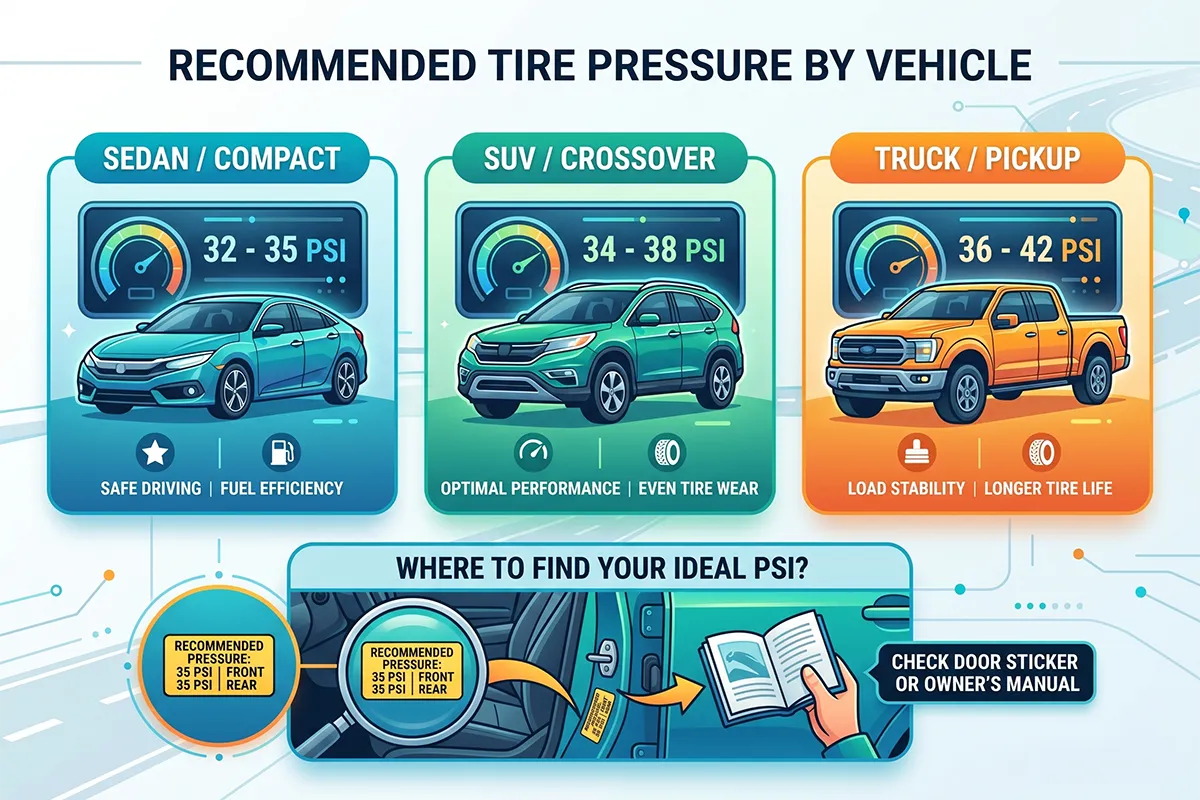
Finding the right tire pressure for your specific car is step one — but navigating where to find the sticker, how to read the TPMS display, and how to reset the system after inflating is a different exercise on every vehicle, and the owner’s manual doesn’t always make it obvious.
- Most passenger cars run 32–35 PSI; most crossover SUVs run 33–36 PSI; half-ton trucks typically run 35 PSI at standard load with higher rear pressure under heavy loads.
- The exact number for your car is on the driver’s door jamb sticker.
- In winter, check monthly and expect to top off regularly.
- This guide covers recommended PSI, TPMS display navigation, and reset procedures for the Honda Civic, Honda Accord, Honda CR-V, Mazda CX-5, Chevy Silverado 1500, Toyota Camry, Toyota RAV4, and Ford F-150.
For the full context on tire pressure fundamentals — what PSI means, why it matters, and how temperature affects your readings — our tire buying and maintenance guide covers all of it in one place.
Liked this article?
Add TireAdvise as a preferred source so you see more of our tire reviews and guides on Google.
How to Use This Guide
Every section below covers a specific vehicle with four things you’ll actually need:
- Recommended cold PSI — front and rear, broken out by trim and wheel size where they differ
- Where to find the sticker — exact location on that vehicle
- How to read the TPMS display — navigation steps for the infotainment or instrument cluster
- How to reset the TPMS — the specific procedure for that car after inflation or sensor service
Before diving into your vehicle: if you’re not sure how to use a pressure gauge correctly or need a refresher on the cold-tire rule, the step-by-step tire pressure checking guide covers the complete technique. And if your TPMS light is currently on or flashing, the low tire pressure light guide will help you figure out whether you’re dealing with a pressure issue or a sensor fault before you start inflating.
Honda Civic Tire Pressure (2016–2025)
The Honda Civic is one of the most popular vehicles in the US, and tire pressure questions on the Civic come up constantly — partly because Honda’s recommended PSI varies meaningfully by trim and wheel package, which catches a lot of owners off guard.
Recommended Tire Pressure
| Year Range | Trim / Tire Size | Front PSI | Rear PSI |
|---|---|---|---|
| 2022–2025 | LX, Sport (215/55R16) | 32 PSI | 32 PSI |
| 2022–2025 | EX, Touring (235/40R18) | 35 PSI | 35 PSI |
| 2022–2025 | Si, Type R | 35–38 PSI | 35–38 PSI |
| 2016–2021 | Standard trims | 32 PSI | 32 PSI |
| 2016–2021 | Sport / larger wheel | 33–35 PSI | 33–35 PSI |
Important: Always verify against your door sticker. The Civic’s pressure spec varies more than most people expect between base and sport trims on the same model year.
Where to Find the Sticker
Open the driver’s door fully. The tire pressure sticker is on the B-pillar — the vertical door frame post between the front and rear door openings. It’s a white label with black text, showing tire size and recommended cold PSI for both front and rear.
Accessing the TPMS Display (2022–2025 Civic)
On 10th and 11th generation Civics with the digital instrument cluster:
- Press the INFO button on the left side of the steering wheel
- Scroll until you see Tire Pressure in the multi-information display
- Individual PSI readings for all four tires display in a wheel-position graphic
On older Civics without the digital MID, you’ll only get the TPMS warning light — no individual readings. You’ll need a gauge to check each tire.
TPMS Reset Procedure (Honda Civic)
The Civic uses an auto-relearn system on most model years — meaning after inflating all tires to the correct PSI, you simply drive at speeds above 25 mph for approximately 10 minutes and the system recalibrates on its own. No button presses required.
If the light doesn’t go off after driving: Confirm all four tire pressures are exactly at spec using a quality gauge. Gas station gauges can be off by several PSI — I covered the best options in the tire pressure gauge guide. If pressures are correct and the light persists, a TPMS sensor may need service.
Honda Accord Tire Pressure (2018–2025)
The 10th and 11th generation Accord (2018–present) is one of the most nuanced vehicles in terms of tire pressure specs, because the base and top trims run meaningfully different wheel and tire packages with different pressure requirements.
Recommended Tire Pressure
| Year Range | Trim / Tire Size | Front PSI | Rear PSI |
|---|---|---|---|
| 2023–2025 | LX, EX (225/50R17) | 33 PSI | 33 PSI |
| 2023–2025 | Sport, Sport-L (235/40R19) | 35 PSI | 35 PSI |
| 2023–2025 | Touring (245/40R19) | 35 PSI | 35 PSI |
| 2018–2022 | Base trims (225/50R17) | 32–33 PSI | 32–33 PSI |
| 2018–2022 | Sport trims (235/45R18) | 35 PSI | 35 PSI |
Where to Find the Sticker
Same location as the Civic — the B-pillar on the driver’s side. Open the driver’s door fully and look at the vertical post. Some Accord years also have the sticker on the inner edge of the driver’s door itself.
Accessing the TPMS Display (2018–2025 Accord)
- Press the HOME button on the steering wheel
- Navigate to Vehicle → Tire Pressure
- The display shows a color-coded wheel graphic with PSI for each tire
The 2023+ Accord with the updated infotainment also shows a persistent tire pressure indicator in the driver’s profile section.
TPMS Reset Procedure (Honda Accord)
Like the Civic, the Accord uses auto-relearn — inflate all tires to correct PSI and drive at normal speeds for 10 minutes. The system recalibrates automatically.
One Accord-specific quirk: On 2018–2020 Accords, I’ve found the TPMS light occasionally stays on after inflation even when pressures are correct, particularly after a significant pressure change from cold weather. If this happens, try turning the car fully off, waiting 30 seconds, and restarting. The system re-initializes and often clears the light if pressure is genuinely correct.
Honda CR-V Tire Pressure (2017–2025)
The CR-V sits in the compact crossover segment and runs slightly higher pressure than Honda’s sedans, which surprises owners coming from a Civic or Accord.
Recommended Tire Pressure
| Year Range | Trim / Drive | Front PSI | Rear PSI |
|---|---|---|---|
| 2023–2025 | All trims FWD / AWD | 33 PSI | 33 PSI |
| 2023–2025 | CR-V Hybrid | 33 PSI | 33 PSI |
| 2017–2022 | LX, EX (225/65R17) | 33 PSI | 33 PSI |
| 2017–2022 | EX-L, Touring (235/55R19) | 35 PSI | 35 PSI |
Note on the CR-V Hybrid: The hybrid powertrain adds significant battery weight. Honda maintains the same 33 PSI recommendation, but it’s worth being particularly diligent about pressure maintenance on the hybrid because the added weight amplifies the effects of underinflation on the rear tires.
Where to Find the Sticker
Driver’s door B-pillar, same as other Honda models. On CR-Vs with a full-size spare under the cargo floor, a separate spare tire pressure recommendation (typically 60 PSI) is sometimes listed on a secondary label inside the cargo area.
Accessing the TPMS Display (2017–2025 CR-V)
- On the steering wheel, press the INFO button
- Scroll to Tire Pressure Monitor in the multi-information display
- A wheel diagram shows all four tire pressures
On 2023+ CR-Vs with the updated 9-inch touchscreen, Tire Pressure is also accessible through Vehicle in the main settings menu.
TPMS Reset Procedure (Honda CR-V)
Auto-relearn — same process as Civic and Accord. Inflate to correct PSI, drive at speeds above 25 mph for approximately 10 minutes.
CR-V seasonal note: With a 33 PSI target, the CR-V sits relatively close to the TPMS trigger threshold (approximately 25 PSI). In regions where overnight temperatures drop 40°F or more from fall to winter, the CR-V is particularly prone to TPMS warnings during cold snaps. I covered exactly how much pressure drops per degree in the winter vs summer tire pressure guide — adding a 2 PSI cold buffer heading into winter prevents most of these repeat warnings.
Mazda CX-5 Tire Pressure (2017–2025)
The CX-5 is one of the most consistently-specced vehicles I’ve worked with — the recommended PSI has stayed remarkably stable across the entire current generation, which makes it easy to remember.
Recommended Tire Pressure
| Year Range | Trim / Tire Size | Front PSI | Rear PSI |
|---|---|---|---|
| 2022–2025 | Sport, Select, Preferred (225/65R17) | 33 PSI | 33 PSI |
| 2022–2025 | Carbon Edition, Signature (225/55R19) | 33 PSI | 33 PSI |
| 2022–2025 | CX-5 Turbo (225/55R19) | 33 PSI | 33 PSI |
| 2017–2021 | All trims | 33 PSI | 33 PSI |
The CX-5 is unusual in that even when Mazda moved to larger 19-inch wheels on premium trims, the recommended pressure stayed at 33 PSI front and rear — no trim-level variation to track.
Where to Find the Sticker
Driver’s door B-pillar, in the standard location. The CX-5 sticker also lists the spare tire pressure separately at 60 PSI for compact spares.
Accessing the TPMS Display (2017–2025 CX-5)
2019–2025 CX-5 with Mazda Connect:
- From the home screen, navigate to Vehicle Status Monitor
- Select Tyre Pressure (Mazda uses the British spelling in the menu)
- Individual PSI readings for all four tires appear on a vehicle diagram
2017–2018 CX-5: The older Mazda Connect system accesses tire pressure through the Settings menu → Vehicle → Tyre Pressure Monitor.
TPMS Reset Procedure (Mazda CX-5)
The CX-5 uses an auto-relearn procedure that activates automatically after tire inflation or rotation. There is no button to press. After inflating all tires to 33 PSI cold:
- Drive at speeds above 25 mph for approximately 10 minutes
- The TPMS module re-reads all four sensors and recalibrates
- The warning light should go off on its own
If the light persists after inflating and driving: Check that all four tires are genuinely at 33 PSI using a calibrated gauge. If pressures are confirmed correct, the most likely cause is a sensor fault. The CX-5’s direct TPMS sensors are typically reliable but battery life varies — on 2017–2019 CX-5s with original sensors, sensor battery failure is increasingly common. The tire pressure sensor guide covers diagnosis, cost, and replacement options.
Chevy Silverado 1500 Tire Pressure (2019–2025)
The Silverado 1500 is America’s second best-selling vehicle, and its tire pressure setup is more complex than any passenger car on this list — because the correct rear pressure depends heavily on what you’re carrying.
Recommended Tire Pressure
| Year Range | Application | Front PSI | Rear PSI |
|---|---|---|---|
| 2019–2025 | Standard load, empty bed | 35 PSI | 35 PSI |
| 2019–2025 | Half load / light hauling | 35 PSI | 40–45 PSI |
| 2019–2025 | Maximum load / towing | 35 PSI | Per tire placard (up to 80 PSI on some packages) |
| Trail Boss / Off-Road | Standard on-road | 35 PSI | 35 PSI |
The most important thing to understand about Silverado tire pressure: The rear pressure is load-dependent in a way that sedan and crossover pressures are not. Running 35 PSI in the rear with a fully loaded 2,000-pound payload is inadequate — the tires will underperform under load, wear unevenly, and handle poorly. Conversely, running maximum load pressure with an empty bed gives you a jackhammer ride.
The door sticker on the Silverado lists two sets of numbers: standard load and maximum load. Use standard load for everyday driving and scale up toward maximum load as your payload or tongue weight increases.
Where to Find the Sticker
On the Silverado, the tire pressure sticker is in the driver’s door jamb — specifically on the door latch pillar when the door is open. On some 2019–2022 trucks, there’s also a supplementary placard in the glove box covering load-related pressure adjustments.
Accessing the TPMS Display (2019–2025 Silverado)
With Driver Information Center (DIC):
- Use the arrow buttons on the left spoke of the steering wheel to scroll through DIC pages
- Find Tire Pressure in the vehicle information menu
- A graphic shows all four tire positions with individual PSI readings
With the Chevy Infotainment 3 system (8-inch or 13.4-inch screen): Navigate to Vehicle → Tire & Wheels → Tire Pressure for the same four-corner display.
TPMS Reset / Relearn Procedure (Chevy Silverado 1500)
The Silverado uses a stationary relearn procedure — not a simple drive cycle. After replacing a sensor or rotating tires, the system needs to be told which sensor is at which corner.
With a TPMS relearn tool (most common method):
- Inflate all tires to correct pressure
- Turn the ignition to ON (engine off) or use the remote start sequence on 2023+ trucks
- Navigate to Vehicle → Tires → Learn Tires in the DIC or infotainment
- The system enters learn mode and the horn will chirp once
- Using a TPMS activation tool, activate each sensor in sequence: LF → RF → RR → LR (the horn chirps after each one is recognized)
- Turn the ignition off to complete the procedure
Without a TPMS tool: Some Silverado model years support an OBD-II relearn procedure — a scan tool connected to the OBD-II port initiates the sequence. Most auto parts stores (AutoZone, O’Reilly, Advance) will perform a TPMS relearn for free or a small fee.
Toyota Camry Tire Pressure (2018–2025)
The Camry is one of the most straightforward vehicles on this list for tire pressure — consistent spec across most trims, minimal variation between model years.
Recommended Tire Pressure
| Year Range | Trim / Tire Size | Front PSI | Rear PSI |
|---|---|---|---|
| 2021–2025 | LE, SE (205/65R16) | 35 PSI | 35 PSI |
| 2021–2025 | XLE, XSE (235/45R18) | 35 PSI | 35 PSI |
| 2021–2025 | TRD (235/45R18) | 35 PSI | 35 PSI |
| 2018–2020 | All trims | 35 PSI | 35 PSI |
| Camry Hybrid (all years) | All trims | 35 PSI | 35 PSI |
The Camry is one of the few vehicles where the spec stays at a consistent 35 PSI across nearly all trim levels and tire sizes — a welcome simplicity.
Where to Find the Sticker
Driver’s door jamb on the B-pillar. Standard location on all Camry generations.
Accessing the TPMS Display (2018–2025 Camry)
- Press the MENU button on the steering wheel or on the instrument cluster
- Navigate to Vehicle Info or Vehicle Settings
- Select Tire Pressure to see individual readings
On 2021+ Camrys with the updated Toyota Multimedia system, it’s also accessible through the main touchscreen under Apps → Vehicle on some configurations.
TPMS Reset Procedure (Toyota Camry)
Toyota uses a unique manual initialization procedure:
- Inflate all tires to the recommended PSI
- Turn the ignition to ON (engine off)
- Hold the TPMS reset button — located under the steering wheel or in the glove box depending on year — until the TPMS light blinks slowly three times
- Start the engine and drive at 25 mph or above for approximately 10 minutes
- The system stores the new baseline and the light should go off
If you can’t find the reset button, check your owner’s manual — Toyota relocated it between generations. On some 2021+ Camrys, the reset is done through the infotainment: Settings → Vehicle → TPMS Calibration → Calibrate.
Toyota RAV4 Tire Pressure (2019–2025)
The RAV4 is the best-selling SUV in the US, and Toyota’s crossover tire pressure setup has some nuances worth knowing — particularly on the hybrid and plug-in hybrid variants.
Recommended Tire Pressure
| Year Range | Trim / Drive | Front PSI | Rear PSI |
|---|---|---|---|
| 2019–2025 | LE, XLE FWD/AWD (225/65R17) | 33 PSI | 33 PSI |
| 2019–2025 | XLE Premium, TRD Off-Road (225/60R18) | 33 PSI | 33 PSI |
| 2019–2025 | Limited, Adventure (225/60R18) | 35 PSI | 35 PSI |
| 2019–2025 | RAV4 Hybrid AWD | 33 PSI | 33 PSI |
| 2019–2025 | RAV4 Prime PHEV | 33 PSI | 36 PSI |
RAV4 Prime note: The plug-in hybrid’s rear pressure spec is 36 PSI — 3 PSI higher than the front — due to the additional weight of the rear drive motor and larger battery pack. This front/rear difference catches RAV4 Prime owners off guard. Double-check your door sticker.
Where to Find the Sticker
Driver’s door B-pillar. On RAV4 models with a full-size spare on the rear door (Adventure and TRD Off-Road), a secondary spare tire pressure sticker is sometimes found on the spare wheel cover.
Accessing the TPMS Display (2019–2025 RAV4)
- Use the steering wheel up/down toggle to scroll through the instrument cluster pages
- Find Vehicle Info → Tire Pressure
- Individual readings show for all four tires
On 2022+ RAV4s with the updated 10.5-inch touchscreen, tire pressure is also visible under Apps → Vehicle Status.
TPMS Reset Procedure (Toyota RAV4)
Same manual initialization procedure as the Camry:
- Inflate all tires to correct PSI
- Ignition ON, engine off
- Hold the TPMS reset button (under the steering wheel, driver’s left knee area) until the light blinks three times
- Drive 10+ minutes above 25 mph
On 2022+ RAV4 with the newer infotainment: Settings → Vehicle → TPMS Calibration → Calibrate handles it through the touchscreen without a physical button.
Ford F-150 Tire Pressure (2021–2025)
The F-150 is America’s best-selling vehicle and has been for over 40 years. Like the Silverado, its tire pressure setup is load-dependent and meaningfully more complex than a car or crossover.
Recommended Tire Pressure
| Year Range | Application / Tire | Front PSI | Rear PSI |
|---|---|---|---|
| 2021–2025 | Standard load, empty (P-metric tires) | 35 PSI | 35 PSI |
| 2021–2025 | Standard load, LT-metric tires | 35 PSI | 35–50 PSI (load-dependent) |
| 2021–2025 | Raptor (37×12.5R17) | 35 PSI | 35 PSI |
| 2021–2025 | Heavy tow package rear | Per placard | Up to 80 PSI at max load |
P-metric vs LT-metric tires on the F-150: This is a key distinction. Many F-150s come from the factory with LT-designation tires (Light Truck metric), which have higher load capacity and correspondingly higher recommended pressures — especially in the rear under load. Check your door sticker to see which designation applies to your truck.
Where to Find the Sticker
Driver’s door jamb in the standard position. The F-150 door sticker is unusually detailed — it lists multiple pressure configurations based on load. Take a photo of it and keep it accessible.
There’s also a payload sticker in the door jamb that shows maximum load capacity, which helps you gauge how much to adjust rear pressure for hauling.
Accessing the TPMS Display (2021–2025 F-150)
SYNC 4 infotainment:
- Select Vehicle from the bottom menu bar
- Choose Tire Pressure from the vehicle submenu
- A four-corner vehicle diagram shows individual PSI for each tire in real time
The F-150’s SYNC 4 system is one of the better TPMS interfaces I’ve seen — it updates quickly and clearly flags which tire is low with a color change.
TPMS Reset / Relearn Procedure (Ford F-150)
The F-150 requires an OBD-II relearn procedure after sensor replacement or tire rotation — unlike Honda’s drive-cycle relearn, Ford’s system generally needs a scan tool or TPMS tool connected to the OBD-II port.
With a TPMS tool (preferred):
- Inflate all tires to correct pressure
- Put the truck in park with the engine running
- Navigate to Vehicle → Tire Pressure → Train Sensors in the SYNC 4 menu, or use the TPMS tool per vehicle instructions
- Activate each sensor in sequence: LF → RF → RR → LR
- The system confirms each sensor; horn chirps once when complete
Without a TPMS tool: Most Ford dealers and AutoZone/O’Reilly stores can perform the relearn procedure. Given the F-150’s complexity around multiple tire configurations, having a dealer perform the initial post-replacement relearn is often the most reliable approach.
After simple inflation (no sensor swap or rotation): If you’ve just added air to a low tire and want the TPMS light to clear, inflating to correct pressure and driving above 25 mph for 10–15 minutes is usually enough — no tool needed for this scenario.
Recommended Tire Pressure for SUVs: General Guide
For readers with SUVs not specifically covered above, here’s a broader reference table covering the most common models. As always, verify against your door sticker — these represent typical manufacturer specifications that can vary by trim and model year.
| Vehicle | Typical Front PSI | Typical Rear PSI | Notes |
|---|---|---|---|
| Honda CR-V | 33 PSI | 33 PSI | Consistent across most trims |
| Honda Pilot | 35 PSI | 35 PSI | — |
| Toyota RAV4 | 33–35 PSI | 33–36 PSI | Hybrid/PHEV rear may differ |
| Toyota Highlander | 35 PSI | 35 PSI | — |
| Mazda CX-5 | 33 PSI | 33 PSI | Consistent all trims |
| Mazda CX-50 | 33–35 PSI | 33–35 PSI | Verify by trim |
| Subaru Outback | 33–35 PSI | 33–35 PSI | AWD variant same spec |
| Subaru Forester | 33 PSI | 33 PSI | — |
| Jeep Grand Cherokee | 35 PSI | 35 PSI | Off-road trim may lower |
| Ford Explorer | 35 PSI | 35 PSI | — |
| Ford Bronco | 35–38 PSI | 35–38 PSI | Lower on sand/off-road |
| Chevy Equinox | 33–35 PSI | 33–35 PSI | — |
| Chevy Tahoe | 35 PSI | 35 PSI | — |
| GMC Terrain | 33–35 PSI | 33–35 PSI | — |
| Nissan Rogue | 33–35 PSI | 33–35 PSI | — |
| Hyundai Tucson | 33–36 PSI | 33–36 PSI | — |
| Kia Sportage | 33–35 PSI | 33–35 PSI | — |
| Volkswagen Tiguan | 36 PSI | 36 PSI | Higher than average |
| BMW X3/X5 | 33–36 PSI | 36–38 PSI | Front/rear often differ |
| Mercedes GLC | 35–36 PSI | 35–38 PSI | Front/rear often differ |
General rule for SUVs: if your crossover or SUV has a recommended PSI below 33, double-check — it’s unusually low for the class. If it’s above 40 PSI on a compact crossover, verify you’re reading the correct sticker (spare tire recommendations are sometimes nearby and can cause confusion).
Seasonal Pressure Management Across All Vehicles
Every vehicle in this guide is subject to the same temperature-driven pressure changes — approximately 1 PSI per 10°F shift. The full seasonal strategy is covered in detail in the winter vs summer tire pressure guide, but the short version for all vehicle types is:
- Fall: Check and add 2–3 PSI cold buffer as daily lows drop below 50°F
- Winter: Check monthly; don’t reduce pressure for snow traction
- Spring: Reset to exact spec as temperatures stabilize above 50°F
- Summer: Check cold in the morning; don’t release air from hot tires
One pattern I’ve noticed across vehicles: compact crossovers and small sedans with lower recommended PSI (32–33 PSI) tend to trigger the TPMS light more often in cold weather than trucks and full-size SUVs with higher base pressures.
A 6 PSI winter drop from 33 PSI puts you at 27 PSI — dangerously close to the TPMS threshold of about 25 PSI. The same 6 PSI drop from 35 PSI leaves you at 29 PSI, which is low but less critical. If you drive a Civic, CR-V, CX-5, or RAV4, winter monthly checks are especially important.
Quick Reference: All Vehicles at a Glance
| Vehicle | Front PSI | Rear PSI | TPMS Reset Type |
|---|---|---|---|
| Honda Civic (2022–2025, base) | 32 PSI | 32 PSI | Auto-relearn (drive) |
| Honda Civic (2022–2025, sport/EX) | 35 PSI | 35 PSI | Auto-relearn (drive) |
| Honda Accord (2023–2025, base) | 33 PSI | 33 PSI | Auto-relearn (drive) |
| Honda Accord (2023–2025, sport) | 35 PSI | 35 PSI | Auto-relearn (drive) |
| Honda CR-V (2023–2025) | 33 PSI | 33 PSI | Auto-relearn (drive) |
| Mazda CX-5 (2017–2025) | 33 PSI | 33 PSI | Auto-relearn (drive) |
| Chevy Silverado 1500 (std load) | 35 PSI | 35 PSI | Stationary w/ TPMS tool |
| Toyota Camry (2018–2025) | 35 PSI | 35 PSI | Manual button + drive |
| Toyota RAV4 (2019–2025) | 33–35 PSI | 33–36 PSI | Manual button + drive |
| Ford F-150 (std load) | 35 PSI | 35 PSI | OBD-II / scan tool |
FAQ: Vehicle-Specific Tire Pressure Questions
What is the recommended tire pressure for a Honda Civic?
Most 2022–2025 Honda Civics on base and Sport trims (16-inch wheels) use 32 PSI front and rear. EX and Touring trims with 18-inch wheels typically call for 35 PSI. Confirm by opening your driver’s door and reading the sticker on the B-pillar.
What is the recommended tire pressure for a Honda Accord?
The 2023–2025 Accord runs 33 PSI on base LX and EX trims with 17-inch wheels, and 35 PSI on Sport and Touring trims with 19-inch wheels. The 10th generation (2018–2022) follows a similar pattern — check your door sticker for your specific trim.
What is the recommended tire pressure for a Honda CR-V?
The 2017–2025 Honda CR-V uses 33 PSI front and rear on most trims, including the hybrid. Some 19-inch tire packages on premium trims specify 35 PSI. Verify on your door sticker.
What is the recommended tire pressure for a Mazda CX-5?
33 PSI front and rear for all trims from 2017 through 2025 — one of the most consistent specs in its class.
What is the recommended tire pressure for a Chevy Silverado 1500?
35 PSI front and rear at standard load with an empty or lightly loaded bed. Rear pressure should increase toward the maximum load specification as payload weight increases. The door sticker lists both standard and maximum load pressures.
Why is my TPMS light still on after I added air to my Honda?
Honda’s auto-relearn system needs approximately 10 minutes of driving above 25 mph to register new pressures. If the light stays on after that, confirm pressures with a quality gauge — gas station gauges can be inaccurate. If pressures are correct and the light persists, a sensor fault is the most likely cause.
Do I need a special tool to reset the TPMS on a Chevy Silverado or Ford F-150?
Yes, typically. Both trucks use a stationary or OBD-II relearn procedure that requires either a TPMS activation tool or a scan tool after sensor replacement or tire rotation. For a simple inflation (no service performed), driving after inflating is usually enough to clear a pressure warning. Most auto parts stores perform TPMS relearns free or for a small fee.
Does tire pressure differ between FWD and AWD versions of the same vehicle?
Usually not — but there are exceptions. The Toyota RAV4 Prime PHEV is a notable case where the AWD system’s rear motor adds weight that changes the rear pressure spec. Always check the door sticker for your specific drivetrain configuration.
Final Thoughts
The fundamentals don’t change between vehicles — cold tires, door sticker target, quality gauge, monthly checks. What changes is the specific number, the location of the infotainment menu, and the relearn procedure that follows any tire service.
The quick reference table above covers the vehicles I get asked about most often. Bookmark this page, take a photo of your door sticker, and pair it with a quality gauge in your glove box — that combination handles 95% of tire pressure situations before they become problems.
For everything else in the tire pressure world — what PSI actually means, how the TPMS sensor system works, how to handle a TPMS warning light, and how to check pressure correctly at home or at a gas station — the other posts in this series have you covered. Start with the complete tire pressure guide if you want the full foundation in one read.
Our tire buying and maintenance guide pulls the entire picture together — from choosing the right tire for your vehicle and driving conditions to knowing when it’s time for a replacement.
Don’t see your vehicle in this guide? Drop the year, make, model, and trim in the comments and I’ll add it in the next update — or give you the answer directly.
