

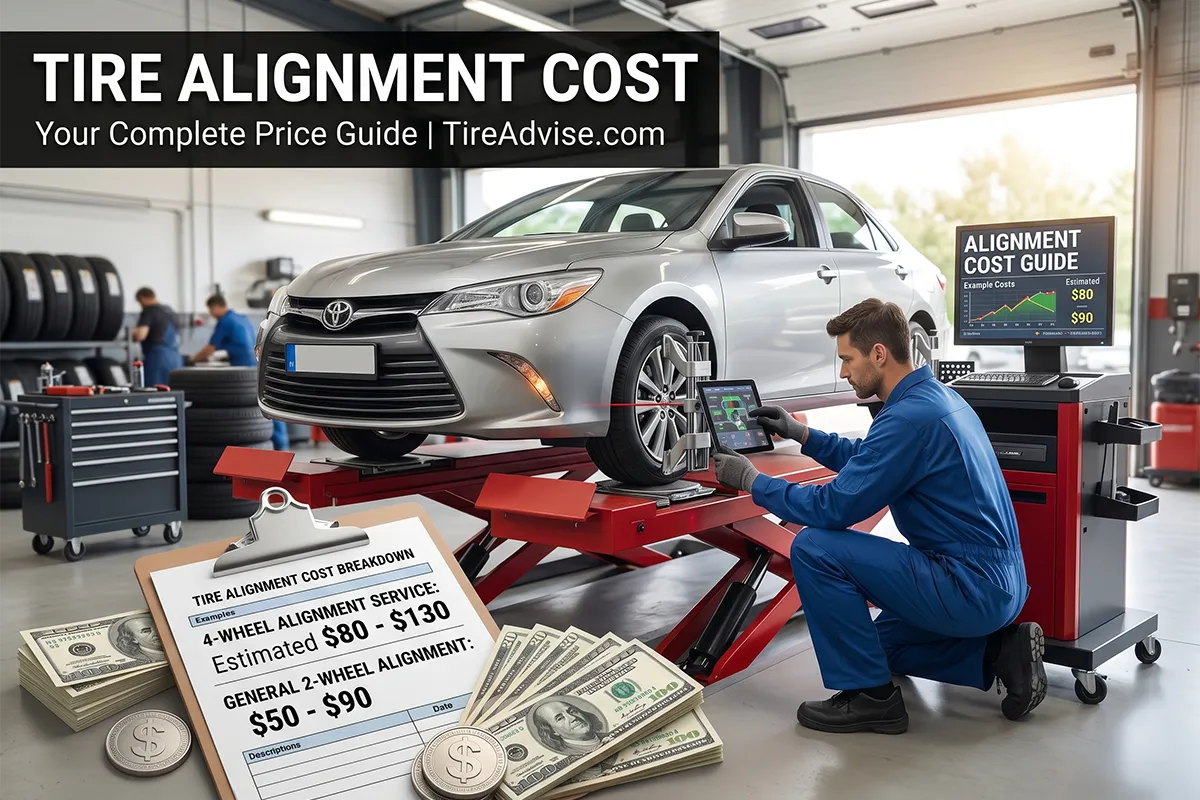
The shop quoted me $220 for an alignment. The place down the street charged $89 for the exact same car. Here’s how to know which number is fair — and which one is a rip-off.
- A standard four-wheel alignment costs $100–$150 at most tire shops and independent garages for a typical passenger car or crossover.
- Front-end (two-wheel) alignments run $65–$100. Luxury vehicles, large trucks, and lifted rigs can push $150–$250 or more.
- Dealer pricing typically runs 20–40% higher than independent shops for identical work.
- The job itself hasn’t gotten more expensive in recent years — what varies dramatically is where you go and whether your car needs any worn suspension parts replaced before the alignment will hold.
Before going further — if you’re not sure whether you actually need an alignment, or you want to understand what the service involves, start with our tire alignment guide.
And for a broader look at tire-related costs and maintenance, our tire buying and maintenance guide covers everything in one place.
Liked this article?
Add TireAdvise as a preferred source so you see more of our tire reviews and guides on Google.
The Quick Answer: Average Tire Alignment Cost by Service Type
If you just want ballpark numbers before you call around, here’s where prices typically land in 2025 across the U.S. market:
| Service Type | Typical Price Range | Best For |
|---|---|---|
| Front-end alignment (2-wheel) | $65 – $100 | Older RWD trucks, solid rear axle vehicles |
| Four-wheel alignment | $100 – $150 | Most modern cars, crossovers, AWD vehicles |
| Four-wheel alignment (luxury/performance) | $130 – $200 | BMW, Mercedes, Audi, Lexus, Porsche |
| Four-wheel alignment (full-size truck / large SUV) | $110 – $180 | F-150, Silverado, Tundra, Suburban |
| Alignment with lift kit / modified suspension | $150 – $300+ | Lifted trucks, lowered vehicles, track builds |
| Lifetime/annual alignment plan | $150 – $200 one-time | Anyone planning to stay at the shop long-term |
These numbers reflect cash pricing at reputable shops. Dealer service departments typically sit at the higher end or above these ranges, while national tire chains often run promotions that bring the price down to the lower end — sometimes lower.
What Factors Affect Tire Alignment Cost?
The spread between $65 and $300 isn’t arbitrary. Here’s exactly what moves the needle.
1. Two-Wheel vs. Four-Wheel Alignment
This is the single biggest pricing split. A front-end (two-wheel) alignment only measures and adjusts the front axle. A four-wheel alignment covers all four corners.
The vast majority of vehicles on the road today — front-wheel drive, all-wheel drive, and vehicles with independent rear suspension — need a four-wheel alignment.
Doing only the front on one of these cars is incomplete work. The rear wheels have their own adjustable geometry, and if they’re out of spec, the car will fight any correction made up front.
True front-end-only alignments are appropriate mainly for older pickups and body-on-frame SUVs with solid rear axles (pre-2000s vintage mostly) where the rear geometry is truly fixed.
If a shop tries to sell you a front-only alignment on a 2015 Honda CR-V or a 2020 Toyota RAV4, push back — or find a different shop.
2. Vehicle Type and Size
Larger vehicles take longer to align and sometimes require additional measurement points, which bumps labor costs. A compact sedan on a flat road is a 30–45 minute job. A three-row SUV or full-size pickup with an independent rear suspension takes longer and involves more adjustment access points.
Luxury and performance vehicles often require specialized equipment — particularly for brands like BMW, Mercedes, and Audi, where manufacturer-specific software and calibration tools are needed to set alignment to factory spec. Not every shop has this equipment, and the ones that do price accordingly.
Average tire alignment cost by vehicle class (four-wheel service):
| Vehicle Class | Examples | Typical Range |
|---|---|---|
| Compact / Economy Car | Civic, Corolla, Elantra, Sentra | $95 – $130 |
| Midsize Sedan / Hatchback | Camry, Accord, Mazda6, Jetta | $100 – $140 |
| Compact Crossover / SUV | RAV4, CR-V, Equinox, Rogue | $100 – $145 |
| Midsize SUV | Pilot, Explorer, Highlander, Pathfinder | $110 – $160 |
| Full-Size Pickup Truck | F-150, Silverado, Ram 1500, Tundra | $110 – $175 |
| Full-Size SUV | Tahoe, Expedition, Sequoia, Suburban | $115 – $180 |
| European Luxury | BMW 3/5 Series, A4, C-Class | $130 – $220 |
| Sports / Performance | Mustang GT, WRX, 86, Challenger | $110 – $175 |
| Modified / Lifted Vehicle | Any vehicle with aftermarket suspension | $150 – $300+ |
3. Where You Go (Shop Type Matters More Than You Think)
In my experience, the shop type is the most underrated factor in alignment pricing. Here’s how the landscape breaks down:
National Tire Chains (Firestone, Pep Boys, Mavis, NTB, Midas) These shops price competitively and run frequent coupons — it’s common to find four-wheel alignments advertised at $89–$99. Equipment quality varies by location, but modern shops in this category typically run Hunter or Snap-on 3D alignment systems. The risk: higher technician turnover means quality can be inconsistent. Always ask for the before-and-after printout.
Dedicated Tire Retailers (Discount Tire, Tire Rack installer network, America’s Tire) Pricing is competitive and these shops do high volume alignment work, which generally means experienced techs. Ranges typically sit at $100–$150. If you bought tires here, they may offer alignment checks at a discount.
Independent Alignment / Suspension Shops Often the best combination of quality and price. Shops that specialize in alignment and suspension have the best equipment and the most experienced technicians. Prices are usually $100–$160, and you’re more likely to get honest advice on whether worn components need attention before the alignment will hold.
Dealership Service Departments Expect to pay a premium — typically $130–$200 for a four-wheel alignment on a mainstream vehicle, and higher for luxury brands. The upside is manufacturer-trained technicians and OEM specs loaded into their systems. If your vehicle is under warranty and there are suspension-related concerns, starting at the dealer makes sense. For routine maintenance alignments, there are usually better options on price.
Quick-Lube / Oil Change Chains (Jiffy Lube, Valvoline Instant Oil Change) I’d avoid getting alignment work done here. Not because they’re bad at oil changes — they’re not — but because alignment is a precision service that benefits from a specialist. The equipment at these locations is often older, and the technicians are generalists, not suspension specialists.
4. Geographic Location
Alignment pricing follows regional labor rates the same way all auto service does. What costs $95 in rural Tennessee might run $145 in San Francisco or $160 in New York City.
The same job, the same equipment, meaningfully different price tags. When shopping around, compare locally — national averages are only useful as a sanity check.
5. Worn Suspension Parts (The Wildcard)
This is where alignment visits can get expensive unexpectedly, and it’s important to understand the difference between necessary work and upsell work.
An alignment can only hold if the underlying suspension components are in good shape. If your tie rod ends are worn and have play, the alignment will shift as soon as you hit the first bump on the way home.
Same with worn control arm bushings, ball joints, and strut mounts. A thorough shop will inspect these components as part of the alignment process and flag anything that needs attention.
Common additional repairs that may be needed:
| Component | Typical Repair Cost |
|---|---|
| Tie rod end (per side) | $80 – $160 parts + labor |
| Control arm bushing | $150 – $300 per arm |
| Ball joint | $150 – $350 per joint |
| Strut or shock | $200 – $400 per corner |
| Camber adjustment kit (aftermarket) | $50 – $150 per axle |
The key question when a shop recommends additional work: Is this part worn to the point where alignment won’t hold, or is it just showing normal wear? A good shop will show you the worn part, demonstrate the play in it, and explain why the alignment can’t be completed without addressing it.
If you’re being told you need $600 in parts before they’ll align your car, but the car drives fine and has no obvious symptoms, get a second opinion.
Is a Lifetime Alignment Plan Worth It?
Several national chains sell “lifetime alignment” packages — a one-time fee ($150–$200 typically) that covers unlimited alignment checks and adjustments for as long as you own the car. Whether these are worth it depends on how long you keep vehicles and how often you’re likely to need alignments.
The math: If a standard alignment costs $120 and you keep a car for 6 years with an alignment every 12,000 miles and you drive 15,000 miles per year, that’s approximately 7–8 alignments over the car’s life = $840–$960 in total alignment costs. The lifetime plan at $170 saves you $670+ — assuming you actually return to that chain for each service.
The catch: you must return to the same chain (though any location of that chain typically qualifies). If you move, if the chain pulls out of your area, or if the car is totaled, the remaining value is lost. If you’re geographically stable and plan to keep the car long-term, a lifetime plan is almost always the better financial call.
What’s Actually Included in an Alignment Service?
When you pay for a tire alignment, here’s what you should always receive:
The actual service:
- Mounting of alignment sensors or cameras on all four wheels
- Computer measurement of current camber, toe, and caster angles vs. OEM specs
- Physical adjustment of adjustable angles to bring them within spec
- Re-measurement to confirm corrections
Documentation you should always ask for:
- Before-and-after alignment printout showing original values vs. corrected values, with green indicators showing values now within spec
If a shop can’t give you the printout, either their equipment doesn’t generate one (older rack) or they’re not willing to document the work. Neither is acceptable for a precision service. I never leave without the spec sheet — it’s your proof of work and a useful diagnostic tool later.
What alignment does NOT include:
- Tire rotation (separate service, $20–$50)
- Tire balancing (separate service, $15–$25 per wheel)
- Tire pressure adjustment (usually complimentary but confirm)
- Replacement of worn parts
How to Get the Best Price on a Tire Alignment
I’ve spent enough time in shops to know that the sticker price is rarely the only price available. Here’s how to make sure you’re not overpaying:
Call three shops and ask for their four-wheel alignment price. Don’t ask for “the best price” — just ask what a four-wheel alignment costs for your specific make and model. You’ll get numbers quickly and a clear spread.
Check for coupons before you book. National chains like Firestone, Mavis, and Pep Boys run alignment coupons constantly. A quick search for “[shop name] alignment coupon” often turns up $20–$30 off. Groupon occasionally has tire service deals as well.
Bundle with other services. If you’re already getting tires installed or rotated, shops will often discount an alignment when it’s added to the same ticket. It costs them minimal extra time, and the margin gives room to negotiate.
Ask about alignment checks vs. full alignment. Some shops offer a free or low-cost alignment check (measurement only, no adjustment) as a service or diagnostic. If the check shows you’re within spec, you’ve saved the full alignment fee. If you’re out of spec, at least now you have documented proof and can shop the adjustment.
Avoid getting alignment done at quick-lube chains even if their price looks attractive. Save those visits for oil changes and leave precision suspension work to specialists.
The Real Cost of Skipping an Alignment
The alignment itself is the easy part of the math. The expensive part is what happens to your tires when you skip it.
A set of mid-grade all-season tires for a typical crossover runs $500–$700 installed. With proper alignment maintained throughout, those tires should reach their rated mileage — typically 50,000–70,000 miles.
With chronic misalignment, I’ve personally seen tires that were down to the wear indicators at 25,000 miles, with 60% of the tread gone on one edge and 20% on the other.
That’s a $500+ tire set gone in half the expected time. Compare that to $120 for an annual alignment. The return on investment isn’t subtle.
And that’s before you factor in fuel economy. Misaligned tires create rolling resistance that measurably increases fuel consumption — typically in the 5–10% range for significant misalignment.
On a 25 MPG car driving 15,000 miles per year at $3.50/gallon, that’s an extra $84–$168 in gas per year. Again, for a $120 service that takes an hour.
For more on whether alignment is something you should prioritize, our article on whether tire alignment is necessary breaks down the decision clearly.
When to Schedule Your Next Alignment
If you’re not sure whether to book one now, here’s a simple decision framework I use:
- Book immediately if: your car pulls to one side, the steering wheel is off-center, your tires are wearing unevenly, or you’ve hit a significant pothole or curb in the last few months
- Book soon if: it’s been more than 12–15,000 miles since your last alignment, or you’ve just mounted new tires
- Hold off if: you have recent documented alignment work, the car tracks perfectly straight, and your tires are wearing evenly
When you do go, pair it with a tire rotation if you’re close to your rotation interval — it’ll save you a separate trip and often cost less bundled. For a full picture of service timing, our article on how often you should get a tire alignment covers the decision in detail.
Frequently Asked Questions: Tire Alignment Cost
How much does a tire alignment cost on average?
For most passenger cars and crossovers, the average tire alignment cost for a four-wheel service is $100–$150 at a tire shop or independent garage. Front-end-only alignments run $65–$100. Luxury and modified vehicles can cost $150–$300+.
How much does a tire alignment cost at Firestone?
Firestone’s standard four-wheel alignment typically runs $89–$109, and they frequently run coupons bringing it below $90. Their lifetime alignment package (Lifetime Alignment Plan) is generally priced at $170–$200 depending on location.
How much does a tire alignment cost at Jiffy Lube?
Jiffy Lube offers alignment services at some locations, generally in the $75–$100 range. However, I’d recommend a dedicated tire shop or alignment specialist for this service — precision suspension work benefits from experienced technicians and modern equipment.
Is $200 too much for a tire alignment?
For a standard four-wheel alignment on a mainstream passenger car, yes — $200 is at the high end and I’d get a second quote. If you’re at a dealership, paying $180–$200 is within range for some brands. For a European luxury vehicle at a marque specialist, $200 is reasonable. For a Camry at a quick-lube chain, it’s too much.
Why did my alignment cost so much?
Common reasons: you may have needed tie rod ends, ball joints, or control arm bushings replaced before the alignment would hold; your vehicle is a luxury or European brand requiring specialized equipment; or you’re at a dealership. Always ask for an itemized breakdown separating the alignment itself from any parts or additional labor.
Does insurance cover tire alignment costs?
Standard auto insurance does not cover routine alignment services. If your suspension was damaged in a covered collision, your collision or comprehensive coverage may reimburse alignment work done as part of the repair — subject to your deductible. Confirm with your insurer.
How long does a tire alignment take?
A standard four-wheel alignment takes 30–60 minutes for most vehicles. If suspension components need replacement first, add time accordingly. Our article on how long a tire alignment takes covers this in detail.
Should I get an alignment with new tires?
Almost always yes. New tires on a misaligned car will wear unevenly from day one, which means you’re shortening the life of an investment you just made. Always pair new tires with at least an alignment check.
Bottom Line
Tire alignment is one of the least expensive preventive maintenance services you can buy relative to what it protects. At $100–$150 for a four-wheel alignment, you’re directly protecting a tire investment that costs 4–6x that amount — and doing it once a year or every 12,000 miles is all it takes to keep things right.
Shop around (three phone calls take five minutes), look for coupons before you book, and always get the before-and-after printout. The actual cost of alignment work is rarely the problem — it’s the cost of skipping it that shows up later, quietly, one worn tire edge at a time.
Related reading:
