

I once sat in a shop waiting room while a tech “aligned” my neighbor’s Accord in eleven minutes flat. The car pulled harder leaving the lot than it did going in. If you’ve ever wondered what a proper alignment actually involves — and how long it should take — this one’s for you.
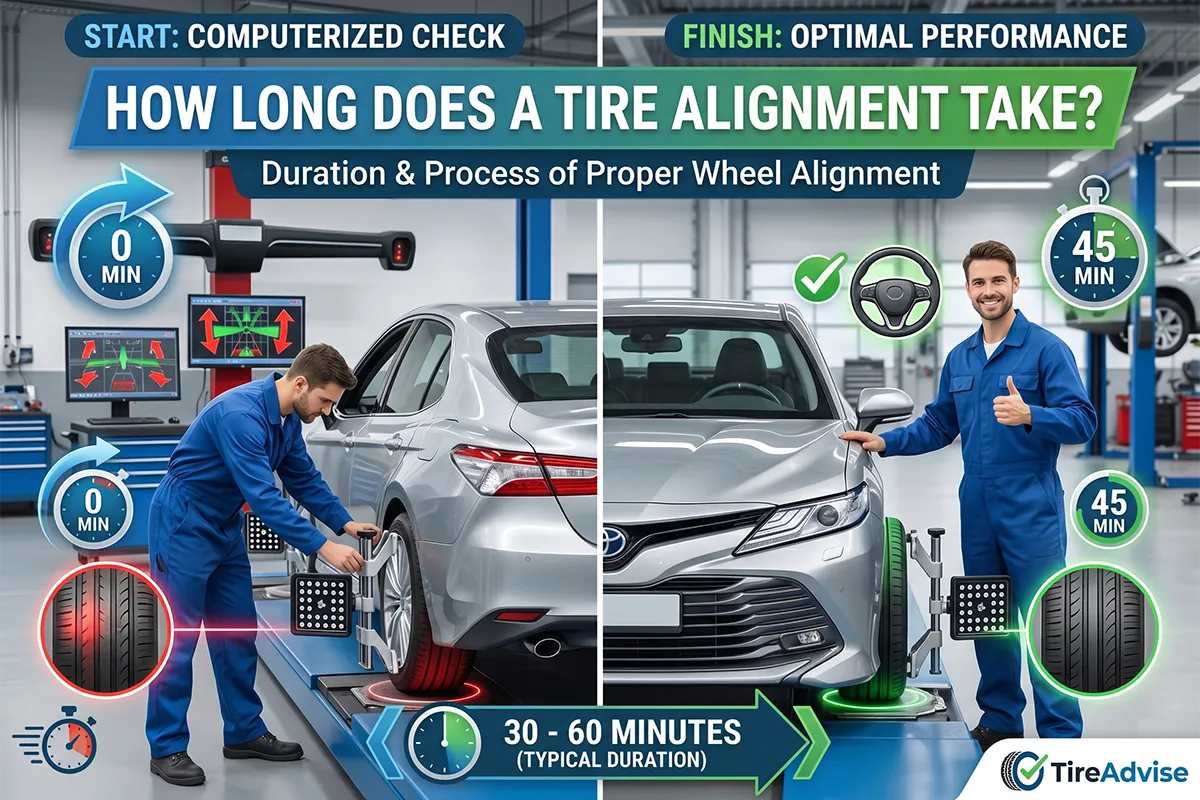
- A standard four-wheel alignment on a typical passenger car takes 45–75 minutes from the time the car goes on the rack to the time you drive away.
- Simple two-wheel alignments on older vehicles can be done in 30–45 minutes.
- The job gets longer — sometimes significantly — if your vehicle needs worn suspension parts replaced before the alignment can hold, if you drive a modified or lifted rig, or if the shop’s equipment is outdated.
- Anything under 30 minutes for a four-wheel alignment on a modern car should raise questions about quality.
If you’re still getting familiar with what a tire alignment actually is and why it matters, our complete tire alignment guide is the best place to start.
For a look at what the service costs alongside the time investment, see our tire alignment cost breakdown. This article focuses on the process itself — what happens, in what order, and what can extend the timeline.
Liked this article?
Add TireAdvise as a preferred source so you see more of our tire reviews and guides on Google.
The Short Answer: How Long Does Tire Alignment Take?
Before diving into the details, here’s a practical reference by vehicle and scenario:
| Situation | Estimated Time on Rack | Total Shop Time (incl. check-in) |
|---|---|---|
| Standard 4-wheel alignment — compact/midsize car | 45 – 60 min | 60 – 90 min |
| Standard 4-wheel alignment — crossover / SUV | 50 – 75 min | 70 – 100 min |
| Standard 4-wheel alignment — full-size truck | 50 – 80 min | 70 – 110 min |
| Front-end (2-wheel) alignment — older RWD truck | 30 – 45 min | 45 – 70 min |
| 4-wheel alignment — luxury / European vehicle | 60 – 90 min | 80 – 120 min |
| Alignment with tie rod replacement (1 side) | 90 – 150 min | 2 – 2.5 hrs |
| Alignment with control arm or ball joint work | 2 – 4 hrs | 2.5 – 5 hrs |
| Alignment on a lifted or modified vehicle | 75 – 120 min | 90 min – 3 hrs |
The wide ranges exist because several variables play into the real-world timeline, and I’ll cover all of them below. But the most important takeaway from this table: if a shop quotes you 20 minutes for a four-wheel alignment on your 2022 Camry, something isn’t right.
How Tire Alignment Is Done: The Step-by-Step Process
Understanding why alignment takes the time it does means understanding what actually happens during a proper service. I’ve spent enough hours in shop waiting rooms — and had enough conversations with alignment technicians — to walk you through this accurately.
Step 1: Check-In and Vehicle Inspection (5–15 minutes)
Before the car even goes on the rack, a good shop does a preliminary inspection. This involves checking tire pressure on all four tires (low or inconsistent pressure distorts the measurements), doing a visual scan of visible suspension components for obvious wear or damage, and noting the vehicle’s current mileage and any symptoms the customer reported.
This step is easy to skip when shops are busy, and some do skip it. That’s a problem — an alignment performed with mismatched tire pressures or on visibly worn tie rods is an alignment that won’t hold.
Step 2: Mount the Alignment Sensors (5–10 minutes)
Once the car is on the alignment rack, the technician mounts the alignment targets or sensors to each wheel. Modern shops use one of two systems:
3D camera alignment (Hunter, Snap-on, Corghi): Four camera heads on towers positioned around the vehicle capture reflective targets clipped to each wheel. This system is faster to set up, highly accurate, and the shop standard at most quality tire shops today.
Laser/wheel-clamp alignment: An older method where sensors physically clamp to each wheel and communicate via laser or wire. Still accurate when properly maintained, but slower to set up and calibrate.
The type of equipment in the shop has a real effect on total service time. A modern Hunter HawkEye Elite system can cut setup and measurement time roughly in half compared to older rack systems.
When I’m choosing between two shops at similar prices, I’ll often ask what alignment equipment they run — it’s a fair question and a reputable shop will answer it directly.
Step 3: Roll the Vehicle and Take Initial Readings (5–10 minutes)
With sensors mounted, the technician will slowly roll the car forward and backward a few feet. This “runout compensation” step calibrates out any wobble in the wheel or sensor mount, so the readings reflect true suspension geometry rather than wheel runout.
After rollout, the computer takes a full snapshot of all current angles — camber, toe, and caster at all four corners — and displays them against the manufacturer’s target specifications.
Values within spec show in green; anything out of range shows in red. This baseline printout is the “before” portion of the before-and-after report you should always leave with.
Step 4: Inspect Suspension Components (5–15 minutes)
A thorough technician uses this moment — with the car on the rack and the wheels at ride height — to physically check the components that alignment depends on.
This means checking for play in the tie rod ends (worn tie rods are the number-one reason an alignment won’t hold), testing ball joint movement, inspecting control arm bushings for deterioration, and looking at the strut mounts.
This step is where the timeline can branch significantly.
If everything looks good, you move to Step 5. If the technician finds a worn tie rod end with noticeable slop, or a cracked bushing, the honest answer is that completing the alignment without addressing those parts will produce results that last maybe 500 miles before the geometry drifts again.
Some shops skip this step entirely and just do the adjustment regardless — which is how you end up paying for an alignment that doesn’t hold. Others will flag every minor wear item as an urgent repair to pad the ticket.
The difference between those two failure modes, and how to read it, is something I cover in the tire alignment cost article under the worn parts section.
Step 5: Make the Adjustments (15–30 minutes)
This is the actual alignment work, and it’s where the quality of the technician matters most. Adjustments are made in a specific order — typically rear axle first, then front — because the rear thrust line determines the reference point for front alignment.
Toe adjustment (most common): The technician loosens the lock nut on the tie rod end and turns the tie rod itself, which physically moves the wheel inward or outward. Toe is adjusted in small increments and verified on the computer screen in real time. On most vehicles this is the primary adjustment point.
Camber adjustment (vehicle dependent): On vehicles with adjustable camber, the technician accesses eccentric bolts or adjustable cam bolts in the strut mount or control arm. Many modern vehicles have fixed camber from the factory — designed-in geometry that can’t be adjusted without aftermarket parts. If your car is one of these and the camber is out of spec, it usually indicates a bent component that needs replacement rather than an adjustment.
Caster adjustment (limited access): Caster is adjustable on relatively few vehicles without aftermarket components. On most modern cars it’s set by the geometry of the strut tower and lower control arm mount — effectively fixed unless there’s collision damage. When caster is the issue, the conversation shifts to collision repair or control arm replacement rather than simple adjustment.
Each adjustment gets verified in real time on the alignment computer, and the technician works iteratively — adjust, measure, refine — until all values fall within the green zone. An experienced technician on a straightforward vehicle will work efficiently through this.
A less experienced tech, or a vehicle with tighter specs (luxury cars, performance vehicles), will take longer.
Step 6: Final Verification and Printout (5–10 minutes)
Once the technician believes all values are within spec, the system takes a final full measurement of all four corners. The before-and-after comparison is printed — showing original out-of-spec values and corrected values — and this printout should be handed to you with your receipt.
A quick steering wheel centering check is also done at this stage: the tech will verify the steering wheel is level when the wheels are pointed straight ahead. If the steering wheel was off-center going in, it should be centered now. This sounds simple but it’s easy to overlook when a shop is rushing.
Step 7: Road Test (Optional but Recommended)
Some shops do a short road test after an alignment to verify the car tracks straight and the steering wheel is centered under actual driving conditions.
Not every shop does this — and on a busy day it’s often skipped — but if you’ve brought the car in for a specific pulling or wandering complaint, I’d ask the technician to drive it out of the bay and confirm the symptom is resolved before calling it done.
What Makes a Tire Alignment Take Longer?
Beyond the baseline process, here are the specific variables that consistently extend the timeline.
Worn Suspension Parts Requiring Replacement
This is by far the most common reason an alignment appointment turns into a half-day ordeal. If your tie rod ends are worn, replacing them adds 30–60 minutes per side on top of the alignment itself. Control arm bushings take 45–90 minutes per arm.
Ball joints can take 1–2 hours depending on the vehicle. And critically — the alignment can’t be properly completed until these components are replaced and torqued to spec, because worn parts have play that makes precise angle adjustment impossible.
When a shop calls to tell you the alignment is going to take longer due to worn parts, the right response is to ask them to show you the wear before authorizing the repair. Most reputable shops are happy to do this.
Modified, Lifted, or Lowered Vehicles
Vehicles with non-stock suspension setups — lifted trucks, lowered performance cars, vehicles with coilovers or spacer lifts — take meaningfully longer to align, often for two reasons.
First, the alignment values may be significantly further from stock specs, requiring more iterative adjustment. Second, modified vehicles sometimes require alignment procedures that differ from the standard OEM workflow, and less experienced technicians spend time figuring out the right approach.
If you have a modified vehicle, I’d strongly recommend finding a shop that specifically mentions working with modified or performance vehicles. The time savings and quality improvement are worth the research.
Shop Busyness and Queue Position
Alignment bays at busy shops are usually booked solid. If you walk in without an appointment on a Saturday morning, your actual time-in-shop could be 3+ hours even though the alignment itself takes 60 minutes — the car sits in the queue waiting for a rack and a technician.
The solution is obvious: book an appointment, and ask for the first slot of the day. Early morning appointments are less likely to suffer from delays caused by previous jobs running long.
Older Shop Equipment
Shops still running cable-based or older laser alignment systems take longer on setup and calibration than shops with current 3D camera equipment.
This doesn’t necessarily affect the quality of the final result — an experienced tech on older equipment can absolutely produce accurate alignment — but it adds 15–30 minutes to the process.
When I’m pricing out an alignment at a new shop, I ask what system they use. It’s a reasonable question, and the answer tells you something about the shop’s investment in their craft.
Luxury and European Vehicles
Vehicles from BMW, Mercedes, Audi, Porsche, and Lexus often have more complex suspension geometry and tighter manufacturer tolerances.
The alignment procedure involves more measurement points, and some brands require model-specific software loaded into the alignment computer.
Expect these vehicles to run 20–40 minutes longer than a comparable mainstream vehicle at a shop that’s properly equipped for them. At a shop that isn’t equipped for them, the risk isn’t just longer time — it’s inaccurate results.
How to Tell if a Shop Is Rushing the Job
Eleven minutes. That’s what I clocked at the shop I mentioned in the opening, and the result spoke for itself. Here are the signs that cut corners are being taken:
The car was on the rack for less than 30 minutes. For a four-wheel alignment on any modern vehicle, 30 minutes is the absolute floor for a quality job. Under that, something was skipped.
No one checked tire pressure before putting the car on the rack. Pressure affects the contact patch geometry and influences camber readings. A shop that skips this step is skipping the calibration foundation.
They can’t or won’t give you a printout. The before-and-after spec sheet is the proof of work. If the shop tells you they “don’t print those out” or the printer is broken, you have no verification that adjustments were actually made to spec.
The steering wheel is still off-center when you drive away. This is the most obvious post-alignment check you can do yourself. When driving straight on a flat road, the steering wheel should be perfectly level. If it’s still rotated, the job wasn’t finished correctly.
The car still pulls to one side. Drive on a flat, straight road immediately after picking up the car. If the original pulling complaint isn’t resolved, go back and make them re-check.
Combining Alignment With Other Services: Does It Save Time?
Getting multiple services done in the same visit is smart scheduling — but understanding which services can genuinely be done simultaneously (versus which ones require sequential completion) helps you set realistic time expectations.
Alignment + tire rotation: These can be done back-to-back efficiently. The rotation happens first (tires moved to their new positions), then the alignment is performed with the tires in their final positions. Combined time: add about 20–30 minutes to the alignment time.
Alignment + tire installation: If you’re mounting new tires, the alignment should be done after the new tires are installed and inflated to spec — not before. Adding an alignment to a tire installation appointment adds roughly 45–60 minutes on top of the mount-and-balance time.
Alignment + tire balancing: These are separate rack procedures and are typically done sequentially. Adding balancing to an alignment appointment adds 30–60 minutes depending on the number of wheels.
Alignment + oil change: Most shops can run the oil change in a parallel bay while the alignment is happening, meaning the total time isn’t additive. Confirm with the shop that they can run these simultaneously.
The broader point: scheduling alignment alongside other services you’re already due for saves you a return trip and often costs less than two separate visits.
For guidance on when to schedule your next alignment relative to your other maintenance intervals, our article on how often you need a tire alignment lays out a practical framework.
Practical Tips for a Smooth Alignment Appointment
Having been through this process more times than I can count, here’s what actually makes a difference:
Book the first appointment of the day. No backlog from previous jobs means your car goes straight on the rack. The technicians are fresh and the shop isn’t yet behind schedule. It’s the single most reliable way to get in and out quickly.
Describe your symptoms specifically when you check in. “It pulls left on the highway but is fine in town” is far more useful than “I think I need an alignment.” Specific symptoms help the technician know where to look first and confirm whether the alignment resolved the issue.
Mention any recent impacts. If you hit a significant pothole or curb recently, tell them upfront. It primes the technician to look carefully at the affected corner and check for bent components before blaming geometry.
Ask for the printout before you pay. Make it part of your checkout routine. A shop that does good work will hand it over without hesitation.
Don’t skip the alignment check with new tires. I’ve said this before in other articles and I’ll keep saying it: installing new tires on a misaligned car starts the wear clock running in the wrong direction immediately. The alignment necessity article covers the math on why this matters.
Frequently Asked Questions
How long does a tire alignment take?
For most passenger cars and crossovers, a four-wheel alignment takes 45–75 minutes on the rack, with total shop time including check-in and check-out running 60–90 minutes. Add time if the shop is busy or if worn suspension parts need attention.
How long does a two-wheel (front-end) alignment take?
A front-end alignment on a vehicle with a solid rear axle typically takes 30–45 minutes. Total shop time runs 45–70 minutes.
Is a 20-minute alignment good or bad?
For a four-wheel alignment on a modern vehicle, 20 minutes is a red flag. A proper job involves sensor setup, roll-out calibration, initial measurement, component inspection, iterative angle adjustment, and final verification — none of which can be rushed into 20 minutes. If it happened that quickly, steps were skipped.
How long does an alignment take if the shop finds worn parts?
Add 30–60 minutes per tie rod end, 45–90 minutes per control arm bushing set, or 1–2 hours for ball joints — on top of the alignment itself. If multiple components need work, the appointment could extend to a half day.
How long does a tire alignment take at Walmart?
Walmart Auto Care Centers offer alignment services at select locations. The process and timeline are similar to other tire shops — 45–75 minutes for a standard four-wheel alignment, though availability varies significantly by location. Queue wait times at high-traffic Walmart centers can be long without an appointment.
Should I wait at the shop or drop the car off?
For a standard alignment with no known worn parts, waiting is reasonable — you’re looking at 60–90 minutes total. If the shop finds issues requiring parts replacement, dropping the car is usually better since the timeline becomes unpredictable. Ask the shop to call you with an update before authorizing any additional work.
Does tire alignment affect how long tires last?
Directly and significantly. Misalignment is one of the leading causes of premature tire wear, particularly uneven edge wear. A properly aligned car will reach the tire’s full rated mileage; a misaligned one may lose 30–50% of expected tread life. For more on whether the service is genuinely worth prioritizing, our article on whether a tire alignment is necessary covers the decision clearly.
Final Thoughts
A proper tire alignment is a 45–75 minute precision service, not a 15-minute checkbox. Understanding the steps involved — sensor setup, baseline measurement, component inspection, iterative adjustment, final verification — is what lets you recognize the difference between a shop doing the job right and one moving cars through as fast as possible.
The printout is your proof. The centered steering wheel is your test drive checkpoint. And the first appointment of the day is your best insurance against an unnecessary wait.
Alignment done well isn’t a long process — but it isn’t a short one either.
Related reading:
