

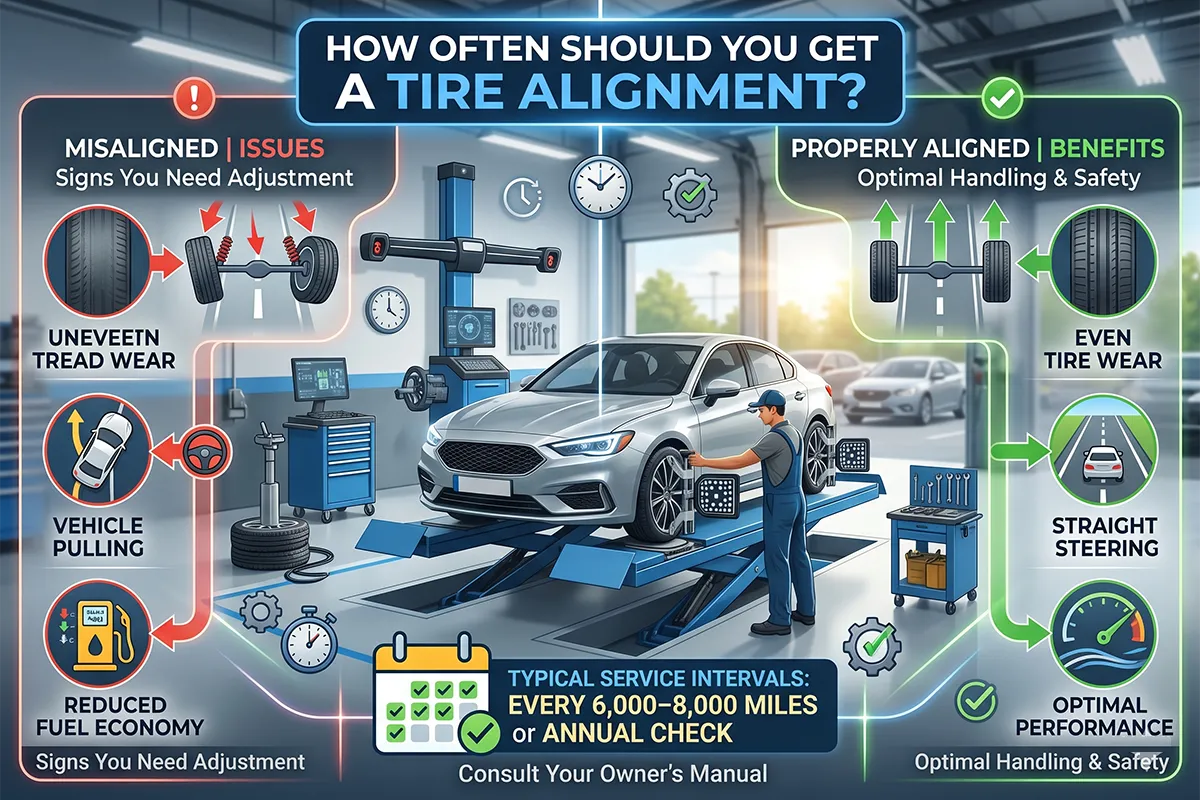
I used to follow the “once a year” rule religiously — until I started paying closer attention to my actual driving patterns and realized I was going to the shop too infrequently on some cars and unnecessarily on others. The real answer to how often you need an alignment is less about the calendar and more about your specific situation.
- The standard recommendation is a tire alignment check every 12–15,000 miles or once a year, whichever comes first.
- That interval works well as a baseline for most drivers under normal conditions.
- But the right frequency for you depends on your roads, your vehicle, your driving style, and what your tires are telling you.
- Some drivers on rough urban roads should be going every 6,000–8,000 miles.
- Others who drive smooth highway miles on a well-sorted suspension can stretch to 15,000 comfortably.
- There are also several trigger events — new tires, a hard pothole hit, any collision, suspension repairs — that mean you should get an alignment check regardless of where you are in your interval.
Before getting into the frequency details, if you’re new to what alignment actually involves — what angles are being measured, what the service does, and why it matters — our complete tire alignment guide covers all of that ground. This article focuses specifically on timing: when to go, when to go sooner, and how to build an alignment schedule that actually matches how you use your car.
Liked this article?
Add TireAdvise as a preferred source so you see more of our tire reviews and guides on Google.
The Standard Interval — And Why It Exists
The 12–15,000-mile or annual recommendation isn’t arbitrary. It maps to a few realities about how suspension geometry drifts over time and distance.
Your suspension is a system of metal components connected through rubber bushings, ball joints, and tie rod ends. Every mile you drive sends vibration and impact through that system.
Every pothole absorbed, every curb approached too sharply, every frost heave in the road causes micro-movement in those connections.
Most of that movement is imperceptible in any single event — but over 10,000 to 15,000 miles of accumulation, the total drift from original spec becomes meaningful enough to affect tire wear.
The annual calendar trigger exists because even drivers who put on relatively low mileage in a year — 8,000 to 10,000 miles — are still exposing their suspension to a full seasonal cycle.
In most of the U.S., that means winter road damage, spring frost heaves, temperature cycling that affects rubber bushing compliance, and road salt that accelerates corrosion on suspension hardware. A once-yearly check catches anything the mileage trigger misses.
In my own rotation, I use 12,000 miles as my personal trigger — it roughly lines up with my oil change cadence at that interval, which makes it easy to remember. Every oil change, I ask for an alignment check. Not always a full adjustment, but at minimum a measurement to see where things stand.
Factors That Should Change Your Alignment Frequency
The standard interval is a reasonable default, but it’s built for a median driver under average conditions. If any of the following apply to you, adjust accordingly.
Your Roads Are Rough
This is the most impactful variable for most drivers, and it’s consistently underweighted when people think about alignment frequency.
If you drive predominantly on smooth suburban streets and well-maintained interstates, your suspension sees relatively gentle, predictable inputs. The 15,000-mile stretch end of the range is realistic for you.
If your commute involves pothole-riddled city streets, poorly maintained rural roads, gravel, or construction zones — that’s a fundamentally different mechanical environment.
The cumulative jarring that suspension components absorb on those roads shifts alignment geometry faster than clean mileage does.
I’d move the interval to 6,000–8,000 miles if rough roads are a regular part of your driving diet. It sounds aggressive until you think about what a set of tires costs versus what an alignment costs.
Urban drivers in older northeastern U.S. cities — Chicago, Boston, Detroit, Philadelphia — are particularly susceptible to this.
The road quality in those markets is objectively poor, and tire shops in those cities see alignment issues at disproportionately high rates. If you’re commuting daily through that kind of pavement, budget for more frequent alignment service and factor it into your annual tire costs.
You’ve Had a Hard Impact
This is a trigger event, not an interval question — and it deserves its own category. Any of the following means schedule an alignment check before you accumulate another 3,000 miles:
- You hit a pothole hard enough to feel it in the steering wheel or hear a thud from the suspension
- You struck a curb with meaningful force, even at low speed
- You bottomed out on a speed bump, dip, or unpaved surface
- You were involved in any collision, however minor — even parking lot contact that left a mark
The reason is simple: suspension geometry can shift in a single event. The cumulative model that underlies the mileage interval doesn’t apply here.
One significant impact can knock a wheel several tenths of a degree out of spec immediately, and that misalignment starts wearing your tires the moment you pull away from the incident.
I once had a client at a shop I was visiting who’d hit a particularly brutal Chicago pothole in February. Nothing looked visibly wrong with the car. No warning lights, no noise, no obvious pull.
The alignment check revealed the left front camber had shifted nearly a full degree out of spec and the toe was off on the same corner. Six months of driving on that before the next service interval would have measurably shortened that tire’s life.
When in doubt after any hard impact, check it. The alignment check is typically free or low cost at most shops — many will measure your alignment without charge and only bill for adjustment if it’s needed.
You Just Put on New Tires
Always. No exceptions. If you’ve just purchased a new set of tires, an alignment check should be part of that service — either included with the tire installation or scheduled immediately afterward.
New tires represent a significant investment. Starting them on a misaligned car means uneven wear begins from the very first mile. By the time the misalignment becomes visually obvious in the tread wear pattern, you’ve potentially already given up thousands of miles of useful tire life that money can’t recover.
Most reputable tire shops will either include an alignment check with tire installation or offer it at a discounted rate as a bundle. If yours doesn’t, ask. If the check reveals you’re out of spec, getting the alignment done before driving away is the single best thing you can do to protect that new tire investment.
Your Vehicle Has Modified or Non-Stock Suspension
Aftermarket suspension setups — lifted trucks, lowered cars, coilovers, spacer lifts, performance springs — operate outside the parameters the factory alignment specs were designed around.
These setups often require custom alignment targets rather than OEM specs, and the non-standard geometry can be more sensitive to drift than a stock suspension.
If you’ve modified your suspension, tighten your alignment interval to every 6,000–10,000 miles depending on how aggressively the suspension has been altered.
A modest sport spring with 0.5″ of drop needs less attention than a two-inch lowering kit on stock control arms. A mild leveling kit on a truck is different from a six-inch lift with aftermarket upper control arms.
The other consideration: modified vehicles need a shop that understands their specific setup. A shop unfamiliar with your lift kit or coilover system may produce technically “green” alignment numbers that still drive poorly because they’re using OEM targets rather than targets appropriate for your configuration.
For more on the time and expertise involved in aligning modified vehicles, the alignment time article covers what makes these jobs take longer.
You’ve Had Suspension or Steering Components Replaced
Any time a suspension or steering component is replaced — tie rod ends, control arm bushings, ball joints, struts, sway bar links — the geometry of that corner changes.
Even if the tech torques everything to spec, the new component is in a slightly different position than the worn one it replaced. Always get an alignment after any suspension work.
This also applies to steering rack replacements and anything that touches the steering geometry. The alignment should be the last step of any suspension repair, not an afterthought.
You Drive a High-Mileage Vehicle
As vehicles age and accumulate miles, rubber suspension components — bushings, mounts, isolators — naturally soften and compress. This gradual compliance change means the effective geometry can shift even without any obvious wear or impact event.
On a vehicle with 80,000+ miles, I’d move closer to the 10,000-mile end of the service interval rather than stretching to 15,000.
A Practical Alignment Frequency Guide by Driver Type
Rather than a single number, here’s how I think about alignment intervals for different real-world driver profiles:
| Driver Profile | Conditions | Recommended Interval |
|---|---|---|
| Highway commuter, smooth roads | Mostly interstate miles, good pavement | 13,000 – 15,000 miles or annually |
| Mixed urban/suburban driver | Moderate road quality, some rough sections | 10,000 – 12,000 miles or annually |
| City driver, rough roads | Daily urban driving, frequent potholes | 6,000 – 8,000 miles |
| Rural driver, gravel roads | Regular unpaved surfaces | 8,000 – 10,000 miles |
| Off-road driver | Regular trail use, rock crawling, overlanding | Every 5,000 – 6,000 miles or after every significant off-road trip |
| Modified vehicle (mild) | Lowered 0.5–1″ or leveling kit on truck | 8,000 – 10,000 miles |
| Modified vehicle (aggressive) | 2″+ drop, lift kit, coilovers | 6,000 – 8,000 miles |
| Track/performance driver | Track days in addition to street use | Every 5,000 – 6,000 miles or after each track event |
| Low-mileage driver (<8,000 mi/yr) | Any road type | Annually regardless of mileage |
The most important column here is the last one — but the profile is nearly as important. A highway commuter in Phoenix driving 14,000 smooth miles per year lives in a fundamentally different mechanical environment than a city driver in Cleveland putting on 12,000 miles of pothole-interrupted stop-and-go. The mileage numbers are similar; the right alignment interval is not.
Warning Signs That Override Any Interval
Regardless of when you last had an alignment, certain symptoms mean go now — not at the next scheduled service. I’ve covered these in detail in the tire alignment pillar guide, but they’re worth repeating here in the context of frequency:
The car pulls consistently to one side on a flat, straight road. This is the classic symptom. If you have to hold steering input to keep the car going straight, alignment has drifted enough to feel it dynamically. That’s past “schedule soon” territory.
Your steering wheel isn’t centered when driving straight. The wheel logo should be level. If it’s rotated even 5–10 degrees left or right while you’re tracking straight, something has shifted since the last alignment.
You can see uneven tread wear across the tire face. Check the inner and outer edges of your front tires periodically. If one edge is wearing notably faster than the other, or you see feathering across the tread blocks when you run your hand across them, that’s physical evidence that toe or camber is out of spec right now.
Squealing during normal-speed turns. Not tight parking lot maneuvers — those can squeal on nearly any tire. I mean highway on-ramps or gentle curves at normal road speed. Toe misalignment forces the tire to slide rather than roll, and that produces noise.
The car feels vague or wandery at highway speed. If you find yourself making constant small corrections to stay in your lane on a straight highway, caster may be the issue. It’s easy to adapt to gradually — which is exactly why it often goes unaddressed until the tire wear is already set in.
How Alignment Fits Into Your Overall Tire Maintenance Schedule
Thinking about alignment as one piece of a broader tire maintenance routine — rather than an isolated service — makes it easier to stay on top of everything without separate tracking.
Here’s how I build the schedule in practice:
Every oil change (or every 5,000–7,500 miles):
- Check tire pressure (including spare)
- Visual scan of tires for obvious wear or damage
Every other oil change (or every 10,000–12,000 miles):
- Tire rotation
- Alignment check (measurement at minimum; adjustment if needed)
- Inspect tire tread depth with a gauge
Annually (regardless of mileage):
- Full alignment check if not already done at mileage interval
- Inspect suspension components for wear (tie rods, bushings, ball joints)
Trigger events (schedule within 1,000 miles of occurrence):
- New tire installation
- Any hard impact (pothole, curb, collision)
- Any suspension or steering component replacement
- Noticeable change in how the car drives or tracks
Pairing alignment with rotation is particularly efficient — both services can often be done in the same appointment, and you’ll avoid a separate trip to the shop. For a full breakdown of the rotation side of this, our tire buying and maintenance guide covers the rotation intervals alongside all the other upkeep decisions.
The Cost of Going Too Long Between Alignments
I’ve made the financial case for regular alignment service in the tire alignment cost article, but it’s worth framing specifically around frequency here.
Alignment service at 12,000-mile intervals costs roughly $100–$150 per visit. Over 60,000 miles, that’s five visits — approximately $500–$750 total in alignment costs.
A set of mid-grade all-season tires for a typical crossover costs $500–$700 installed and should last 50,000–60,000 miles under proper care.
If alignment neglect cuts that by 30%, you’re replacing tires at 35,000–42,000 miles instead of 50,000–60,000. That’s one to two extra tire replacements over the vehicle’s life — a cost of $500–$1,400 in premature tire replacement.
The math consistently favors staying on schedule. You’re spending a few hundred dollars on a service to protect a much larger tire investment, while also protecting fuel economy and driving dynamics.
The counterpoint people raise: “What if I go in and I don’t need an adjustment — isn’t that wasted money?” Not really. Many shops will perform the alignment measurement (check only) for free or at minimal cost and only charge for adjustment if values are out of spec.
Even at shops that charge for both, knowing your alignment is within spec is useful information. You leave confirmed rather than guessing.
Frequently Asked Questions
How often should you get a tire alignment?
For most drivers under typical conditions, every 12–15,000 miles or once a year is the right baseline. Adjust shorter — toward 6,000–8,000 miles — if you regularly drive on rough roads, have a modified vehicle, or do off-road driving.
How often do you need a tire alignment if you drive mostly highway miles?
Highway driving is relatively gentle on suspension geometry compared to urban stop-and-go on rough pavement. If your driving is predominantly smooth interstate miles, you can comfortably stretch toward the 15,000-mile end of the range.
How often should you get an alignment with a new car?
New cars come from the factory with alignment set to spec, but that doesn’t mean they stay there indefinitely. Start checking at 12,000–15,000 miles like any other vehicle — and immediately if you have any hard impact event regardless of vehicle age.
How often to do tire alignment on a lifted truck?
More frequently than a stock vehicle. For a mild lift (leveling kit, 1–2″), check at 8,000–10,000 miles. For more aggressive lifts with aftermarket upper control arms or significant geometry changes, 6,000–8,000 miles is a more appropriate interval.
Does alignment need to be done every tire rotation?
Not necessarily, but the two services make sense to schedule together every other rotation — roughly every 10,000–12,000 miles. Rotating tires more frequently than you align them is fine; tires should be rotated every 5,000–7,500 miles, while alignment checks every 10,000–15,000 miles is adequate for most drivers.
When should you get a tire alignment outside the regular schedule?
Get an alignment check any time you: install new tires, have a hard impact with a pothole or curb, notice the car pulling to one side, see uneven tire wear, or have any suspension or steering component replaced.
Is it bad to go too long without an alignment?
Yes, measurably so. Extended misalignment accelerates tire wear — often unevenly — which shortens tire life and wastes money spent on tires. It also degrades fuel economy and, in significant cases, affects vehicle handling. The longer misalignment goes unaddressed, the harder it becomes to recover even tire wear across the set.
How long does a tire alignment take once I’m at the shop?
A standard four-wheel alignment on a passenger car runs 45–75 minutes on the rack. Our detailed breakdown of how long a tire alignment takes covers what affects that timeline, including worn parts, vehicle type, and shop equipment.
Final Thoughts
The “once a year” rule is a reasonable starting point — but treating it as a fixed answer rather than a default is a mistake I see plenty of drivers make. Your actual optimal interval depends on your roads, your vehicle, and your driving patterns in ways that a single number can’t capture.
The framework I’d leave you with: use 12,000 miles or one year as your baseline, tighten it if your roads are rough or your vehicle is modified, and treat certain events — new tires, hard impacts, suspension work — as non-negotiable triggers that reset the clock regardless of where you are in the interval.
Your tires will tell you when you’ve waited too long. The goal is to listen before the wear pattern writes it into the tread.
Related reading:
