

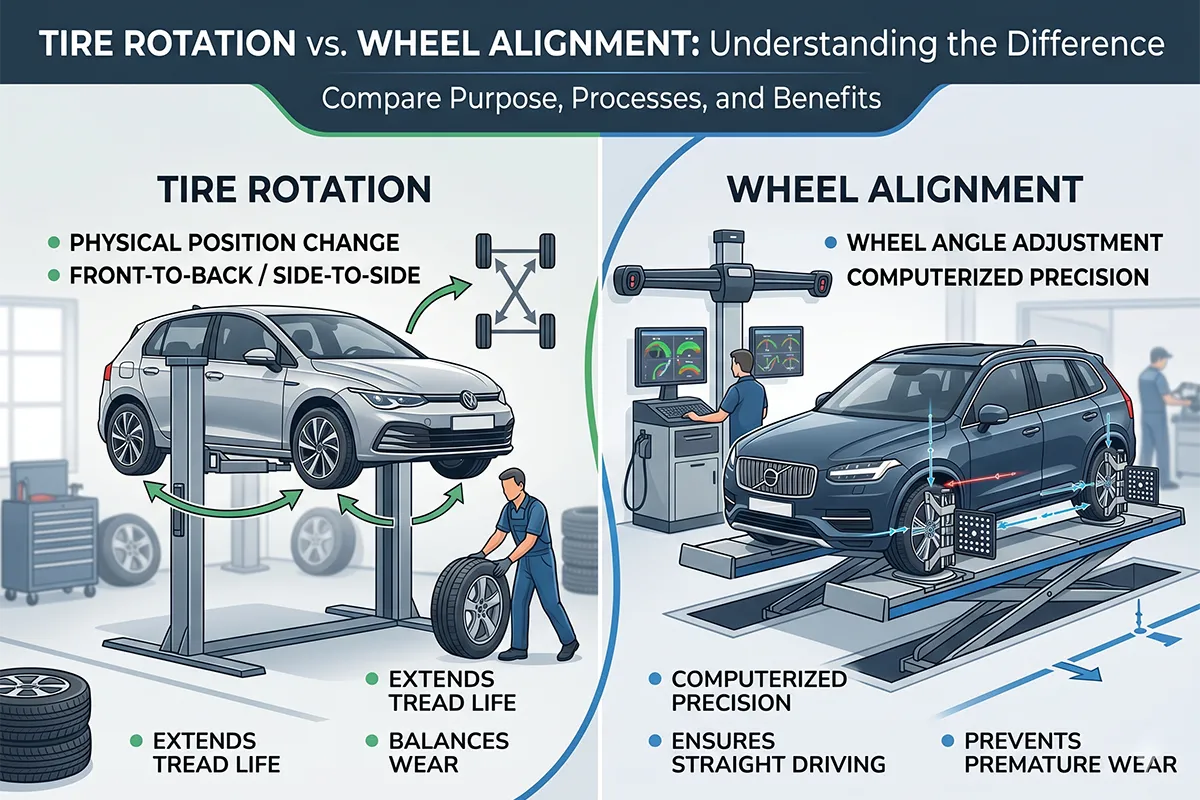
I’ve had this conversation at the service counter more times than I can count — a customer comes in asking for a rotation, and when I mention their alignment is also due, they look at me like I’m trying to sell them something they already bought. “Didn’t you just rotate them?” Not quite. Confusing these two services is one of the most common maintenance mistakes I see, and it costs drivers real money when it goes uncorrected.
- Tire rotation and tire alignment are completely different services that solve different problems.
- Rotation physically moves your tires between positions on the car to equalize wear across all four.
- Alignment adjusts the suspension angles so your tires make correct, even contact with the road regardless of position.
- You need both — on different schedules — and doing one without the other leaves the job half done.
- If your alignment is off, rotating your tires just redistributes misalignment damage instead of preventing it.
If you want to understand exactly what alignment involves at a mechanical level — what camber, toe, and caster mean and why they matter — our complete tire alignment guide covers all of that.
This article focuses on understanding both services side by side: what each one actually does, how they interact, and how to schedule them intelligently.
Liked this article?
Add TireAdvise as a preferred source so you see more of our tire reviews and guides on Google.
The One-Line Answer
Tire rotation = moving tires to different positions on the car. Tire alignment = adjusting the suspension angles so tires contact the road correctly.
They address completely separate aspects of tire health and vehicle performance. One moves the tires around. The other fixes the geometry they’re mounted into. You can need one without needing the other, or need both simultaneously — and understanding the difference between them tells you which situation you’re in.
What Is Tire Rotation? (And What It Actually Does)
Tire rotation is the periodic process of moving each tire from its current wheel position to a different one — front-left to rear-right, rear-right to front-left, and so on — according to a defined pattern. That’s the complete definition.
No suspension work, no angle measurement, no computer equipment required. The tire comes off one corner, goes on another corner, and the process is repeated for all four.
Why Tires Wear Differently by Position
To understand why rotation matters, you need to appreciate why tires in different positions on the same car wear at different rates.
Front tires work harder than rear tires on most vehicles. On a front-wheel-drive car — which describes the majority of passenger vehicles on the road — the front tires are doing three jobs simultaneously: steering, braking, and transmitting engine power to the road. Rear tires only brake. That workload difference means front tires consistently wear faster, often two to three times faster than rears on FWD cars. Without rotation, you’d end up replacing the fronts while the rears still had 60–70% of their tread life remaining.
Steering and braking loads aren’t evenly distributed. Most people brake harder and more often than they accelerate. The outside front tire takes more load in left turns, the inside front in right turns. These patterns create subtle wear asymmetries that accumulate over thousands of miles.
Weight distribution affects contact patch pressure. A front-engine vehicle puts more weight over the front axle, increasing contact patch pressure and wear rate at the front. A rear-engine or mid-engine layout shifts that burden accordingly.
Rotation is the solution to all of this: by periodically reassigning which tire handles which load profile, you average out the wear across all four tires over their lifespan. The goal is for all four tires to reach the end of their useful life at approximately the same time, maximizing the value of the full set.
Common Rotation Patterns
The specific pattern used depends on your vehicle’s drivetrain, whether your tires are directional (designed to rotate in one direction only), and whether your front and rear tires are the same size:
Forward cross: Front tires go straight back, rear tires cross to opposite front corners. Standard for front-wheel-drive vehicles.
Rearward cross: Rear tires go straight forward, front tires cross to opposite rear corners. Used on rear-wheel-drive and all-wheel-drive vehicles.
X-pattern: All four tires cross to the diagonally opposite corner simultaneously. Less common, used on some FWD vehicles where more aggressive front-to-rear equalization is needed.
Side-to-side: Used only when front and rear tires are different sizes (staggered fitment). Tires swap left-to-right but can’t move front-to-rear. Note: if your tires are also directional, a side-to-side rotation requires dismounting and remounting the tires on opposite rims — a more involved process.
Front-to-rear: For directional tires of the same size, where the tread pattern requires the tire to spin in a specific direction. Fronts go to rear on the same side; rears go to front on the same side.
How Often Should You Rotate Tires?
The standard interval for tire rotation is every 5,000–7,500 miles, or roughly every oil change at modern oil change intervals. Some manufacturers specify up to 10,000 miles, but I’d stay on the shorter end — particularly for front-wheel-drive vehicles where the differential in front-to-rear wear rate is sharpest.
What Is Tire Alignment? (The Brief Version)
Since this site has a full breakdown of alignment in our tire alignment guide, I’ll keep this section focused on the comparison.
Alignment is the adjustment of your vehicle’s suspension system — the arms, struts, tie rods, and mounting points that connect your wheels to the car’s frame — to bring the angles at which your tires meet the road back to manufacturer specifications. Those angles are:
Camber: The inward or outward tilt of the tire when viewed from the front. Affects how evenly the tread width contacts the road.
Toe: Whether the tires point slightly inward or outward when viewed from above. The single most common cause of rapid, uneven tread wear.
Caster: The forward or backward tilt of the steering axis. Primarily affects steering stability and the car’s tendency to track straight.
These angles drift over time from road impacts, suspension wear, and normal use. The drift is invisible in the early stages — the car may drive normally while toe or camber quietly grinds away at one edge of each tire. By the time misalignment is obvious in the wear pattern, the damage is already done.
Alignment requires a rack with electronic measurement equipment, a trained technician, and physical adjustment of suspension components. It is meaningfully more involved than rotation, takes longer, and costs more — but it addresses a completely different root cause.
Side-by-Side Comparison
| Tire Rotation | Tire Alignment | |
|---|---|---|
| What it does | Moves tires between wheel positions | Adjusts suspension angles |
| What it fixes | Unequal wear from position-specific load differences | Unequal wear from improper tire contact angles |
| Equipment needed | Jack, tire iron, torque wrench | Alignment rack with electronic measurement system |
| Time required | 20–30 minutes | 45–75 minutes |
| Typical cost | $20–$50 | $100–$150 (4-wheel) |
| Recommended interval | Every 5,000–7,500 miles | Every 12,000–15,000 miles |
| Fixes a pulling car? | No | Yes |
| Fixes off-center steering wheel? | No | Yes |
| Fixes uneven edge wear? | No (moves it to a new position) | Yes (corrects the cause) |
| Fixes front-to-rear wear difference? | Yes (equalizes it over time) | No |
| Required after new tire install? | Yes | Yes (check at minimum) |
| Required after hitting a pothole? | No | Yes (check) |
| Required after suspension work? | No | Yes |
How Rotation and Alignment Work Together
This is where most of the confusion — and most of the costly mistakes — live.
Rotation and alignment aren’t competing services. They’re complementary ones that address different failure modes in tire wear. Understanding how they interact is more useful than simply knowing they’re different.
Rotation Without Alignment: Moving the Problem Around
Here’s the scenario that costs drivers the most money and goes unrecognized the longest.
Your alignment drifts — let’s say toe is out on the front axle, causing the inner edges of both front tires to wear faster than the outer edges.
You get your tires rotated on schedule, which moves those front tires to the rear and puts the rear tires up front. The rotation is done correctly. The tires are now in new positions.
But the alignment is still wrong.
The tires that were wearing on their inner edges at the front will now wear on their inner edges at the rear — because the misalignment problem is in the suspension geometry, not in the tire’s position.
The rotation redistributed the wear opportunity but didn’t fix its cause. Your new front tires (the old rears) are now also going to start wearing unevenly, because they’ve inherited the same misaligned suspension.
Meanwhile, the inner-edge wear already accumulated on the rotated tires doesn’t disappear. It’s baked in. The tread depth on those edges is permanently less than the center and outer edge, regardless of what position the tire occupies.
This is the exact scenario that produces a full set of tires with uneven, cross-pattern wear that seems to make no sense until you reconstruct the rotation history and realize alignment was never addressed.
The Right Order of Operations
When both services are due at the same time — which they will be periodically, since alignment is typically done every other rotation cycle — the correct order is:
1. Alignment first. Rotation second.
Here’s why: if you rotate the tires and then align, you’ve just moved tires to new positions and then set the angles for how they’ll sit in those new positions. The rotation is done correctly. This order works fine.
But the reverse is also acceptable in practice, because an alignment corrects the suspension geometry, which applies equally to whichever tire ends up in that position. A correct toe setting is correct regardless of which tire is mounted in that corner.
What you must never do is rotate without aligning when alignment is genuinely out of spec. The rotation simply redistributes uneven wear to new corners without addressing the geometry that’s causing it.
The practical takeaway: when you’re scheduling service, if both are due, do them in the same appointment. Most shops run rotation in a bay while the alignment rack is being set up, so there’s no meaningful time penalty to combining them. You get everything corrected in one visit.
Tire Balancing: The Third Service That Gets Confused With Both
While we’re clarifying what rotation and alignment are and aren’t, it’s worth addressing tire balancing — the third service in this category that gets conflated with the other two.
Tire balancing corrects the weight distribution of the wheel-and-tire assembly as a unit. Even a brand new tire mounted on a brand new wheel won’t have perfectly uniform weight distribution around its circumference — manufacturing tolerances mean slight heavy spots exist.
A balancing machine identifies these heavy spots, and the technician counteracts them by attaching small lead or zinc weights to the rim at specific positions.
Imbalance causes vibration — typically felt in the steering wheel or through the floor at highway speeds, usually in a specific speed range (often 55–70 mph).
It does not cause uneven tread wear in the same way misalignment does, and it doesn’t affect steering pull. Balancing fixes vibration; alignment fixes pull and uneven wear; rotation equalizes position-specific wear.
| Symptom | Rotation Fixes It? | Alignment Fixes It? | Balancing Fixes It? |
|---|---|---|---|
| Uneven wear front vs rear | Yes | No | No |
| Uneven wear edge to edge | No | Yes | No |
| Car pulls to one side | No | Yes | No |
| Highway vibration | No | No | Yes |
| Off-center steering wheel | No | Yes | No |
| Premature wear overall | Partially | Partially | No |
Practical Scheduling: When to Do Each Service
One of the most common questions I get after explaining the difference between rotation and alignment is: how do I fit both into a maintenance schedule without tracking two separate intervals?
The answer is to anchor them together using a simple ratio.
Rotate every oil change (or every 5,000–7,500 miles). Align every other rotation (every 10,000–15,000 miles). This means roughly every other oil change appointment includes both a rotation and an alignment check. The only variation is that certain trigger events — hard pothole hits, new tires, suspension work, any collision — warrant an alignment check outside the normal interval regardless of where you are in the rotation cycle.
Here’s what that looks like in practice for a driver doing 12,000 miles per year:
| Mileage | Service |
|---|---|
| 5,000 mi | Tire rotation |
| 10,000 mi | Tire rotation + alignment check |
| 15,000 mi | Tire rotation |
| 20,000 mi | Tire rotation + alignment check |
| 25,000 mi | Tire rotation |
| 30,000 mi | Tire rotation + alignment check (+ tread depth inspection) |
This schedule keeps both services current without requiring separate tracking. At each “rotation only” appointment, you’re still getting eyes on the tires and can catch any emerging wear pattern that suggests alignment should be moved up.
For a deeper look at alignment intervals and how to adjust them based on your specific driving conditions and vehicle type, our article on how often to get a tire alignment covers all the variables — road quality, vehicle type, driving style — that should influence your personal interval.
Does Combining Services Save Money?
Yes — usually meaningfully so. Most shops offer a discount when alignment is added to a tire rotation at the same appointment, simply because the car is already on a lift and the technician is already handling the wheels.
The incremental labor cost is lower than it would be for a standalone alignment appointment, and shops pass some of that savings through.
Beyond the direct discount, the indirect saving is time: one trip instead of two for two services that happen to be due around the same time. Scheduling service efficiently is one of the underrated habits of drivers who consistently get more life out of their tires than average.
For a full breakdown of what alignment costs across different vehicle types and shop categories — so you know what a fair price looks like when you ask about bundling — the tire alignment cost guide has the current numbers.
What Happens to Your Tires If You Only Ever Do One of These Services?
If you only rotate and never align: Your tires will wear relatively evenly front-to-rear (which rotation handles), but if your alignment drifts — and it will, over time and through impacts — the edge-to-edge wear pattern will worsen at every position. You may not see a dramatic difference in the first 20,000 miles depending on how far out of spec things drift. By 40,000–50,000 miles on a car that’s never been aligned, the cumulative damage is usually visible and significant.
If you only align and never rotate: Your tires will make proper, even contact with the road — which is what alignment provides — but the workload differences between axles and positions will still apply. On a front-wheel-drive car, the front tires will wear significantly faster than the rears with no rotation to equalize them. You’ll end up replacing fronts early while the rears still have useful life, which is both expensive and inefficient.
If you do both on schedule: Each service handles the failure mode the other can’t. Rotation equalizes position-specific wear rates. Alignment ensures the contact patch is correct at every position. Together, they give you the best realistic chance of getting the full rated mileage out of every set of tires you buy.
For a clear-eyed look at whether the investment in regular alignment is genuinely worth it versus an unnecessary expense, our article on whether tire alignment is necessary works through both sides of that question honestly — including the situations where an alignment recommendation from a shop is worth scrutinizing.
Frequently Asked Questions
Is tire alignment and rotation the same thing?
No. Tire rotation moves your tires between wheel positions to equalize wear from position-specific load differences. Tire alignment adjusts suspension angles so your tires make correct, even contact with the road. They’re different services performed by different equipment that address different problems — and you need both.
Can a tire rotation fix a car that pulls to one side?
No. A pull to one side is caused by misaligned suspension angles — specifically toe or caster imbalance between left and right. Rotation moves tires to different positions but doesn’t change the geometry those tires are mounted into. Only an alignment corrects a pull.
Should I get an alignment every time I rotate my tires?
Not necessarily — the intervals are different. Rotation is recommended every 5,000–7,500 miles; alignment every 12,000–15,000 miles. A practical approach is to include an alignment check every other rotation appointment, so roughly every 10,000–12,000 miles.
Does tire rotation affect alignment?
Rotation itself doesn’t change alignment angles — it only moves the tire from one corner to another. However, if alignment is out of spec, rotation will spread misalignment-related wear to the tires that move into the affected positions. This is why fixing alignment before or alongside rotation matters.
Can I do a rotation and alignment at the same visit?
Yes, and it’s usually the most efficient and cost-effective approach. The rotation is typically done before the alignment, so the final alignment settings apply to the tires in their new positions.
What’s the difference between alignment, rotation, and balancing?
Three different services for three different problems: rotation equalizes wear across all four positions; alignment corrects suspension geometry for proper tire contact; balancing corrects weight distribution in the wheel-tire assembly to eliminate vibration. For a full breakdown of what balancing involves and when you need it, ask your tire shop — balancing is typically done when mounting new tires or when you notice highway-speed vibration.
How much does tire rotation cost compared to alignment?
Rotation is the less expensive service — typically $20–$50. A four-wheel alignment runs $100–$150 for most vehicles. See our tire alignment cost guide for a full breakdown by vehicle type and shop category.
How long does each service take?
Rotation takes 20–30 minutes. A four-wheel alignment takes 45–75 minutes. Done together, the combined appointment typically runs 60–90 minutes since some steps overlap. Our article on how long a tire alignment takes covers the full alignment process step by step.
Final Thoughts
Tire rotation and tire alignment are the maintenance equivalent of two tools in the same toolbox that solve two different jobs. You wouldn’t use a torque wrench to do what a tape measure does, and you wouldn’t skip either one just because you used the other recently.
Rotation keeps wear equalized across your tire set by managing position-specific load differences. Alignment keeps wear even within each tire by ensuring correct suspension geometry. Together, on the right schedule, they protect your full tire investment and keep your car driving the way it was designed to.
The confusion between them is understandable — both involve tires, both prevent wear, and shops tend to recommend both in the same conversation. But they’re not interchangeable, they’re not redundant, and treating one as a substitute for the other is a costly misunderstanding.
Do both. Schedule them intelligently. And when your shop mentions alignment after a rotation appointment, it’s not double-billing — it’s two different services your car may legitimately need at the same time.
Related reading:
