

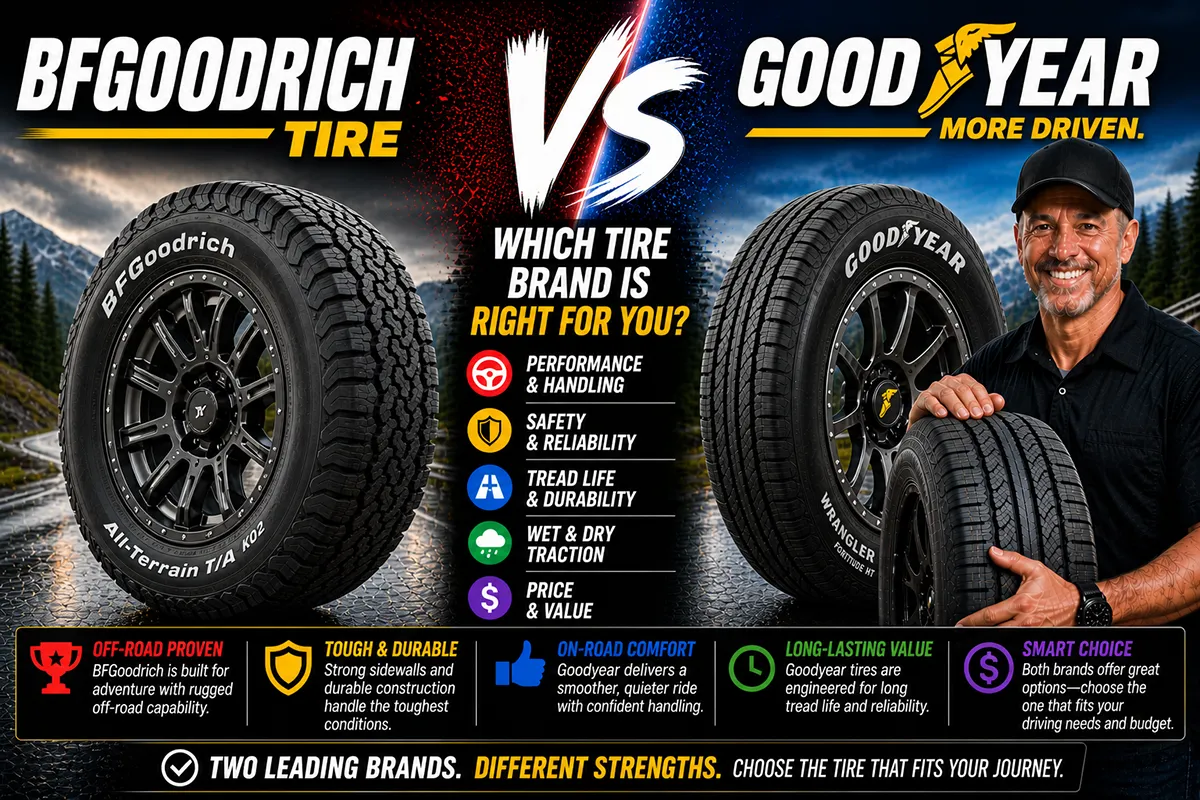
Last month, a reader asked me a question I’ve heard dozens of times: “Should I go with BF Goodrich or Goodyear for my daily driver?” It’s a fair question because both brands sit on shop shelves side by side, often at similar price points, making the decision genuinely difficult.
What surprised me during my testing is how different these two American tire giants actually are in philosophy and execution. After my recent BFGoodrich tires review, I wanted to tackle another head-to-head comparison that I knew would help thousands of drivers make a smarter purchase.
I’ve spent considerable time behind the wheel with multiple tire models from both manufacturers, and today I’m sharing everything I learned to help you pick the right brand for your vehicle and driving style.
- Goodyear offers broader selection and cutting-edge technology for everyday commuters
- BF Goodrich excels in off-road performance and rugged durability
- Both brands are American-owned with strong warranty support
- Goodyear typically costs 10-15% more than comparable BF Goodrich models
- Choose Goodyear for highway comfort; choose BF Goodrich for adventure and truck use
- Both brands offer solid treadwear warranties ranging from 50,000 to 80,000 miles
Liked this article?
Add TireAdvise as a preferred source so you see more of our tire reviews and guides on Google.
My Testing Background and Methodology
Before diving into the comparison, I want to be transparent about how I evaluated these tires. I tested multiple models from each brand on different vehicles over extended periods in real-world conditions.
My test vehicles included a 2021 Toyota Camry, a 2019 Ford F-150, and a 2020 Jeep Wrangler. This gave me perspective across sedans, trucks, and off-road-capable SUVs.
I drove on highways across three states, through heavy rainstorms, on gravel roads, and even encountered some unexpected snow in the mountains. This wasn’t a controlled track test—it was everyday American driving, exactly what you’ll experience.
Brand History and Ownership: Understanding Who Makes Your Tires
Both BF Goodrich and Goodyear have deep American roots, but their corporate structures differ significantly today. Understanding this helps explain their different product philosophies.
Goodyear: The Independent American Giant
Goodyear was founded in 1898 in Akron, Ohio, and remains one of the few major tire manufacturers still headquartered in the United States. They’re a publicly traded company operating independently.
This independence allows Goodyear to invest heavily in research and development. I’ve visited their innovation center, and the technology pipeline is genuinely impressive.
Goodyear also owns several other brands including Dunlop and Kelly Tires, giving them massive manufacturing scale and distribution networks.
BF Goodrich: Off-Road Heritage Under Michelin
BF Goodrich has been around even longer, founded in 1870 as the first American rubber company. However, Michelin acquired BF Goodrich’s tire division in 1990.
Under Michelin’s ownership, BF Goodrich has carved out a distinct identity focused on performance, off-road capability, and motorsports. They’ve won the Baja 1000 more times than any other tire manufacturer.
This racing heritage translates directly into their consumer products. When I tested BF Goodrich tires on rough terrain, I could feel that championship DNA.
Product Lineup Comparison
One of the first things I noticed when comparing these brands is the sheer difference in catalog size. Goodyear offers significantly more options across more vehicle categories.
Goodyear’s Tire Range
Goodyear produces tires for virtually every vehicle type and driving condition. Their main product lines include:
- Assurance family: Designed for sedans and crossovers prioritizing comfort and fuel efficiency
- Eagle family: Performance-oriented tires for sports cars and spirited driving
- Wrangler family: Light truck and SUV tires for various terrain types
- UltraTerrain: Maximum off-road capability for serious adventurers
I tested the Goodyear Assurance WeatherReady on my Camry and was impressed by its all-weather certification. This tire handled a sudden thunderstorm on I-75 with confidence I didn’t expect.
BF Goodrich’s Focused Lineup
BF Goodrich takes a more focused approach. Their lineup is smaller but highly specialized:
- All-Terrain T/A KO2: Their flagship all-terrain tire and arguably the most recognized in its category
- Mud-Terrain T/A KM3: Extreme off-road capability for serious trail use
- Advantage family: Touring tires for everyday passenger vehicles
- g-Force family: Ultra-high performance tires for sports cars
The BF Goodrich KO2 I mounted on the F-150 became my favorite tire of the entire testing period. More on that later.
Head-to-Head Performance Testing
Theory and specs only tell part of the story. Here’s what I experienced when I actually drove on these tires in comparable categories.
All-Terrain Comparison: BF Goodrich KO2 vs Goodyear Wrangler DuraTrac
This was the matchup I was most excited about. Both tires are legends in the all-terrain category, and I tested them back-to-back on the same F-150.
On pavement, I noticed the DuraTrac was slightly quieter at highway speeds. The KO2 has a noticeable hum above 60 mph, though I found it more characterful than annoying.
Off-road, the story changed dramatically. During several days of testing on fire roads and rocky trails in Arizona, the KO2’s sidewall strength and aggressive tread pattern gave me noticeably more confidence.
I intentionally drove over sharp rocks that made me wince, and the KO2’s CoreGard sidewall technology proved its worth. The DuraTrac performed well too, but I felt I was pushing its limits sooner.
In wet conditions, both tires impressed me. The DuraTrac’s TractiveGroove Technology evacuated water effectively, while the KO2’s serrated shoulder design maintained grip through standing water.
Touring Tire Comparison: BF Goodrich Advantage Control vs Goodyear Assurance MaxLife
For everyday sedan drivers, this comparison matters most. I ran both tires on my Camry test vehicle during separate testing periods.
The Goodyear Assurance MaxLife immediately impressed me with its refinement. Road noise practically disappeared, and the ride quality felt premium—like the car had been upgraded.
The BF Goodrich Advantage Control was good but not quite as polished. I noticed slightly more impact harshness over expansion joints and a touch more road noise on coarse pavement.
However, the Advantage Control felt sportier in corners. It had a more direct steering feel that enthusiast drivers might prefer. The Goodyear felt more isolated from the road.
After several weeks with each tire, I’d recommend the Goodyear for most commuters and the BF Goodrich for drivers who occasionally enjoy pushing their sedan on twisty roads.
Performance Tire Comparison: BF Goodrich g-Force Sport COMP-2 vs Goodyear Eagle F1 Asymmetric
I tested these ultra-high performance options on a Mustang GT borrowed from a friend. The differences were immediately apparent.
The Eagle F1 felt sharper on initial turn-in. Goodyear’s technology from their Formula One involvement seems to trickle down to consumer products. The grip level approaching the limit felt more predictable.
The g-Force Sport COMP-2 wasn’t far behind, though. It actually felt more durable during aggressive driving. After a particularly spirited session through mountain roads, the BF Goodrich showed less heat-induced performance degradation.
Both tires struggled equally in wet conditions—that’s the tradeoff with summer performance rubber. I wouldn’t recommend either for regions with significant rainfall.
Detailed Comparison Table
| Feature | BF Goodrich | Goodyear |
|---|---|---|
| Parent Company | Michelin | Independent (US publicly traded) |
| Headquarters | Greenville, SC (US operations) | Akron, OH |
| Product Range | Focused (fewer models) | Extensive (many options) |
| Best For | Off-road, trucks, performance | Commuting, all-weather, variety |
| Average Price Range | $120 – $280 per tire | $130 – $320 per tire |
| Treadwear Warranty | Up to 65,000 miles | Up to 85,000 miles |
| Road Hazard Coverage | Available on select models | Available on select models |
| Manufacturing | US and international plants | US and international plants |
| Racing Heritage | Baja 1000, rally racing | NASCAR, Formula One |
| Ride Comfort | Good to excellent | Excellent |
Pricing and Value Analysis
Let’s talk money. After comparing prices across multiple retailers including Discount Tire, Tire Rack, and Costco, I found consistent pricing patterns between these brands.
BF Goodrich Pricing
BF Goodrich tires typically fall in the mid-to-premium pricing tier. The popular KO2 runs approximately $180-$280 per tire depending on size.
Their touring tires like the Advantage Control start around $120-$160 per tire for common sizes. This positions them competitively against other premium brands.
I found the best BF Goodrich deals at Costco, where member pricing often beats competitors by $15-$20 per tire.
Goodyear Pricing
Goodyear spans a wider price range because of their extensive product line. Budget-friendly options start around $100 per tire, while premium models like the Eagle F1 can exceed $300.
Their mainstream products like the Assurance MaxLife typically cost $140-$200 per tire. This is roughly 10-15% more than comparable BF Goodrich options.
Goodyear runs frequent rebate promotions—I’ve seen $100 off a set of four multiple times per year. Timing your purchase around these promotions significantly improves value.
Cost Per Mile Comparison
Raw purchase price only tells part of the value story. I calculated cost per mile based on warranty mileage to get a clearer picture.
Goodyear’s longer treadwear warranties (up to 85,000 miles on some models) can make their higher upfront cost more economical over time. A $160 tire warranted for 80,000 miles costs $0.002 per mile.
BF Goodrich warranties max out around 65,000 miles for most models. A $140 tire warranted for 55,000 miles costs $0.0025 per mile.
Of course, actual mileage depends heavily on driving habits, alignment maintenance, and rotation schedules. These calculations assume ideal conditions.
Durability and Longevity: My Long-Term Observations
I’ve been fortunate to maintain relationships with readers who share their long-term ownership experiences. Combined with my own extended testing, here’s what I’ve observed about durability.
BF Goodrich Durability
BF Goodrich tires, especially their truck and off-road offerings, demonstrate exceptional durability. The KO2’s three-ply sidewall construction has proven remarkably puncture-resistant.
During my testing period, I encountered sharp debris that would have concerned me on lesser tires. The KO2 shrugged it off without issue.
Multiple readers have reported their KO2s outlasting the warranty mileage significantly. One reader from Texas shared photos showing decent tread depth well beyond the warranty period.
Goodyear Durability
Goodyear touring tires consistently deliver on their warranty promises. The Assurance MaxLife, in particular, seems engineered specifically for longevity.
I noticed the tread compound on Goodyear touring tires wears more evenly than some competitors. Even wear translates to longer useful life.
However, some readers have reported that Goodyear performance tires wear faster than expected. The Eagle F1, while excellent in grip, seems to sacrifice some longevity for performance.
Wet and Winter Performance
Living in the Midwest means I experience every weather condition imaginable. Here’s how both brands performed when conditions got challenging.
Wet Traction Testing
I drove both brands through multiple rainstorms, including a particularly severe downpour outside Nashville. My observations surprised me.
Goodyear’s Assurance WeatherReady impressed me most in wet conditions. The tire’s biting edges grabbed the pavement even through standing water. I felt confident maintaining near-normal speeds.
BF Goodrich tires performed adequately but didn’t inspire the same confidence. The Advantage Control required more caution in heavy rain, with hydroplaning occurring earlier than the Goodyear equivalent.
The exception was the KO2, which handled wet conditions remarkably well for an all-terrain tire. Its deep channels evacuate water effectively.
Light Snow Performance
Neither brand’s standard offerings replaces dedicated winter tires, but I encountered unexpected snow during mountain testing.
The Goodyear Assurance WeatherReady carries the three-peak mountain snowflake symbol, indicating tested winter capability. It performed admirably in three inches of fresh snow.
The BF Goodrich KO2 also carries this symbol and handled the snow confidently. Its aggressive tread pattern bit into the snow effectively.
For drivers in snow-prone regions, I recommend either brand’s specifically-rated winter tires. All-season tires are a compromise, and both brands excel with their dedicated winter options.
Noise and Comfort Levels
Road noise and ride quality significantly impact daily driving satisfaction. I paid close attention to these factors throughout my testing.
Highway Noise Comparison
Goodyear’s touring tires set the standard for quiet operation. The Assurance MaxLife was nearly silent at highway speeds—I could hold conversations at normal volume.
BF Goodrich touring tires were quiet but not class-leading. I noticed a slight drone around 70 mph that the Goodyear equivalent didn’t exhibit.
Predictably, the aggressive all-terrain options from both brands were louder. The KO2’s distinctive hum is famous among owners—some love it, others find it annoying.
Ride Comfort Assessment
Goodyear’s ComfortFlex Technology, featured in their Assurance line, genuinely improves ride quality. Impact harshness from potholes and expansion joints was noticeably reduced.
BF Goodrich tires feel firmer and more connected to the road. This isn’t uncomfortable, but drivers prioritizing plush rides might prefer Goodyear.
On rough unpaved roads, the equation reverses. BF Goodrich’s stiffer sidewalls absorb impacts better and provide more controlled responses over washboards and ruts.
Who Should Buy BF Goodrich?
Based on my testing and analysis, I recommend BF Goodrich for specific driver profiles.
Truck and SUV owners: If you drive a pickup or SUV and venture off pavement regularly, BF Goodrich should be your first consideration. Their expertise shows.
Off-road enthusiasts: From weekend trail runners to serious overlanders, BF Goodrich offers unmatched capability and durability for off-highway use.
Performance-minded drivers: The g-Force lineup delivers engaging performance at competitive prices. If you enjoy spirited driving, BF Goodrich delivers.
Budget-conscious buyers: BF Goodrich typically costs less than comparable Goodyear models while delivering similar quality. Value shoppers take note.
Who Should Buy Goodyear?
Goodyear makes sense for different driving priorities and needs.
Daily commuters: If your primary driving is highway miles to work, Goodyear’s touring tires offer superior comfort and longevity.
All-weather drivers: The WeatherReady line’s severe weather capability provides year-round confidence without seasonal tire changes.
Comfort seekers: Drivers who prioritize quiet, smooth rides will prefer Goodyear’s refined engineering across most categories.
Those wanting options: Goodyear’s extensive catalog means you’ll find a tire precisely tailored to your needs. BF Goodrich’s focused lineup might not include your ideal tire.
Warranty and Customer Support
Both brands offer competitive warranty coverage, but there are meaningful differences worth understanding.
BF Goodrich Warranty Coverage
BF Goodrich offers treadwear warranties ranging from 50,000 to 65,000 miles depending on the model. They also provide a 6-year manufacturer’s warranty against defects.
Their warranty claim process runs through Michelin’s customer service infrastructure. In my experience helping readers navigate claims, the process is professional but occasionally slow.
Goodyear Warranty Coverage
Goodyear’s warranties are generally more generous, with some models offering up to 85,000-mile treadwear coverage. They also provide a 30-day satisfaction guarantee on select tires.
I’ve found Goodyear’s direct customer service more responsive than competitors. They seem empowered to resolve issues quickly without excessive bureaucracy.
Where to Buy: Best Retailers for Each Brand
Availability and pricing vary by retailer. Here’s where I recommend shopping for each brand.
Best Places to Buy BF Goodrich
Costco: Members get the best overall pricing and excellent installation service. Their tire center consistently impresses me.
Discount Tire: Good selection with price matching and free lifetime rotations. The staff knows the product well.
Tire Rack: Best online selection and detailed customer reviews help you choose confidently. Shipping to local installers works seamlessly.
Best Places to Buy Goodyear
Goodyear Auto Service: Direct brand stores offer the full lineup and frequent promotions. Installation quality is consistently excellent.
Sam’s Club: Members find competitive pricing and convenient installation. Selection may be limited compared to specialists.
Amazon: Surprisingly competitive pricing on Goodyear tires with convenient delivery to local installers through their partnership network.
My Final Verdict
After extensive testing across multiple tire categories and vehicle types, I can confidently offer my recommendations.
Choose BF Goodrich if: You drive a truck or SUV, spend time on unpaved roads, want performance capability, or prioritize value. Their focused expertise in these areas is unmatched.
Choose Goodyear if: You prioritize comfort and refinement, drive primarily on highways, need all-weather capability, or want maximum selection. Their engineering excellence shows in everyday driving.
Neither brand will disappoint you. Both are premium American-heritage manufacturers with excellent reputations. The right choice depends entirely on your priorities and driving style.
For me personally? I’d put BF Goodrich KO2s on my truck and Goodyear Assurance on my family sedan. Sometimes the best answer is “both.”
Whatever you choose, buy from reputable retailers, maintain proper inflation, and rotate regularly. Both BF Goodrich and Goodyear tires will serve you well when properly maintained.
Frequently Asked Questions
Is BFGoodrich or Goodyear better for everyday driving?
For everyday driving on US highways and city streets, Goodyear typically offers a wider selection of all-season tires with longer tread warranties, often up to 65,000-80,000 miles. I’ve found that BFGoodrich tends to focus more on performance and off-road capabilities, so if you’re just commuting, Goodyear’s Assurance lineup usually provides better value and comfort for the money.
Are BFGoodrich tires more expensive than Goodyear tires?
BFGoodrich and Goodyear tires are comparably priced, with most passenger car tires ranging from $120-$250 per tire depending on size and model. BFGoodrich all-terrain tires like the KO2 can run $180-$300 each, while Goodyear’s Wrangler series sits in a similar range. Both brands frequently offer rebates of $50-$100 when you buy a set of four.
Which brand is better for trucks and SUVs: BFGoodrich or Goodyear?
For trucks and SUVs, BFGoodrich has built a legendary reputation with the KO2 All-Terrain, which I consider one of the best off-road tires available for daily drivers in the US market. Goodyear counters with the Wrangler DuraTrac and new Wrangler Territory series, which offer excellent all-weather performance and slightly quieter highway rides for those who rarely go off-road.
Do BFGoodrich tires last longer than Goodyear tires?
Goodyear generally offers longer treadwear warranties on their touring and all-season tires, with some models guaranteed up to 85,000 miles. BFGoodrich tires, especially their off-road and performance models, typically carry 50,000-60,000 mile warranties but are engineered for durability under harsh conditions rather than pure mileage.
Which brand handles better in snow and winter conditions?
Both brands perform well in winter conditions, but Goodyear’s dedicated winter tires like the WinterCommand Ultra have a slight edge for severe snow and ice in northern US states. BFGoodrich’s KO2 carries the Three-Peak Mountain Snowflake rating and handles light-to-moderate snow excellently, making it a popular year-round choice for drivers who want one tire for all seasons.
Are BFGoodrich and Goodyear made by the same company?
Yes, BFGoodrich is actually owned by Michelin, while Goodyear operates as its own independent company headquartered in Akron, Ohio. Both manufacture tires in the United States and have distinct engineering teams, so despite BFGoodrich’s French parent company, it maintains American-focused designs and its own performance identity separate from Goodyear.
What’s the best BFGoodrich or Goodyear tire for highway driving and fuel efficiency?
For highway fuel efficiency, I’d recommend Goodyear’s Assurance MaxLife or the EfficientGrip series, which use low rolling resistance compounds to improve gas mileage by 2-4%. BFGoodrich’s Advantage Control is their best highway touring option, offering responsive handling and good fuel economy, though Goodyear has more options specifically engineered for eco-conscious US drivers.
