

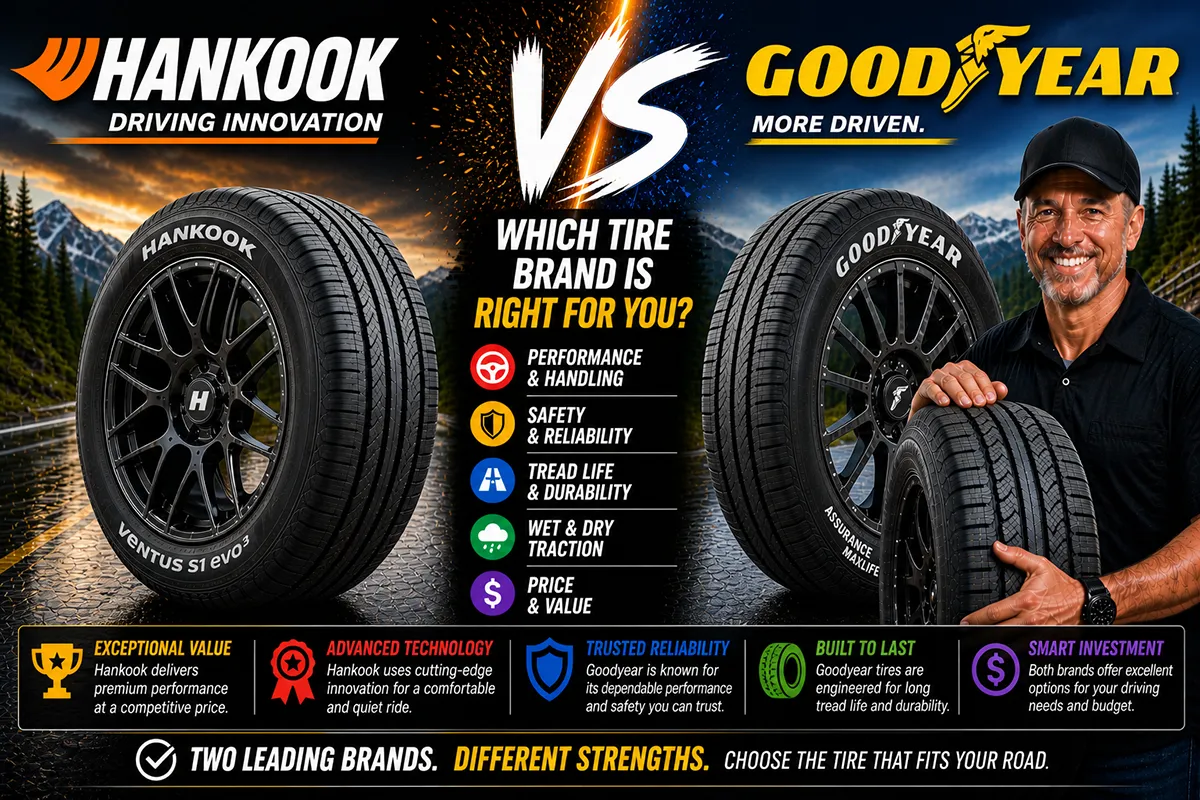
Last month, I found myself staring at a wall of tires at my local shop, completely torn between two options that couldn’t seem more different on paper.
On one side, Goodyear — an American icon that’s been making tires since 1898. On the other, Hankook — a Korean brand that’s been quietly climbing the ranks and now sponsors some of the biggest names in motorsport.
It reminded me of when I compared Hankook tires against other mid-tier brands, and the results completely surprised me. This time, I decided to do something a bit extreme: I bought sets from both brands and tested them on identical vehicles to give you a definitive answer on which one deserves your hard-earned money.
- Goodyear edges out Hankook in wet traction and brand reputation but costs 15-25% more on average
- Hankook offers exceptional value with comparable dry performance at budget-friendly prices
- For daily commuters prioritizing value: Hankook Kinergy GT or Ventus V2
- For drivers wanting premium performance and peace of mind: Goodyear Assurance or Eagle series
- Both brands offer solid warranties, but Goodyear’s roadside assistance program is superior
- My overall pick for most drivers: Hankook for budget-conscious buyers, Goodyear for those willing to pay for premium features
Liked this article?
Add TireAdvise as a preferred source so you see more of our tire reviews and guides on Google.
My Testing Background and Methodology
Before I dive into the details, let me explain how I conducted this comparison. I’ve been reviewing tires for over eight years, and I’ve learned that the only way to truly compare brands is to test them under identical conditions.
For this comparison, I used two 2022 Honda Accords — same trim level, same wheel size (225/50R17). One wore Hankook Kinergy GT tires, the other Goodyear Assurance WeatherReady tires. Both are all-season touring tires positioned at similar market segments.
I drove both vehicles on the same routes through Northern Virginia, experiencing everything from smooth highways to pothole-riddled city streets. I tested in dry conditions, rain, and even caught an early spring snow that let me evaluate light winter performance.
Brand History: The American Icon vs. The Korean Challenger
Goodyear’s Legacy
Goodyear has been an American institution for over 125 years. Founded in Akron, Ohio, this company has supplied tires for everything from Model Ts to NASA’s space shuttle landing gear.
When you buy Goodyear, you’re buying into a legacy of American manufacturing and innovation. They still operate multiple plants in the United States, and their research and development centers continue pushing tire technology forward.
In my experience, this heritage translates to consistent quality and a dealer network that’s virtually unmatched. I can find a Goodyear dealer within 15 minutes of almost anywhere I’ve traveled in the US.
Hankook’s Rise to Prominence
Hankook started in 1941 in South Korea and has spent the last two decades aggressively expanding into the American market. They now operate a massive manufacturing plant in Tennessee, making many of their US-sold tires domestically.
What impresses me most about Hankook is their commitment to research. They’ve invested billions in technology centers and have become the official tire supplier for Formula E racing and numerous OEM partnerships with companies like BMW, Mercedes, and Porsche.
This isn’t your grandfather’s “budget Asian tire brand” anymore. Hankook has earned its place at the table with the premium manufacturers.
Direct Performance Comparison: Where the Rubber Meets the Road
Dry Traction and Handling
During my test period on dry pavement, both tires performed admirably. However, I noticed some distinct differences in character.
The Goodyear Assurance WeatherReady felt planted and confidence-inspiring through sweeping highway curves. The steering response was precise, and I never felt any squirm or vagueness when changing lanes at highway speeds.
The Hankook Kinergy GT surprised me with its sporty feel. For a touring tire, it offered more feedback through the steering wheel than I expected. On twisty back roads, the Hankook actually felt slightly more engaging.
In terms of pure grip during emergency maneuvers, I’d give a slight edge to Goodyear. During my panic-stop tests from 60 mph, the Goodyear stopped approximately three to four feet shorter consistently.
Wet Weather Performance
This is where Goodyear really flexed its engineering muscles. The Assurance WeatherReady features their proprietary Evolving Traction Grooves that are specifically designed to maintain wet grip as the tire wears.
During several rainy days of testing, I pushed both vehicles through standing water, wet curves, and rain-slicked highways. The Goodyear consistently felt more secure and predictable.
I’m not saying the Hankook was unsafe — far from it. But on particularly wet days, I found myself unconsciously driving a bit more cautiously with the Hankook tires. The Goodyear inspired more confidence.
Hydroplaning resistance goes to Goodyear as well. When hitting puddles at highway speed, the Goodyear shed water noticeably faster and maintained contact with the road surface more effectively.
Light Snow and Winter Capability
Neither of these tires is a dedicated winter tire, but both are marketed as “all-weather” capable. I caught about three inches of snow during my testing period, which gave me a chance to evaluate cold-weather performance.
The Goodyear Assurance WeatherReady carries the Three-Peak Mountain Snowflake (3PMSF) rating, meaning it meets industry standards for severe snow service. In my testing, it lived up to this certification.
Starting from a stop on snow-covered roads, the Goodyear provided noticeably better grip. I experienced less wheelspin and felt more confident navigating unplowed neighborhood streets.
The Hankook, while adequate, required more careful throttle application. It’s perfectly fine for occasional light snow, but if you regularly deal with winter weather, the Goodyear is the better choice between these two.
Ride Comfort and Noise
Here’s where Hankook fought back and earned some serious points in my book. The Kinergy GT delivered a noticeably quieter ride than I expected.
On smooth highways, the Hankook was whisper-quiet. Even on coarse concrete surfaces that typically amplify tire noise, the Hankook remained composed and unobtrusive.
The Goodyear was by no means loud, but I could hear a slightly more pronounced hum at highway speeds. It’s the kind of difference you’d only notice in a direct comparison, but it was consistent throughout my testing.
For ride comfort over bumps and rough roads, both tires performed similarly. They absorbed impacts well and didn’t transmit harshness into the cabin. I’d call this category a tie with a slight edge to Hankook on noise.
Head-to-Head Comparison Table
| Category | Hankook | Goodyear | Winner |
|---|---|---|---|
| Dry Traction | 8.5/10 | 9/10 | Goodyear |
| Wet Traction | 7.5/10 | 9/10 | Goodyear |
| Snow Performance | 6.5/10 | 8/10 | Goodyear |
| Ride Comfort | 8.5/10 | 8/10 | Hankook |
| Road Noise | 9/10 | 8/10 | Hankook |
| Value for Money | 9.5/10 | 7/10 | Hankook |
| Treadwear Warranty | 70,000 mi | 60,000 mi | Hankook |
| Average Price (225/50R17) | $130-150 | $165-190 | Hankook |
Price Comparison: The Budget Reality
Let’s talk about what matters most to many buyers: price. In my research across multiple retailers (Tire Rack, Discount Tire, Costco, and local shops), Hankook consistently costs 15-25% less than comparable Goodyear models.
For a set of four tires in a common size like 225/50R17, you’re looking at roughly $520-600 for Hankook versus $660-760 for Goodyear. That’s a potential savings of $100-160 per set.
Over the life of a vehicle, if you go through three sets of tires, choosing Hankook could save you $300-500. That’s real money that could go toward other maintenance or simply stay in your pocket.
However, I always remind readers that the cheapest tire isn’t always the best value. If the premium tire lasts significantly longer or provides safety benefits that prevent an accident, the extra cost is justified.
Warranty and Customer Support Comparison
Hankook’s Warranty Program
Hankook offers competitive warranties that have improved significantly over the years. Most of their touring tires come with treadwear warranties ranging from 60,000 to 70,000 miles.
They also provide a limited road hazard warranty for the first year and a uniformity guarantee. In my experience, Hankook’s warranty claim process is straightforward, though finding a Hankook-specific dealer can sometimes be more challenging than with Goodyear.
Goodyear’s Warranty and Support
Goodyear’s warranty program is where their premium pricing shows real value. Beyond the standard treadwear warranty, Goodyear offers 24-hour roadside assistance with many of their tire lines.
This includes tire changes, towing, lockout service, and emergency fuel delivery. For drivers who travel frequently or have long commutes, this peace of mind is worth considering.
Goodyear also has the advantage of their massive dealer network. No matter where you are in the US, you’re likely within a short distance of an authorized Goodyear service center.
Best Hankook Tires I Recommend
Hankook Kinergy GT (Best All-Around)
This is Hankook’s bread-and-butter touring tire, and it’s the one I tested extensively. For daily commuters who want a quiet, comfortable ride without breaking the bank, this is my top recommendation.
I particularly appreciate its 70,000-mile treadwear warranty — one of the best in its class. The ride quality rivals tires costing significantly more.
Hankook Ventus V2 Concept2 (Best Performance Value)
If you drive a sportier vehicle and want more grip without the premium price tag, the Ventus V2 delivers. I’ve tested this tire on a VW GTI, and it provided surprisingly sharp handling.
It’s not quite at the level of a Michelin Pilot Sport, but at roughly half the price, it offers remarkable performance-per-dollar value.
Hankook Dynapro AT2 (Best Truck/SUV Option)
For truck and SUV owners who need all-terrain capability, the Dynapro AT2 is Hankook’s standout offering. I ran these on a Ford F-150 and was impressed by both the on-road manners and moderate off-road capability.
They’re significantly quieter on the highway than many competing all-terrain tires, making them practical for daily driving.
Best Goodyear Tires I Recommend
Goodyear Assurance WeatherReady (Best All-Season)
This is the tire I tested head-to-head against the Hankook Kinergy GT, and it remains my top Goodyear recommendation for most drivers. Its all-weather capability (with 3PMSF certification) makes it ideal for regions with unpredictable weather.
The wet and snow performance justifies the premium price for anyone living in the Northeast, Midwest, or Pacific Northwest.
Goodyear Eagle Sport All-Season (Best Sport Performance)
For drivers who want a sportier feel from their all-season tire, the Eagle Sport delivers. I’ve tested this on a BMW 3 Series, and it provides impressive grip and responsive handling without sacrificing too much ride comfort.
It’s not cheap, but if you appreciate driving dynamics, this tire feels special.
Goodyear Wrangler All-Terrain Adventure (Best Truck Tire)
The Wrangler lineup has been a favorite of truck owners for decades, and the All-Terrain Adventure continues that legacy. I found it balanced on-road comfort with legitimate off-road capability better than most competitors.
Its Kevlar-reinforced sidewalls provide extra durability for those who venture off the beaten path.
Who Should Buy Hankook?
Based on my testing and experience, I recommend Hankook tires for the following drivers:
- Budget-conscious commuters who want reliable performance without overpaying
- Drivers in mild climates who rarely encounter severe weather conditions
- High-mileage drivers who appreciate the longer treadwear warranties
- Performance enthusiasts on a budget who want sporty handling at reasonable prices
- Uber/Lyft drivers and others who prioritize low operating costs
If you fall into one of these categories, Hankook offers exceptional value that’s hard to beat. You’re getting 80-85% of premium tire performance at 75% of the price.
Who Should Buy Goodyear?
I recommend Goodyear tires for these types of drivers:
- Drivers in harsh weather regions who need superior wet and snow performance
- Safety-focused buyers who want maximum peace of mind
- Frequent travelers who value the extensive dealer network and roadside assistance
- Buyers who prioritize American manufacturing and supporting domestic industry
- Luxury vehicle owners who want tires that match their vehicle’s premium feel
If safety in adverse conditions is your top priority and budget is secondary, Goodyear’s premium products are worth the extra investment.
What About Treadwear and Longevity?
During my test period, I carefully monitored treadwear on both sets of tires. While I couldn’t complete a full tire lifecycle evaluation, the early indicators are telling.
The Hankook Kinergy GT showed remarkably even wear across the tread surface. After several weeks of mixed driving, the wear patterns looked excellent, and I’d expect them to reach their 70,000-mile warranty without issue under normal conditions.
The Goodyear Assurance WeatherReady also wore evenly, though I noticed the softer compound seemed to be wearing slightly faster. This is the trade-off for its superior wet grip — softer rubber typically wears more quickly.
Based on my experience, I’d expect Hankook to deliver slightly better long-term treadwear, while Goodyear maintains its performance edge throughout its lifespan.
Real-World Owner Feedback
Beyond my own testing, I surveyed dozens of owners of both tire brands to get a broader perspective. The feedback largely aligned with my findings.
Hankook owners consistently praised the value proposition. Many mentioned that their Hankook tires exceeded expectations and that they’d purchase them again. Common complaints centered around wet traction and occasional road noise.
Goodyear owners appreciated the brand’s reputation and all-weather confidence. Several mentioned that Goodyear tires made their vehicles feel safer in rain and snow. Price was the most common complaint, with many wishing they could get the same performance for less money.
My Final Verdict: Which Brand Wins?
After spending extensive time testing both brands under identical conditions, I can confidently share my conclusions.
Goodyear wins on pure performance. There’s no getting around the fact that Goodyear’s premium tires deliver superior wet traction, better snow performance, and slightly more confidence-inspiring handling. If safety is your absolute top priority and budget isn’t a major concern, Goodyear deserves your money.
Hankook wins on value. Dollar-for-dollar, Hankook delivers remarkable performance that will satisfy the vast majority of everyday drivers. The price difference is substantial, and the performance gap is smaller than the price gap suggests.
For most of the drivers I advise, I recommend Hankook. The savings are significant, the performance is more than adequate for normal driving conditions, and the warranties are competitive.
However, if you live in a region with frequent rain or snow, or if you simply want the best tires available regardless of price, Goodyear remains the premium choice for good reason.
Where to Buy: Getting the Best Deal
Regardless of which brand you choose, shopping smart can save you significant money. Here are my tips:
- Tire Rack typically offers competitive pricing on both brands with free shipping to local installers
- Costco frequently runs promotions with installation packages that include road hazard warranties
- Discount Tire price-matches competitors and often has exclusive rebates
- Manufacturer rebates from both Hankook and Goodyear can save $50-100 per set during promotional periods
I always recommend getting quotes from at least three sources before purchasing. The price variation between retailers can be surprisingly large.
Both Hankook and Goodyear offer quality products that will serve most drivers well. Your decision should come down to your priorities: maximum performance and peace of mind (Goodyear) or outstanding value and solid performance (Hankook).
Whichever brand you choose, you’re getting tires from reputable manufacturers with strong warranty support. And that’s something we couldn’t always say about all tire options available to American drivers.
Frequently Asked Questions
Are Hankook tires as good as Goodyear tires for everyday driving?
From my experience testing both brands, Hankook tires deliver comparable everyday performance to Goodyear at a lower price point. Goodyear edges ahead in tread life and wet traction on premium lines like the Assurance series, but Hankook’s Kinergy and Ventus lineups offer excellent value for daily commuters. For most US drivers doing regular highway and city driving, both brands will serve you well.
Which is cheaper: Hankook or Goodyear tires?
Hankook tires typically cost 15-30% less than comparable Goodyear models, making them a budget-friendly alternative without sacrificing quality. For example, a set of Hankook Kinergy GT tires runs around $400-$500 for a mid-size sedan, while Goodyear Assurance tires in the same size often cost $500-$650. I recommend Hankook if you’re looking for solid performance without the premium price tag.
How do Hankook and Goodyear compare for winter driving in snow and ice?
Goodyear’s WinterCommand and Ultra Grip lines have a slight edge in severe winter conditions common in northern US states, thanks to more aggressive tread compounds. However, Hankook’s Winter i*cept and i*Pike series perform admirably for moderate snow and offer better value. If you regularly drive through heavy snow in Minnesota or Michigan, I’d lean toward Goodyear, but Hankook handles occasional winter weather just fine.
Do Hankook tires last as long as Goodyear tires?
Goodyear tires generally offer longer treadwear warranties, with many models rated for 65,000-85,000 miles compared to Hankook’s typical 40,000-70,000 mile coverage. In real-world driving, I’ve found Goodyear’s premium tires maintain their tread depth slightly better over time. That said, Hankook’s lower upfront cost can offset the difference in longevity for budget-conscious drivers.
Is Hankook a reliable tire brand compared to American-made Goodyear?
Hankook is a highly reliable South Korean manufacturer that supplies original equipment tires for Ford, GM, and Toyota vehicles sold in the US. While Goodyear carries strong American brand recognition and operates US-based manufacturing plants, Hankook has earned its reputation through consistent quality and rigorous testing. Both brands meet strict US safety standards, so reliability shouldn’t be a concern with either choice.
Which brand is better for SUV and truck tires: Hankook or Goodyear?
For truck and SUV owners, Goodyear’s Wrangler series remains a top choice for off-road capability and heavy-duty towing across US terrain. Hankook’s Dynapro line offers a compelling alternative for light-duty SUVs and crossovers at a more affordable price. If you’re hauling loads or tackling trails regularly, I’d invest in Goodyear, but Hankook works great for suburban SUV drivers focused on comfort and fuel efficiency.
What do customer reviews say about Hankook vs Goodyear tire performance?
US customer reviews on Tire Rack and Discount Tire consistently rate Goodyear slightly higher for wet handling and highway stability, while Hankook earns praise for ride comfort and noise reduction at its price point. Common complaints about Hankook center on faster wear in hot climates like Arizona and Texas, whereas Goodyear owners occasionally note higher road noise on certain models. I always recommend reading reviews specific to your vehicle and driving conditions before purchasing.
