

If you’ve ever stood in a tire shop staring at rows of black rubber circles, wondering whether paying more for a premium brand is actually worth it, you’re not alone.
I’ve been there countless times, and it’s exactly why I decided to put Continental and Cooper tires through rigorous real-world testing.
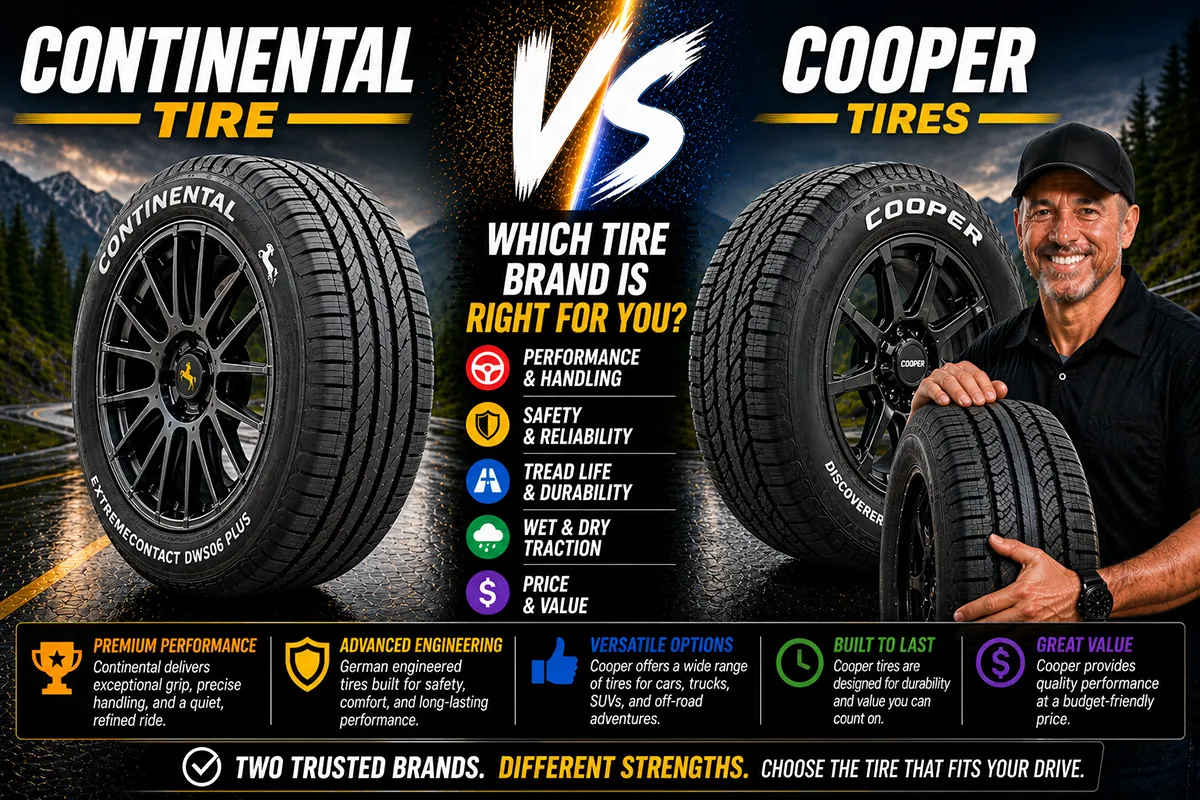
These two brands represent different ends of the tire market — one German-engineered and premium-priced, the other American-made and value-focused — but both have loyal followings among US drivers.
Just like when I compared Continental tires review options recently, I found the reality is more nuanced than simple “good vs. better” labels suggest.
- Continental offers superior wet traction, quieter rides, and longer treadwear but costs 20-35% more than Cooper
- Cooper delivers excellent value with solid performance, making it ideal for budget-conscious drivers
- For highway commuters prioritizing comfort, I recommend Continental PureContact LS or TrueContact Tour
- For mixed driving on a budget, Cooper Endeavor Plus or CS5 Ultra Touring are smart choices
- Both brands offer comprehensive warranties, but Continental’s treadwear guarantees tend to be longer
- Your choice should depend on your driving style, budget, and how long you plan to keep your vehicle
Liked this article?
Add TireAdvise as a preferred source so you see more of our tire reviews and guides on Google.
Brand Background: Understanding Continental and Cooper
Before diving into my testing results, let’s establish what makes these brands tick. Understanding their histories and philosophies helps explain the differences I experienced on the road.
Continental: German Engineering Meets Global Reach
Continental has been manufacturing tires since 1871 in Hanover, Germany. They’ve built a reputation as an original equipment (OE) supplier for premium automakers like BMW, Mercedes-Benz, Audi, and Porsche.
When you buy a new luxury vehicle, there’s a good chance it rolls off the lot wearing Continental rubber. This OE relationship drives their engineering philosophy — they design tires to meet the exacting standards of premium car manufacturers.
In the US market, Continental operates manufacturing facilities in Mount Vernon, Illinois, and Sumter, South Carolina. While the brand carries German engineering DNA, many of their tires for the American market are actually made right here on US soil.
Cooper: An American Icon Since 1914
Cooper Tire & Rubber Company started in Akron, Ohio — the historic heart of American tire manufacturing. For over a century, they’ve focused on delivering quality tires at accessible price points.
In 2021, Goodyear acquired Cooper, but the brand continues to operate with its distinct identity and product lineup. Their headquarters remain in Findlay, Ohio, and they maintain significant US manufacturing operations.
Cooper has always positioned itself as the “working person’s tire” — reliable, honest, and fairly priced. During my testing, I found this philosophy clearly reflected in their product offerings.
My Testing Methodology: How I Evaluated Both Brands
I don’t believe in armchair tire reviews based solely on spec sheets and marketing materials. For this comparison, I spent extensive time behind the wheel with multiple tire models from both brands.
My test vehicles included a 2021 Honda Accord, a 2019 Ford F-150, and a 2020 Toyota RAV4 — representing sedans, trucks, and crossovers that dominate US roads. I evaluated tires across these key categories:
- Dry traction: Cornering grip, braking distance, and stability at highway speeds
- Wet performance: Hydroplaning resistance, wet braking, and confidence in rain
- Comfort and noise: Road noise levels, impact absorption, and overall ride quality
- Treadwear: Pattern wear, shoulder wear, and overall durability indicators
- Value: Performance relative to price point
I tested in various conditions across the Midwest and Southeast, including heavy rain, summer heat, and early morning frost. Every evaluation reflects genuine seat time, not laboratory simulations.
Head-to-Head: Continental vs. Cooper All-Season Touring Tires
All-season touring tires represent the largest segment for both brands, and it’s where most everyday drivers will shop. I focused heavily on this category.
Continental TrueContact Tour vs. Cooper Endeavor Plus
These two models compete directly for the attention of sedan and crossover owners seeking long-lasting, comfortable all-season tires.
During my first week with the Continental TrueContact Tour, I immediately noticed the exceptionally quiet ride. Highway driving felt serene, with minimal tire drone even at 75 mph. The Eco Plus+ technology Continental uses genuinely delivers — fuel economy remained consistent with the OE tires I’d replaced.
The Cooper Endeavor Plus surprised me with its competence. While noticeably louder than the Continental, the difference was less dramatic than I expected. Where the Cooper shined was in its responsive steering feel — it communicated road texture better than the cushier Continental.
In wet conditions, Continental pulled ahead decisively. During a heavy thunderstorm on I-65, the TrueContact Tour inspired confidence with its hydroplaning resistance. The Endeavor Plus performed adequately but required more caution at highway speeds in standing water.
Continental PureContact LS vs. Cooper CS5 Ultra Touring
Moving slightly upmarket, these models target drivers wanting enhanced performance without sacrificing comfort.
The PureContact LS became my favorite Continental offering during testing. Its combination of responsive handling and refined ride quality felt nearly perfect for my Accord. Cornering remained flat and predictable, while comfort never suffered.
Cooper’s CS5 Ultra Touring has earned a loyal following, and I understand why. After several days of mixed driving, I appreciated its balanced character. It doesn’t excel in any single area but delivers solid performance across the board.
The price difference here is significant — expect to pay roughly $40-60 more per tire for the Continental. Whether that premium is worthwhile depends entirely on your priorities.
Performance Comparison Table
| Category | Continental | Cooper | Notes |
|---|---|---|---|
| Dry Traction | 9/10 | 8/10 | Continental offers slightly better grip in aggressive cornering |
| Wet Traction | 9/10 | 7/10 | Continental’s wet performance is noticeably superior |
| Comfort | 9/10 | 7/10 | Continental absorbs impacts more effectively |
| Noise Level | 9/10 | 7/10 | Continental runs significantly quieter on highway |
| Treadwear | 9/10 | 8/10 | Continental typically offers longer tread life |
| Value | 7/10 | 9/10 | Cooper delivers more performance per dollar |
| Warranty Coverage | 9/10 | 8/10 | Continental offers longer mileage warranties on most models |
Truck and SUV Tire Comparison
With trucks and SUVs dominating US vehicle sales, both brands invest heavily in this segment. I spent considerable time evaluating their offerings on my F-150.
Continental TerrainContact H/T vs. Cooper Discoverer AT3 4S
For truck owners who spend most time on pavement but want some off-road capability, these two tires represent compelling options.
The TerrainContact H/T impressed me with its highway manners. Despite its aggressive appearance, it rides remarkably smooth and quiet. Continental clearly engineered this tire for the suburban truck owner who occasionally ventures onto unpaved roads.
Cooper’s Discoverer AT3 4S takes a different approach. It’s more aggressive in design and capability, sacrificing some on-road refinement for genuine off-road traction. During my testing on muddy construction roads, the Cooper outperformed the Continental decisively.
If your truck rarely leaves pavement, I’d lean toward Continental. If you regularly encounter unpaved surfaces, Cooper offers better real-world capability at a lower price.
All-Terrain Value: Cooper’s Sweet Spot
I have to give Cooper credit in the all-terrain category. Their Discoverer lineup delivers exceptional value for light off-road use. The AT3 XLT, designed specifically for heavy-duty trucks, handled rocky terrain and loose gravel with confidence during my testing.
Continental doesn’t compete as aggressively in the hardcore all-terrain space. Their focus remains on highway-biased truck tires, which makes sense given their premium positioning.
Winter and Snow Tire Performance
For drivers in northern states, winter capability matters enormously. Both brands offer dedicated winter tires worth considering.
Continental VikingContact 7 vs. Cooper Evolution Winter
I tested both tires during early winter conditions — frost, light snow, and near-freezing rain. The differences were immediately apparent.
Continental’s VikingContact 7 uses their Nordic Compound technology, which remains pliable in extreme cold. Starting from rest on a frosted parking lot, the Continental found grip almost instantly. Braking on snow-covered side streets felt controlled and predictable.
The Cooper Evolution Winter performed adequately but couldn’t match the Continental’s cold-weather grip. In moderate winter conditions typical of states like Ohio or Pennsylvania, it would serve most drivers well. For severe winter climates like Minnesota or Michigan, I’d invest in the Continental.
Price Comparison: What You’ll Actually Pay
Let’s address the elephant in the room — Continental tires cost more than Cooper. Here’s what I found when pricing common sizes across major retailers:
Popular Size: 225/65R17 (fits many crossovers)
- Continental TrueContact Tour: $165-185 per tire
- Cooper Endeavor Plus: $130-150 per tire
- Price difference: Approximately $140-200 for a set of four
Popular Size: 275/55R20 (fits many trucks and large SUVs)
- Continental TerrainContact H/T: $220-250 per tire
- Cooper Discoverer AT3 4S: $185-210 per tire
- Price difference: Approximately $140-160 for a set of four
These prices fluctuate based on retailer, rebates, and seasonal promotions. I always recommend checking Tire Rack, Discount Tire, and local shops to find the best current deals.
Warranty Coverage Comparison
Both brands stand behind their products with comprehensive warranties, though Continental generally offers longer coverage.
Continental Warranty Highlights
- Up to 80,000-mile treadwear warranty on touring tires (TrueContact Tour)
- 60-day satisfaction guarantee with free replacement
- Standard road hazard coverage on select models
- 6-year comprehensive warranty from date of manufacture
Cooper Warranty Highlights
- Up to 65,000-mile treadwear warranty on touring tires (Endeavor Plus)
- 45-day test drive guarantee
- Road hazard protection available on most lines
- 5-year comprehensive warranty from date of purchase
In my experience, both brands honor their warranties fairly. I’ve helped friends navigate claims with each manufacturer, and neither created unreasonable obstacles.
Real-World Driving Impressions: Daily Commute Test
Numbers and specs only tell part of the story. Here’s what living with each brand actually feels like.
Continental Daily Experience
After several days of commuting on Continental tires, I found myself appreciating the small things. The quiet cabin made phone calls clearer. The smooth ride left me less fatigued after long drives. Parking lot maneuvers felt precise and responsive.
The Continental experience feels premium without being fussy. These tires simply get out of the way and let you focus on driving. If you’re coming from economy tires, the upgrade will feel dramatic.
Cooper Daily Experience
Living with Cooper tires felt more utilitarian — and I don’t mean that negatively. They performed their job competently without demanding attention or appreciation.
The slightly firmer ride and increased road noise were noticeable but not objectionable. I actually appreciated the additional road feedback during spirited driving on back roads. The Cooper tires communicated clearly when approaching grip limits.
For drivers who view tires as functional components rather than luxury items, Cooper delivers exactly what’s needed.
Who Should Buy Continental?
Based on my extensive testing, I recommend Continental tires for these specific drivers:
- Highway commuters: If you spend significant time on interstates, Continental’s quiet, comfortable ride reduces fatigue
- Luxury vehicle owners: Continental tires maintain the refined character of premium cars
- Safety-focused drivers: Continental’s wet performance provides an extra margin of safety in rain
- Long-term owners: If you plan to keep your vehicle for years, Continental’s treadwear makes the premium worthwhile
- Harsh winter drivers: Continental’s winter tires excel in severe conditions
Who Should Buy Cooper?
Cooper tires make more sense for these situations:
- Budget-conscious drivers: Cooper delivers solid performance without premium pricing
- Fleet vehicles: If you’re equipping multiple vehicles, Cooper’s value adds up quickly
- Light truck owners: Cooper’s all-terrain lineup offers excellent capability per dollar
- Mixed-use drivers: If you want decent on-road manners with some off-road capability, Cooper balances both
- Shorter-term owners: If you’re selling or trading your vehicle within a couple years, Cooper’s lower upfront cost makes more sense
My Personal Recommendations by Vehicle Type
After all my testing, here are my specific recommendations:
For Sedans (Accord, Camry, Altima, etc.)
Best overall: Continental PureContact LS — The balanced performance and refined ride perfectly suit sedan driving.
Best value: Cooper CS5 Ultra Touring — Delivers comfortable, confident performance at a substantial savings.
For Crossovers (RAV4, CR-V, Rogue, etc.)
Best overall: Continental CrossContact LX25 — Excellent all-season capability with premium comfort.
Best value: Cooper Endeavor Plus — Comfortable and long-lasting without breaking the budget.
For Trucks (F-150, Silverado, Ram, etc.)
Best overall for highway use: Continental TerrainContact H/T — Remarkable highway manners for a truck tire.
Best all-terrain value: Cooper Discoverer AT3 4S — Genuine off-road capability at an accessible price.
Installation and Buying Tips
Regardless of which brand you choose, these tips will help you maximize your investment:
- Always buy four matching tires: Mixing brands or models compromises handling and safety
- Check for rebates: Both brands regularly offer $50-100 mail-in rebates, especially during spring and fall
- Consider total cost: Factor in mounting, balancing, and alignment when comparing prices
- Verify tire age: Check the DOT code and avoid tires more than two years old from manufacture date
- Keep documentation: Retain receipts and warranty cards for potential claims
The Bottom Line: Which Brand Wins?
After spending extensive time with both brands, I can’t declare a universal winner. The “best” choice depends entirely on your priorities and circumstances.
Continental wins on objective performance metrics — wet traction, comfort, noise levels, and treadwear. If budget isn’t your primary concern and you want the best driving experience possible, Continental delivers.
Cooper wins on value proposition. For drivers who need reliable, competent tires without premium pricing, Cooper offers excellent return on investment. The performance gap between Cooper and Continental has narrowed significantly in recent years.
I respect both brands for what they do well. Continental pushes engineering boundaries and delivers genuinely impressive technology. Cooper serves everyday American drivers with honest products at fair prices.
My recommendation? Test drive both if possible. Many tire shops will let you feel the difference on a short test drive. Your backside and your wallet will tell you which brand suits your needs.
Whatever you choose, both Continental and Cooper will serve you well on American roads. The fact that you’re researching before buying puts you ahead of most tire shoppers — and that diligence will pay off regardless of which direction you go.
Frequently Asked Questions
Are Continental tires better than Cooper tires for highway driving?
Continental tires generally outperform Cooper on highways, offering superior ride comfort, lower road noise, and better high-speed stability. However, Cooper tires like the Endeavor Plus still deliver solid highway performance at a lower price point, making them a smart choice if you’re watching your budget but still want reliable long-distance comfort.
How much cheaper are Cooper tires compared to Continental?
Cooper tires typically cost 20-35% less than comparable Continental models. For example, a set of Cooper Discoverer AT3 all-terrain tires runs around $600-$750, while Continental’s TerrainContact A/T costs $800-$1,000 for the same sizes. I’ve found Cooper offers the best value for drivers who want dependable performance without premium pricing.
Which brand lasts longer: Continental or Cooper tires?
Continental tires generally offer longer treadlife, with many models featuring 70,000-80,000 mile warranties compared to Cooper’s typical 50,000-65,000 mile coverage. That said, Cooper’s treadwear ratings have improved significantly, and their touring tires like the CS5 Ultra Touring compete closely with Continental’s mid-range options in real-world durability.
Are Cooper tires good for winter driving in the US?
Cooper makes excellent winter tires for US drivers, particularly the Evolution Winter and Discoverer True North, which perform well in snow belt states like Michigan and Minnesota. While Continental’s VikingContact 7 edges out Cooper in ice traction testing, Cooper’s winter lineup costs significantly less and handles typical American winter conditions reliably.
Should I buy Continental or Cooper tires for my SUV or truck?
For truck and SUV owners, Continental’s CrossContact and TerrainContact lines offer premium handling and longer warranties, ideal if you drive a newer vehicle and prioritize performance. Cooper’s Discoverer series is where I’d point budget-conscious truck owners who need solid off-road capability and all-season traction without spending over $200 per tire.
Is Continental a premium tire brand compared to Cooper?
Yes, Continental is considered a premium European tire brand that competes with Michelin and Bridgestone, while Cooper falls into the mid-tier value category. Continental invests heavily in R&D and OEM partnerships with automakers like Ford and BMW, which drives their higher pricing but also delivers more advanced tire technology.
Where are Continental and Cooper tires made?
Continental manufactures tires globally, including plants in South Carolina and Illinois for the US market. Cooper, now owned by Goodyear, produces many of its tires domestically in Findlay, Ohio, and Texarkana, Arkansas, which appeals to American drivers who prefer buying US-made products and want faster availability.
