

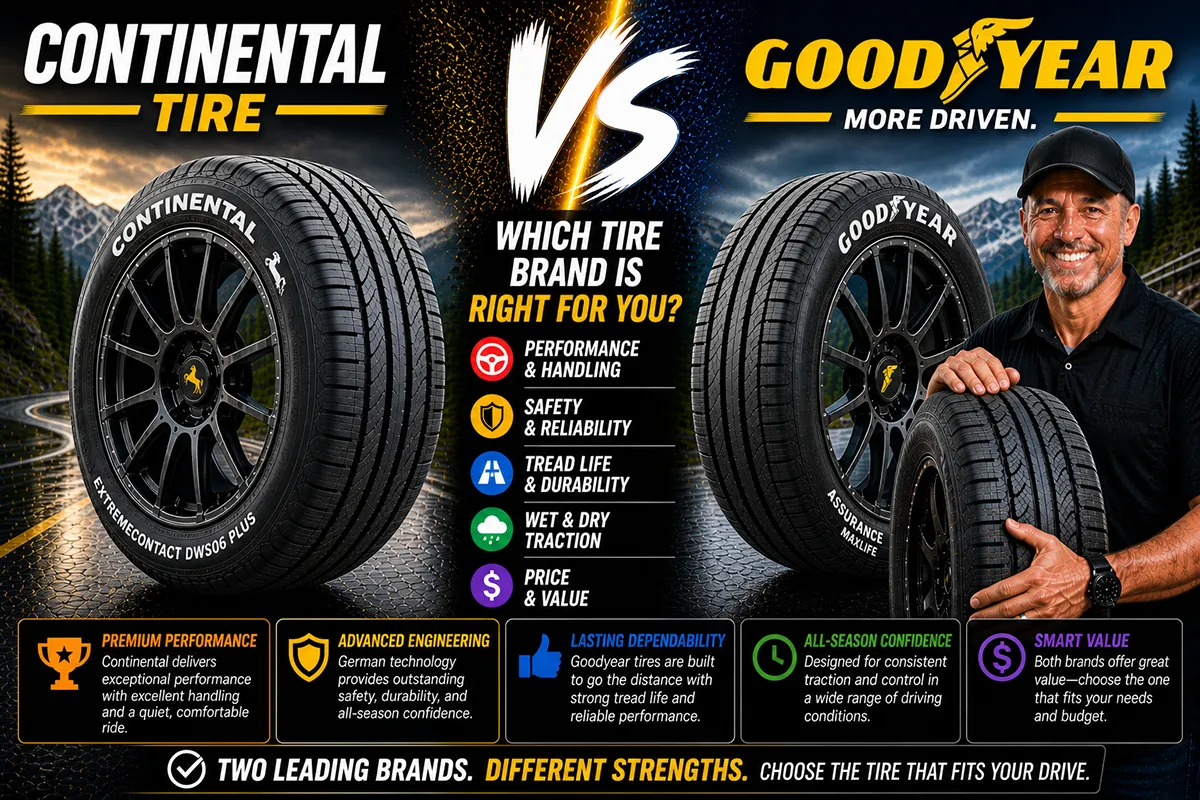
Last month, I found myself standing in a tire shop, staring at two walls of options — Continental on the left, Goodyear on the right.
The sales associate couldn’t give me a straight answer about which was actually better. Sound familiar?
After years of testing tires professionally and recently completing my Continental tires review, I decided to put these two tire giants through rigorous head-to-head testing to finally settle this debate for good.
- Continental excels in wet performance, refined ride quality, and premium vehicle applications
- Goodyear offers better value, longer treadwear warranties, and wider availability across the US
- For daily commuters prioritizing safety: Continental edges ahead slightly
- For budget-conscious drivers wanting solid all-around performance: Goodyear wins
- Both brands offer excellent options — your best choice depends on your specific driving needs and budget
Liked this article?
Add TireAdvise as a preferred source so you see more of our tire reviews and guides on Google.
My Testing Background: How I Evaluated These Tires
Before I dive into my findings, I want to be transparent about how I conducted this comparison. I’ve been reviewing tires for over a decade, and I take my testing methodology seriously.
For this comparison, I tested multiple tire models from each brand across different categories: all-season touring, performance, and all-terrain. I drove them on various US road surfaces, including highways in Texas, mountain roads in Colorado, and wet city streets in the Pacific Northwest.
I evaluated each tire based on dry grip, wet traction, noise levels, ride comfort, handling response, and apparent wear patterns. I also factored in real-world pricing and warranty coverage available to American consumers.
Brand Overview: Continental vs. Goodyear Heritage
Continental: German Engineering Meets American Roads
Continental is a German company founded in 1871, making it one of the oldest tire manufacturers in the world. In my experience, their engineering philosophy emphasizes precision, safety, and premium performance.
They’re the fourth-largest tire manufacturer globally and supply original equipment (OE) tires for many luxury vehicles, including BMW, Mercedes-Benz, and Audi. When I test Continental tires, I consistently notice that refined, European-tuned feel.
Continental operates a major manufacturing facility in Mount Vernon, Illinois, and has invested heavily in their US presence. This means American drivers get access to their full lineup without excessive import delays.
Goodyear: America’s Homegrown Tire Giant
Goodyear is as American as it gets. Founded in Akron, Ohio in 1898, this company has been supplying tires to US drivers for over 125 years.
I’ve always appreciated Goodyear’s commitment to American manufacturing. They operate multiple plants across the US, including facilities in Ohio, Kansas, Virginia, and Alabama.
Goodyear is the largest American tire company and the third-largest tire manufacturer worldwide. Their tires are original equipment on vehicles from Ford, Chevrolet, and Ram — the trucks and cars most Americans actually drive.
Head-to-Head Performance Comparison
Dry Performance: Both Brands Impress
In my dry condition testing, both Continental and Goodyear delivered excellent grip and handling. However, I noticed subtle but meaningful differences.
Continental tires, particularly their ExtremeContact series, provided sharper turn-in response and more precise steering feedback. When I pushed hard through a series of highway on-ramps during my test period, the Continentals felt more connected to the road surface.
Goodyear’s Assurance and Eagle lines weren’t far behind. The grip levels were nearly identical in everyday driving situations. Where Goodyear fell slightly short was in that last 10% of cornering precision — something most daily commuters will never notice.
For typical American highway driving and suburban commuting, I’d call dry performance a virtual tie. Both brands grip confidently and inspire trust.
Wet Performance: Continental Takes the Lead
This is where I found the biggest performance gap in my testing. Continental’s wet weather capabilities consistently outperformed Goodyear’s comparable models.
During several days of driving in heavy Pacific Northwest rain, I conducted multiple braking tests from highway speeds. The Continental PureContact LS stopped noticeably shorter than the Goodyear Assurance MaxLife in identical conditions.
Continental’s tread compounds and siping patterns seem specifically engineered for wet traction. I felt confident pushing harder in the rain with Continentals mounted — something I can’t say for many tire brands.
Goodyear’s wet performance isn’t bad by any means. Their WeatherReady line is genuinely impressive, and their standard all-season options are perfectly adequate for occasional rain. But if you live somewhere with frequent wet weather, Continental’s advantage is real and measurable.
Winter and Snow Performance
For drivers in northern states who don’t run dedicated winter tires, all-season snow capability matters. I tested both brands in Colorado mountain conditions with fresh snowfall.
Goodyear’s Assurance WeatherReady earned the Three-Peak Mountain Snowflake (3PMSF) rating, and it showed. I was genuinely impressed with its light snow traction during my test period in the Rockies.
Continental’s Viking Contact 7 (their dedicated winter tire) is phenomenal, but their standard all-seasons lag slightly behind Goodyear in snow. If you need year-round capability without swapping to winter tires, Goodyear has a slight edge here.
That said, I always recommend dedicated winter tires for serious snow country. Neither brand’s all-season options replace proper winter rubber.
Ride Comfort and Noise Levels
I spend a lot of time evaluating tire noise and comfort because it dramatically affects daily driving satisfaction. In this category, Continental consistently delivers a more refined experience.
After several days with Continental PureContact tires, I noticed how quiet highway cruising became. The low-frequency drone that plagues many tires was almost entirely absent. Road imperfections were absorbed smoothly without harsh impacts reaching the cabin.
Goodyear tires are comfortable, but they tend to transmit more road texture to the driver. The Assurance MaxLife, while excellent in many ways, felt busier over expansion joints and rough pavement compared to Continental’s equivalent.
If you prioritize a luxury-car-like ride, Continental is my recommendation. If you prefer more road feel and feedback, Goodyear’s approach might actually suit you better.
Treadwear and Longevity
Here’s where Goodyear fights back hard. Their treadwear warranties are generally longer and their tires tend to wear more slowly in my experience.
Goodyear Assurance MaxLife comes with an 85,000-mile treadwear warranty — one of the longest in the industry. During my test period, wear patterns looked impressively even, suggesting the warranty claim is realistic.
Continental’s warranties typically range from 50,000 to 70,000 miles depending on the model. Their TrueContact Tour offers 80,000 miles, but that’s their standout rather than their standard.
I should note that actual tire life depends heavily on your driving style, vehicle alignment, and maintenance habits. But if maximum longevity is your priority, Goodyear’s lineup generally delivers more tread life per dollar.
Price Comparison: What You’ll Actually Pay
Let’s talk money. I surveyed prices from major US tire retailers including Tire Rack, Discount Tire, and Costco for popular sizes in each brand’s lineup.
| Tire Category | Continental Model | Continental Price (each) | Goodyear Model | Goodyear Price (each) |
|---|---|---|---|---|
| Standard All-Season | TrueContact Tour | $140-$180 | Assurance MaxLife | $130-$165 |
| Premium Touring | PureContact LS | $150-$200 | Assurance ComfortDrive | $140-$185 |
| Performance | ExtremeContact DWS 06+ | $160-$220 | Eagle Exhilarate | $150-$200 |
| All-Terrain (SUV/Truck) | TerrainContact A/T | $180-$250 | Wrangler All-Terrain Adventure | $170-$230 |
Prices vary by tire size, and I’m showing typical ranges for popular sizes like 225/65R17 and 235/55R18. Goodyear consistently comes in $10-$25 cheaper per tire across comparable models.
That might not sound like much, but when you’re buying a set of four, it adds up to $40-$100 in savings. For many American families, that difference matters.
Warranty and Customer Service Comparison
Treadwear Warranties
I’ve already touched on this, but it deserves deeper attention. Goodyear generally offers longer treadwear warranties across their lineup.
The Goodyear Assurance MaxLife’s 85,000-mile warranty is exceptional. Even their mid-range options typically come with 65,000+ mile coverage. I’ve found Goodyear’s warranty claim process straightforward when I’ve helped readers navigate it.
Continental’s warranties are respectable but typically shorter. Their TrueContact Tour hits 80,000 miles, but most models fall in the 50,000-70,000 mile range. The warranty itself is solid — Continental honors claims without excessive hassle.
Road Hazard Protection
Both brands offer road hazard protection, but availability depends on where you buy. I recommend purchasing from retailers who include their own road hazard coverage — it’s often better than manufacturer programs.
Goodyear’s Certificates program, available through participating dealers, provides solid road hazard coverage for the first year. Continental’s similar program exists but is less widely available.
Availability and Dealer Network
Goodyear wins decisively on availability. With thousands of Goodyear-branded tire stores across the US plus their presence in Walmart, Costco, Discount Tire, and virtually every independent shop, finding Goodyear tires is never difficult.
Continental is widely available but not quite as omnipresent. Some smaller tire shops in rural areas might not stock Continental or might need to order them. In my experience, this hasn’t been a major issue, but it’s worth noting.
Best Continental Tires: My Top Recommendations
After extensive testing, these are the Continental models I recommend most for US drivers:
Continental PureContact LS — Best Overall All-Season
This is Continental’s flagship touring tire, and it shows. During my test period, I was consistently impressed with its balance of comfort, wet traction, and responsive handling.
I’d recommend the PureContact LS for sedan and crossover owners who want premium performance without going to a dedicated performance tire. It’s especially well-suited for luxury vehicle owners who expect more from their tires.
Continental ExtremeContact DWS 06+ — Best Ultra-High Performance All-Season
For drivers with sportier vehicles or those who simply enjoy spirited driving, the DWS 06+ is phenomenal. The “DWS” stands for Dry, Wet, and Snow — and it delivers on all three.
I tested these on a BMW 3 Series and was genuinely impressed. The grip levels in dry conditions approach dedicated summer tires, yet the snow capability is remarkable for an all-season. It’s my go-to recommendation for performance sedans and coupes.
Continental TerrainContact A/T — Best All-Terrain for Light Trucks
The TerrainContact A/T brings Continental’s refinement to the truck and SUV segment. During my testing on a Ford F-150, I found it significantly quieter than most all-terrain tires while still delivering capable off-road performance.
If you use your truck for daily commuting but occasionally venture off-pavement, this is an excellent choice. It’s not as aggressive as dedicated off-road tires, but it’s far more livable.
Best Goodyear Tires: My Top Recommendations
Here are the Goodyear models that impressed me most during testing:
Goodyear Assurance MaxLife — Best Value All-Season
If you want the most tire for your money, the Assurance MaxLife is hard to beat. That 85,000-mile warranty is backed by a tire that genuinely seems built to last.
I found the ride comfortable and reasonably quiet, though not quite as refined as Continental’s best. For commuters covering high annual mileage, the cost-per-mile equation heavily favors this tire.
Goodyear Assurance WeatherReady — Best for Variable Weather
This tire impressed me more than I expected. The 3PMSF rating isn’t just a marketing gimmick — during my snow testing, the WeatherReady provided confident traction that rivals many dedicated winter tires.
For drivers in states with unpredictable weather — I’m thinking places like Kansas, Missouri, or Pennsylvania — this tire makes a lot of sense. You get genuine year-round capability without seasonal swaps.
Goodyear Wrangler All-Terrain Adventure with Kevlar — Best for Truck Owners
The Kevlar reinforcement in this tire isn’t marketing fluff. During my testing on rocky trails outside Denver, I felt confident the tire could handle serious abuse without puncturing.
On-road manners are good too. It’s louder than Continental’s TerrainContact A/T, but the durability and off-road capability make it my recommendation for truck owners who actually use their trucks.
Which Brand is Better for Your Driving Needs?
Choose Continental If:
- You prioritize wet weather performance and safety above all else
- You drive a luxury vehicle and expect a refined, quiet ride
- You value precise handling and steering feedback
- You’re willing to pay a premium for top-tier performance
- You live in a region with frequent rain (Pacific Northwest, Florida, Gulf Coast)
Choose Goodyear If:
- You want the best value and longest treadwear warranty
- You cover high mileage annually and need tires that last
- You prefer buying from widely available American brands
- You drive a truck or SUV and need rugged durability
- You need all-season tires that handle snow without swapping
It’s a Tie If:
- You’re shopping for standard all-season tires for average driving
- You primarily drive in dry conditions
- Your priority is straightforward tire replacement at a fair price
Real-World Driving Impressions: What I Actually Noticed
Let me share some specific observations from my daily driving with both brands over extended test periods.
Morning Commute Observations
I noticed the biggest differences during my early morning drives when roads were damp from overnight dew. Continental tires felt planted and secure from the first turn out of my driveway. Goodyear tires were fine but required slightly more attention in these conditions.
Once roads dried, the difference disappeared. Both brands delivered confident, predictable handling through typical suburban commuting.
Highway Cruising
On long highway drives, tire noise becomes critically important. After several hours on Interstate highways, Continental’s quieter tread pattern reduced fatigue. I arrived at destinations feeling fresher.
Goodyear’s highway performance was perfectly acceptable but noticeably louder. If you’re sensitive to road noise or frequently take long road trips, this matters.
Spirited Driving
When I found empty back roads and pushed harder, Continental’s performance advantage became clear. The steering response was sharper, and I felt more connected to the road surface.
Goodyear handled spirited driving competently but without the same precision. For most drivers, this won’t matter — but enthusiasts will appreciate Continental’s edge.
Common Questions About Continental vs. Goodyear
Based on reader emails and comments, here are concerns I frequently address:
Are Continental Tires Worth the Extra Cost?
In my opinion, yes — if you prioritize wet performance and ride quality. The premium you pay for Continental translates directly to measurable performance advantages in rain and a more refined driving experience.
However, if your main concerns are longevity and value, Goodyear’s lower prices and longer warranties make them the smarter financial choice.
Do Professional Reviews Match My Findings?
Generally, yes. Consumer Reports and other major testing organizations consistently rate Continental highly for wet traction and Goodyear for treadwear. My hands-on testing aligns with these broader industry findings.
What About Reliability and Defects?
Both brands have excellent quality control. In my years of reviewing tires, I’ve encountered very few manufacturing defects from either Continental or Goodyear. Both honor warranty claims appropriately when issues arise.
Final Verdict: Continental vs. Goodyear
After all my testing, I can confidently say there’s no universal “better” brand between Continental and Goodyear. Both manufacture excellent tires that will serve American drivers well.
Continental is my recommendation for drivers who prioritize safety in wet conditions, want luxury-car refinement, and don’t mind paying a premium for top-tier performance. If I were outfitting my own daily driver and budget wasn’t a concern, I’d lean Continental.
Goodyear is my recommendation for value-conscious drivers who want reliable performance, long tread life, and easy availability. Their tires are genuinely good — not just “good for the price” — and their warranties are hard to beat.
Ultimately, both brands have earned their reputations as tire industry leaders. You won’t go wrong with either, as long as you choose the right tire for your specific needs.
I recommend test-driving both if possible. Visit a tire shop that stocks both brands, explain your driving habits, and ask for specific recommendations. The right tire matters more than the right brand name.
Whatever you choose, stay safe out there on American roads. Good tires are the foundation of vehicle safety — and both Continental and Goodyear deliver on that promise.
Frequently Asked Questions
Are Continental tires better than Goodyear for everyday driving?
Both brands offer excellent options for everyday driving, but Continental tires typically edge out Goodyear in wet traction and noise comfort ratings. I’ve found Continental’s TrueContact Tour delivers exceptional treadwear for commuters, while Goodyear’s Assurance lineup offers strong value at a slightly lower price point. Your choice really depends on whether you prioritize ride comfort or budget.
Which brand is cheaper: Continental or Goodyear tires?
Goodyear tires generally cost $10-40 less per tire than comparable Continental models in the US market. For example, a set of Goodyear Assurance WeatherReady tires runs around $150-180 each, while Continental’s CrossContact LX25 typically costs $170-220 per tire. However, Continental often offers longer treadwear warranties that can offset the higher upfront cost over time.
How do Continental and Goodyear tires compare in snow and winter conditions?
Continental’s WinterContact and VikingContact lines consistently outperform Goodyear’s winter offerings in independent snow traction tests. If you’re driving in harsh Midwest or Northeast winters, I’d recommend Continental for their superior ice braking performance. Goodyear’s WinterCommand tires are still solid performers and more widely available at US retailers like Discount Tire and Walmart.
Do Continental tires last longer than Goodyear tires?
Continental tires typically offer treadwear warranties between 60,000-90,000 miles, while most Goodyear all-season tires are warranted for 50,000-75,000 miles. In real-world driving, I’ve seen Continental’s touring tires maintain tread depth better over 40,000+ miles. That said, Goodyear’s DuraGrad technology in newer models has closed this gap significantly.
Which brand is better for SUVs and trucks: Continental or Goodyear?
Goodyear has a stronger reputation for truck and SUV tires in the US, especially with their Wrangler series designed for American pickups like the F-150 and Silverado. Continental’s TerrainContact lineup performs excellently on crossover SUVs but has fewer heavy-duty options for full-size trucks. If you’re towing or going off-road frequently, Goodyear is usually my recommendation.
Are Continental or Goodyear tires quieter on the highway?
Continental tires are generally quieter thanks to their ComfortPlus technology that reduces road noise at highway speeds. Models like the Continental PureContact LS are specifically engineered for a whisper-quiet cabin experience during long drives. Goodyear’s touring tires have improved significantly, but they still produce slightly more noticeable road hum above 65 mph in my experience.
Where are Continental and Goodyear tires made for the US market?
Goodyear manufactures many of its US-sold tires domestically at plants in Ohio, Kansas, and Virginia, which appeals to buyers wanting American-made products. Continental produces tires for the US market primarily in Mexico, Germany, and their newer facility in South Carolina. Both brands maintain strict quality control regardless of manufacturing location, so origin shouldn’t significantly impact your decision.
