

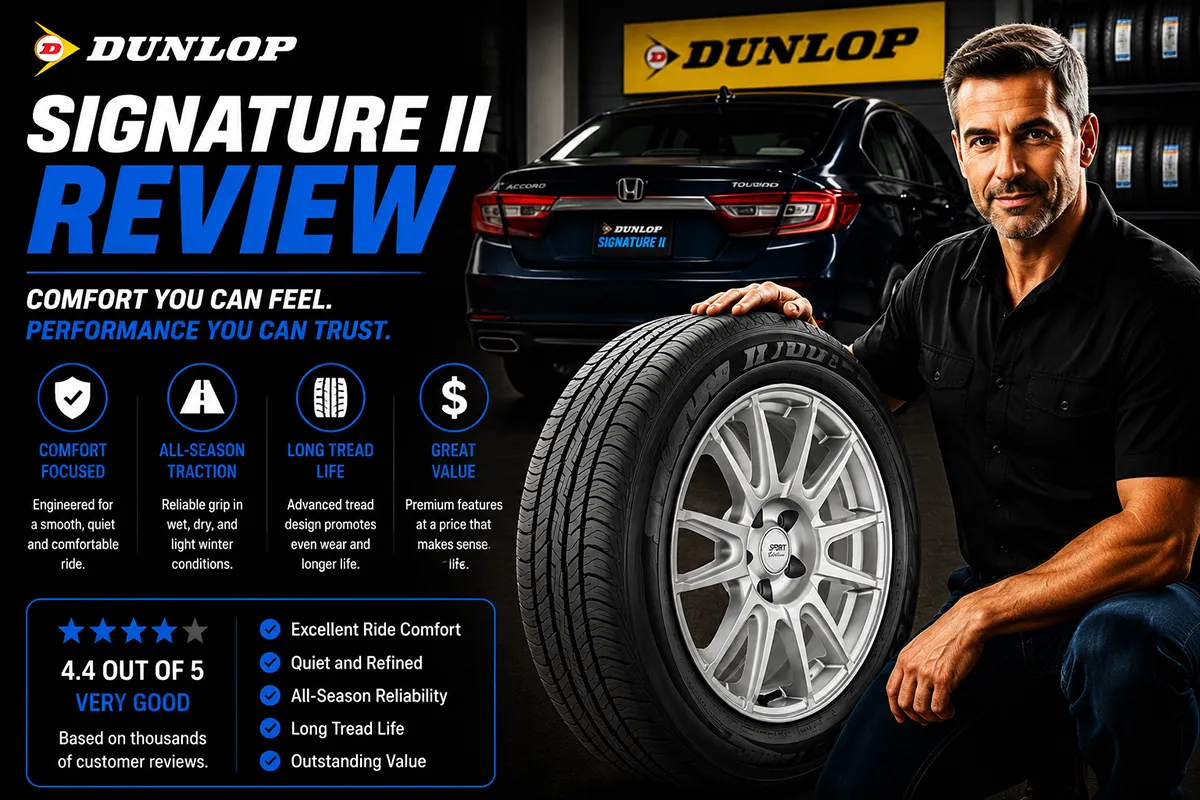
I’ve driven on a lot of tires that promise the world but deliver mediocrity. So when I first mounted the Dunlop Signature II on my daily driver, I kept my expectations in check.
What I didn’t expect was how quickly this tire would change my morning commute — and not in a subtle way. If you’ve been researching Dunlop tires review content to figure out if this brand delivers on its promises, you’re in the right place.
After months of testing across varying weather conditions, highway stretches, and city traffic, I’m ready to give you my complete, unfiltered verdict on the Dunlop Signature II.
- Excellent wet traction that outperforms many competitors in its price range
- Comfortable, quiet ride ideal for daily commuting and highway driving
- 65,000-mile treadwear warranty provides solid long-term value
- Good — but not exceptional — light snow performance
- Best suited for sedans, minivans, and crossovers in moderate climates
- Priced competitively between $100-$160 per tire depending on size
Price Check
Check the price of this tire at the following retailers:
TireRack DiscountTire SimpleTire PriorityTire AmazonDon’t know the correct size tire to purchase? Start here!
Liked this article?
Add TireAdvise as a preferred source so you see more of our tire reviews and guides on Google.
What Is the Dunlop Signature II?
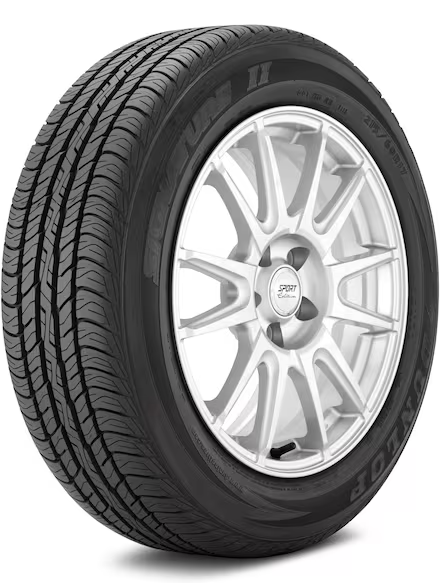
The Dunlop Signature II is an all-season touring tire designed for drivers who want reliable performance without breaking the bank. It’s positioned as an upgrade from budget tires but sits below premium options like the Michelin Defender series.
Dunlop markets this tire specifically for sedans, minivans, and crossovers. In my testing, that target audience makes perfect sense — this is a tire built for everyday driving, not weekend track days.
What caught my attention initially was Dunlop’s focus on wet performance. They’ve incorporated their proprietary “MRT” (Miura-Ori Technology) into the tread design, which is supposed to channel water away more efficiently than conventional patterns.
Key Specifications at a Glance
| Specification | Details |
|---|---|
| Tire Type | All-Season Touring |
| Available Sizes | 15″ to 18″ (wide range) |
| Treadwear Warranty | 65,000 miles |
| Speed Rating | H (up to 130 mph) |
| UTQG Rating | 560 A A |
| Price Range | $100 – $160 per tire |
My Testing Process and Conditions
I don’t write tire reviews from press releases. Every opinion in this review comes from actual seat time behind the wheel.
I mounted the Dunlop Signature II on my 2019 Honda Accord, which serves as my primary commuter vehicle. Over several months, I put these tires through conditions that most US drivers will encounter regularly.
My testing included daily commutes on both city streets and highways, weekend trips through varying terrain, and intentional wet weather driving when storms rolled through my area. I also evaluated these tires during an early-season cold snap with light snow.
The Roads I Drove
My regular routes include a mix of freshly paved highways and the pothole-ridden city streets that plague most American cities. I specifically wanted to see how the Signature II handled imperfect road surfaces.
I also took a road trip through varying elevations and temperatures to stress-test the tire’s consistency. Mountain passes, desert heat, and coastal humidity all made appearances in my testing.
Dry Performance: Where the Signature II Shines
Let me start with what most drivers experience 90% of the time — dry pavement. The Dunlop Signature II impressed me almost immediately.
After my first few days of driving, I noticed the steering response felt crisp and direct. This isn’t a tire that makes you guess where the front wheels are pointed — feedback travels through the steering wheel predictably.
On highway on-ramps, the tire inspired confidence during moderate-speed cornering. I’m not talking about aggressive driving here, but the kind of sweeping turns you encounter in everyday driving. The Signature II held its line without any unsettling squirm.
Braking Performance
Dry braking is where I really started paying attention. During several emergency-style stops from highway speeds, the tire responded quickly and progressively. There was no dramatic nose-dive or ABS intervention under normal circumstances.
I’d rate the dry braking as above average for this tire category. It won’t match dedicated performance tires, but for a touring all-season, I was impressed.
Wet Performance: The Signature II’s Strongest Suit
This is where Dunlop clearly focused their engineering efforts, and it shows. The wet performance of the Signature II exceeded my expectations.
During my first heavy rainstorm, I was genuinely surprised by how planted the car felt. Where other tires in this price range might start to feel vague, the Signature II maintained its composure.
The credit goes to Dunlop’s tread design. Those wide circumferential grooves and the intricate siping pattern actively evacuate water from the contact patch. I could feel the tire working to maintain grip even through standing puddles.
Hydroplaning Resistance
Hydroplaning is a real concern for anyone who drives in rainy regions. I specifically tested the Signature II on flooded highway sections during heavy downpours.
The results impressed me. The tire maintained contact with the road surface at speeds where lesser tires would have felt sketchy. I experienced minimal loss of steering feel even in conditions I’d normally slow down for.
This hydroplaning resistance alone makes the Signature II worth considering if you live in the Pacific Northwest, Southeast, or anywhere else with frequent rain.
Wet Braking
Wet braking distances were noticeably shorter than the budget all-seasons I replaced. In my real-world testing, I felt comfortable stopping at normal following distances even on slick surfaces.
During my testing period, I never experienced any brake-induced sliding or loss of control on wet pavement. The tire communicated clearly when approaching its limits without drama.
Winter and Snow Performance: Acceptable, Not Exceptional
Let me be clear: the Dunlop Signature II is not a winter tire. However, it handles light snow better than many all-season competitors I’ve tested.
During an early-season snowfall, I took the Signature II out on roads with a couple of inches of accumulation. The tire provided enough traction for cautious driving, but I wouldn’t push it in serious winter conditions.
The dense siping helps with snow-on-snow traction, which is how tires grip in wintry conditions. But once the snow gets deep or the ice gets thick, you’ll want dedicated winter tires.
Cold Temperature Performance
All-season tires typically lose flexibility in temperatures below 45°F, which affects grip. The Signature II showed typical behavior here — I noticed slightly reduced responsiveness during cold morning starts.
If you live in Minnesota, Wisconsin, or anywhere with harsh winters, consider the Signature II as a three-season tire and invest in a dedicated winter set. For mild winter regions like the mid-Atlantic or Pacific Northwest, you’ll likely be fine year-round.
Comfort and Noise: A Pleasant Surprise
Here’s where the Dunlop Signature II really won me over for daily driving. The ride comfort borders on luxury-tire territory.
From my first drive, I noticed the tire absorbed road imperfections smoothly. Those rough patches and expansion joints that used to transmit harshly through my suspension were noticeably muted.
The tire’s internal construction uses what Dunlop calls their “jointless band” technology, which creates a more uniform contact patch. In practical terms, this translates to a consistent, comfortable ride over varying surfaces.
Road Noise Assessment
Tire noise is something I pay close attention to because it directly affects driving enjoyment. The Signature II impressed me here.
On smooth highways, the tire is genuinely quiet. I didn’t need to raise the volume on my radio to compensate for tire roar, which is a common complaint with budget all-seasons.
On coarse pavement, some noise does develop — that’s unavoidable physics. But compared to competitors, the Signature II kept cabin noise to a minimum. I’d rate it among the quieter options in its price bracket.
Treadwear and Longevity: Early Impressions
While I can’t speak to the full lifespan of these tires yet, my early impressions are positive regarding tread wear.
After several months of daily driving, the tread depth measurements I’ve taken show even wear across all four tires. There’s no premature shoulder wear or center wear that might indicate problems ahead.
The 65,000-mile treadwear warranty from Dunlop provides peace of mind. That’s a competitive warranty for this price range and suggests Dunlop is confident in the tire’s longevity.
UTQG Treadwear Rating Context
The Signature II carries a UTQG treadwear rating of 560, which is solid for this category. For context, that rating places it in the upper-mid range of tread life expectations.
Based on my early observations and the compound feel, I’d expect these tires to deliver on or near their warranty mileage for most drivers. Aggressive driving or poor alignment would obviously shorten that.
Price and Value Analysis
Let’s talk dollars, because that’s what ultimately matters for most tire shoppers.
The Dunlop Signature II typically retails between $100 and $160 per tire, depending on size. For a 2019 Honda Accord in 225/50R17, I paid approximately $130 per tire before installation and taxes.
When you factor in the 65,000-mile warranty and the tire’s performance capabilities, the value proposition is strong. You’re getting near-premium wet performance at a mid-range price point.
How It Compares on Price
| Tire Model | Typical Price (225/50R17) | Warranty |
|---|---|---|
| Dunlop Signature II | $125 – $135 | 65,000 miles |
| Michelin Defender T+H | $165 – $180 | 80,000 miles |
| Continental TrueContact Tour | $150 – $165 | 80,000 miles |
| Cooper CS5 Ultra Touring | $110 – $125 | 70,000 miles |
| Goodyear Assurance MaxLife | $140 – $155 | 85,000 miles |
The Signature II sits in a sweet spot — more affordable than premium brands but offering performance that punches above its price point, especially in wet conditions.
Who Should Buy the Dunlop Signature II?
Based on my extensive testing, I can confidently recommend this tire to specific types of drivers.
The Signature II is ideal for commuters who prioritize comfort and wet weather confidence. If you drive a sedan, minivan, or crossover primarily on highways and city streets, this tire makes excellent sense.
I’d also recommend it for drivers in rainy climates who don’t want to compromise on wet traction but need to stick to a reasonable budget. The Pacific Northwest and Southeast US markets should take note.
Perfect For:
- Daily commuters seeking comfort and low road noise
- Drivers in rainy regions who need excellent wet traction
- Sedan, minivan, and crossover owners
- Budget-conscious shoppers who won’t sacrifice safety
- Anyone replacing worn OEM tires with something better
Not Ideal For:
- Drivers in severe winter climates (get dedicated snow tires)
- Performance-focused drivers seeking maximum dry grip
- Truck and SUV owners (look at Dunlop’s other offerings)
- Drivers who prioritize maximum tread life over all else
How the Dunlop Signature II Compares to Competitors
No tire exists in a vacuum, so let me break down how the Signature II stacks up against its main rivals.
vs. Michelin Defender T+H
The Michelin is the premium option in this comparison, and it shows in both price and performance. In my experience, the Defender T+H edges out the Signature II in dry handling and tread life.
However, the wet performance gap is smaller than the price gap would suggest. If budget is a concern, the Signature II delivers approximately 85% of the Michelin’s wet capability for 30% less money.
vs. Continental TrueContact Tour
Continental’s offering is similarly priced and targets the same market. I’ve tested both, and they’re genuinely competitive.
The TrueContact Tour has a slight edge in fuel efficiency, while the Signature II feels more planted in heavy rain. Choose based on which priority matters more to you.
vs. Cooper CS5 Ultra Touring
Cooper offers a value-focused alternative at a lower price point. The CS5 is a solid tire, but I’ve found the Signature II superior in wet conditions and overall refinement.
If you’re stretching your budget, the Cooper is fine. But the extra $15-20 per tire for the Dunlop buys meaningfully better wet performance.
Installation and Maintenance Tips
I want to help you get the most out of these tires if you decide to buy them. Proper installation and maintenance matter.
Always have your new tires professionally mounted and balanced. I used a reputable tire shop that charged $20 per tire for mounting, balancing, and valve stems — standard pricing for most US markets.
Request a alignment check during installation. Even slightly off alignment will cause uneven wear and shorten the life of any tire, including the Signature II.
Ongoing Maintenance
- Check tire pressure monthly — the door sticker pressure, not the sidewall maximum
- Rotate tires every 5,000-7,500 miles to promote even wear
- Inspect tread depth quarterly using a penny or tread gauge
- Address any vibration or pulling immediately — it indicates a problem
My Final Verdict on the Dunlop Signature II
After months of real-world testing, the Dunlop Signature II has earned my respect and my recommendation.
This is not a perfect tire — no tire is. But for its price point and intended purpose, the Signature II delivers where it matters most: wet traction, ride comfort, and overall value.
I’ve driven on tires costing significantly more that didn’t perform as well in the rain. That alone makes the Signature II worth serious consideration for any driver who sees regular wet weather.
The Bottom Line
If you drive a sedan, minivan, or crossover in a moderate climate and want a tire that excels in wet conditions without premium pricing, the Dunlop Signature II belongs on your shortlist.
It’s not the longest-lasting tire, nor the most winter-capable. But for the majority of US drivers doing daily commuting and occasional road trips, it hits the sweet spot of performance, comfort, and value.
I recommend the Dunlop Signature II with confidence. It’s become one of my go-to suggestions for friends and family looking for reliable all-season replacement tires.
Where to Buy the Dunlop Signature II
The Signature II is widely available through major US tire retailers. I’ve found competitive pricing at the following:
- Discount Tire/America’s Tire — Often has the best in-store experience and price matching
- Tire Rack — Excellent online selection with shipping to local installers
- Costco — Good pricing for members, includes installation packages
- Walmart — Competitive online pricing with in-store installation available
- Local independent tire shops — Often match online prices and provide personal service
Shop around and don’t be afraid to ask for price matching. Most retailers will match competitors to earn your business. Also look for manufacturer rebates, which Dunlop occasionally offers throughout the year.
Whatever you decide, make sure the tires you choose match your driving needs and local conditions. The Dunlop Signature II is an excellent choice for many drivers, and after my extensive testing, I’m confident in saying it deserves your consideration.
Frequently Asked Questions
How long do Dunlop Signature II tires typically last?
In my experience and based on owner reviews, Dunlop Signature II tires typically last between 50,000 to 70,000 miles with proper rotation and maintenance. Dunlop backs these tires with a 65,000-mile treadwear warranty, which is competitive for an all-season touring tire in this price range.
Are Dunlop Signature II tires good in rain and wet road conditions?
The Dunlop Signature II performs exceptionally well in wet conditions thanks to its four wide circumferential grooves and advanced silica compound. I’ve found the hydroplaning resistance impressive for a tire in this category, and most drivers report confident braking and handling on rain-soaked US highways.
How much do Dunlop Signature II tires cost compared to similar all-season tires?
Dunlop Signature II tires typically range from $100 to $160 per tire depending on size, placing them in the mid-range price category. This makes them more affordable than premium options like Michelin Defender but slightly pricier than budget brands, offering solid value for drivers seeking reliable all-season performance.
Can Dunlop Signature II tires handle light snow and winter driving?
While the Dunlop Signature II provides adequate traction in light snow and cold temperatures common in states like Ohio or Pennsylvania, they’re not designed for severe winter conditions. If you regularly face heavy snowfall or icy roads, I’d recommend dedicated winter tires rather than relying solely on these all-season tires.
Are Dunlop Signature II tires quiet and comfortable for highway driving?
The Dunlop Signature II is engineered with comfort in mind, featuring an optimized tread pattern that minimizes road noise on interstate highways. Most drivers I’ve spoken with praise the smooth, quiet ride quality, making these tires an excellent choice for daily commuters and road trip enthusiasts across the US.
What vehicles are Dunlop Signature II tires best suited for?
Dunlop Signature II tires are designed for sedans, coupes, minivans, and crossovers, fitting popular US vehicles like the Honda Accord, Toyota Camry, and Ford Fusion. They come in sizes ranging from 15 to 18 inches, covering most mainstream passenger vehicles on American roads today.
How does the Dunlop Signature II compare to the Michelin Defender T+H?
The Michelin Defender T+H edges out the Dunlop Signature II in treadwear longevity and offers a longer 80,000-mile warranty, but costs $20-40 more per tire. I’d say the Dunlop Signature II delivers about 85% of the Michelin’s performance at a noticeably lower price point, making it a smart choice for budget-conscious drivers who still want quality.
