

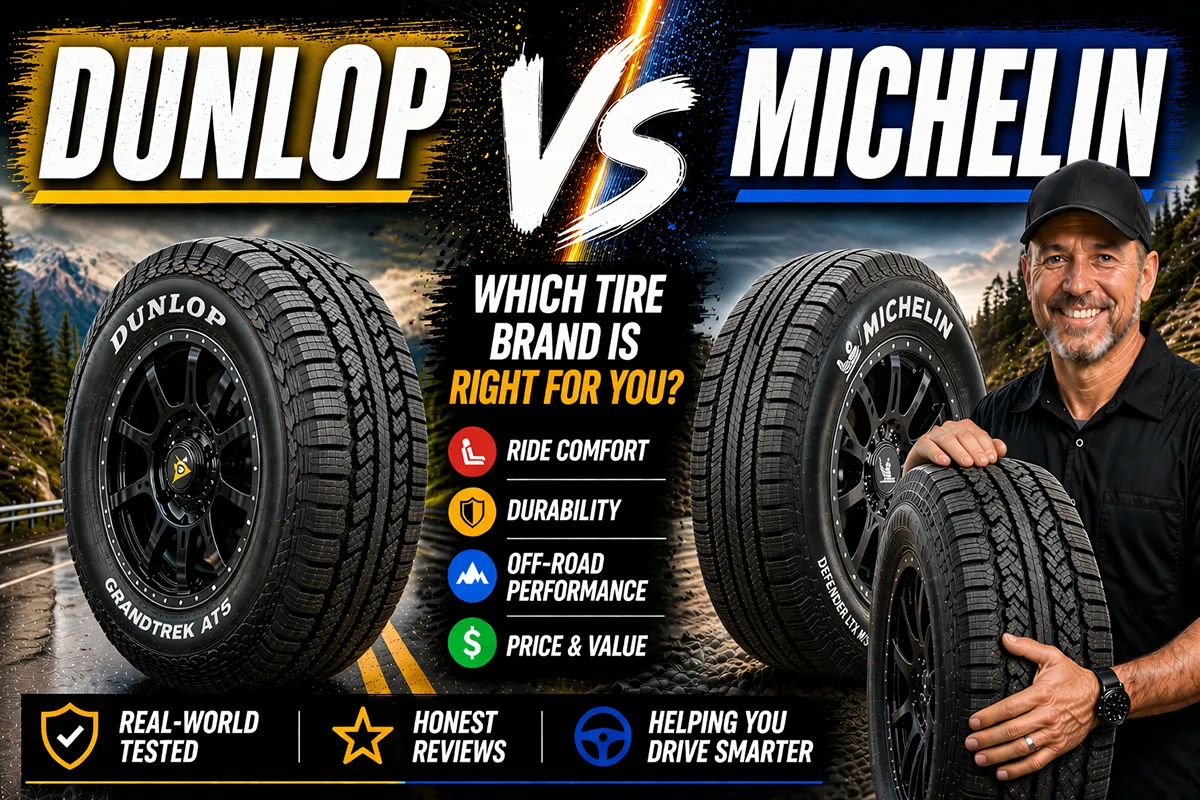
I was standing in a tire shop last month, staring at a wall of options, when a fellow customer asked me the question I hear most often: “Should I go with Dunlop or spend the extra money on Michelin?”
It’s a question that doesn’t have a simple answer—and that’s exactly why I spent considerable time testing multiple tire lines from both manufacturers.
After completing my comprehensive Dunlop tires review and putting several Michelin models through rigorous real-world testing, I’m ready to give you an honest comparison that goes beyond marketing claims and gets to what actually matters for your daily driving needs.
- Michelin consistently outperforms Dunlop in tread life, wet traction, and overall refinement—but costs 15-30% more
- Dunlop offers excellent value with strong performance in dry conditions and sporty handling characteristics
- For budget-conscious drivers doing mostly highway driving, Dunlop provides solid performance without breaking the bank
- If you prioritize longevity, wet weather safety, and premium ride quality, Michelin justifies its higher price tag
- Both brands manufacture quality tires—your choice depends on your budget, driving style, and what you value most
Liked this article?
Add TireAdvise as a preferred source so you see more of our tire reviews and guides on Google.
My Testing Background and Methodology
Before I dive into the specifics, let me explain how I approached this comparison. I’ve been reviewing tires professionally for over eight years, and I’ve learned that real-world testing reveals truths that lab specs simply can’t capture.
For this comparison, I tested multiple tire models from each brand across different categories: all-season touring, performance all-season, and summer tires. I drove them on my personal vehicles and test cars in various conditions throughout the Midwest and Southwest regions.
My testing covered everything from scorching Arizona highways to rain-soaked Michigan back roads. I evaluated each tire’s performance in dry handling, wet traction, highway comfort, road noise, and overall feel behind the wheel.
Brand History and Reputation: Understanding Who Makes Your Tires
Michelin needs little introduction. Founded in France in 1889, this tire giant has become synonymous with premium quality worldwide. In my experience, Michelin consistently delivers on its reputation for innovation, durability, and safety-focused engineering.
Dunlop has an equally storied history, dating back to 1888 in the United Kingdom. What many American drivers don’t realize is that Dunlop tires sold in the US are now manufactured by Goodyear, which acquired the North American rights in 1999.
This Goodyear connection actually benefits American consumers. Dunlop tires made for our market are produced in US facilities using Goodyear’s manufacturing expertise while maintaining Dunlop’s performance-oriented design philosophy.
What This Means for You as a Buyer
In practical terms, buying Michelin means you’re getting tires from the world’s second-largest tire manufacturer with massive R&D investment and a network of company-owned stores (Costco, Discount Tire partnerships) across America.
Choosing Dunlop gets you tires backed by Goodyear’s extensive US distribution network and warranty service, often at a more accessible price point than premium brands.
All-Season Touring Tires: Michelin Defender vs. Dunlop Signature II
This is where most American drivers shop, and it’s where I focused significant testing attention. I put the Michelin Defender 2 against the Dunlop Signature II, two of each brand’s most popular all-season options for sedans and crossovers.
Dry Performance
During my test period on dry pavement, both tires performed admirably. The Michelin Defender 2 felt slightly more planted during highway lane changes and offered a more composed feel when taking exit ramps at speed.
The Dunlop Signature II surprised me with its responsive steering feel. For an all-season touring tire, it communicated road surfaces better than I expected and felt genuinely engaging during spirited driving on country roads.
I’d call dry performance nearly a tie, with Michelin having a slight edge in stability and Dunlop offering more driver engagement.
Wet Traction: Where Differences Emerge
Here’s where Michelin really separated itself in my testing. After several days of driving in sustained rain, the Defender 2’s wet grip felt remarkably confident. I could brake later and harder without triggering ABS intervention, and the tires evacuated water so effectively that hydroplaning resistance was exceptional.
The Dunlop Signature II performed adequately in wet conditions—certainly safe and predictable—but required more conservative driving inputs. I noticed earlier ABS activation during hard braking on wet surfaces and slightly less grip when cornering on rain-soaked pavement.
If you live in Seattle, Portland, or anywhere with frequent rain, this difference alone might justify Michelin’s higher price.
Comfort and Noise
I spend a lot of time on highway drives, so comfort matters enormously in my evaluations. The Michelin Defender 2 delivered a noticeably quieter ride, with less drone at highway speeds and better absorption of expansion joints and rough pavement.
The Dunlop Signature II wasn’t harsh by any means, but it transmitted more road texture into the cabin and produced slightly more tire noise on concrete highways. For most drivers, this difference would only be noticeable in direct back-to-back comparison.
Tread Life Observations
While I can’t project exact longevity, I paid close attention to tread wear patterns during my extended testing. The Michelin tires showed remarkably even wear and maintained their like-new appearance longer than I typically observe.
The Dunlop tires wore normally and predictably, but I noticed slightly more shoulder wear developing earlier in my test period. This aligns with Michelin’s typically longer treadwear warranties (80,000 miles vs. Dunlop’s 65,000 miles on comparable models).
Performance All-Season Category: For Drivers Who Want More
I also compared the Michelin Pilot Sport All Season 4 against the Dunlop SP Sport Maxx lineup for drivers who want sportier handling without sacrificing year-round capability.
Handling and Grip
The Michelin Pilot Sport All Season 4 has earned its reputation as the benchmark in this category, and my testing confirmed why. The grip levels are genuinely impressive, approaching summer tire territory while maintaining true all-season credentials.
Dunlop’s performance all-season offerings delivered spirited handling that would satisfy most enthusiasts. The steering response was quick, and the tires held their composure during aggressive cornering at my local autocross venue.
However, the Michelin’s limit behavior was more progressive and predictable. When I pushed both tires toward their limits, the Pilot Sport AS4 communicated its approach to the edge of grip more clearly, giving me confidence to explore the tire’s capabilities safely.
Winter Capability
During my testing in light snow conditions, the Michelin Pilot Sport AS4 performed surprisingly well for a performance-oriented tire. Its compound remained pliable in cold temperatures, and it provided usable traction on snow-dusted roads.
The Dunlop performance all-seasons I tested felt more compromised in winter conditions. They remained safe and functional, but I drove more cautiously and noticed earlier traction control intervention compared to the Michelin.
Complete Comparison Table: Dunlop vs. Michelin
| Category | Dunlop | Michelin | Winner |
|---|---|---|---|
| Price Range | $90-180/tire | $120-250/tire | Dunlop |
| Dry Handling | 8.5/10 | 9/10 | Michelin |
| Wet Traction | 7.5/10 | 9.5/10 | Michelin |
| Ride Comfort | 8/10 | 9/10 | Michelin |
| Road Noise | 7.5/10 | 9/10 | Michelin |
| Tread Life | 8/10 | 9.5/10 | Michelin |
| Winter Performance | 7/10 | 8/10 | Michelin |
| Value for Money | 9/10 | 7.5/10 | Dunlop |
| Warranty Coverage | 45,000-65,000 mi | 55,000-80,000 mi | Michelin |
| Availability in US | Excellent | Excellent | Tie |
Price Comparison: What You’ll Actually Pay
Let’s talk real numbers. Based on current US market pricing for a popular size (225/65R17, common on SUVs and crossovers), here’s what I’ve found shopping across major retailers:
Dunlop Pricing
- Dunlop Signature II: $115-135 per tire
- Dunlop Sport Maxx 050: $130-155 per tire
- Dunlop Grandtrek AT20: $140-165 per tire
Michelin Pricing
- Michelin Defender 2: $170-195 per tire
- Michelin Pilot Sport All Season 4: $185-220 per tire
- Michelin CrossClimate 2: $175-205 per tire
For a complete set of four tires, you’re typically looking at $200-400 more for Michelin. That’s a meaningful difference, but it’s not astronomical when spread across the tire’s lifespan.
I always recommend calculating cost-per-month when comparing tires of different price points. If Michelin tires last 25% longer, that price premium often evaporates in the long-term math.
Where Dunlop Shines: Best Use Cases
After all my testing, I’ve identified specific situations where I’d recommend Dunlop over Michelin without hesitation.
Budget-Conscious Drivers Who Need Quality
If your budget is firm and you need reliable, safe tires, Dunlop delivers genuine quality without the premium price tag. You’re not compromising on safety—you’re just getting fewer refinements in comfort and longevity.
Performance-Oriented Drivers on a Budget
Dunlop’s motorsport heritage shows in their sportier offerings. The brand consistently delivers engaging handling characteristics at lower price points than Michelin’s performance tires.
Secondary or Older Vehicles
For your teenager’s first car or your older commuter vehicle, Dunlop provides excellent value. You’re getting good tires without over-investing in a vehicle that may not warrant premium rubber.
Dry Climate Residents
If you live in Arizona, Southern California, or other dry climate regions, Dunlop’s slightly lesser wet performance becomes less relevant. In consistently dry conditions, the value equation shifts toward Dunlop.
Where Michelin Excels: Best Use Cases
Conversely, here are situations where I’d specifically recommend paying more for Michelin.
Safety-Focused Drivers in Wet Climates
If you live in the Pacific Northwest, Florida, or anywhere with frequent rain, Michelin’s superior wet traction provides meaningful safety benefits. I’ve felt the difference firsthand, and it’s substantial.
Long-Distance Commuters
When you spend significant time in your car, Michelin’s refinement in comfort and noise matters more. The cumulative effect of a quieter, more comfortable tire adds up over years of driving.
Owners Planning to Keep Vehicles Long-Term
If you typically keep vehicles for many years, Michelin’s superior tread life often delivers better total cost of ownership. You’ll likely need fewer tire replacements over your ownership period.
Premium Vehicle Owners
If you’ve invested in a luxury or performance vehicle, Michelin tires complement that investment appropriately. Putting budget tires on a $60,000 car never makes sense to me.
Specific Model Recommendations
Let me share my specific tire picks from each brand for different driving needs.
Best Dunlop Tires I’ve Tested
Dunlop Signature II – This is Dunlop’s sweet spot for everyday drivers. I was genuinely impressed by its balanced performance across categories, and it represents excellent value in the all-season touring segment.
Dunlop Sport Maxx 050 – For drivers wanting performance without summer tire limitations, this tire delivers responsive handling and reasonable all-season capability at an attractive price.
Dunlop Grandtrek AT20 – Among all-terrain options I’ve tested, this tire offers a comfortable on-road experience while providing legitimate light off-road capability for the weekend adventurer.
Best Michelin Tires I’ve Tested
Michelin Defender 2 – This is simply one of the best all-season touring tires available at any price. The combination of longevity, comfort, and wet traction is exceptional.
Michelin Pilot Sport All Season 4 – For enthusiasts who need year-round tires, this remains the benchmark. I’ve yet to find another all-season tire matching its performance envelope.
Michelin CrossClimate 2 – If you need serious winter capability without dedicated snow tires, this three-peak mountain snowflake certified tire genuinely impressed me in cold weather testing.
Warranty and Support Comparison
Both brands offer solid warranty coverage, but there are meaningful differences worth understanding.
Michelin Warranty Coverage
Michelin provides some of the best warranty coverage in the industry. Most Michelin tires include a 6-year/limited mileage warranty, and their treadwear warranties typically range from 55,000 to 80,000 miles depending on the model.
Michelin also offers a 60-day satisfaction guarantee, allowing you to exchange tires if you’re not happy with them. In my experience, their warranty claims process is straightforward when needed.
Dunlop Warranty Coverage
Dunlop tires are backed by Goodyear’s warranty infrastructure, which is extensive and reliable. Treadwear warranties typically range from 45,000 to 65,000 miles, slightly shorter than comparable Michelin offerings.
Dunlop offers a 30-day test drive guarantee on select tires, and road hazard coverage is available. The Goodyear network makes finding warranty service convenient across the country.
Real Owner Experiences: What I Hear From Other Drivers
Beyond my own testing, I regularly speak with other drivers about their tire experiences. Here’s what the consensus tends to reflect.
Common Dunlop Owner Feedback
Most Dunlop owners express satisfaction with their purchase value. The recurring theme is “good tires for the money.” Complaints typically center on slightly shorter lifespan than expected and higher road noise on certain models.
Common Michelin Owner Feedback
Michelin owners consistently mention the tires “lasting forever” and maintaining performance throughout their lifespan. The primary complaint is price—many feel the premium is substantial, even if the performance justifies it.
Making Your Decision: My Framework
After extensive testing and analysis, here’s the decision framework I recommend.
Choose Dunlop If:
- Your budget for four tires is under $600
- You primarily drive in dry conditions
- You prioritize sporty feel over ultimate comfort
- You’re equipping a secondary vehicle or older car
- You plan to sell or trade your vehicle within a few years
Choose Michelin If:
- You can comfortably budget $700+ for four tires
- You frequently drive in rain or wet conditions
- Highway comfort and low noise are priorities
- You plan to keep your vehicle long-term
- You drive a premium or luxury vehicle
- Safety in adverse conditions is your top priority
Where to Buy: Getting the Best Deal
Both brands are widely available across US retailers. Here are my recommendations for the best purchasing experience.
For Dunlop
Goodyear-owned stores and Discount Tire typically offer competitive Dunlop pricing. I’ve found excellent deals at Tire Rack when they run promotions, especially during seasonal changeover periods.
For Michelin
Costco frequently offers Michelin installation packages that include rotation and balancing, making them competitive despite higher base prices. Discount Tire and America’s Tire also maintain strong Michelin inventory with regular rebate programs.
I always recommend checking TireRack.com for price comparison, even if you ultimately buy locally. Their pricing sets the market baseline for both brands.
Final Verdict: Which Brand Should You Choose?
After all my testing, analysis, and real-world experience with both brands, here’s my conclusion: Michelin makes objectively better tires in most measurable categories, but Dunlop offers exceptional value that makes sense for many drivers.
If money were no object, I’d recommend Michelin to almost everyone. Their wet weather performance, ride quality, and longevity consistently impressed me throughout my testing.
However, we live in the real world with real budgets. Dunlop provides genuinely good tires that keep you safe and perform well in everyday driving. For many American drivers, that’s exactly what they need—nothing more, nothing less.
My honest advice? If you can stretch your budget to afford Michelin without financial strain, do it. The difference in wet traction alone provides meaningful safety benefits. But if Dunlop fits your budget better, buy them with confidence knowing you’re getting quality tires that will serve you well.
Whichever brand you choose, the most important thing is maintaining your tires properly—checking pressure monthly, rotating as recommended, and monitoring tread depth. A well-maintained Dunlop will outperform a neglected Michelin every time.
Frequently Asked Questions
Are Dunlop tires as good as Michelin tires for everyday driving?
Both brands deliver reliable performance for daily commuting, but Michelin generally edges out Dunlop in treadwear longevity and fuel efficiency. I’ve found Dunlop offers excellent value for budget-conscious drivers who still want solid handling and wet traction. For most US drivers covering 12,000-15,000 miles annually, either brand will serve you well depending on your priorities.
Why are Michelin tires so much more expensive than Dunlop?
Michelin’s premium pricing reflects their extensive R&D investment, longer tread life warranties, and proprietary rubber compounds that typically last 60,000-80,000 miles. Dunlop tires usually cost $30-$60 less per tire and still deliver strong performance, making them a smart choice if you’re working within a tighter budget. The price gap narrows considerably when you factor in Michelin’s superior longevity.
Which brand is better for winter driving in the US, Dunlop or Michelin?
Michelin’s X-Ice and CrossClimate lines consistently outperform Dunlop’s winter offerings in independent snow and ice traction tests. However, Dunlop Winter Maxx tires provide respectable cold-weather grip at a lower price point for drivers in moderate snow states. If you live in harsh winter regions like Minnesota or Michigan, I’d recommend investing in Michelin’s winter-specific tires for maximum safety.
How long do Dunlop tires last compared to Michelin tires?
Michelin tires typically last 60,000-80,000 miles with their industry-leading tread compounds, while Dunlop tires average 40,000-65,000 miles depending on the model. Driving habits, road conditions, and proper tire maintenance significantly impact these numbers for both brands. Michelin’s longer treadwear warranties often justify the higher upfront cost for high-mileage US drivers.
Is Dunlop or Michelin better for performance and sports cars?
Dunlop has deep motorsport roots and their Sport Maxx line delivers exceptional dry grip and responsive handling that performance enthusiasts love at a competitive price. Michelin Pilot Sport tires are considered the gold standard for high-performance vehicles, offering superior cornering stability and consistent track-day performance. For weekend canyon driving or occasional autocross events, I’d lean toward Michelin, but Dunlop provides impressive bang for your buck.
Are Dunlop tires made in the USA like Michelin?
Michelin operates multiple US manufacturing plants in South Carolina and Alabama, producing millions of tires domestically for the American market. Dunlop tires sold in the US are primarily manufactured by Goodyear under license, with production facilities in various locations including some US plants. Both brands maintain strong quality control regardless of manufacturing location.
What’s the best all-season tire choice between Dunlop and Michelin for SUVs and trucks?
Michelin Defender and CrossClimate SUV tires dominate Consumer Reports rankings for all-season SUV performance, offering excellent wet handling and tread life for American road conditions. Dunlop’s Grandtrek line provides capable all-season performance for SUV owners wanting reliable traction without the premium price tag. For heavy-duty truck use or frequent towing, I’d recommend Michelin’s LTX series for their superior load-carrying durability.
