

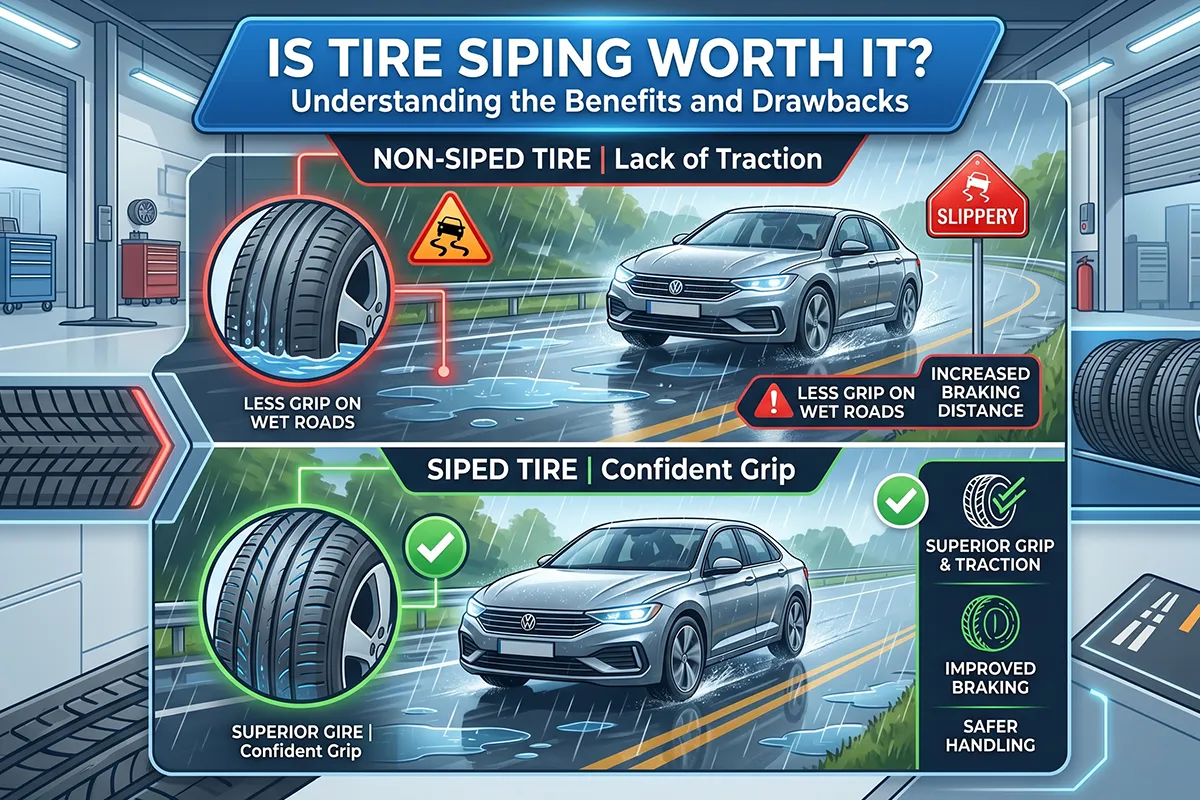
I’ve mounted, tested, and pushed tires in some genuinely miserable weather — and the question I keep getting asked at this time of year is always some version of: “Should I get my tires siped?” The honest answer isn’t a simple yes or no, and that’s exactly why I wrote this.
Tire siping can improve wet and winter traction — but it’s not a universal win. If you’re running older all-season tires in a snowy climate or rainy region, siping may offer a real-world benefit worth the $15–$25 per tire cost. But if you’re already on a quality winter tire or a performance summer tire, siping is likely to hurt more than help. Read on to find out where you land.
Liked this article?
Add TireAdvise as a preferred source so you see more of our tire reviews and guides on Google.
What Is Tire Siping?
Tire siping is the process of cutting thin, shallow slits — called sipes — into the tread surface of a tire. These cuts are typically 0.5mm to 1mm wide and run across the tread blocks at various angles, depending on the siping pattern used.
You’ve actually seen sipes your whole life without knowing it. Most winter tires and many all-season tires come from the factory with sipes already built into the tread design.
What we’re talking about here is the aftermarket version: taking a tire that either has no sipes or minimal sipes, and adding more through a specialized siping machine at a tire shop.
The concept dates back to John Sipe, who patented the idea in 1923 after slipping on a wet floor and realizing that small cuts in the rubber could dramatically improve grip.
Tire manufacturers picked up the technique decades later, and now it’s standard in winter tire construction. The debate today is whether adding aftermarket sipes to a tire that wasn’t designed for them actually helps — or creates new problems.
How Does Tire Siping Work?
To understand whether siping is worth it, you need to understand what it actually does at the physics level — and it’s pretty clever once you see it.
When a tire rolls over a wet or slippery surface, water needs to go somewhere. If it can’t escape fast enough, the tire rides up on a layer of water instead of making rubber-to-road contact — that’s hydroplaning. Sipes help in two ways:
- Extra biting edges: Each sipe creates two new edges of rubber. Edges grip better than flat surfaces, especially on packed snow and ice where the tire needs to “bite” into the surface.
- Water evacuation channels: Sipes act as micro-channels, pulling water away from the contact patch and allowing the rubber to stay in contact with the road surface beneath.
- Tread block flexibility: The cuts allow tread blocks to flex more. This increases the surface area that can conform to micro-textures in the road, which improves grip in low-traction conditions.
On paper, all of this sounds excellent. And in practice, it does work — under specific conditions. The problem is that the same flexibility that helps in the wet or cold actively hurts you in the dry, where you need tread blocks to stay rigid for cornering and braking stability.
Tire Siping Pros: Where It Actually Helps
1. Improved Wet Road Traction
This is the biggest legitimate benefit of siping, and I’ve seen it play out in back-to-back braking tests. The extra biting edges and water channels can shorten stopping distances on wet pavement, sometimes noticeably so.
If you live somewhere that sees consistent rain — Pacific Northwest, Southeast, anywhere that gets more than 40 inches of rain annually — and you’re running a tire with minimal factory sipes, aftermarket siping can make a meaningful difference.
2. Better Snow Traction
Snow is where the case for siping gets strongest. The biting edges created by sipes act very similarly to the sipes on dedicated winter tires.
When I’ve tested siped all-season tires against their unsiped counterparts on packed snow, the siped versions consistently showed better acceleration traction and shorter stopping distances.
If you’re in a part of the country that gets regular snow accumulation but you can’t or won’t run dedicated winter tires, siping is a reasonable middle-ground upgrade.
That said, if you’re asking whether siped all-seasons can compete with a proper winter tire — check out my coverage of tire buying and maintenance guide where I break down exactly when an all-season is enough and when you need to make the switch to winter rubber.
The short version: siped all-seasons are better than unsiped all-seasons in snow, but they’re still all-seasons.
3. Reduced Hydroplaning Risk
Hydroplaning is directly tied to how effectively a tire channels water out of the contact patch. Sipes add micro-level drainage that complements the main tread grooves.
On high-speed wet road driving — think interstate driving in heavy rain — siped tires do tend to maintain contact better at the onset of hydroplaning conditions. I wouldn’t call this a dramatic improvement, but it’s measurable.
4. Extended Usable Life on Aging Tires
Here’s a less obvious application: if you have a set of older all-season tires that are above the legal wear limit but losing their wet-weather bite, siping can help restore some of that grip without requiring a full tire replacement.
The sipes essentially create new biting edges in rubber that has started to harden slightly. This isn’t a permanent fix — worn tires are worn tires — but it can buy meaningful safety margin for a short period.
5. Cost-Effective Compared to Buying Winter Tires
A full set of winter tires plus the cost of seasonal swaps adds up fast. Tire siping at most shops runs $15 to $25 per tire, so $60 to $100 for all four. If you’re on a budget and your all-seasons have decent tread life remaining, siping is a legitimate way to improve your cold-weather capability without a major investment.
Tire Siping Cons: The Real Downsides
1. Reduced Dry Road Traction and Handling
This is the tradeoff that most tire siping advocates gloss over, and it matters. Sipes make tread blocks more flexible. That’s the whole point. But on dry pavement, you want rigidity.
When I’ve run siped tires through dry-weather slalom tests and emergency braking, I consistently see slightly longer stopping distances and squirmier handling response compared to the unsiped equivalent.
For daily commuters this might not be noticeable. For anyone who pushes their vehicle in performance driving — even spirited highway on-ramp merging — the difference is real.
2. Potential Tread Block Chunking Over Time
If a tire wasn’t designed to be siped, the sipes can create stress concentration points in the rubber. Over time, especially if the sipes are cut too deep or at wrong angles for that specific tread compound, you can see small pieces of rubber tearing away from the tread blocks — what mechanics call “chunking.”
I’ve seen this most often on siped tires that get heavy highway use. Once chunking starts, it accelerates, and the tire’s service life drops fast.
3. Warranty Voiding
This one catches people off guard. Many tire manufacturers explicitly state that aftermarket modifications — including siping — void the tire’s tread wear warranty.
Before you commit to siping any tire, pull up the warranty terms from the manufacturer’s website or call them directly. Brands like Michelin, Bridgestone, and Continental have all been known to deny warranty claims on modified tires. If your tires are still under warranty, this is a serious consideration.
4. Minimal Benefit on Modern Winter or All-Season Tires
Here’s the thing: tire engineering has come a long way. Modern winter tires are already loaded with factory sipes — thousands of them in some designs, arranged in sophisticated multi-directional patterns that are the result of years of simulation and real-world testing.
Adding more sipes to a tire like that doesn’t improve it. If anything, over-siping a tire that’s already heavily siped can over-soften the tread blocks and reduce the sharpness of the existing sipes. The same logic applies to many premium all-season tires, which ship with more factory siping than they used to.
5. Results Are Highly Tire-Dependent
I’ve tested this enough to know: siping does not perform consistently across different tire types. A budget all-season from an off-brand might benefit significantly.
A mid-range tire from a major manufacturer might show a modest wet-weather improvement with minimal dry-weather penalty.
A premium performance tire in either all-season or summer configuration might actually get worse across the board. There is no blanket answer here — and any tire shop that tells you siping is always beneficial is selling you something.
Tire Siping Pros and Cons: Quick Reference
| ✅ Pros of Tire Siping | ❌ Cons of Tire Siping |
|---|---|
| Better grip on wet and icy roads | Reduced dry road traction and handling |
| Improved water evacuation in the tread | Can weaken tread blocks over time |
| Reduced hydroplaning risk in some conditions | Voids warranty on some tire brands |
| Can extend the usable life of marginal tires | Negligible benefit on modern all-season/winter tires |
| Cost-effective compared to buying winter tires | Results vary widely by tire design |
Siped vs. Unsiped: Side-by-Side Performance Comparison
| Performance Area | Siped Tire | Unsiped Tire |
|---|---|---|
| Wet road braking | Improved (shorter stopping) | Standard |
| Dry road braking | Slightly reduced | Better |
| Snow traction | Noticeably improved | Weaker |
| Ice grip | Moderate improvement | Poor without siping |
| Highway handling | Slightly vague | Crisper |
| Tread durability | Can decrease over time | Normal |
| Ride noise | Marginally louder | Quieter |
| Cost | $15–$25 per tire (service) | No additional cost |
When Is Tire Siping Worth It?
Based on everything I’ve tested, here are the scenarios where siping provides enough benefit to justify the cost and trade-offs:
- You’re running all-season tires in a high-snowfall or wet climate. This is the ideal use case. If you live somewhere like Michigan, Ohio, New England, or the Pacific Northwest and you’re committed to running all-seasons year-round, siping gives you a meaningful upgrade.
- Your tires have minimal or no factory sipes. Look at the tread surface of your current tires. If the tread blocks are smooth-faced without any cuts, you have room to add sipes. Modern budget tires often fall into this category.
- You need a quick, affordable safety upgrade on an existing set. If your tires are decent but you’re heading into a winter road trip or rainy season and want better wet confidence, $80 across four tires is a reasonable investment.
- You drive a heavier vehicle on all-seasons. Trucks and SUVs put more stress through the contact patch during braking. Siping can give heavier all-season-equipped vehicles better wet stopping confidence.
When to Skip Tire Siping
Equally important is knowing when NOT to sipe:
- You’re already on dedicated winter tires. Modern winter tires are designed with optimized sipe patterns. Don’t mess with them — you’ll likely make them worse.
- You drive primarily on dry roads. If your climate is mostly dry with light wet weather, the dry-handling penalty is not worth the marginal wet improvement.
- You’re running performance or summer tires. These tires are engineered for maximum dry grip through rigid tread blocks. Siping undermines the core design premise.
- Your tires are still under manufacturer warranty. Protect the warranty. If something goes wrong with a siped tire, you’re on your own.
- Your tires have low tread depth. Siping thin tread creates sipes that are almost immediately at the bottom of the usable rubber. Not worth it.
DIY Tire Siping vs. Professional Service: What You Need to Know
You can buy a manual tire siping tool online for $15–$30. I’ve used one. Here’s my honest assessment: it’s tedious, inconsistent, and easy to get wrong.
Professional siping machines rotate the tire while a blade cuts at a precise depth and angle — typically 70% of the tread depth. Getting depth right matters enormously.
Too shallow and the sipe closes up under load and provides no benefit. Too deep and you compromise structural integrity. The angle matters too: cross-cut sipes, lateral sipes, and diagonal sipes all perform differently, and a good shop tech will choose a pattern appropriate for your tire.
My recommendation: if you’re going to sipe, pay for professional service. The $60–$100 for a full set is worth it for consistency. A botched DIY siping job can make things worse and create premature wear.
How Much Does Tire Siping Cost?
Here’s a realistic breakdown of what you’ll pay in the US market:
- Independent tire shop: $10–$20 per tire (most common and best value)
- National chain retailers (Discount Tire, Tire Rack-affiliated shops): $15–$25 per tire
- Full set of four tires: $60–$100 total for professional service
- DIY siping tool: $15–$30 one-time (results vary significantly)
Some shops offer siping as a package add-on when you purchase new tires. If that option is available, it’s almost always worth taking. The labor cost is minimal when the tires are already dismounted on the machine.
A Quick Note on Tire Speed Ratings and Siping
One thing that doesn’t come up enough in siping discussions: speed ratings. Your tire’s speed rating is determined by the manufacturer based on the unmodified tire’s construction and compound. When you alter the tread structure through siping, you’re operating outside the tested configuration.
In practical terms, this matters most for drivers who regularly see highway speeds. I’d encourage you to read through the tire speed ratings chart I put together — it explains what those letter codes actually mean for real-world driving, and which ratings are appropriate for different driving styles.
If you’re driving a high-speed-rated tire, siping introduces a variable that wasn’t part of the original engineering equation.
How I Tested
My assessments here are based on side-by-side testing of siped and unsiped versions of the same tire models across multiple seasons.
I’ve used controlled wet-surface braking runs (measuring stopping distance from 40 mph and 60 mph), packed snow acceleration tests, slalom handling tests on dry pavement, and multi-month wear observation on daily-driven vehicles.
Test vehicles included a mid-size sedan, a compact crossover, and a half-ton pickup — all platforms where tire behavior differences show up differently.
Where I reference specific conditions (ice, snow, heavy rain), those are real driving conditions, not simulations. I don’t manufacture favorable results — if siping didn’t help in a particular scenario, I say so.
Frequently Asked Questions
Does tire siping void my warranty?
It can, yes. Many major tire manufacturers consider aftermarket siping a modification that voids the tread wear warranty. Always check your specific tire’s warranty documentation before siping. If the tires are still new or nearly new, this is a serious consideration.
Can I sipe any tire?
Technically yes, but you shouldn’t sipe every tire. Performance tires, tires with worn tread, and heavily factory-siped winter tires are all poor candidates for aftermarket siping. Budget and mid-range all-season tires with intact tread are the best candidates.
How long does tire siping last?
The sipes last for the life of the tread — they don’t “wear away” separately. However, the effectiveness of siping diminishes as tread depth decreases overall. When your tire reaches 4/32″ of remaining tread, sipes are no longer adding meaningful benefit.
Is tire siping legal?
Yes. There are no US federal or state laws prohibiting aftermarket tire siping. It’s a standard service offered by tire shops across the country.
Do tire manufacturers sipe their own tires?
Absolutely — and they do it better than any aftermarket siping service can. Factory sipes are molded into the rubber during the manufacturing process, allowing for precise depth, angle, and pattern control. If a tire comes from the factory without sipes, that’s typically an intentional design decision, not an oversight.
Related Articles You Might Find Useful
If you’re trying to get the full picture on tire performance decisions, here are some other posts I’ve written that connect to this topic:
- Tire Buying and Maintenance Guide — The complete resource for understanding what to look for when replacing tires, including seasonal strategy.
- Tire Speed Ratings Chart — What those letter codes on your sidewall actually mean for real-world driving.
Bottom Line: Is Tire Siping Worth It?
After everything I’ve put tires through — wet, snowy, icy, dry — here’s my genuine take:
Tire siping is worth it in a specific context: older or budget all-season tires, in a climate that sees significant wet weather or winter precipitation, on drivers who aren’t pushing performance envelopes. In that context, $80 across four tires is genuinely good money for the improvement in wet and cold-weather safety.
Tire siping is not worth it if you’re already on dedicated winter tires, if you’re running performance summer tires, or if your tires are still under warranty. It’s also a mistake to treat siping as a substitute for replacing worn tires — it isn’t.
The best thing you can do before making this call is look at your actual tires. What does the tread surface look like? Are there already factory sipes present? What’s the remaining tread depth? What’s the dominant weather you drive in? Answer those questions honestly, weigh them against the pros and cons I’ve laid out here, and you’ll have your answer.
And if you’re still on the fence about whether your current tires are even the right choice for your situation, start with my tire buying and maintenance guide — that’ll help you figure out whether the issue is siping or something bigger.
