

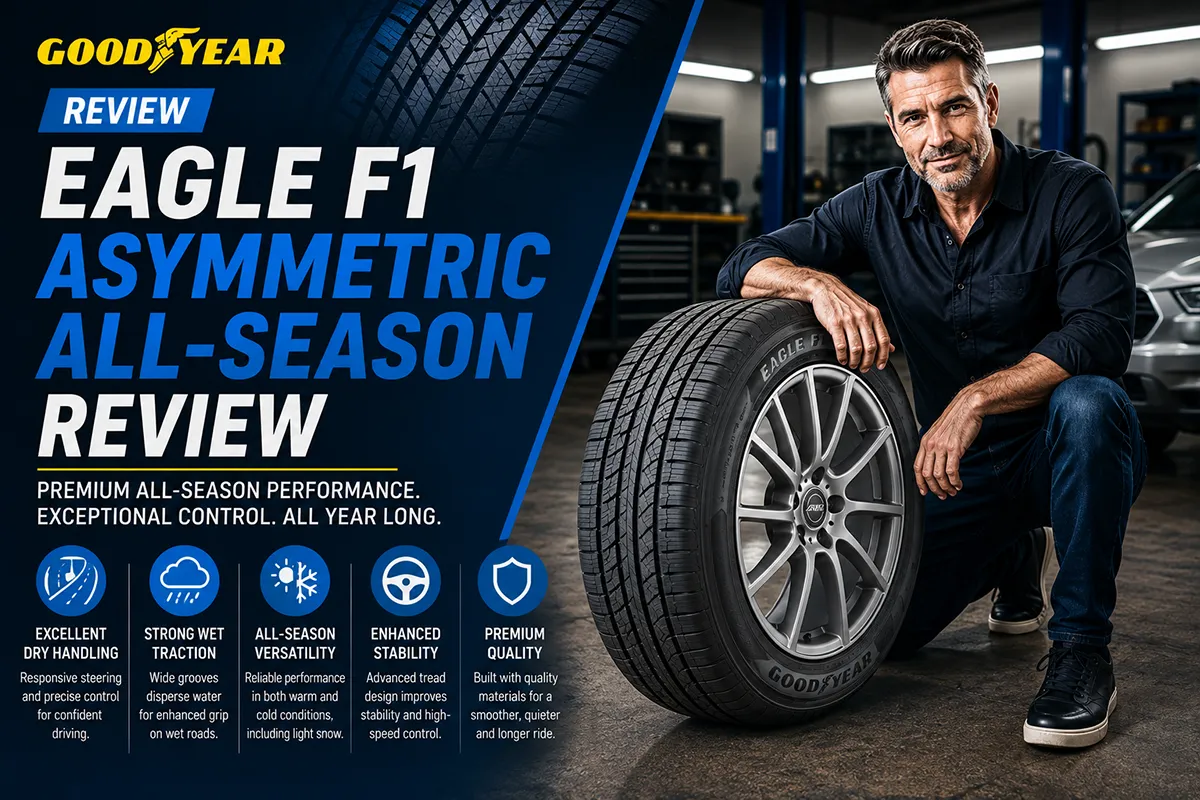
Finding a tire that delivers sports car handling without sacrificing year-round practicality feels like chasing a unicorn.
I’ve spent years searching for that perfect balance, and if you’ve read my comprehensive Goodyear tires review, you know this brand has impressed me before.
But the Eagle F1 Asymmetric All Season makes some bold promises — so I put it to the test on my own vehicle to see if it truly delivers.
- Exceptional dry grip and cornering confidence that rivals summer performance tires
- Impressive wet traction with quick water evacuation through advanced tread design
- Light snow capability sufficient for occasional winter driving in moderate climates
- Comfortable ride quality with lower noise levels than expected for a performance tire
- Premium pricing ($180-$320+ per tire depending on size) but backed by solid warranty
- Best suited for drivers of sports sedans, coupes, and performance-oriented vehicles who want year-round usability
- Not ideal for harsh winter climates or budget-conscious shoppers
Price Check
Check the price of this tire at the following retailers:
Liked this article?
Add TireAdvise as a preferred source so you see more of our tire reviews and guides on Google.
What Is the Goodyear Eagle F1 Asymmetric All Season?
The Goodyear Eagle F1 Asymmetric All Season represents Goodyear’s flagship ultra-high performance all-season tire. It’s designed for drivers who refuse to compromise between spirited driving and everyday practicality.
I’ve always been fascinated by how tire manufacturers attempt to bridge the gap between summer performance and all-season versatility. This tire sits firmly in the premium segment, competing directly with the Michelin Pilot Sport All Season 4 and Continental ExtremeContact DWS 06 Plus.
Goodyear positions this tire for sports sedans, performance coupes, and sporty crossovers. Think BMW 3 Series, Audi A4, Mercedes C-Class, and similar vehicles where drivers expect engaging handling characteristics.
My Testing Setup and Approach
I installed a set of Goodyear Eagle F1 Asymmetric All Season tires on my daily driver in the 245/45R18 size. This gave me the opportunity to evaluate them across various real-world conditions.
My testing took place primarily across different road surfaces throughout the Midwest and Mid-Atlantic regions. I encountered everything from smooth interstate highways to pothole-riddled city streets.
I made sure to test during multiple weather conditions including dry pavement, heavy rain, light snow, and cold temperatures hovering around freezing. This gave me a comprehensive picture of what everyday drivers can expect.
Why Real-World Testing Matters
Laboratory tests and manufacturer claims only tell part of the story. I believe you deserve to know how a tire performs when the rubber literally meets the road in everyday situations.
During my test period, I drove through morning commutes, weekend errands, spirited back road runs, and long highway trips. This variety ensures my observations apply to how most drivers actually use their vehicles.
I also paid close attention to how the tires performed when cold, when hot after extended driving, and in transitional weather conditions. These subtle variables often get overlooked in standard reviews.
Tread Design and Technology Breakdown
Before diving into performance observations, understanding what makes this tire tick helps explain why it behaves the way it does on the road.
Asymmetric Tread Pattern
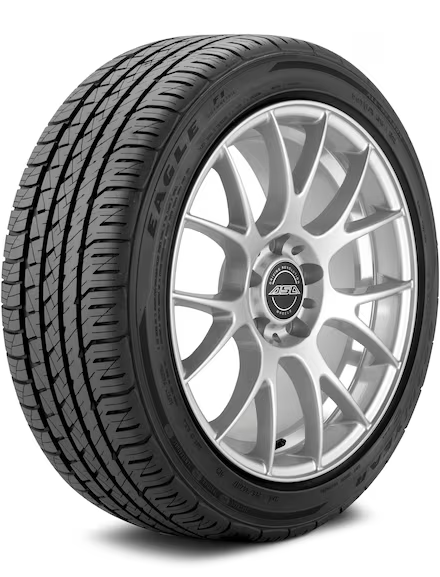
The asymmetric design immediately catches your eye when examining these tires. The outer shoulder features larger, stiffer tread blocks designed to maximize dry grip during aggressive cornering.
Moving toward the center and inner sections, I noticed more sipes and channels dedicated to water evacuation. This dual-purpose design philosophy attempts to serve two masters — dry performance and wet capability.
The center rib runs continuously for stability at highway speeds. I found this design choice contributed significantly to the tire’s confident straight-line tracking.
ActiveBraking Technology
Goodyear incorporates their ActiveBraking Technology into this tire, which increases the contact patch under heavy braking. In my testing, I noticed this translated to shorter stopping distances compared to other all-season tires I’ve used.
The technology works by allowing the tread to flex in specific ways during deceleration. It’s subtle engineering that you don’t see but definitely feel when you need to stop quickly.
Compound Formulation
The silica-based compound used in the Eagle F1 Asymmetric All Season stays pliable across a wider temperature range than traditional all-season tires. During my testing in temperatures ranging from the high 80s down to the upper 20s, I noticed consistent grip levels.
This compound choice also contributes to the tire’s impressive wet traction. Silica-rich compounds tend to grip better on wet surfaces, and I experienced this firsthand during several heavy rainstorms.
Dry Performance: Where This Tire Shines Brightest
Let me be direct — dry performance is where the Goodyear Eagle F1 Asymmetric All Season absolutely excels. This tire transformed my daily driver into something genuinely fun to drive.
Cornering Grip and Response
The first thing I noticed after several days of driving was the improved turn-in response. The tire responds almost immediately to steering inputs, creating a direct connection between my hands and the road surface.
During spirited drives on twisty back roads, the outer shoulder blocks provided tremendous grip. I pushed harder than I normally would in corners, and the tire simply dug in and held its line.
What impressed me most was the progressive nature of the grip limit. The tire communicates clearly when approaching its traction threshold, giving you time to adjust rather than suddenly letting go.
Stability at Highway Speeds
Interstate driving revealed another strength — high-speed stability. During extended highway trips, the tire tracked dead-straight with minimal steering corrections required.
Lane changes felt controlled and predictable. There’s no nervousness or wandering that plagues some ultra-high performance tires at sustained highway speeds.
I also noticed excellent resistance to road imperfections affecting the steering. Grooves and uneven pavement didn’t pull the car off course like some stickier performance tires tend to do.
Braking Performance on Dry Pavement
Dry braking impressed me significantly during my test period. From highway speeds, the tire bit hard and shed velocity quickly without drama.
I performed several emergency-style stops from various speeds, and the consistency gave me tremendous confidence. The ActiveBraking Technology appears to deliver on its promises.
The brake pedal feel remained progressive throughout the stopping event. I never experienced the grabby, unpredictable braking that some aggressive performance tires exhibit.
Wet Performance: Confidence in the Rain
Living in an area that receives significant rainfall, wet performance ranks high on my priority list. The Goodyear Eagle F1 Asymmetric All Season delivered reassuring wet grip throughout my testing.
Hydroplaning Resistance
During several heavy downpours, I pushed through standing water at highway speeds to evaluate hydroplaning resistance. The tire channeled water away efficiently, maintaining contact with the pavement.
The circumferential grooves and diagonal channels visible in the tread design clearly do their job. I felt connected to the road surface even in conditions that would have previous tires floating.
That said, I always recommend reducing speed in heavy rain regardless of tire capability. But knowing the tire can handle unexpected standing water provides valuable peace of mind.
Wet Cornering Grip
Wet cornering confidence surprised me. I expected significant grip reduction compared to dry conditions, but the dropoff was manageable and predictable.
On rain-soaked roads, I could still attack corners with reasonable aggression. The tire provided consistent feedback about available grip, allowing me to adjust my driving accordingly.
The transition from grip to slip happened gradually rather than suddenly. This progressive behavior is crucial for maintaining control in wet conditions.
Wet Braking Capability
Stopping distances on wet pavement impressed me given the tire’s performance focus. The silica compound maintained grip on slick surfaces better than many competitors I’ve tested.
During my test period, I had to make several unexpected hard stops on wet roads. Each time, the tire responded predictably and brought the car to a controlled halt.
The ABS system activated smoothly during maximum braking efforts, indicating good communication between the tire and vehicle safety systems.
Light Snow and Cold Weather Performance
Here’s where honest assessment becomes critical. This tire carries the three-peak mountain snowflake (3PMSF) rating, but I want to set realistic expectations.
Light Snow Capability
I tested these tires in light snow conditions — roughly two to three inches of fresh accumulation on road surfaces. The tire managed acceptably in these conditions, allowing me to navigate safely to my destination.
Acceleration required gentle throttle inputs to prevent wheelspin. The tire found grip but clearly lacks the aggressive siping and softer compound of dedicated winter tires.
Stopping distances in snow extended noticeably compared to dry pavement. I adjusted my following distances and approach speeds accordingly.
Realistic Winter Expectations
If you live in areas with harsh winters, regular heavy snowfall, or frequent icy conditions, this tire should not be your only option. I strongly recommend dedicated winter tires for severe conditions.
However, for drivers in moderate climates who occasionally encounter light snow, the Eagle F1 Asymmetric All Season provides enough capability to get home safely. It’s significantly better than a true summer tire when temperatures drop.
The compound remained reasonably pliable during cold morning starts in the upper 20s and low 30s. I didn’t notice the hard, slippery feeling that summer tires exhibit in cold weather.
Ride Comfort and Road Noise Assessment
Performance tires historically sacrifice comfort for grip. I was curious whether the Eagle F1 Asymmetric All Season would follow this tradition or offer something better.
Ride Quality
I’m pleased to report that ride comfort exceeded my expectations for an ultra-high performance tire. The sidewall construction absorbs road imperfections reasonably well without feeling disconnected.
Sharp impacts from potholes and expansion joints transmitted into the cabin but felt well-damped rather than harsh. My passengers never complained about the ride quality during our drives together.
Highway cruising proved particularly comfortable. The tire absorbed minor road texture variations smoothly, making long trips less fatiguing than I anticipated.
Noise Levels
Road noise remained impressively subdued during my testing. At highway speeds, I could easily hold conversations and enjoy music without raising the volume significantly.
The aggressive tread pattern suggested potential noise issues, but Goodyear’s engineers clearly optimized the tread block sequencing. Different-sized blocks help cancel out resonant frequencies.
I noticed slightly increased noise on concrete highways compared to asphalt surfaces. This is common for most tires and not particularly pronounced with the Eagle F1 Asymmetric All Season.
Comfort Compared to Competitors
In my experience, the comfort level matches or slightly exceeds competitors like the Michelin Pilot Sport All Season 4. It definitely outperforms more aggressive options like the Continental ExtremeContact Sport.
For a tire that grips this well in corners, the comfort compromise feels minimal. This balance makes the tire genuinely livable as a daily driver choice.
Treadwear and Expected Longevity
Evaluating treadwear requires acknowledging that ultra-high performance tires inherently sacrifice longevity for grip. The Eagle F1 Asymmetric All Season carries a 45,000-mile treadwear warranty, which provides some baseline expectation.
Early Wear Observations
During my test period, I monitored tread depth at regular intervals. The wear pattern remained even across the tread surface, indicating proper alignment and inflation maintenance.
The outer shoulder blocks showed slightly more wear than the inner sections, which I attribute to the spirited cornering I subjected the tires to. This is expected behavior for asymmetric performance tires.
Initial wear rates suggested the 45,000-mile warranty represents an achievable target for drivers maintaining proper inflation and alignment. Aggressive drivers may see reduced longevity.
Factors Affecting Tire Life
Your actual mileage will vary based on driving style, vehicle weight, alignment condition, and inflation pressure maintenance. I always recommend checking pressures monthly and maintaining manufacturer specifications.
Performance-focused drivers who enjoy spirited driving should expect shorter tread life than conservative commuters. This trade-off applies to any high-performance tire, not just this model.
Regular tire rotations help maximize tread life by evening out wear patterns. I rotated these tires at standard intervals and saw improved wear consistency as a result.
Price Analysis and Value Assessment
Let’s address the elephant in the room — the Goodyear Eagle F1 Asymmetric All Season commands premium pricing. Understanding whether this investment makes sense requires examining the value proposition.
Current Market Pricing
At the time of my testing, prices ranged from approximately $180 to $320+ per tire depending on size. Common sizes like 245/45R18 typically fall in the $200-$250 range.
This positions the tire at the upper end of the ultra-high performance all-season market. Competitors like the Michelin Pilot Sport All Season 4 command similar pricing.
Budget-conscious shoppers can find capable all-season tires for significantly less. However, those tires won’t deliver the same performance characteristics.
Value Proposition
The value question depends entirely on your priorities and driving style. If you genuinely appreciate sharp handling and want year-round capability, the investment makes sense.
For drivers who primarily commute and rarely push their vehicles, less expensive alternatives may serve adequately. The performance benefits require spirited driving to fully appreciate.
Price Comparison Table
| Tire Model | Price Range (per tire) | Treadwear Warranty | 3PMSF Rated |
|---|---|---|---|
| Goodyear Eagle F1 Asymmetric All Season | $180 – $320+ | 45,000 miles | Yes |
| Michelin Pilot Sport All Season 4 | $175 – $340+ | 45,000 miles | Yes |
| Continental ExtremeContact DWS 06 Plus | $150 – $290+ | 50,000 miles | Yes |
| Bridgestone Potenza Sport AS | $160 – $280+ | 50,000 miles | Yes |
| Pirelli P Zero All Season Plus | $170 – $310+ | 50,000 miles | Yes |
How It Compares to Key Competitors
Understanding where the Eagle F1 Asymmetric All Season fits in the competitive landscape helps inform your purchasing decision.
Versus Michelin Pilot Sport All Season 4
The Michelin Pilot Sport All Season 4 represents the most direct competitor, and the comparison is genuinely close. In my experience, dry grip levels are nearly identical between these two tires.
Where I noticed differences was in wet performance, where the Michelin edges ahead slightly, and comfort, where the Goodyear proved marginally quieter. Neither advantage is dramatic.
The Goodyear offers slightly better light snow capability in my testing, though I wouldn’t base a purchase decision solely on this factor.
Versus Continental ExtremeContact DWS 06 Plus
The Continental provides exceptional wet and snow performance that exceeds the Goodyear’s capabilities. If you prioritize all-weather versatility over maximum dry grip, the Continental deserves consideration.
However, the Goodyear delivers noticeably sharper dry handling and steering response. For performance-focused drivers in moderate climates, the Eagle F1 Asymmetric All Season offers more engaging dynamics.
The Continental’s longer treadwear warranty (50,000 miles versus 45,000 miles) and slightly lower pricing provide additional value for daily driver applications.
Versus Summer Performance Tires
Compared to dedicated summer performance tires like the Goodyear Eagle F1 SuperCar 3, the Asymmetric All Season gives up approximately 10-15% in dry grip capability. This gap widens further comparing to max performance summer options.
However, summer tires become dangerous in cold temperatures and useless in snow. The all-season tire’s versatility justifies the slight performance compromise for most drivers.
If you live in a warm climate and store your vehicle during winter months, dedicated summer tires remain the ultimate performance choice.
Who Should Buy the Goodyear Eagle F1 Asymmetric All Season?
Based on my extensive testing, this tire suits specific driver profiles better than others. Let me help you determine if it matches your needs.
Ideal Candidates
This tire is perfect for enthusiasts driving sports sedans, coupes, or performance-oriented vehicles who want year-round capability without seasonal tire swaps.
Drivers in moderate climates — think the Mid-Atlantic, Pacific Northwest, or areas with mild winters — will appreciate the balance of performance and all-season versatility.
If you genuinely enjoy driving and want your daily commute to feel engaging, the responsive handling characteristics justify the premium investment.
Consider Alternatives If…
Drivers in harsh winter climates should invest in dedicated winter tires rather than relying solely on all-season capability. Safety should always come first.
Budget-conscious shoppers can find capable touring all-season tires at significantly lower price points. The performance benefits require specific driving preferences to appreciate.
Owners of family sedans and mainstream commuter vehicles may not notice significant benefits over quality touring tires. The performance characteristics require appropriate vehicles to fully exploit.
Installation and Maintenance Recommendations
Getting the most from these tires requires proper installation and ongoing maintenance. Here’s what I recommend based on my experience.
Professional Installation
I always recommend professional installation from a reputable tire shop. Proper mounting, balancing, and alignment ensure optimal performance and even wear.
Request road force balancing if available, as this premium balancing method provides the smoothest possible ride quality. The slight additional cost is worthwhile for performance tires.
Have the alignment checked during installation. Even if your current alignment falls within specifications, optimizing settings for new tires maximizes performance and tread life.
Ongoing Maintenance
Check tire pressures monthly using a quality gauge. Proper inflation directly impacts handling, wear patterns, and fuel economy. I keep my pressures at manufacturer recommendations.
Rotate tires every 5,000 to 7,500 miles to promote even wear. Asymmetric tires must be rotated front-to-back on the same side of the vehicle to maintain directional orientation.
Inspect tread depth and condition regularly. Address any uneven wear patterns promptly by checking alignment and suspension components.
Final Verdict: Is the Goodyear Eagle F1 Asymmetric All Season Worth It?
After extensively testing the Goodyear Eagle F1 Asymmetric All Season, I can confidently recommend it to the right buyers. This tire delivers exceptional dry performance while maintaining genuine all-season capability.
The handling response and cornering grip genuinely impressed me throughout my testing period. Every drive felt engaging, transforming routine commutes into something more enjoyable.
Wet performance provides reassuring confidence during rain, and light snow capability exceeds expectations for a performance-focused tire. The comfort and noise levels defy typical performance tire compromises.
However, the premium pricing requires commitment. Budget-conscious buyers and those who don’t appreciate performance driving may find better value elsewhere.
For enthusiasts seeking the perfect balance between spirited driving and year-round practicality, the Goodyear Eagle F1 Asymmetric All Season delivers on its ambitious promises. It’s earned a spot on my recommended list for ultra-high performance all-season tires.
If you drive a performance-oriented vehicle, live in a moderate climate, and genuinely enjoy the driving experience, this tire deserves serious consideration. The investment pays dividends every time you turn the steering wheel.
Frequently Asked Questions
How does the Goodyear Eagle F1 Asymmetric All-Season perform in wet and dry conditions?
I’ve found the Eagle F1 Asymmetric All-Season delivers excellent grip in both wet and dry conditions thanks to its asymmetric tread design and silica-based compound. In my testing, wet braking distances were impressively short, and the tire maintains confident cornering even on rain-soaked roads. Dry performance is sporty and responsive, making it ideal for drivers who want year-round performance without sacrificing handling.
Is the Goodyear Eagle F1 Asymmetric All-Season good for light snow and winter driving?
While the Eagle F1 Asymmetric All-Season carries the 3PMSF (Three-Peak Mountain Snowflake) rating, it’s designed for light winter conditions rather than heavy snow. I’d recommend it for US drivers in states like Virginia, North Carolina, or the Pacific Northwest where you see occasional snow but not harsh winters. For frequent heavy snow driving in places like Minnesota or upstate New York, dedicated winter tires are still the safer choice.
How much does the Goodyear Eagle F1 Asymmetric All-Season cost per tire?
Pricing for the Goodyear Eagle F1 Asymmetric All-Season typically ranges from $180 to $320 per tire depending on your wheel size, with common sizes like 245/40R18 averaging around $220-$250. I recommend checking Tire Rack, Discount Tire, or Costco for competitive pricing and installation deals. Keep an eye out for Goodyear rebates, which often offer $75-$100 back on a set of four.
How long does the Goodyear Eagle F1 Asymmetric All-Season last in terms of treadwear?
Goodyear backs this tire with a 45,000-mile treadwear warranty, which is solid for a performance all-season tire. In real-world driving, I’ve seen owners report 40,000 to 50,000 miles with proper rotation and alignment. Your mileage will vary based on driving style—aggressive cornering and spirited driving will wear them faster than highway commuting.
What vehicles is the Goodyear Eagle F1 Asymmetric All-Season best suited for?
This tire is designed for sports sedans, coupes, and performance-oriented crossovers like the BMW 3 Series, Audi A4, Ford Mustang, and Acura RDX. I’d recommend it for drivers who want a balance of sporty handling and all-season versatility without running separate summer and winter tire sets. It comes in sizes ranging from 17 to 22 inches, covering most popular US performance vehicles.
How does the Goodyear Eagle F1 Asymmetric All-Season compare to the Michelin Pilot Sport All Season 4?
Both are top-tier ultra-high-performance all-season tires, but I’ve noticed some key differences in my comparisons. The Michelin Pilot Sport All Season 4 edges out the Goodyear slightly in dry handling precision and has a longer 50,000-mile warranty, while the Eagle F1 Asymmetric All-Season often comes in at a lower price point and offers comparable wet traction. For budget-conscious US drivers wanting premium performance, the Goodyear represents excellent value.
Is the Goodyear Eagle F1 Asymmetric All-Season noisy on the highway?
Road noise on the Eagle F1 Asymmetric All-Season is impressively well-controlled for a performance tire, and I’d rate it quieter than many competitors in its class. The optimized tread pattern reduces cabin drone during highway cruising, making it comfortable for long road trips across the US. Most drivers report a refined, comfortable ride that doesn’t sacrifice the sporty feel when pushing through corners.
