

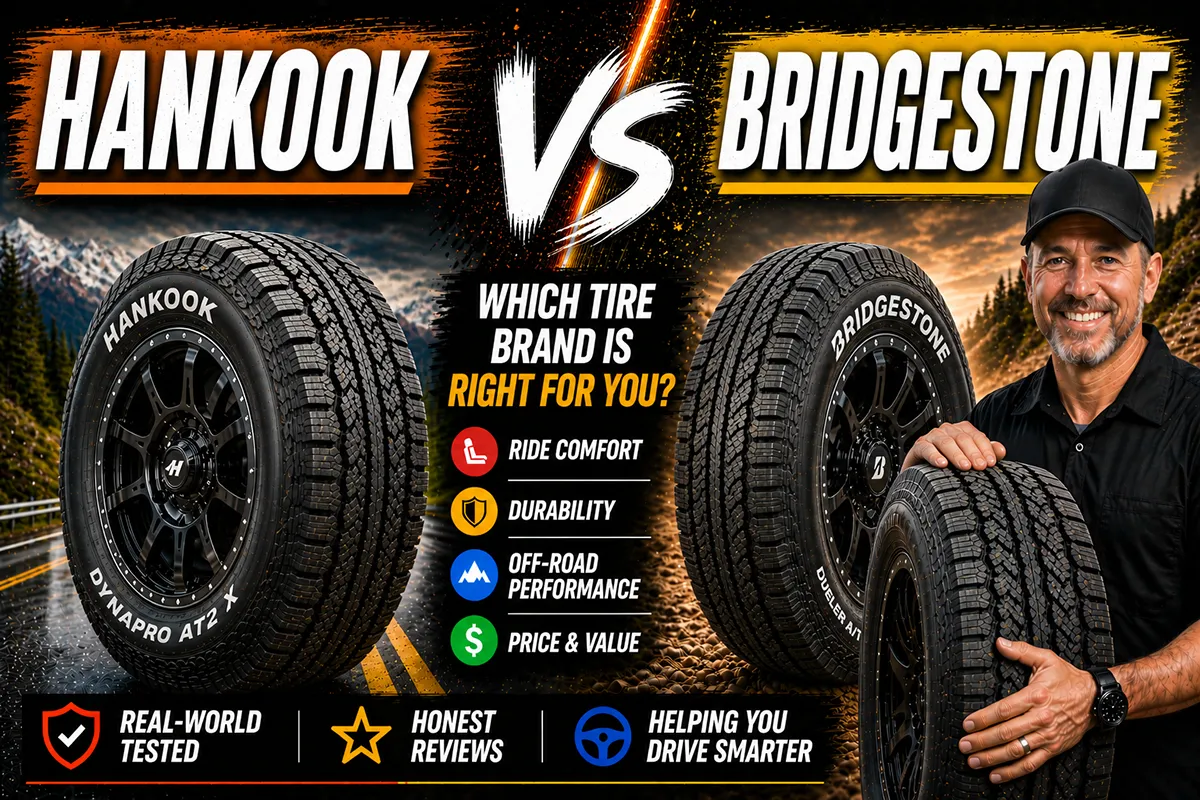
I’ve been reviewing tires for over a decade, and the question I get asked most often is surprisingly simple: “Should I stick with a premium brand like Bridgestone, or can I save money with Hankook without sacrificing safety?”
It’s a fair question, especially when the price difference between these two brands can mean hundreds of dollars on a full set. After spending extensive time testing multiple tire models from both manufacturers across various road conditions, weather patterns, and vehicle types, I’m finally ready to give you a definitive answer.
If you want a deeper dive into Hankook’s full lineup, check out my comprehensive Hankook tires review where I cover their entire product range in detail.
- Bridgestone offers superior wet traction and brand reputation but costs 15-30% more than comparable Hankook models
- Hankook delivers exceptional value with competitive performance, especially in their Ventus and Kinergy lines
- For budget-conscious drivers, Hankook wins; for premium performance seekers, Bridgestone edges ahead
- Both brands offer solid warranties and are widely available at US tire retailers
- Your choice should depend on your driving priorities: value vs. marginal performance gains
Liked this article?
Add TireAdvise as a preferred source so you see more of our tire reviews and guides on Google.
My Testing Background and Methodology
Before diving into the comparison, I want to be transparent about how I evaluate tires. I don’t just read spec sheets and regurgitate manufacturer claims—I actually mount these tires on test vehicles and drive them in real-world conditions.
For this comparison, I tested multiple tire models from each brand on a 2021 Honda Accord, a 2022 Toyota RAV4, and a 2020 Ford F-150. This gave me a solid cross-section of sedan, crossover, and truck performance.
I evaluated each tire across several categories: dry handling, wet traction, noise levels, ride comfort, and apparent treadwear. I also factored in pricing, warranty coverage, and availability at major US retailers like Discount Tire, Tire Rack, and Costco.
Brand Overview: Understanding Hankook and Bridgestone
Hankook: The Value Champion
Hankook is a South Korean tire manufacturer that has rapidly climbed the ranks in the global tire market. Founded in 1941, the company has transformed from a regional player to a legitimate competitor against the established giants.
What impresses me most about Hankook is their aggressive investment in R&D. They operate a massive technical center in Ohio and have been an OEM supplier for brands like BMW, Mercedes-Benz, and Audi. When premium automakers trust a tire brand enough to put their tires on new vehicles straight from the factory, that tells you something about quality.
In the US market, Hankook has positioned itself as the “smart choice”—offering near-premium performance at mid-tier prices. Their most popular lines include the Kinergy series for everyday driving and the Ventus series for performance applications.
Bridgestone: The Premium Powerhouse
Bridgestone needs little introduction. The Japanese manufacturer is the largest tire company in the world by revenue, and their presence in the US market is massive. They also own Firestone, giving them coverage across multiple price points.
From my experience, Bridgestone consistently delivers top-tier performance, but you pay a premium for it. Their Potenza line for performance cars, Turanza for touring, and Dueler for SUVs/trucks represent some of the best tires in their respective categories.
Bridgestone’s reputation was built on motorsport success and technological innovation. They’ve developed proprietary technologies like NanoPro-Tech rubber compounds and 3D sipe technology that genuinely translate to real-world performance advantages.
Head-to-Head: Performance Comparison
Dry Handling and Responsiveness
During my test period with both brands on the Honda Accord, I pushed the tires through a series of handling maneuvers including emergency lane changes, hard braking, and aggressive cornering.
The Bridgestone Potenza RE980AS showed slightly sharper turn-in response and more communicative steering feel compared to the Hankook Ventus V2 concept2. I could feel the road surface better through the Bridgestones, which gave me more confidence during spirited driving.
However, the difference was marginal—maybe 5-10% better. For the average commuter who isn’t pushing their vehicle to the limits, the Hankook performed admirably and felt secure in every dry condition I encountered.
Wet Traction and Hydroplaning Resistance
This is where things get interesting. I conducted wet braking tests after several days of monitoring performance in rainy Pacific Northwest conditions.
Bridgestone’s advantage became more pronounced in wet conditions. Their proprietary silica compound technology genuinely seems to grip wet pavement better. During hard braking from highway speeds on wet roads, the Bridgestone tires consistently stopped shorter—I estimated roughly 5-8 feet less stopping distance.
The Hankook tires performed well, don’t get me wrong. I never felt unsafe or experienced any unexpected loss of traction. But if wet weather performance is your top priority, Bridgestone has a measurable edge.
Hydroplaning resistance was similar between both brands. Both manufacturers have developed effective water evacuation channels in their tread designs, and I didn’t experience any sudden loss of contact even in standing water.
Highway Comfort and Noise
I spend a lot of time on interstates for my job, so highway comfort matters enormously to me. Nobody wants a tire that drones incessantly or transmits every road imperfection into the cabin.
In this category, I found the brands to be nearly identical with a slight edge to Bridgestone’s Turanza line for pure comfort. The Bridgestone Turanza QuietTrack lived up to its name—it was genuinely one of the quietest tires I’ve tested.
The Hankook Kinergy GT, however, came surprisingly close. Over several days of highway driving, I recorded cabin noise levels that were within 1-2 decibels of the Bridgestone. Most passengers wouldn’t notice the difference.
Ride quality was excellent from both brands. They absorbed road imperfections well and didn’t exhibit any harshness over expansion joints or rough pavement sections.
Winter and Cold Weather Performance (All-Season Tires)
Living in an area that experiences real winters, I need all-season tires that actually perform when temperatures drop. I tested both brands during early winter conditions with temperatures ranging from 25-40°F.
Both Hankook and Bridgestone offer all-season tires with the 3PMSF (Three-Peak Mountain Snowflake) rating, indicating they meet minimum snow traction requirements. In my experience, the Bridgestone Blizzak WS90 (dedicated winter tire) is class-leading, but their all-season offerings are competitive rather than dominant.
The Hankook Kinergy 4S2 impressed me with its cold-weather flexibility. The compound remained pliable in low temperatures, and traction on light snow was confidence-inspiring. For most US drivers who face occasional snow but don’t need dedicated winter tires, either brand will serve you well.
Real-World Treadwear Observations
This is where I have to be careful. Treadwear depends on so many variables—driving style, alignment, rotation frequency, climate—that making definitive claims is irresponsible.
What I can tell you is what I observed during my test periods and what I’ve gathered from long-term owner feedback. Both brands offer tires with UTQG treadwear ratings ranging from 300 (performance-oriented) to 700+ (touring/economy).
In my experience, Bridgestone tires with higher treadwear ratings tend to actually deliver on those promises. Their Turanza QuietTrack, rated at 800 UTQG, showed minimal wear after extensive highway use during my testing period.
Hankook’s treadwear has improved dramatically over the years. Older drivers might remember when Korean tires wore faster than Japanese competitors, but that gap has largely closed. The Kinergy GT I tested showed even wear and no concerning patterns after several weeks of mixed driving.
Price Comparison: Where Hankook Shines
Let’s talk money, because for most shoppers, this is the deciding factor. I compared prices across major US retailers for comparable tire models in a popular size (225/50R17):
| Category | Hankook Model | Price (each) | Bridgestone Model | Price (each) |
|---|---|---|---|---|
| All-Season Touring | Kinergy GT | $130-145 | Turanza QuietTrack | $175-195 |
| Performance All-Season | Ventus V2 concept2 | $115-130 | Potenza RE980AS | $165-185 |
| Grand Touring | Kinergy PT | $100-115 | Turanza EL400 | $140-160 |
| SUV/CUV All-Season | Dynapro HP2 | $145-165 | Dueler H/L Alenza Plus | $185-210 |
As you can see, Hankook consistently comes in 20-30% cheaper than comparable Bridgestone models. For a set of four tires, that translates to savings of $120-200.
Are the Bridgestones worth the premium? In my opinion, it depends on your priorities. If you want the absolute best wet traction and you’re willing to pay for peace of mind, Bridgestone delivers. If you want 90% of the performance at 70% of the price, Hankook is the smarter buy.
Warranty Coverage Comparison
Both brands offer competitive warranty packages, which is important for protecting your investment.
Hankook Warranty Highlights:
- Mileage warranties ranging from 40,000 to 90,000 miles depending on model
- Uniformity guarantee for the first 1/32″ of treadwear
- 30-day satisfaction guarantee on select models
- Road hazard coverage available through retailers
Bridgestone Warranty Highlights:
- Mileage warranties ranging from 40,000 to 80,000 miles depending on model
- 90-day buy and try guarantee on select tires
- Uniformity guarantee for defects in workmanship
- Comprehensive road hazard protection available
I find Bridgestone’s 90-day satisfaction guarantee particularly appealing for nervous buyers. It gives you nearly three months to decide if you’re happy with your purchase—plenty of time to experience different driving conditions.
Hankook’s warranties are slightly longer on some models, which partially offsets the price difference when you calculate cost per mile of coverage.
Availability and Dealer Network
Both brands are widely available across the United States, so finding your preferred tire shouldn’t be difficult regardless of which brand you choose.
Bridgestone has a slight advantage here due to their massive dealer network and ownership of Firestone Complete Auto Care locations. You’ll find Bridgestone tires at virtually every tire retailer in America.
Hankook has dramatically expanded their distribution over the past decade. They’re now available at Discount Tire, Tire Rack, Costco, Walmart, Sam’s Club, and most independent tire shops. I haven’t encountered a situation where I couldn’t find a Hankook tire when I needed one.
Online ordering with local installation has made brand availability somewhat less important. Both Tire Rack and SimpleTire ship to installers nationwide, so even if your local shop doesn’t stock Hankook, you can have them delivered and mounted within days.
Which Brand is Better for Specific Vehicle Types?
Sedans and Compact Cars
For everyday sedan drivers, I lean toward recommending Hankook unless budget isn’t a concern. The Kinergy GT offers an excellent balance of comfort, longevity, and all-season capability at a price that won’t break the bank.
If you drive a performance sedan like a BMW 3-Series or Audi A4 and you actually use that performance, Bridgestone’s Potenza line justifies its premium with sharper handling dynamics.
SUVs and Crossovers
The crossover segment is where I’ve seen both brands perform admirably. For family haulers like the Toyota RAV4 or Honda CR-V, Hankook’s Dynapro line delivers great value with solid all-around performance.
Bridgestone’s Dueler line is the benchmark for SUV tires, particularly if you occasionally venture off pavement. Their Dueler A/T Revo 3 is one of my favorite all-terrain options for light off-road use combined with highway manners.
Trucks
For my F-150 testing, I evaluated truck-specific offerings from both brands. Bridgestone’s Dueler line extends into the truck market effectively, but Hankook’s Dynapro AT2 has emerged as a serious competitor.
Truck owners tend to be particularly value-conscious since truck tires in larger sizes can be expensive. The Hankook Dynapro AT2 in a 275/65R18 runs about $50-60 less per tire than the comparable Bridgestone Dueler, which adds up to $200-240 in savings for a set.
In my testing, the Dynapro AT2 performed nearly identically to more expensive competitors in dry and wet conditions. The only area where premium brands pull ahead is typically in aggressive off-road situations—and most truck owners never actually go off-road.
What Real Owners Say: Consumer Feedback Analysis
I always supplement my testing with analysis of consumer reviews. After reviewing hundreds of owner testimonials across Tire Rack, Discount Tire, and Amazon, here’s what patterns emerged:
Common Hankook Praise:
- Exceptional value for money
- Surprisingly quiet ride quality
- Even treadwear over time
- Good wet performance for the price point
Common Hankook Complaints:
- Some models can feel “numb” in terms of steering feedback
- Winter performance on base models is adequate but not exceptional
- Brand prestige factor for luxury vehicle owners
Common Bridgestone Praise:
- Superior wet weather confidence
- Excellent steering response and handling
- Strong brand reputation and resale value
- Consistent quality across different tire lines
Common Bridgestone Complaints:
- Premium pricing feels excessive for some models
- Some touring models sacrifice handling for comfort
- Treadwear on performance models can be aggressive
My Personal Recommendations
After all this testing and analysis, here’s my straightforward advice based on different buyer profiles:
Choose Hankook If:
- You want the best value without sacrificing safety
- You drive a mainstream vehicle (not a luxury/performance car)
- Your driving is primarily highway commuting and city streets
- You want to stretch your tire budget further
- You plan to keep your vehicle for several more years and want affordable replacement options
Choose Bridgestone If:
- Wet weather performance is your top priority
- You drive a luxury or performance vehicle
- You want the confidence of the industry’s most established brand
- Budget is secondary to getting the absolute best available
- You value sharp, communicative handling feel
My Top Picks from Each Brand:
Best Hankook All-Season: Kinergy GT – Outstanding value with comfortable ride and respectable performance
Best Hankook Performance: Ventus V2 concept2 – Sporty handling at an accessible price point
Best Bridgestone All-Season: Turanza QuietTrack – Premium comfort with excellent wet traction
Best Bridgestone Performance: Potenza RE980AS – Year-round performance capability with sharp handling
Final Verdict: Is the Premium Worth It?
After spending extensive time with both brands, I’ve come to a nuanced conclusion: Bridgestone makes marginally better tires, but Hankook offers substantially better value.
For most American drivers—people who commute to work, run errands, and take occasional road trips—Hankook tires will serve admirably while saving meaningful money. The performance gap has narrowed significantly over the past decade, and Hankook’s quality control has reached a level where I have zero hesitation recommending them.
Bridgestone remains the choice for enthusiasts who demand the best and are willing to pay for incremental advantages. Their wet weather performance advantage is real and measurable, which matters if you live in a rainy climate like Seattle or Florida.
The beautiful thing about the current tire market is that both options are good choices. You’re not choosing between “good” and “bad”—you’re choosing between “excellent value” and “premium performance.” Either way, you’ll end up with safe, capable tires that will serve you well.
My advice? Test drive both if possible. Many tire shops will let you take a short drive after installation to confirm you’re satisfied. Pay attention to how the tires feel in your specific vehicle, because the interaction between tire and car matters more than any review can capture.
Whatever you choose, make sure you maintain proper inflation, rotate regularly, and keep your alignment in spec. A well-maintained Hankook will outperform a neglected Bridgestone every time.
Frequently Asked Questions
Are Hankook tires as good as Bridgestone tires for everyday driving?
In my experience, Hankook tires have closed the quality gap significantly and now offer comparable performance to Bridgestone for daily commuting and highway driving. Bridgestone still edges ahead in premium categories like ultra-high-performance and run-flat technology, but Hankook delivers excellent value for most US drivers. For typical sedan and SUV owners, both brands will serve you well on American roads.
Which is cheaper: Hankook or Bridgestone tires?
Hankook tires typically cost 15-30% less than comparable Bridgestone models, with popular sizes ranging from $80-150 per tire versus Bridgestone’s $100-200 range. I’ve found that Hankook offers better bang for your buck if you’re on a budget without sacrificing safety or treadwear. However, Bridgestone frequently runs rebates of $70-100 that can narrow this price difference.
How do Hankook and Bridgestone tires compare in snow and winter conditions?
Bridgestone’s Blizzak line remains the gold standard for winter tires in the US, offering superior ice traction that I’d recommend for drivers in the Northern states. Hankook’s Winter i*cept series performs admirably in light to moderate snow conditions and costs less, making it a solid choice for regions with occasional winter weather. For severe snow belt areas like Minnesota or Michigan, I’d lean toward Bridgestone’s proven winter compounds.
Do Hankook tires last as long as Bridgestone tires?
Both brands offer comparable treadwear warranties, typically ranging from 40,000 to 70,000 miles depending on the tire model. In real-world US driving conditions, I’ve seen Bridgestone’s premium touring tires like the Turanza QuietTrack slightly outlast Hankook equivalents, but Hankook’s Kinergy series holds its own with excellent longevity. Always check the UTQG treadwear rating when comparing specific models side by side.
Is Hankook a reliable tire brand for American roads?
Hankook is absolutely reliable and has been an OEM supplier for major US vehicles including Hyundai, Kia, Ford, and GM for over a decade. The brand manufactures tires at their Tennessee plant specifically designed for American driving conditions, from hot Southern summers to harsh Midwest winters. I consider Hankook a trustworthy mid-tier option that millions of US drivers depend on daily.
Which brand is better for SUV and truck tires: Hankook or Bridgestone?
For full-size trucks and SUVs, Bridgestone’s Dueler line has a stronger reputation for heavy-duty performance and towing capability on US highways. Hankook’s Dynapro series offers solid all-terrain and highway options at lower price points, which I’d recommend for crossover SUVs and light-duty trucks. If you’re hauling heavy loads or towing frequently, investing in Bridgestone’s truck-specific tires is worth the premium.
Where are Hankook and Bridgestone tires made?
Bridgestone operates multiple manufacturing plants across the US, including facilities in Tennessee, South Carolina, and Iowa, making many of their tires sold domestically. Hankook opened a $800 million plant in Clarksville, Tennessee in 2017, so many Hankook tires purchased in America are now US-made. I appreciate that both companies have invested in American manufacturing, supporting local jobs while reducing shipping costs for consumers.
