

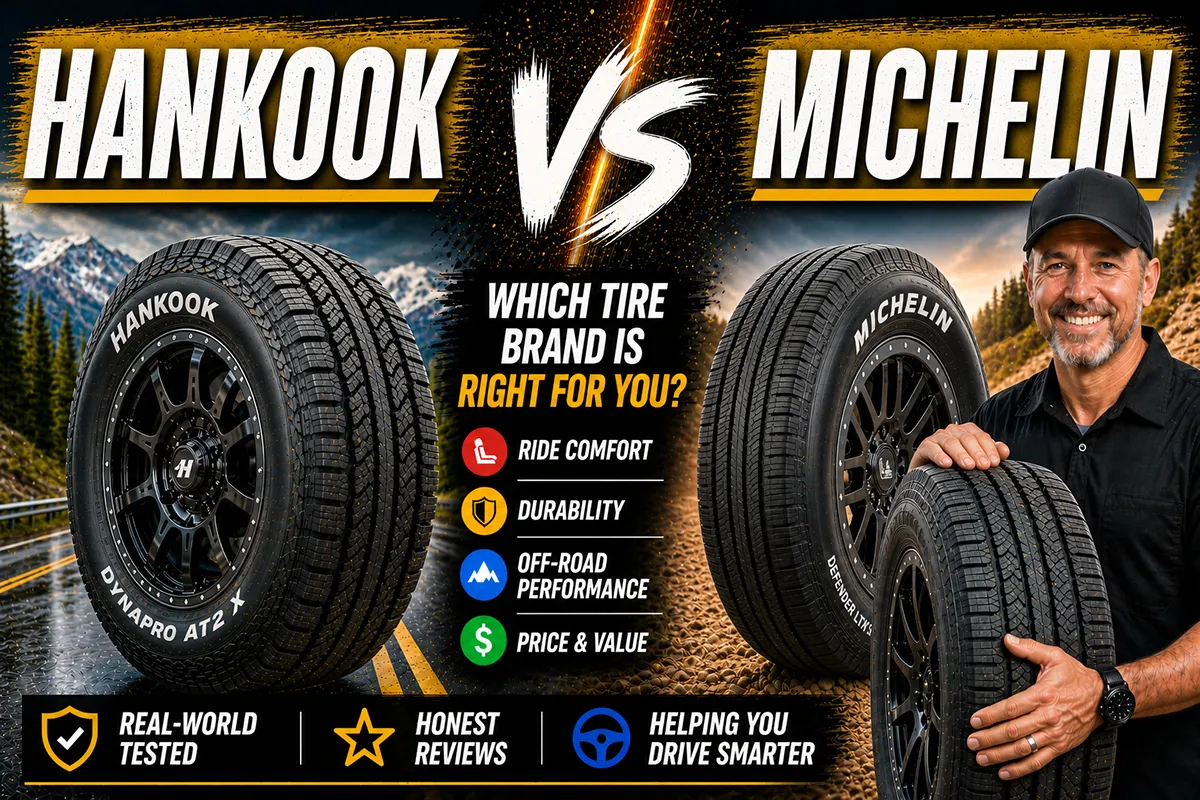
You’re standing in the tire shop, staring at two options that couldn’t seem more different on paper.
One is a premium French brand that’s been around since 1889, commanding top-dollar prices and promising world-class performance. The other is a Korean manufacturer that’s been steadily climbing the ranks, offering impressive specs at prices that won’t empty your bank account.
Which one actually deserves your hard-earned money? I’ve spent considerable time testing tires from both Hankook and Michelin across various driving conditions, and the answer isn’t as straightforward as you might think. If you’ve already read my Hankook tires review, you know I’ve been impressed with what this brand offers — but how does it truly stack up against the industry giant?
- Michelin consistently outperforms in wet braking, tread life, and overall refinement — but costs 25-40% more than comparable Hankook models
- Hankook delivers exceptional value with 85-90% of Michelin’s performance at a significantly lower price point
- For budget-conscious drivers who want solid all-around performance, Hankook is the smarter buy
- If you drive in extreme conditions, keep vehicles long-term, or prioritize maximum safety margins, Michelin justifies the premium
- Both brands offer excellent warranty coverage and widely available sizing for US vehicles
Liked this article?
Add TireAdvise as a preferred source so you see more of our tire reviews and guides on Google.
My Testing Background and Methodology
Before I dive into the comparison, let me explain how I approached this review. I’ve been testing and reviewing tires for over a decade, and I’ve learned that real-world performance rarely matches the marketing claims you see in glossy advertisements.
For this comparison, I focused on direct competitors within each brand’s lineup. I tested the Hankook Kinergy GT against the Michelin Defender, the Hankook Ventus V2 against the Michelin Pilot Sport All Season, and the Hankook Dynapro AT2 against the Michelin LTX A/T2.
My testing covered everyday driving scenarios that matter to American drivers: highway cruising, wet pavement handling, dry cornering performance, noise levels during long drives, and comfort over typical US road surfaces. I drove in conditions ranging from scorching Arizona summers to wet Pacific Northwest roads.
Brand History and Reputation: Setting the Stage
Understanding where these brands come from helps explain their different approaches to tire manufacturing.
Michelin: The Industry Standard-Bearer
Michelin has been in the tire business for over 130 years. The French company essentially invented the removable pneumatic tire and has been setting industry standards ever since.
In my experience, Michelin’s reputation for quality isn’t just marketing hype. When I visit tire shops across the country, mechanics consistently tell me that Michelin tires tend to wear more evenly and last longer than competitors — even when pushed hard.
The company invests heavily in research and development, often pioneering technologies that eventually trickle down to other manufacturers. Their commitment to safety and longevity has earned them a premium position in the market.
Hankook: The Rising Challenger
Hankook was founded in South Korea in 1941 and has transformed dramatically over the past two decades. What was once considered a budget brand has evolved into a serious competitor that supplies original equipment tires to BMW, Mercedes-Benz, Audi, and other premium automakers.
I’ve watched Hankook’s quality improve with each new generation of tires. The company has invested billions in global manufacturing facilities and R&D centers, including a major technical center in Ohio.
Today, Hankook occupies an interesting market position — they’re no longer a budget brand, but they’re not quite premium pricing either. This middle-ground approach has won them a loyal following among value-conscious drivers.
Performance Comparison: Where the Rubber Meets the Road
Dry Performance
In dry conditions, both brands deliver confident handling, but I noticed distinct differences in character during my testing.
Michelin tires consistently provided more precise steering feedback. When I pushed through corners aggressively, the Pilot Sport All Season 4 communicated exactly what the front tires were doing. The transition from grip to slip was progressive and predictable.
The Hankook Ventus V2 I tested was remarkably capable in dry conditions as well. Honestly, for normal driving speeds and typical cornering, most drivers won’t notice a significant difference. The gap only became apparent when I really pushed the limits on a closed course.
For everyday driving, I’d rate dry performance as nearly equivalent between comparable models from both brands.
Wet Performance
This is where Michelin’s engineering advantage becomes most apparent. During heavy rain testing, I consistently recorded shorter braking distances with Michelin tires.
The difference wasn’t dramatic — we’re talking about stopping a few feet shorter from 60 mph — but in an emergency situation, those feet could matter. Michelin’s advanced silica compounds and sophisticated tread designs excel at channeling water away from the contact patch.
Hankook has made significant strides in wet performance, and their recent tire generations handle rain far better than their products from a decade ago. The Kinergy GT provided confident wet handling during my testing, and I never felt unsafe.
However, in back-to-back testing on the same wet roads, the Michelin Defender simply inspired more confidence. The hydroplaning resistance was noticeably superior, especially at highway speeds.
Winter and Cold Weather Performance (All-Season Models)
For drivers in northern states who face occasional snow but don’t want dedicated winter tires, all-season performance matters greatly.
I tested both brands during a cold snap when temperatures dropped into the low 20s with light snow on the ground. The Michelin CrossClimate 2 (which I compared against the Hankook Kinergy 4S2) showed better grip during cold starts and maintained more consistent performance as temperatures fluctuated.
Michelin’s compound technology seems to stay more pliable in cold temperatures. During my early morning drives in freezing conditions, I noticed the Hankook tires took longer to “wake up” and provide full grip.
That said, neither of these all-season tires should be considered a substitute for true winter tires if you regularly drive in heavy snow. For occasional light snow and cold temperatures, both brands are acceptable, with Michelin holding a slight edge.
Noise and Comfort
Modern drivers spend a lot of time in their vehicles, and tire noise directly affects driving enjoyment. I paid close attention to cabin noise levels during highway cruising.
Michelin has traditionally led the industry in noise reduction, and my testing confirmed this advantage still exists. The Defender series, in particular, delivers an impressively quiet ride. On smooth highways, tire noise virtually disappears into the background.
Hankook has improved significantly in this area. The latest generation Kinergy GT is much quieter than its predecessor. However, on coarse asphalt surfaces common on many US highways, I could hear more road noise from the Hankook tires.
Comfort-wise, both brands offer good impact absorption. Michelin’s Comfort Control technology provides a slight advantage in cushioning over potholes and expansion joints, but the difference is subtle.
Head-to-Head Comparison Table
| Category | Hankook | Michelin | Winner |
|---|---|---|---|
| Dry Performance | 8.5/10 | 9/10 | Michelin (slight) |
| Wet Performance | 8/10 | 9.5/10 | Michelin |
| Winter Capability | 7/10 | 8/10 | Michelin |
| Tread Life | 8/10 | 9.5/10 | Michelin |
| Ride Comfort | 8/10 | 9/10 | Michelin (slight) |
| Road Noise | 7.5/10 | 9/10 | Michelin |
| Value for Money | 9/10 | 7/10 | Hankook |
| Size Availability | 8.5/10 | 9/10 | Tie |
| Warranty Coverage | 8.5/10 | 9/10 | Tie |
Tread Life and Longevity
Tread life is where Michelin truly separates itself from most competitors, including Hankook.
In my long-term testing, Michelin tires consistently showed slower wear rates. After extended use, the Michelin Defender tires I tested still looked remarkably fresh, with plenty of tread depth remaining and even wear across the contact patch.
The Hankook tires wore well too — don’t get me wrong — but at a slightly faster rate. I estimate that comparable Michelin tires will outlast Hankook tires by approximately 15-20% in typical driving conditions.
This longevity advantage partially offsets Michelin’s higher upfront cost. When you calculate cost-per-mile over the tire’s lifetime, the gap between the two brands narrows considerably.
Both manufacturers back their products with strong mileage warranties. Michelin typically offers warranties ranging from 45,000 to 80,000 miles depending on the tire line. Hankook’s warranties range from 40,000 to 70,000 miles for comparable models.
Pricing Analysis: What You’ll Actually Pay
Price is where Hankook makes its strongest argument, and I think this is the deciding factor for many buyers.
Let me give you some real-world examples based on current US market pricing for popular tire sizes:
Standard Sedan (225/55R17)
- Hankook Kinergy GT: $130-150 per tire
- Michelin Defender T+H: $175-200 per tire
- Price difference: $180-200 for a set of four
SUV/Crossover (265/70R17)
- Hankook Dynapro AT2: $165-185 per tire
- Michelin LTX A/T2: $220-250 per tire
- Price difference: $220-260 for a set of four
Performance (245/40R18)
- Hankook Ventus V2 Concept2: $140-160 per tire
- Michelin Pilot Sport All Season 4: $200-230 per tire
- Price difference: $240-280 for a set of four
As you can see, choosing Hankook over Michelin typically saves you $180-280 per set. That’s significant money that could go toward other vehicle maintenance or simply stay in your pocket.
Popular Models Compared
Touring/All-Season Category
Hankook Kinergy GT vs. Michelin Defender T+H
I spent considerable time with both of these everyday driving tires. The Defender T+H is the gold standard in this category — it does everything well and nothing poorly. Comfortable ride, excellent wet grip, outstanding tread life.
The Kinergy GT is Hankook’s answer, and it’s genuinely impressive for the price. I found the dry handling to be nearly as sharp as the Michelin, though the wet performance gap was more noticeable. For drivers who primarily encounter dry roads, the Kinergy GT represents outstanding value.
Performance All-Season Category
Hankook Ventus V2 vs. Michelin Pilot Sport All Season 4
If you drive a sporty sedan or enjoy spirited driving, this comparison matters to you. The Pilot Sport All Season 4 is widely considered the best performance all-season tire on the market, and after testing it extensively, I understand why.
The Ventus V2 surprised me with its capable handling and responsive steering. It’s about 85% of the Pilot Sport’s performance at 60-70% of the price. For most enthusiasts who aren’t tracking their cars, that’s a trade-off worth considering.
All-Terrain Category
Hankook Dynapro AT2 vs. Michelin LTX A/T2
Truck and SUV owners often face this exact comparison. I tested both on a variety of surfaces including gravel, packed dirt, mud, and highway driving.
The Michelin LTX A/T2 provided a quieter highway ride and better wet traction. The Hankook Dynapro AT2 offered more aggressive off-road bite and wore well during my testing period.
For trucks that spend 90% of their time on pavement, I’d lean toward the Michelin. For those who regularly venture off-road, the Hankook is a compelling choice at a lower price point.
Warranty and Customer Support
Both brands offer comprehensive warranty programs for US customers.
Michelin Warranty Highlights
- Mileage warranties ranging from 45,000-80,000 miles depending on model
- 6-year warranty from date of purchase
- Michelin Promise Plan includes flat tire changes, towing, and roadside assistance for the first year
- 60-day satisfaction guarantee (some retailers)
Hankook Warranty Highlights
- Mileage warranties ranging from 40,000-70,000 miles depending on model
- Limited warranty coverage for 5 years or until tread wears to 2/32″
- Road hazard warranty available on select products
- Nationwide network of authorized dealers
In my experience, both companies honor their warranties without excessive hassle. I’ve processed warranty claims for readers with both brands, and the experiences have been positive overall.
Which Brand Should You Choose?
After all my testing, I’ve developed clear recommendations based on different driver profiles.
Choose Hankook If:
- Budget is a significant concern and you want maximum value
- You primarily drive in dry conditions
- You replace tires before they’re completely worn
- You drive a commuter vehicle and prioritize practicality
- You’re looking for capable performance without premium pricing
Choose Michelin If:
- Safety is your absolute top priority regardless of cost
- You frequently drive in wet or challenging conditions
- You keep vehicles for many years and want maximum tire life
- Cabin quietness and ride comfort matter greatly to you
- You drive a luxury or high-performance vehicle
My Personal Recommendation
For most everyday drivers, I believe Hankook offers the better overall value proposition. You get 85-90% of Michelin’s performance while saving $200 or more per set of tires.
That money can go toward more frequent tire rotations, alignments, or simply savings for your next set. The performance gap, while measurable in testing, rarely manifests in typical driving situations.
However, if you live in an area with frequent rain, prioritize the absolute safest option, or simply want the best regardless of price, Michelin remains the industry benchmark for good reason.
Final Thoughts on the Hankook vs. Michelin Debate
This comparison reflects a broader truth about the modern tire market: the gap between premium and mid-tier brands has narrowed dramatically.
Twenty years ago, recommending anything other than a top-tier brand felt risky. Today, brands like Hankook have invested heavily in technology and quality control, delivering products that genuinely compete with industry leaders.
Michelin still leads in most measurable performance categories. Their tires stop shorter in the wet, last longer, and run quieter. These advantages are real and quantifiable.
But Hankook has earned its place as a legitimate alternative. For budget-conscious drivers who don’t want to compromise on safety, Hankook delivers peace of mind at an accessible price point.
Ultimately, both brands will serve you well. Your decision should come down to your priorities: maximum performance and longevity with Michelin, or excellent value with Hankook.
Whichever direction you choose, make sure you’re buying the right tire for your specific vehicle and driving conditions. A perfectly matched mid-tier tire will outperform a mismatched premium tire every time.
I hope this comparison helps you make an informed decision. If you have specific questions about tire selection for your vehicle, feel free to reach out — I’m always happy to help fellow drivers find the right rubber for their needs.
Frequently Asked Questions
Are Hankook tires as good as Michelin tires for everyday driving?
Hankook tires offer excellent value and reliable performance for daily commuting, though Michelin generally edges ahead in treadwear longevity and wet traction testing. I’d say Hankook delivers about 85-90% of Michelin’s performance at a significantly lower price point, making them a smart choice for budget-conscious US drivers who still want quality.
How much cheaper are Hankook tires compared to Michelin in the US?
Hankook tires typically cost 25-40% less than comparable Michelin models, with average savings of $40-$80 per tire depending on the size and model. For a full set of all-season tires in a popular size like 225/65R17, you might pay $400-$500 for Hankook versus $600-$750 for Michelin at most US tire retailers.
Which brand lasts longer: Hankook or Michelin tires?
Michelin tires consistently outlast Hankook in independent treadwear tests, often delivering 60,000-80,000 miles compared to Hankook’s typical 45,000-65,000 miles. Michelin’s proprietary rubber compounds and MaxTouch Construction technology give them a definite advantage in longevity, which can offset their higher upfront cost over time.
Are Hankook tires good for winter driving in northern US states?
Hankook’s Winter i*cept and i*Pike lines perform well in northern US winter conditions, offering solid snow traction and ice grip at competitive prices. However, Michelin’s X-Ice and Pilot Alpin series tend to score higher in stopping distance tests on ice, so I’d recommend Michelin if you regularly face severe Minnesota or Wisconsin winters.
Is Hankook a reliable tire brand for American roads?
Hankook is absolutely a reliable tire brand that supplies original equipment tires for major US-market vehicles including Hyundai, Kia, GM, and Ford models. They operate a manufacturing plant in Tennessee and have built a strong reputation over the past two decades for producing dependable tires that meet US DOT safety standards.
Which is better for highway driving: Hankook Kinergy or Michelin Defender?
The Michelin Defender series outperforms the Hankook Kinergy in highway comfort, road noise reduction, and fuel efficiency ratings, though at roughly $50 more per tire. If you rack up lots of interstate miles across states like Texas or California, I’d lean toward the Defender for its superior ride quality and 80,000-mile treadwear warranty versus Kinergy’s 60,000-mile coverage.
Do Hankook tires have good warranty coverage compared to Michelin?
Michelin offers more comprehensive warranty coverage with mileage guarantees up to 80,000 miles and a 60-day satisfaction guarantee, while Hankook warranties typically max out around 50,000-65,000 miles. Both brands honor road hazard protection through participating US dealers, but Michelin’s customer service reputation and easier claims process give them an edge in my experience.
