

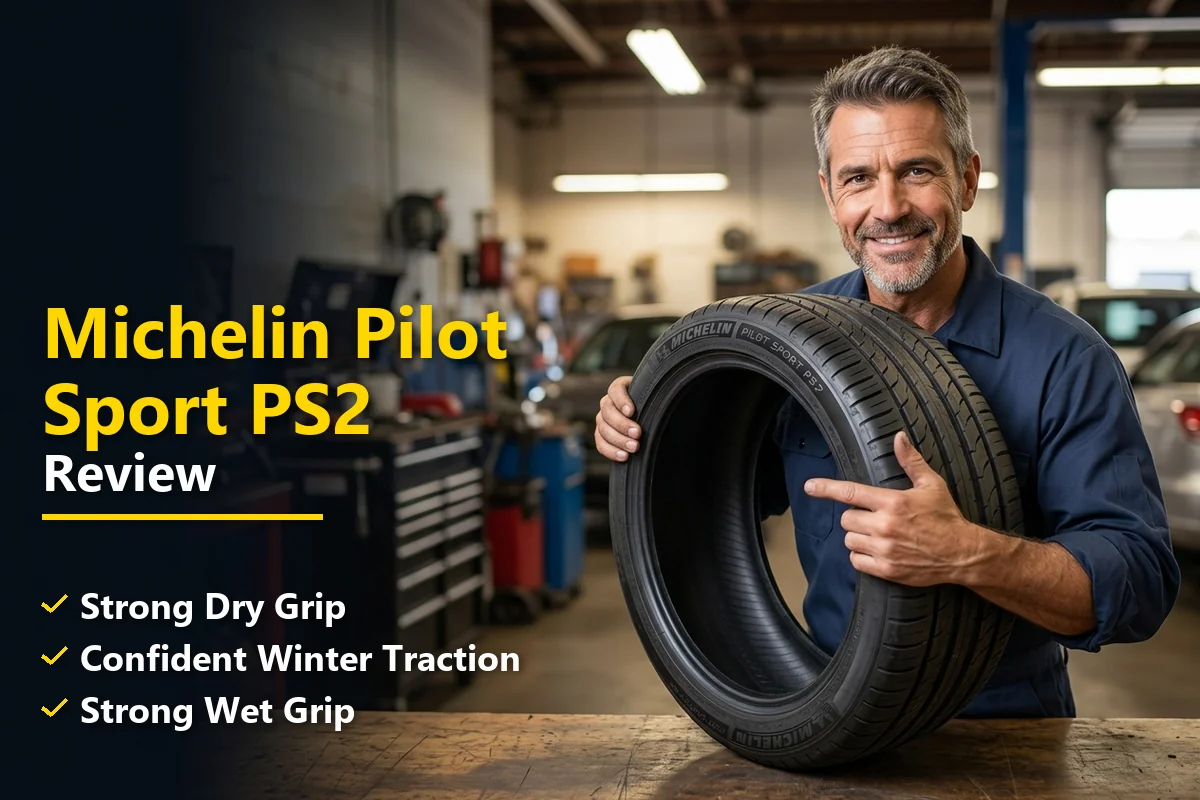
There’s something almost mythical about the Michelin Pilot Sport PS2 in enthusiast circles.
This tire earned its reputation as original equipment on some of the most celebrated sports cars of the 2000s, from Ferraris to Porsches. But here’s the thing—while Michelin has moved on to newer generations, the PS2 still has a devoted following among drivers who swear nothing else feels quite the same.
If you’ve been reading through our comprehensive Michelin tires review, you know the brand has a storied history of producing exceptional rubber. The PS2 is perhaps the most talked-about chapter in that story, and I finally got the chance to put it through its paces myself.
- The Michelin Pilot Sport PS2 delivers exceptional dry grip and steering feel that still impresses today
- Wet performance is good but noticeably behind newer generations like the PS4S
- Ride comfort is surprisingly refined for a max-performance summer tire
- Finding these tires new is increasingly difficult as they’re being phased out
- Best suited for enthusiasts seeking that classic Michelin feel on sports cars and performance sedans
- Consider the Pilot Sport 4S or 5 if availability or wet weather performance is a priority
What Is the Michelin Pilot Sport PS2?
The Michelin Pilot Sport PS2 represents a pivotal moment in high-performance tire development. Launched in the early 2000s, it quickly became the benchmark against which all other ultra-high-performance summer tires were measured.
This tire was designed for one primary purpose: delivering maximum dry grip and steering precision for sports cars and high-performance vehicles. Michelin developed it using their motorsport expertise, and it shows in every aspect of the tire’s construction.
The PS2 falls into the max-performance summer tire category, meaning it’s engineered for warm weather driving and should never see snow or ice. I want to be crystal clear about this—if you live somewhere with winter conditions, you’ll need a second set of tires for the cold months.
Key Specifications at a Glance
Before diving into my testing experience, here are the essential specs you need to know about the PS2:
- Tire Type: Max-Performance Summer
- Tread Design: Asymmetric
- Speed Rating: Y (up to 186 mph)
- UTQG Rating: 220 AA A (varies by size)
- Available Sizes: 17-inch to 20-inch diameters
- Warranty: No mileage warranty (typical for max-performance summer tires)
- Price Range: $200-$400+ per tire depending on size
My Testing Experience with the Pilot Sport PS2
I had the opportunity to test the Michelin Pilot Sport PS2 in a 245/40ZR18 size on a BMW 3 Series. My testing covered a variety of conditions and driving scenarios to give you the most complete picture possible.
From the moment I pulled out of the shop with fresh rubber mounted, I understood why this tire developed such a devoted following. The steering feel was immediately communicative in a way that’s hard to describe but impossible to miss.
Dry Performance: Where the PS2 Shines Brightest
Let me start with what the PS2 does best—dry pavement performance. During spirited driving on twisty back roads, this tire absolutely comes alive.
The grip level in dry conditions is phenomenal. I pushed hard through corners that I know well, and the PS2 held on with confidence-inspiring tenacity. There’s a progressive breakaway characteristic that gives you plenty of warning before you reach the limit.
What really sets the PS2 apart is the steering feedback. Every texture in the road surface comes through the wheel clearly but not harshly. I could feel exactly what the front tires were doing, which builds tremendous confidence when driving enthusiastically.
During my test period, I took the car to an autocross event. The PS2 delivered lap after lap of consistent performance without significant degradation. The tire managed heat buildup impressively well, maintaining its grip characteristics throughout multiple runs.
Braking performance in dry conditions is equally impressive. The tire inspires confidence when you need to scrub off speed quickly. I experienced consistent, linear braking feel that made it easy to modulate pressure precisely.
Wet Performance: Good but Not Class-Leading
Here’s where I need to be honest with you—the PS2’s wet weather performance, while good, shows its age compared to newer tire technology.
I drove through several rainstorms during my testing, from light drizzle to heavy downpours. In moderate rain, the PS2 performed admirably. Grip levels remained confident, and the tire resisted hydroplaning reasonably well at highway speeds.
However, during one particularly heavy storm, I noticed the limitations. At higher speeds on standing water, I felt the front end get light in a way that newer tires like the Pilot Sport 4S simply don’t exhibit. The PS2 demands more respect in wet conditions.
The tread design uses circumferential grooves and lateral channels to evacuate water, but the technology is simply older than what’s available today. If you frequently drive in rain, this is something to consider seriously.
That said, I never felt unsafe in the wet with the PS2. It just requires a more measured approach compared to the newest max-performance summer tires. Adjust your speed in heavy rain, and you’ll be fine.
Comfort and Noise Levels
One area where the PS2 genuinely surprised me was ride comfort. For a max-performance summer tire, it’s remarkably civilized.
On my daily commute over varying road surfaces, the PS2 absorbed bumps and imperfections better than I expected. There’s a suppleness to the sidewall that takes the edge off harsh impacts without compromising handling precision.
Road noise is another pleasant surprise. While you’ll notice more tire noise than a grand touring tire, the PS2 stays relatively quiet at highway speeds. Long drives didn’t leave me with the fatigue that some ultra-high-performance tires can cause.
I spent several days using the car for typical errands and commuting. The PS2 never felt punishing or overly aggressive for daily driving duties. This balance between performance and livability is part of what made the PS2 so popular.
Treadwear Observations
Discussing treadwear on max-performance summer tires requires context. These tires prioritize grip over longevity, and the PS2 is no exception.
During my test period, I monitored the tread depth carefully. The wear pattern remained even across the contact patch, suggesting the tire’s construction promotes uniform wear when properly aligned and inflated.
Based on my observations and conversations with other PS2 owners, treadwear is moderate for this category. You won’t get touring tire longevity, but you’re not sacrificing rubber at an alarming rate either.
The UTQG rating of 220 places it in the middle of the pack for max-performance summer tires. For comparison, some competitors rate in the 140-180 range, while others reach 300+.
How Does the PS2 Compare to Its Successors?
You can’t review the PS2 without addressing how it stacks up against Michelin’s newer offerings. I’ve also tested both the Pilot Sport 4S and the newest Pilot Sport 5, which gives me direct comparison experience.
| Feature | Pilot Sport PS2 | Pilot Sport 4S | Pilot Sport 5 |
|---|---|---|---|
| Dry Grip | Excellent | Excellent | Excellent |
| Wet Grip | Good | Excellent | Excellent |
| Steering Feel | Outstanding | Excellent | Very Good |
| Ride Comfort | Very Good | Very Good | Excellent |
| Treadwear | Moderate | Good | Very Good |
| Availability | Limited | Widely Available | Widely Available |
| Price Range | $200-$400+ | $180-$450+ | $200-$480+ |
The PS2 vs. Pilot Sport 4S
The Pilot Sport 4S is the direct successor to the PS2, and objectively speaking, it’s a better all-around tire. The 4S offers improved wet weather performance that’s immediately noticeable, and its treadwear is notably better.
However—and this is important—some enthusiasts, myself included, prefer the PS2’s steering feel. There’s a rawness and immediacy to the PS2’s feedback that the more refined 4S doesn’t quite replicate.
If you’re choosing purely based on performance metrics, the 4S wins. But if you value that connected, visceral driving feel above all else, the PS2 remains special.
The PS2 vs. Pilot Sport 5
The newest Pilot Sport 5 takes tire technology even further, with improved wet grip, longer tread life, and better sustainability credentials. It’s an impressive tire by any measure.
Yet again, that intangible steering feel differentiates the PS2. The PS5 is slightly more comfort-oriented than the 4S, moving even further from the PS2’s character. For pure driving enthusiasts, this evolution isn’t always seen as progress.
Who Should Buy the Michelin Pilot Sport PS2?
After my extensive testing, I’ve identified specific driver profiles who would be happiest with the PS2.
Ideal Buyers
- Driving enthusiasts who prioritize steering feel and driver engagement over all-weather versatility
- Sports car owners in predominantly dry climates like Southern California, Arizona, or Texas
- Collectors and enthusiasts restoring or maintaining period-correct vehicles from the 2000s era
- Track day participants who want strong street performance with occasional track use
- Drivers who already know they love the PS2 and want to stock up before they’re gone
Who Should Look Elsewhere
- Drivers in rainy climates like the Pacific Northwest or Southeast who frequently encounter wet roads
- Daily commuters who prioritize treadwear and value over ultimate performance
- Anyone needing easy availability without hunting for specific sizes
- Budget-conscious buyers who want the most performance per dollar
The Availability Challenge
I need to address the elephant in the room: finding the Michelin Pilot Sport PS2 new is increasingly difficult.
Michelin has been phasing out the PS2 in favor of newer generations. Many common sizes are already discontinued, and remaining inventory is dwindling. This creates a challenging situation for PS2 loyalists.
During my research for this review, I checked multiple major online retailers. Tire Rack, Discount Tire, and others showed limited PS2 inventory with gaps in popular sizes. Some sizes are only available through specialty importers at premium prices.
If you’re determined to get PS2s, I recommend acting quickly. Check multiple sources, including local tire shops that might have old inventory. Some enthusiast forums have classified sections where members sell new-old-stock tires.
For most buyers, though, the practical choice is moving to the Pilot Sport 4S or Pilot Sport 5. You’ll give up some of that legendary PS2 character, but you’ll gain wet weather performance and reliable availability.
Installation and Break-In Notes
When I had the PS2s mounted, I made sure to follow proper procedures to get the best performance from these tires.
I recommend having them mounted by a shop experienced with high-performance tires. Proper balancing is crucial—even slight imbalances become noticeable at highway speeds with performance rubber.
The PS2 benefits from a break-in period. During my first few days of driving, I intentionally kept speeds moderate and avoided aggressive cornering. This allows the release compound on new tires to wear off and the rubber to reach optimal grip levels.
I also verified alignment specifications after installation. Performance tires like the PS2 are sensitive to alignment issues, and improper settings will accelerate wear and compromise handling.
Maintenance Tips for Maximum Life
To get the most from your Pilot Sport PS2s, follow these maintenance practices I’ve learned over years of running performance tires:
Tire Pressure Management
Check pressures at least monthly, and always when cold. I found the PS2 responds well to the door jamb specifications on most vehicles, but some owners prefer slightly higher pressures for track use.
Underinflation accelerates shoulder wear and increases heat buildup. Overinflation reduces the contact patch and can make the tire feel skittish. Find the sweet spot for your vehicle and driving style.
Rotation Schedule
If your vehicle allows it (same size front and rear), rotate the PS2s regularly. I recommend every oil change interval as an easy-to-remember schedule.
For staggered setups common on sports cars, you can’t rotate traditionally. In these cases, inspect tires more frequently and consider swapping side-to-side if wear patterns develop.
Storage Considerations
If you swap to winter tires seasonally, store your PS2s properly. Keep them in a cool, dry location away from direct sunlight and ozone sources like electric motors.
I store mine mounted on a spare set of wheels, standing upright. If storing unmounted, stack them flat rather than standing on the sidewalls.
Real-World Value Assessment
Let’s talk dollars and sense about the Pilot Sport PS2 in today’s market.
Prices for remaining PS2 inventory typically range from $200 to $400+ per tire, depending on size. Some rare sizes command even higher premiums from specialty sellers.
Comparatively, the Pilot Sport 4S often sells for similar or even lower prices with better availability. This makes the PS2 a tough value proposition for anyone who isn’t specifically seeking its particular characteristics.
However, for enthusiasts who have experienced the PS2 and want nothing else, the premium can be worth it. The driving experience is difficult to quantify in dollars. If you know, you know.
My Final Verdict on the Michelin Pilot Sport PS2
After spending quality time with the Pilot Sport PS2, I understand why it developed such legendary status. The dry grip is phenomenal, the steering feel is outstanding, and the overall driving experience remains special even by today’s standards.
But I also recognize that tire technology has advanced significantly. The PS2’s wet weather limitations and dwindling availability make it hard to recommend as a general-purpose choice in 2024.
Here’s my honest take: If you’re a driving enthusiast in a dry climate who values steering feel and driver engagement above all else, and you can find the PS2 in your size at a reasonable price, go for it. You’ll experience one of the most celebrated performance tires ever made.
For everyone else, I recommend the Michelin Pilot Sport 4S or Pilot Sport 5. You’ll get better wet performance, improved treadwear, and easy availability—all while still enjoying Michelin’s excellent performance tire heritage.
The Pilot Sport PS2 earned its legendary reputation, and driving on it helped me understand why. It’s a tire that prioritizes the driving experience in a way that’s increasingly rare. While its time in the spotlight is ending, the PS2 remains a benchmark that influenced every max-performance summer tire that followed.
If you get the chance to experience the PS2 before they’re gone entirely, take it. You’ll understand why enthusiasts speak about this tire with such reverence—and why its influence on performance tire development will be felt for generations to come.
Frequently Asked Questions
Is the Michelin Pilot Sport PS2 still a good tire in 2024?
While the Michelin Pilot Sport PS2 was revolutionary when released, it’s now been discontinued and replaced by newer options like the Pilot Sport 4S. If you find PS2s in your size, they still deliver excellent dry grip and steering response, but I’d recommend checking manufacture dates since older tire stock can compromise performance and safety.
How much do Michelin Pilot Sport PS2 tires cost in the US?
Since the PS2 is discontinued, prices vary widely depending on availability, typically ranging from $200 to $350 per tire for remaining stock. I’ve seen some retailers offering clearance deals, but you’ll likely pay a premium for harder-to-find sizes. For most US drivers, the Pilot Sport 4S at $250-$400 per tire offers better value as the current replacement.
How does the Michelin Pilot Sport PS2 perform in rain and wet conditions?
The PS2 provides solid wet traction for a performance tire, though it doesn’t match modern competitors with updated silica compounds. In my experience driving through typical US summer storms, hydroplaning resistance is adequate at highway speeds, but you’ll notice the difference compared to newer Pilot Sport generations in heavy rain.
What cars did the Michelin Pilot Sport PS2 come as original equipment on?
The Pilot Sport PS2 was OEM equipment on some impressive performance vehicles, including the Porsche 911 GT3, Ferrari F430, BMW M3 E46, and Ford GT. If you’re restoring a mid-2000s sports car and want period-correct rubber, the PS2 maintains that authentic driving feel these vehicles were tuned for.
Should I buy Michelin Pilot Sport PS2 or upgrade to the Pilot Sport 4S?
I’d strongly recommend upgrading to the Pilot Sport 4S for most US drivers since it outperforms the PS2 in nearly every category, especially wet grip and treadwear longevity. The PS2 only makes sense if you’re finding a great clearance deal or need a specific OEM size no longer made in the 4S lineup. The 4S also handles temperature extremes better during hot Southern summers and cold Northern spring mornings.
How long do Michelin Pilot Sport PS2 tires last in miles?
Most drivers report getting 20,000 to 30,000 miles from the Pilot Sport PS2 with normal street driving, which is typical for a max-performance summer tire. Aggressive driving, track days, or frequent high-speed highway cruising on US interstates will reduce that significantly. The PS2 wears faster than modern ultra-high-performance tires, which is another reason the newer 4S offers better long-term value.
Can I use Michelin Pilot Sport PS2 tires in winter or cold weather?
No, the Pilot Sport PS2 is strictly a summer tire and should never be used when temperatures consistently drop below 40°F. The compound hardens dramatically in cold weather, drastically reducing grip on cold pavement, ice, or snow common throughout much of the US from November through March. I always recommend swapping to dedicated winter tires or quality all-seasons if you live in northern states or areas with unpredictable spring weather.
