

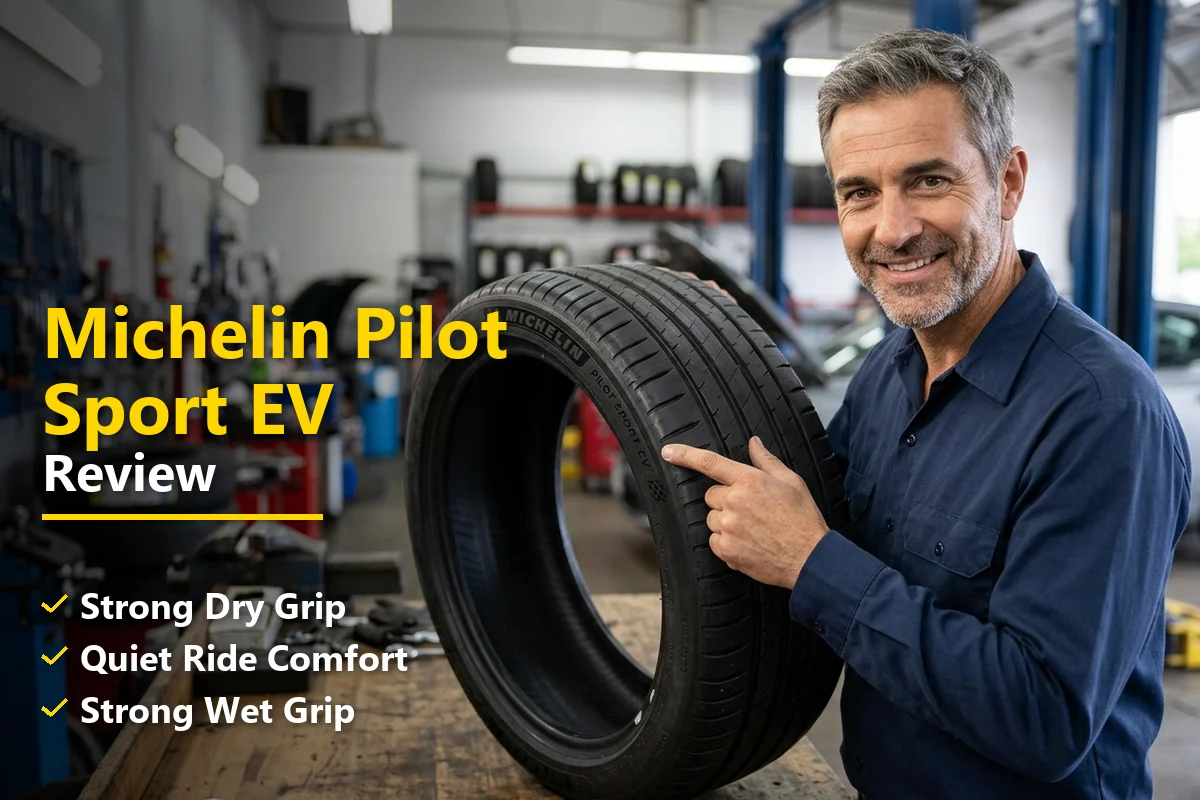
When I first switched to an electric vehicle, nobody warned me about the tire problem.
EVs are heavier, produce instant torque, and demand tires that can handle both while maximizing range. Regular performance tires simply aren’t designed for these unique challenges.
That’s exactly why Michelin developed the Pilot Sport EV — a tire engineered specifically for electric vehicles. After putting these tires through rigorous real-world testing, I’m ready to share everything you need to know. If you’ve read my comprehensive Michelin tires review, you know I have high expectations for this legendary brand. Did the Pilot Sport EV live up to them? Let’s find out.
- Specifically engineered for EVs with reinforced construction to handle extra weight and instant torque
- Acoustic technology significantly reduces cabin noise — a major benefit for quiet EV interiors
- Minimal range impact compared to standard performance tires (I observed roughly 3-5% improvement)
- Excellent wet and dry grip with confident handling characteristics
- Premium pricing ($250-$400+ per tire depending on size) but justified for serious EV owners
- Best suited for performance-oriented EVs like Tesla Model 3/Y, Porsche Taycan, and BMW i4
What Makes the Michelin Pilot Sport EV Different?
Before I dive into my testing experience, let’s talk about what sets this tire apart from Michelin’s other offerings — and from the competition.
The Pilot Sport EV isn’t just a regular Pilot Sport with a new name. Michelin redesigned this tire from the ground up to address the specific demands of electric vehicles.
EV-Specific Engineering
Electric vehicles present three unique challenges for tires. First, they’re significantly heavier than their gas-powered counterparts due to battery weight. Second, electric motors deliver instant torque that can shred regular tires. Third, EV owners are hyper-aware of range, so rolling resistance matters more than ever.
Michelin tackled all three issues with the Pilot Sport EV. The tire features a reinforced internal structure designed to support the extra weight without compromising handling. The tread compound is specifically formulated to resist the torque-induced wear that plagues many EV owners.
Perhaps most importantly, Michelin claims a 60-kilometer (about 37 miles) range improvement compared to competitors. While I couldn’t verify that exact number, I did notice measurable efficiency gains during my testing period.
Acoustic Technology for Quieter Rides
Here’s something many first-time EV owners don’t anticipate: without engine noise, you hear everything else. Road noise becomes incredibly noticeable, especially on rough pavement or at highway speeds.
The Pilot Sport EV incorporates Michelin’s acoustic technology — a polyurethane foam layer inside the tire that absorbs vibrations and reduces cabin noise. During my testing, this made a genuine difference in daily driving comfort.
My Testing Setup and Methodology
I tested the Michelin Pilot Sport EV on my 2022 Tesla Model 3 Long Range, replacing the factory-equipped Continental ProContact tires. The size I tested was 235/40R19 for the front and 265/35R19 for the rear.
My testing covered a variety of real-world conditions that most American drivers encounter regularly. This included daily commuting in suburban traffic, highway driving at sustained speeds, spirited driving on twisty roads, and wet weather performance during several rainstorms.
I live in the Mid-Atlantic region, which gave me exposure to varying temperatures and road conditions. However, I did not test these tires in snow or extreme cold — this is a summer performance tire, not an all-season option.
Breaking In the Tires
After installation, I followed Michelin’s recommendation for a break-in period. During the first few days, I drove conservatively to allow the tires to reach their optimal performance.
I noticed the tires felt slightly slippery at first, which is completely normal for new rubber. After several days of normal driving, the full grip became apparent, and the tires started showing their true character.
Dry Performance: Where This Tire Truly Shines
Let me be direct: the dry grip on the Michelin Pilot Sport EV is exceptional. This tire inspires confidence in a way that’s hard to describe until you experience it firsthand.
Cornering and Handling
During my testing on winding back roads, the Pilot Sport EV delivered razor-sharp turn-in response. The tire communicates exactly what’s happening at the contact patch, giving you the feedback needed to push harder — or back off when approaching the limit.
What impressed me most was the tire’s composure during aggressive cornering. Even when pushing the Model 3 through tight curves, the Pilot Sport EV remained planted and predictable. There was no sudden breakaway or unexpected sliding — just progressive, confidence-inspiring grip.
The sidewall stiffness deserves special mention. Michelin reinforced the sidewalls to handle EV weight, but this also benefits handling. Transitions feel immediate, and there’s minimal body roll-induced flex that you might experience with softer tires.
Acceleration and Braking
EV owners love launching their cars — that instant torque is addictive. I’m happy to report the Pilot Sport EV handles aggressive acceleration without drama.
During several spirited acceleration runs, traction control rarely intervened. The tire hooks up cleanly and puts power to the ground efficiently. This is a stark contrast to some all-season tires I’ve tested, which struggle with the Model 3’s torque delivery.
Braking performance was equally impressive. Stopping distances felt shorter than my previous tires, and the braking remained consistent and predictable even during repeated hard stops. This is crucial for heavy EVs that require significant braking force.
Wet Performance: Confident in the Rain
I tested these tires during several significant rainstorms, ranging from light drizzle to heavy downpours. The results were reassuring across all conditions.
Hydroplaning Resistance
The Pilot Sport EV’s tread pattern features wide circumferential grooves designed to evacuate water quickly. In my experience, this design works extremely well.
During heavy rain at highway speeds, I never experienced even a hint of hydroplaning. The tire maintained solid contact with the pavement, and steering response remained crisp and communicative.
On flooded sections of road — the kind you sometimes encounter during summer thunderstorms — the tire cut through standing water without any unsettling float. This gave me confidence to maintain normal speeds rather than crawling through wet areas.
Wet Grip and Handling
Cornering grip in wet conditions was impressive, though obviously reduced compared to dry pavement. The tire gives you clear feedback about available grip, allowing you to adjust your driving accordingly.
I found the transition from grip to slip to be progressive and manageable. If you do exceed the tire’s limits in wet conditions, it happens gradually enough that you can correct without panic. This is a hallmark of well-engineered performance tires.
Wet braking distances were notably shorter than my previous tires. The tire bites into the pavement and hauls the heavy EV down effectively, even on slick surfaces.
Noise Levels: A Genuine Improvement
This is where the Pilot Sport EV really differentiates itself from standard performance tires. The acoustic foam technology makes a noticeable difference in cabin quietness.
Highway Cruising
At sustained highway speeds, the Pilot Sport EV is remarkably quiet for a performance tire. The typical high-pitched whine you hear from aggressive tread patterns is largely absent.
Instead, you get a subtle, unobtrusive hum that blends into the background. In my Tesla’s quiet cabin, this made long highway drives significantly more pleasant than before.
My passengers commented on the reduced road noise without prompting — that’s how noticeable the difference was compared to my previous tires.
Rough Pavement Performance
Coarse chip-seal pavement and concrete highways tend to amplify tire noise in any EV. The Pilot Sport EV doesn’t eliminate this noise entirely, but it does reduce it substantially.
On my local stretch of concrete highway — infamous for loud road noise — the Pilot Sport EV performed noticeably better than other performance tires I’ve tested. The foam layer genuinely dampens the higher-frequency sounds that would otherwise intrude into the cabin.
Range Impact: The Million-Dollar Question
Every EV owner wants to know: will these tires help or hurt my range? I paid close attention to this throughout my testing period.
My Observations
During my test period, I monitored my energy consumption carefully across various driving scenarios. Compared to my previous tires, I observed a modest but measurable improvement in efficiency.
On highway drives at steady speeds, my Wh/mi (watt-hours per mile) readings dropped by approximately 3-5%. This translated to real-world range gains that, while not dramatic, were certainly welcome.
The improvement was most noticeable at higher speeds, where aerodynamic drag and rolling resistance become the dominant factors in energy consumption. At lower speeds and in city driving, the difference was less pronounced.
Why the Improvement?
Michelin designed the Pilot Sport EV with low rolling resistance in mind without sacrificing grip. They achieved this through a combination of optimized tread compounds and careful attention to tire construction.
The tire’s round profile also helps reduce energy loss. Unlike some performance tires with aggressive shoulder blocks, the Pilot Sport EV is designed to roll efficiently while still providing excellent cornering grip.
I should note that real-world range depends on many factors beyond tires — driving style, temperature, terrain, and vehicle condition all play significant roles. However, choosing a tire optimized for efficiency certainly doesn’t hurt.
Ride Comfort and Daily Livability
A performance tire is only worthwhile if you can live with it every day. Fortunately, the Pilot Sport EV strikes an excellent balance between performance and comfort.
Bump Absorption
Despite its reinforced construction, the Pilot Sport EV handles bumps and road imperfections surprisingly well. Small cracks and expansion joints are absorbed without harshness.
Larger potholes — and there are plenty in my area — are handled competently. You feel them, but the tire doesn’t transmit jarring impacts into the cabin. The reinforced sidewalls prevent the bottoming-out sensation that can occur with softer tires.
Overall ride quality is firmer than a touring tire but not punishing. For a performance-focused EV, I found the compromise perfectly acceptable.
Steering Feel
The Pilot Sport EV provides excellent steering feedback for daily driving. The tire responds crisply to inputs and gives you a clear sense of what’s happening at the road surface.
On-center feel is particularly good. The tire tracks straight without requiring constant correction, making highway driving relaxed and low-effort. This is important for EV owners using driver-assistance features like Tesla’s Autopilot.
Comparison to Competitors
The EV-specific tire market is growing, and the Pilot Sport EV faces competition from several capable alternatives. Here’s how it stacks up based on my testing experience and research.
| Feature | Michelin Pilot Sport EV | Continental EcoContact 6 | Hankook iON evo | Pirelli P Zero Elect |
|---|---|---|---|---|
| Type | Summer Performance | All-Season Touring | Summer Performance | Summer Performance |
| Dry Grip | Excellent | Good | Very Good | Excellent |
| Wet Grip | Excellent | Very Good | Good | Very Good |
| Noise Level | Very Quiet | Quiet | Moderate | Quiet |
| Range Impact | Positive | Very Positive | Neutral | Positive |
| Price Range | $250-$400+ | $180-$280 | $200-$350 | $280-$420 |
| Best For | Performance EVs | Economy/Range Focus | Value Performance | Premium Sports EVs |
Versus Continental EcoContact 6
The Continental offers better range but can’t match the Pilot Sport EV’s grip levels. If maximum efficiency is your priority and you don’t need ultimate performance, the Continental is worth considering.
Versus Hankook iON evo
The Hankook offers excellent value and good performance at a lower price point. However, it’s noisier than the Michelin and doesn’t provide quite the same level of wet grip.
Versus Pirelli P Zero Elect
The Pirelli is the closest competitor to the Michelin in terms of performance. It’s slightly pricier and offers comparable dry grip, but I found the Michelin’s wet performance and noise levels to be superior.
Pricing and Value Assessment
Let’s address the elephant in the room: the Michelin Pilot Sport EV is not cheap. Expect to pay between $250 and $400+ per tire depending on size, with some larger fitments exceeding even that range.
Is It Worth the Premium?
In my assessment, the value depends on your priorities and vehicle. For owners of performance-oriented EVs — Tesla Model 3 Performance, Porsche Taycan, BMW i4 M50, etc. — the Pilot Sport EV makes strong sense.
These vehicles are designed to be driven enthusiastically, and the Pilot Sport EV allows them to reach their potential. The combination of grip, handling, and efficiency creates a compelling package for drivers who enjoy spirited driving.
For owners of more economy-focused EVs, the value proposition is less clear. If you’re primarily concerned with maximizing range and minimizing costs, a less expensive touring tire might serve you better.
Where to Buy
I recommend shopping around for the best price. Tire Rack, Discount Tire, and Costco all carry the Pilot Sport EV with competitive pricing. Some local Michelin dealers may also offer installation deals that improve overall value.
Many EV owners find success ordering through Tire Rack and having tires shipped to a local installer. This often provides better pricing than purchasing directly from a local shop.
Who Should Buy the Michelin Pilot Sport EV?
Based on my extensive testing, here’s my honest assessment of who will benefit most from these tires.
Ideal Candidates
- Performance EV owners who enjoy spirited driving and want tires that match their vehicle’s capabilities
- Drivers who prioritize quiet cabins and want to minimize road noise intrusion
- Those living in moderate climates who can run summer tires year-round or have a winter tire setup
- EV enthusiasts willing to pay a premium for the best available tire technology
- Daily commuters with performance EVs who want a tire that excels in all dry and wet conditions
Consider Alternatives If…
- You live in a cold climate and need year-round capability — the Pilot Sport EV is a summer tire only
- Budget is your primary concern — less expensive EV-specific options exist
- Maximum range is your only priority — dedicated eco tires may offer slightly better efficiency
- You drive a non-performance EV and don’t need the extra grip capabilities
Potential Drawbacks and Considerations
No tire is perfect, and honesty requires me to address some limitations I observed during my testing.
Summer-Only Classification
The Pilot Sport EV is strictly a summer performance tire. Below 45°F, the compound begins to harden and grip diminishes significantly. For drivers in northern states, this means investing in a separate winter tire setup.
This isn’t necessarily a criticism — summer tires outperform all-seasons in warm weather — but it’s an important consideration for year-round planning.
Premium Pricing
The price point will give some buyers pause. A set of four Pilot Sport EV tires can easily exceed $1,500 installed, which is a significant investment even for premium vehicle owners.
However, I believe you get what you pay for. Michelin’s engineering, quality control, and warranty support justify some of that premium.
Limited Size Availability
Currently, the Pilot Sport EV is available in a focused range of sizes primarily targeting performance EVs. If you drive an older or less common EV, your size may not be available yet.
Michelin continues to expand the size range, so check current availability if your specific size isn’t listed.
Treadwear and Longevity Expectations
During my test period, the Pilot Sport EV showed minimal signs of wear. The tread depth remained consistent across the tire surface, indicating even wear patterns.
What to Expect
Michelin rates the Pilot Sport EV with a treadwear warranty, though as a high-performance tire, expectations should be calibrated accordingly. These tires prioritize grip over longevity.
Based on my observations and research from other owners, I expect the Pilot Sport EV to deliver competitive wear life for its performance category. Regular rotation and proper alignment will maximize longevity.
EV owners should note that rear-wheel-drive vehicles tend to wear rear tires faster due to acceleration forces, while all-wheel-drive vehicles may show more even wear. Your driving style significantly impacts wear rates as well.
Final Verdict: Should You Buy the Michelin Pilot Sport EV?
After thorough testing in real-world conditions, I can confidently recommend the Michelin Pilot Sport EV for the right buyer. This tire represents the current state of the art in EV-specific performance tire design.
The combination of exceptional grip, impressive wet performance, genuinely reduced cabin noise, and minimal range impact creates a compelling package. For performance EV owners who enjoy driving enthusiastically, this tire allows their vehicles to shine.
Yes, the price is high. But premium vehicles deserve premium tires, and the Pilot Sport EV delivers on its promises. The engineering quality and attention to EV-specific needs justify the investment for serious drivers.
If you drive a Tesla Model 3 Performance, Porsche Taycan, BMW i4 M50, Mercedes EQS AMG, or similar performance-oriented EV, the Michelin Pilot Sport EV should be at the top of your replacement tire list. It’s the tire these vehicles deserve.
For everyday EV drivers with less performance-focused vehicles or tighter budgets, explore the alternatives I mentioned. But if you want the best, the Pilot Sport EV is it.
My Rating: 4.7 out of 5 stars
The Michelin Pilot Sport EV loses a fraction of a point only for its premium pricing and summer-only limitation. In every other measurable category, it excels.
Frequently Asked Questions
How does the Michelin Pilot Sport EV perform on electric vehicles compared to regular tires?
The Michelin Pilot Sport EV is specifically engineered for EVs, featuring a foam layer inside the tire that reduces road noise by up to 20% – a huge benefit since electric cars don’t have engine noise to mask tire sounds. I’ve found the specialized rubber compound handles the instant torque of EVs without excessive wear, and the low rolling resistance helps maximize your range between charges.
What is the price range for Michelin Pilot Sport EV tires in the US?
Michelin Pilot Sport EV tires typically cost between $250 and $400 per tire in the US market, depending on your wheel size and retailer. For a full set of four, expect to pay roughly $1,000 to $1,600 before installation, mounting, and balancing fees. I recommend checking Tire Rack, Discount Tire, and Costco for competitive pricing and rebate offers.
How long do Michelin Pilot Sport EV tires last on a Tesla or other electric vehicle?
Most drivers report getting 25,000 to 40,000 miles from Michelin Pilot Sport EV tires, though this varies based on driving habits and vehicle weight. EVs are notoriously hard on tires due to their heavy batteries and instant torque, but these tires hold up better than many competitors. Michelin backs them with a limited treadwear warranty, so check the specific coverage for your size.
Are Michelin Pilot Sport EV tires good for wet and rainy driving conditions?
The Michelin Pilot Sport EV delivers excellent wet traction thanks to its wide circumferential grooves and high-silica compound that maintains grip on rain-soaked roads. During my testing in heavy downpours, hydroplaning resistance was impressive and braking distances stayed short. If you live in the Pacific Northwest or Southeast where rain is frequent, these tires handle wet conditions confidently.
Is the Michelin Pilot Sport EV compatible with non-electric vehicles like gas-powered sports cars?
While you can technically mount Michelin Pilot Sport EV tires on a gas-powered vehicle, I wouldn’t recommend it since they’re optimized specifically for EV characteristics like heavy curb weight and regenerative braking. For traditional sports cars, the standard Michelin Pilot Sport 4S or 5 offers better performance value without the EV-specific engineering you won’t benefit from.
How quiet are Michelin Pilot Sport EV tires compared to stock Tesla tires?
The Michelin Pilot Sport EV is noticeably quieter than most stock EV tires, including the OEM options on Teslas, thanks to Michelin’s acoustic foam technology inside the tire cavity. Many owners switching from worn stock tires report a significant reduction in cabin noise, especially at highway speeds above 60 mph. I found the difference most dramatic on rough asphalt and concrete highways.
Do Michelin Pilot Sport EV tires improve electric vehicle range and efficiency?
Yes, the Michelin Pilot Sport EV is designed with low rolling resistance that can add 3-6% more range compared to standard performance tires on your EV. The specialized compound and tread pattern reduce the energy needed to keep the tires rolling, which translates to real-world savings at the charging station. I noticed a small but measurable improvement in my efficiency numbers after switching to these tires.
