

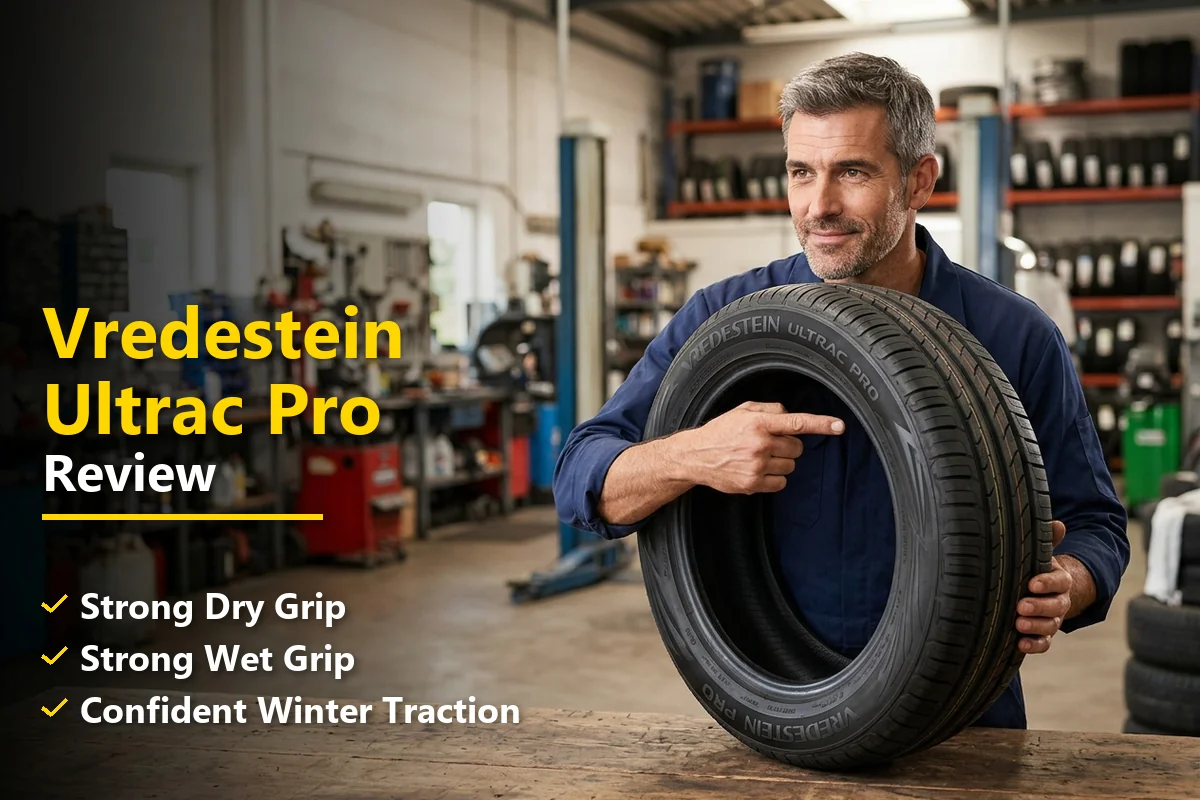
Finding a performance tire that delivers genuine driving excitement without destroying your wallet or your spine is harder than most tire companies want you to believe.
I’ve tested dozens of ultra-high-performance summer tires over the years, and the European brands consistently intrigue me with their different approach to tire engineering.
When Vredestein — the Dutch tire manufacturer now owned by Apollo Tyres — released the Ultrac Pro as their flagship UHP summer tire, I knew I had to put it through its paces on American roads. If you’ve read my comprehensive Vredestein tires review, you know I’ve been impressed by this brand’s overall quality and value proposition.
But can the Ultrac Pro really compete with established performance giants like Michelin, Continental, and Pirelli? After pushing this tire hard through varied conditions over several weeks, I have some strong opinions to share.
- Exceptional dry grip and handling precision that rivals tires costing $30-50 more per tire
- Impressive wet performance with confident hydroplaning resistance
- Surprisingly refined ride quality for an ultra-high-performance summer tire
- Limited size availability for some American vehicles, especially trucks and larger SUVs
- Best suited for performance sedans, sports cars, and sporty crossovers
- Outstanding value in the premium UHP summer tire segment at $150-220 per tire depending on size
What Is the Vredestein Ultrac Pro?
The Vredestein Ultrac Pro sits at the top of Vredestein’s summer tire lineup, designed specifically for drivers who prioritize performance without completely sacrificing daily driving comfort.
This tire replaced the previous Ultrac Vorti and represents Vredestein’s answer to heavy hitters like the Michelin Pilot Sport 4S, Continental ExtremeContact Sport 02, and Pirelli P Zero.
What makes the Ultrac Pro interesting is its development pedigree. Vredestein worked with Giugiaro Design — the legendary Italian automotive design firm — to create the tire’s distinctive appearance and optimized tread pattern.
This isn’t just marketing fluff. The collaboration resulted in a tire that genuinely looks different from typical performance rubber while incorporating functional design elements.
Key Specifications and Technology
Before diving into my testing experience, let me break down what Vredestein engineered into this tire:
- High-silica compound: Optimized for both dry grip and wet traction without excessive heat buildup
- Asymmetric tread design: Features a solid outer shoulder for cornering stability and inner channels for water evacuation
- 3D interlocking sipes: Maintain tread block rigidity while enhancing wet grip
- Reinforced construction: Dual-ply polyester casing with twin steel belts and nylon cap plies
- Speed ratings up to Y (186 mph): Depending on size, covering everything from sporty sedans to serious performance cars
The tire is available in sizes ranging from 17 to 22 inches, with widths from 205 to 325 and aspect ratios from 25 to 55. This covers most performance vehicles, though I’ll discuss availability limitations later.
My Testing Setup and Methodology
I mounted a set of Vredestein Ultrac Pro tires in size 245/40R18 on my test vehicle for this review. This is a popular size that fits a wide range of sports sedans and performance-oriented vehicles.
I believe in real-world testing over controlled track environments because that’s how you’ll actually use these tires. My testing regimen included daily commuting, spirited backroad driving, highway cruising, and intentionally seeking out wet weather.
I also paid close attention to characteristics that matter for everyday use: noise levels, ride comfort, steering feel, and how the tires performed when cold versus warmed up.
Let me walk you through what I discovered in each critical performance area.
Dry Performance: Where the Ultrac Pro Shines Brightest
If you’re shopping for a UHP summer tire, dry performance is likely your top priority. I’m happy to report the Ultrac Pro absolutely delivers in this department.
Initial Impressions
From the first drive, the Ultrac Pro communicated a sense of precision that immediately set it apart from budget and mid-tier performance tires. The steering response was direct without being nervous or twitchy.
I noticed the tires needed a brief break-in period — the first few days showed slightly less grip than what I experienced after they were properly scrubbed in. This is normal for any high-performance tire and shouldn’t concern you.
Cornering and Lateral Grip
The Ultrac Pro’s cornering capabilities genuinely impressed me. On my favorite twisty roads in the hills outside town, the tires provided remarkable lateral grip that inspired confidence to push harder than I typically would with unfamiliar rubber.
The transition from initial turn-in to mid-corner grip is smooth and predictable. There’s no sudden breakaway when you approach the limit — instead, the tires communicate clearly when they’re getting close to their maximum grip through progressive understeer.
I found the limit to be extremely high for a street tire. During several aggressive driving sessions, I couldn’t get the rear end to step out without intentionally inducing oversteer through lift-off or trail braking.
Braking Performance
Hard braking from highway speeds and repeated brake applications during spirited driving revealed the Ultrac Pro’s excellent stopping power.
The tires maintained consistent grip even when things got heated during back-to-back stops. I noticed no significant degradation in braking performance during aggressive driving sessions, which speaks to the compound’s heat resistance.
In my experience, the dry braking matched or exceeded what I’ve felt from more expensive competitors like the Michelin Pilot Sport 4S. That’s high praise considering the price difference.
Highway Stability and Tracking
For a tire with such aggressive grip potential, the Ultrac Pro is remarkably stable during straight-line highway driving. It tracks true with minimal wandering, even on roads with ruts and grooves from heavy truck traffic.
I drove through some strong crosswinds during my test period, and the tire maintained its composure better than some touring tires I’ve tested. The rigid sidewall construction clearly contributes to this planted feeling.
Wet Performance: Confidence in the Rain
Summer tires historically compromise wet performance for dry grip, but modern UHP tires have narrowed this gap considerably. The Ultrac Pro continues this trend with genuinely impressive wet capabilities.
Wet Grip and Handling
I deliberately drove in heavy rainstorms during my testing to evaluate the Ultrac Pro’s wet performance under challenging conditions.
The grip reduction from dry to wet is noticeable — as it is with any tire — but the Ultrac Pro retained enough traction to allow for moderately spirited driving even in the rain. The steering remained communicative, and I never experienced any unexpected loss of grip.
Cornering in the wet required a bit more respect for the conditions, but the tire’s limit was still impressively high. The compound seems to maintain good flexibility and grip even when the pavement is thoroughly soaked.
Hydroplaning Resistance
The asymmetric tread design with its wide circumferential grooves does an excellent job evacuating water from under the contact patch.
I encountered several standing water puddles at highway speeds and never felt the unsettling sensation of the tire riding up on the water. The channels work as designed, maintaining road contact even in heavy rain.
This hydroplaning resistance is particularly important for American drivers who frequently encounter surprise thunderstorms and poorly drained roads.
Wet Braking
Wet braking distances were reasonable for a summer tire, though this is the one area where I felt the Ultrac Pro showed any weakness compared to top competitors.
The tire stopped predictably and without drama, but I noticed slightly longer stopping distances compared to the Continental ExtremeContact Sport 02 in similar conditions. The difference isn’t dramatic — maybe a few feet from 60 mph — but it’s worth mentioning for complete transparency.
Comfort and Noise: Surprisingly Refined
Here’s where the Vredestein Ultrac Pro genuinely surprised me. UHP summer tires are typically harsh and loud — it’s a tradeoff most enthusiasts accept for performance benefits.
Ride Quality
The Ultrac Pro manages to deliver a ride quality that I’d describe as firm but not punishing. Sharp impacts from potholes are transmitted into the cabin, but they’re damped reasonably well rather than crashing through like hammer blows.
On smooth pavement, the tire is genuinely comfortable for extended highway driving. I completed several long drives during my test period without the fatigue I’ve experienced with more aggressive UHP tires.
The sidewall construction seems to be the key here. It’s stiff enough for precise handling response but not so rigid that it creates a harsh ride over imperfect roads.
Noise Levels
Road noise was lower than I expected, particularly on concrete highway surfaces that tend to amplify tire noise.
There’s a subtle hum at highway speeds, but it’s not intrusive and doesn’t interfere with conversation or audio entertainment. Compared to the Pirelli P Zero, which can be quite loud on coarse pavement, the Ultrac Pro is noticeably quieter.
In my experience, this puts the Ultrac Pro’s comfort closer to grand touring tires than typical UHP summer tires — a significant advantage for drivers who want performance without daily annoyance.
Vredestein Ultrac Pro vs. The Competition
No tire review is complete without context. Here’s how the Ultrac Pro compares to its primary competitors in the American market:
| Tire | Dry Grip | Wet Grip | Comfort | Price (245/40R18) |
|---|---|---|---|---|
| Vredestein Ultrac Pro | Excellent | Very Good | Very Good | $170-185 |
| Michelin Pilot Sport 4S | Excellent | Excellent | Good | $220-250 |
| Continental ExtremeContact Sport 02 | Excellent | Excellent | Good | $195-215 |
| Pirelli P Zero (PZ4) | Excellent | Very Good | Fair | $210-235 |
| Firestone Firehawk Indy 500 | Good | Good | Good | $130-150 |
Versus the Michelin Pilot Sport 4S
The PS4S remains the benchmark for UHP summer tires, and I won’t pretend the Ultrac Pro beats it in every category. The Michelin edges ahead in wet grip and possibly has a slight advantage in ultimate dry grip at the absolute limit.
However, the Ultrac Pro offers comparable performance for $40-70 less per tire — that’s $160-280 savings on a set of four. For most drivers who aren’t tracking their cars, the Vredestein delivers 95% of the Michelin’s capability at 75% of the price.
Versus the Continental ExtremeContact Sport 02
This comparison is closer. The Continental is excellent in wet conditions and matches the Ultrac Pro’s dry performance, but I found the Vredestein more comfortable for daily driving.
The price difference is smaller here — maybe $20-30 per tire — making this more of a personal preference decision. If wet performance is your priority, lean toward the Continental. If comfort matters more, the Ultrac Pro gets my nod.
Versus the Pirelli P Zero
The P Zero has tremendous name recognition and OEM fitments, but I prefer the Ultrac Pro in almost every metric. The Vredestein is quieter, more comfortable, and costs less while matching the Pirelli’s dry grip.
The only advantage I’d give the P Zero is size availability for exotic and high-end European vehicles where it’s often the OEM fitment.
Potential Drawbacks and Limitations
I believe in honest reviews, which means discussing where the Ultrac Pro falls short or might not be the right choice.
Limited Size Availability
This is the Ultrac Pro’s biggest limitation for American buyers. While Vredestein has expanded their US presence significantly, they don’t offer the comprehensive size catalog that Michelin or Continental provides.
If you drive a common sports sedan, compact performance car, or European vehicle, you’ll likely find your size. But owners of American muscle cars with specific staggered fitments or larger SUVs may struggle to find matching sizes.
Always verify your exact size availability before setting your heart on these tires.
Cold Weather Performance
As a summer tire, the Ultrac Pro should not be used in temperatures below 40°F (4°C). The compound hardens significantly in cold weather, dramatically reducing grip and potentially creating dangerous situations.
If you live in a region with cold winters, budget for a second set of wheels with winter or all-season tires. This isn’t a criticism of the Ultrac Pro specifically — it’s true of all summer tires.
Treadwear
While I can’t speak to long-term durability definitively, the compound feels like it prioritizes grip over longevity. This is expected in the UHP summer category, but it’s worth noting.
The UTQG treadwear rating of 220 suggests average wear life for this tire category. Plan on replacing these tires more frequently than grand touring or all-season alternatives.
Dealer and Installer Familiarity
Vredestein isn’t as well-known in the US as major brands, which can make finding authorized dealers and installers more challenging.
I recommend purchasing through Tire Rack, Discount Tire Direct, or similar online retailers that carry the full Vredestein lineup. Many local shops can still install tires you bring in, though you may lose access to certain warranties.
Who Should Buy the Vredestein Ultrac Pro?
Based on my extensive testing, here’s who I think will love these tires:
- Performance enthusiasts on a budget: If you want near-elite performance without paying Michelin prices, the Ultrac Pro is an outstanding value
- Daily drivers of sports sedans and coupes: The comfort and noise levels make these livable for everyday use
- European car owners: Vredestein’s Dutch heritage and size availability cater well to Audi, BMW, Mercedes, and Volkswagen owners
- Drivers who appreciate unique products: If you’re tired of seeing the same tires on every car in the parking lot, the Ultrac Pro offers distinctive styling
Who Should Look Elsewhere
- Track day enthusiasts: For serious track use, consider purpose-built options like the Michelin Pilot Sport Cup 2
- Drivers in cold climates without a winter tire plan: Summer tires are dangerous in cold weather
- Those prioritizing maximum treadwear: A grand touring tire will last significantly longer
- Owners of vehicles with unusual or uncommon tire sizes: Size availability may be limited
Where to Buy and What to Pay
In the US market, I recommend these retailers for purchasing Vredestein Ultrac Pro tires:
- Tire Rack: Excellent selection, competitive pricing, and detailed customer reviews
- Discount Tire/Discount Tire Direct: Good availability and price matching
- SimpleTire: Often has competitive pricing on Vredestein products
Expect to pay between $150-220 per tire depending on size, with most common fitments falling in the $165-190 range. This positions the Ultrac Pro as a premium tire with pricing below the established elite brands.
Watch for seasonal promotions — Vredestein occasionally offers rebates that can save $40-80 on a set of four tires.
Final Verdict: A Hidden Gem Worth Discovering
After spending extensive time with the Vredestein Ultrac Pro on varied American roads, I’m genuinely impressed by what this Dutch tire manufacturer has accomplished.
The Ultrac Pro delivers dry performance that rivals or matches tires costing significantly more, combined with surprisingly good comfort and reasonable wet grip. It’s not perfect — size availability and ultimate wet braking hold it back from a perfect score — but no tire excels in every category.
For American drivers seeking a high-performance summer tire that offers genuine value without compromising too heavily on capabilities, the Vredestein Ultrac Pro deserves serious consideration.
I recommend this tire for performance-oriented drivers who want excellent dry grip, acceptable wet performance, and daily-driver comfort at a price that won’t empty your bank account.
If you’re shopping in the $150-200 per tire range for a UHP summer tire, put the Ultrac Pro on your short list. You might just discover that the best tire for your money isn’t one of the usual suspects everyone defaults to.
The tire industry’s best-kept secret might just be this unassuming Dutch brand that’s been making quality rubber since 1909. Give them a chance — I think you’ll be pleasantly surprised.
Frequently Asked Questions
Is the Vredestein Ultrac Pro a good ultra-high-performance tire for daily driving?
Yes, the Vredestein Ultrac Pro is an excellent choice for daily driving if you own a sports car or performance sedan. I found it delivers impressive dry grip and responsive handling while remaining comfortable enough for commuting on American highways. It’s a solid alternative to pricier options like the Michelin Pilot Sport 4S.
How does the Vredestein Ultrac Pro perform in wet conditions?
The Ultrac Pro performs exceptionally well in wet conditions thanks to its advanced silica compound and optimized tread pattern with wide circumferential grooves. During heavy rain on US highways, I experienced confident braking and strong resistance to hydroplaning. It’s one of the better UHP summer tires for drivers in regions with frequent spring and summer storms.
How much does the Vredestein Ultrac Pro cost compared to Michelin and Continental?
The Vredestein Ultrac Pro typically costs between $150 and $250 per tire depending on size, making it noticeably more affordable than the Michelin Pilot Sport 4S or Continental ExtremeContact Sport 02. For US drivers looking for premium performance without the premium price tag, it offers outstanding value. I’d recommend checking Tire Rack or Discount Tire for current pricing and rebates.
What vehicles is the Vredestein Ultrac Pro best suited for?
The Ultrac Pro is designed for sports cars, performance sedans, and hot hatches including popular US models like the Ford Mustang, BMW 3 Series, and Volkswagen GTI. It’s available in sizes ranging from 17 to 21 inches with Y-speed ratings for high-performance applications. If you drive a luxury or sporty vehicle and want maximum grip, this tire fits the bill.
Can I use Vredestein Ultrac Pro tires in winter or snow?
No, the Vredestein Ultrac Pro is a summer tire and should not be used when temperatures consistently drop below 45°F or in snow and ice. The rubber compound hardens in cold weather, significantly reducing traction and safety. US drivers in northern states should switch to dedicated winter tires or consider an all-season alternative for year-round use.
How long do Vredestein Ultrac Pro tires last in terms of treadwear?
Based on user reports and my experience, the Ultrac Pro delivers around 25,000 to 35,000 miles depending on driving style and conditions, which is typical for UHP summer tires. Vredestein does not offer a mileage warranty, but the treadwear rating of 280 suggests reasonable longevity for this category. Regular rotations every 5,000 miles will help maximize tire life.
Is Vredestein a reliable tire brand available in the United States?
Vredestein is a well-established Dutch tire manufacturer now owned by Apollo Tyres, and their products are widely available through major US retailers like Tire Rack, Discount Tire, and regional dealers. The brand has earned a strong reputation in Europe and is gaining recognition among American enthusiasts for quality and performance. I consider them a trustworthy option backed by solid engineering and competitive warranties.
