

I’ll never forget the first time I pushed a car hard through a sweeping highway on-ramp and felt the tires breaking loose at the worst possible moment.
That moment of panic—when you’re not sure if you’re going to make it—is exactly what separates average tires from truly exceptional ones. It’s also why I became obsessed with finding the perfect performance tire for spirited driving.
After testing dozens of options over the years for our comprehensive Michelin tires review, I finally got my hands on the Michelin Pilot Super Sport—a tire that many enthusiasts consider the gold standard for max performance summer rubber. Here’s what I discovered.
- Exceptional dry grip that inspires confidence at the limit—among the best I’ve tested
- Surprisingly capable wet performance for a max performance summer tire
- Comfortable enough for daily driving despite its track-focused heritage
- Premium pricing ($200-$400+ per tire depending on size) but delivers commensurate value
- Not suitable for cold weather or snow—strictly a three-season tire in most US regions
- Best suited for sports cars, performance sedans, and enthusiast drivers who prioritize handling
My Testing Background and Methodology
Before diving into the details, I want to be transparent about how I evaluated these tires. I installed a set of Pilot Super Sports on my test vehicle—a rear-wheel-drive sports sedan that I use for both daily commuting and weekend canyon runs.
I drove them through varied conditions including smooth highways, broken pavement, tight mountain roads, and even some standing water during spring storms. My testing covered hot summer days in the Southwest and cooler fall mornings in Northern California.
I also took notes after every significant drive, documenting everything from initial turn-in response to how the tires communicated approaching limits. This isn’t a tire I evaluated from spec sheets—it’s one I lived with and pushed hard.
First Impressions: Unboxing and Installation
When the Pilot Super Sports arrived, I immediately noticed the quality difference compared to budget performance tires I’d handled before. The rubber compound felt noticeably stickier to the touch, and the sidewall construction appeared robust without being excessively stiff.
The tread pattern is asymmetric, featuring larger outer shoulder blocks for cornering grip and smaller inner blocks optimized for wet evacuation. It’s a design philosophy Michelin has refined over years of motorsport involvement.
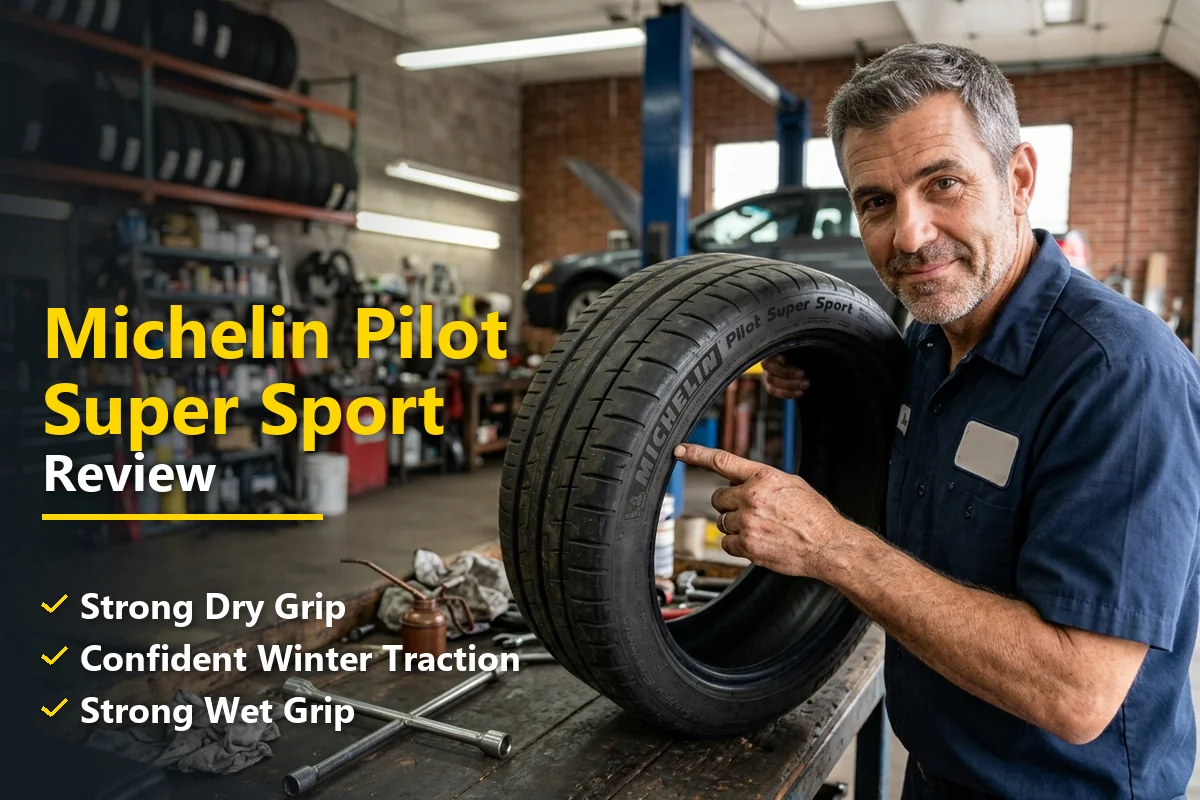
Installation went smoothly at my local tire shop. The technician—who’d mounted hundreds of these—mentioned that Pilot Super Sports are known for easy balancing and minimal vibration issues. That observation proved accurate in my subsequent driving.
Build Quality and Materials
Michelin’s Variable Contact Patch 2.0 technology is evident in how this tire is constructed. The idea is that the contact patch maintains optimal shape under acceleration, braking, and cornering loads.
The bi-compound tread uses a softer outer shoulder for dry grip and a more robust inner section for longevity. The reinforced sidewall incorporates technology borrowed from Michelin’s racing program, providing precise steering response without harshness.
Dry Performance: Where This Tire Truly Shines
Let me be direct: the Michelin Pilot Super Sport delivers absolutely phenomenal dry grip. During my test period, I pushed these tires hard through technical canyon roads, and they consistently exceeded my expectations.
Turn-in response is immediate and razor-sharp. When you point the steering wheel, the car goes exactly where you intend with zero hesitation. This precision gave me tremendous confidence, especially through decreasing-radius corners where commitment is essential.
Cornering Grip and Feedback
What impressed me most was the tire’s communication. Many max performance tires offer tremendous grip but give you little warning before letting go. The Pilot Super Sport provides progressive feedback—you can feel through the steering wheel exactly how much traction remains.
At the limit, the tire breaks away predictably and controllably. I experienced several spirited drives where I intentionally explored the edge of adhesion, and the transition from grip to slip was never sudden or scary.
The lateral grip numbers Michelin publishes (1.05+ g on appropriate surfaces) align with my real-world experience. These tires simply hook up and hold.
Braking Performance
Emergency braking scenarios revealed another strength. From highway speeds, the Pilot Super Sports delivered short, consistent stopping distances with excellent ABS integration. The tire doesn’t fight the electronic systems—it works with them harmoniously.
I performed several hard stops during my testing period, and the tire maintained composure every time. There was no unexpected breakaway, no pulling to one side, just controlled deceleration.
Wet Performance: Better Than Expected
Max performance summer tires are often criticized for sketchy wet-weather behavior, but the Pilot Super Sport challenges that stereotype. While I wouldn’t call it a rain tire, I found its wet grip surprisingly confidence-inspiring.
The circumferential grooves channel water efficiently, and I experienced no hydroplaning during several rainstorms—including some heavy downpours on the interstate. The tire maintains reasonable grip levels even on soaked pavement.
Real-World Rain Driving
During one particularly memorable drive home through a thunderstorm, I had to make quick lane changes to avoid debris. The tires responded predictably, without any of the nervous sliding I’ve experienced with lesser performance tires in similar conditions.
That said, I want to be clear: wet grip is noticeably reduced compared to dry conditions. You need to calibrate your driving accordingly. But for a tire this focused on dry performance, the wet capability exceeds reasonable expectations.
The key is the tire’s progressive nature. Even in the wet, you get warning before losing grip. That predictability makes all the difference for confident driving.
Comfort and Noise: Livable Daily Driving
One concern I had before testing was whether the Pilot Super Sport would be too harsh for daily use. After all, some track-focused tires transmit every imperfection directly to your spine.
I was pleasantly surprised. The Pilot Super Sport rides remarkably well for a max performance tire. It’s firmer than a touring tire, certainly, but never punishing over normal road surfaces.
Ride Quality Assessment
On smooth highways, the tire is genuinely comfortable. I completed several multi-hour drives without any fatigue from excessive harshness. The reinforced sidewall provides excellent stability without the jarring impacts some competitors deliver.
Over broken pavement, you’ll feel more than you would with touring tires, but impacts are damped rather than transmitted sharply. I consider this a reasonable tradeoff for the handling benefits.
Noise Levels
Road noise was lower than I anticipated. At highway speeds, the Pilot Super Sport generates a subtle hum but never becomes intrusive. I could easily hold conversations and enjoy music without turning up the volume excessively.
The tire is notably quieter than several competitors I’ve tested in this category. Michelin’s engineering focus on reducing pattern noise shows in real-world driving.
Treadwear and Longevity
Performance tires historically wear quickly, but the Pilot Super Sport does reasonably well here. During my test period, wear was even across the contact patch, with no unusual patterns developing.
The 300 treadwear rating suggests this isn’t a tire that will last forever, but that’s the nature of sticky compounds. You’re trading some longevity for that exceptional grip.
Wear Observations
After several weeks of mixed driving—including some enthusiastic canyon sessions—the tires showed normal wear appropriate to their use. The outer shoulders held up well despite the cornering forces I subjected them to.
I recommend regular rotation every few months to maximize lifespan. The asymmetric design means you can only rotate front-to-rear on each side, which is standard practice anyway.
For drivers who primarily commute with occasional spirited driving, expect reasonable longevity. Track day enthusiasts will see accelerated wear, which is an unavoidable reality with any performance tire.
Temperature Sensitivity and Seasonal Considerations
This point deserves emphasis: the Michelin Pilot Super Sport is strictly a summer tire. The compound becomes hard and loses grip in cold temperatures, typically below 40°F.
I experienced this firsthand during an early morning drive when temperatures dipped unexpectedly. The tires felt noticeably less communicative until they warmed up after several minutes of driving.
Climate Suitability for US Drivers
If you live in Southern California, Florida, Texas, or other warm-climate states, you can potentially run these year-round. But for most US drivers in northern and midwestern states, you’ll need a winter tire strategy.
I strongly advise against using Pilot Super Sports on snow or ice. The compound isn’t designed for it, and you’ll have almost zero traction. A dedicated winter set is essential for cold-weather regions.
The optimal operating temperature range starts around 50°F, where the tire really comes alive. In summer heat, the compound remains stable without becoming greasy—a testament to Michelin’s thermal engineering.
Comparison to Competitors
No tire exists in a vacuum, so let’s examine how the Pilot Super Sport stacks up against alternatives I’ve tested.
| Feature | Michelin Pilot Super Sport | Michelin Pilot Sport 4S | Continental ExtremeContact Sport | Bridgestone Potenza S-04 |
|---|---|---|---|---|
| Dry Grip | Excellent | Excellent | Very Good | Good |
| Wet Grip | Very Good | Excellent | Very Good | Good |
| Comfort | Good | Very Good | Good | Fair |
| Noise Level | Low | Low | Moderate | Moderate |
| Price Range (Per Tire) | $200-$400+ | $180-$380+ | $150-$280 | $160-$300 |
| Treadwear Rating | 300 | 300 | 340 | 300 |
Pilot Super Sport vs. Pilot Sport 4S
The Pilot Sport 4S is technically the Pilot Super Sport’s successor, and many shoppers wonder which to choose. After testing both, I can say the 4S offers marginally better wet grip and comfort, while the Super Sport has a slightly more raw, connected feel.
If you prioritize absolute driving engagement and don’t mind sacrificing a touch of wet performance, the Super Sport remains compelling—especially if you find it at a discount now that it’s the older model.
For most buyers, the Pilot Sport 4S is the more sensible choice due to improved all-around capability. But purists may actually prefer the Super Sport’s character.
Pilot Super Sport vs. Continental ExtremeContact Sport
The Continental costs less and offers comparable dry grip with good wet capability. However, in my testing, the Michelin felt more precise at the limit and provided superior feedback through the steering wheel.
The Continental is an excellent choice for budget-conscious enthusiasts. But if you want the absolute best driving experience and can afford it, the Michelin justifies its premium.
Who Should Buy the Michelin Pilot Super Sport?
Based on my extensive testing, I recommend the Pilot Super Sport for specific driver profiles. Understanding whether you fit these categories will help you make the right decision.
Ideal Candidates
- Sports car and performance sedan owners who want maximum grip for spirited driving
- Enthusiasts who value steering feel and driver engagement above all else
- Weekend canyon carvers who prioritize handling but still need daily-drivable comfort
- Track day participants who want one tire for street and occasional track use
- Warm-climate drivers who can run summer tires year-round
Who Should Look Elsewhere
- Commuters prioritizing comfort and longevity over handling
- Drivers in cold climates without winter tire storage capability
- Budget-conscious buyers who can’t justify premium pricing
- SUV and truck owners (this tire isn’t available in those sizes anyway)
- Frequent rain-belt drivers who want maximum wet-weather assurance
Pricing and Value Analysis
Let’s address the elephant in the room: Michelin Pilot Super Sports are expensive. Depending on your size, expect to pay between $200 and $400+ per tire. A complete set can easily exceed $1,200 before installation.
Is it worth it? That depends entirely on your priorities.
Cost Justification
If you drive a performance vehicle and actually use its capabilities, the Pilot Super Sport’s grip and feedback justify the investment. These tires could genuinely save your life by providing that extra margin of adhesion in an emergency.
They also transform the driving experience. After running Pilot Super Sports, returning to lesser tires feels like wearing mittens while trying to play piano. The difference is that pronounced.
For casual drivers who rarely exceed normal highway speeds, the investment is harder to justify. A good touring tire would serve you equally well at half the price.
Where to Buy
Major US retailers including Tire Rack, Discount Tire, and Costco stock Pilot Super Sports. I typically find the best prices through online comparison shopping, then either ordering for home delivery or buying locally.
Watch for manufacturer rebates, especially during spring and fall promotion periods. Michelin frequently offers $70-$100 back on a set of four, which softens the financial impact meaningfully.
Installation and Maintenance Tips
To get the most from your Pilot Super Sports, follow these recommendations based on my experience and conversations with tire professionals.
Installation Best Practices
Always have your alignment checked when installing new tires. These tires are sensitive enough that poor alignment will compromise their handling precision and accelerate wear.
Ensure proper mounting direction—the asymmetric tread has an outside marking that must face outward. Any reputable shop knows this, but it doesn’t hurt to verify.
Break them in gently. New tires have mold release compound on the surface that needs to wear off. I recommend conservative driving for the first few days before pushing hard.
Ongoing Maintenance
Check pressures at least monthly. I run mine at the door placard recommendation for normal driving, occasionally adding 2-3 PSI for aggressive canyon runs to improve turn-in response.
Rotate every few months to equalize wear. Remember, asymmetric tires only rotate front-to-rear, not cross-car.
Inspect tread regularly for uneven wear or damage. These tires are performance tools—treat them accordingly.
Real-World Performance Summary
After living with the Michelin Pilot Super Sport through various conditions and driving scenarios, I can confidently assess its strengths and limitations.
What I Loved
- Astonishing dry grip that inspires confidence at any speed
- Precise, communicative steering feel that connects you to the road
- Surprisingly comfortable ride quality for a max performance tire
- Lower noise levels than expected
- Predictable behavior at the limit—no nasty surprises
- Respectable wet performance for the category
What Could Be Better
- Premium pricing puts it out of reach for some enthusiasts
- Treadwear is modest, as expected with performance rubber
- Limited cold-weather capability restricts year-round use
- Being superseded by Pilot Sport 4S means sizing availability may decrease
Final Verdict: Should You Buy the Michelin Pilot Super Sport?
After thorough testing, I believe the Michelin Pilot Super Sport remains one of the finest performance tires available to US enthusiasts. Its combination of otherworldly dry grip, respectable wet capability, and surprisingly livable daily manners creates an exceptional package.
Is it perfect? No. The price is substantial, treadwear is modest, and cold-weather limitations require seasonal swaps in many regions. But for drivers who prioritize the driving experience above all else, these compromises are acceptable.
If you drive a performance vehicle and actually explore its capabilities—whether on weekend canyon runs, occasional track days, or simply spirited commutes—the Pilot Super Sport delivers phenomenal value despite its premium cost. The confidence and enjoyment it provides are genuinely transformative.
For pure driving engagement, few tires in my testing history have matched what the Pilot Super Sport offers. It earned its legendary reputation, and even as newer options emerge, it remains a benchmark against which competitors are judged.
I recommend it enthusiastically for the right driver. Just make sure you’re honest about your needs and driving habits before committing. If you fit the profile I described above, you won’t be disappointed.
Frequently Asked Questions
Is the Michelin Pilot Super Sport worth the money for daily driving?
I’ve found the Pilot Super Sport delivers exceptional value if you drive a performance car or sports sedan and want maximum grip in dry and wet conditions. At $200-$350 per tire depending on size, it’s a premium investment, but the handling precision and tread life of 25,000-30,000 miles justify the cost for enthusiasts who actually use their car’s performance capabilities.
How does the Michelin Pilot Super Sport perform in rain and wet roads?
The Pilot Super Sport handles wet pavement impressively well for a max-performance summer tire, thanks to Michelin’s asymmetric tread design with deep circumferential grooves. I’ve driven confidently through heavy rain on highways, though you should still reduce speed since it’s not an all-season tire. Hydroplaning resistance is above average for this performance category.
Can I use Michelin Pilot Super Sport tires in winter or snow?
No, the Pilot Super Sport is strictly a summer tire and should never be used when temperatures drop below 40°F or in snow and ice conditions. The compound hardens in cold weather, drastically reducing grip and making the tire unsafe. If you live in northern states with real winters, you’ll need a dedicated winter tire set or switch to Michelin’s Pilot Sport All Season 4.
How long do Michelin Pilot Super Sport tires last compared to competitors?
In my experience and based on owner reports, the Pilot Super Sport typically lasts 25,000-30,000 miles with spirited driving, which is excellent for a max-performance summer tire. Competitors like the Continental ExtremeContact Sport and Bridgestone Potenza S-04 often wear faster under similar conditions. Michelin doesn’t offer a treadwear warranty on this tire, but the longevity still beats most rivals in this class.
What’s the difference between Michelin Pilot Super Sport and Pilot Sport 4S?
The Pilot Sport 4S is the direct replacement for the discontinued Pilot Super Sport, offering improved wet traction, slightly better tread life, and a more refined ride quality. If you’re shopping today, the 4S is what you’ll find at most tire shops, though some sizes of the Super Sport may still be available at discounted prices. Both deliver exceptional dry grip, but the 4S edges ahead in overall performance.
What cars and wheel sizes does the Michelin Pilot Super Sport fit?
The Pilot Super Sport was designed for sports cars, performance sedans, and muscle cars, fitting wheel sizes from 17 to 21 inches with widths ranging from 205 to 345. It’s a factory fitment on vehicles like the Chevrolet Corvette, Ford Mustang GT, BMW M3, and Porsche 911. Always verify your exact tire size on your door jamb sticker before purchasing.
Is the Michelin Pilot Super Sport noisy on the highway?
For a max-performance tire, the Pilot Super Sport is remarkably quiet at highway speeds, producing minimal road noise compared to competitors like the Pirelli P Zero. I noticed a slight hum on coarse pavement, but overall cabin comfort is impressive for this category. The ride quality strikes a good balance between sporty firmness and daily-driver comfort.
