

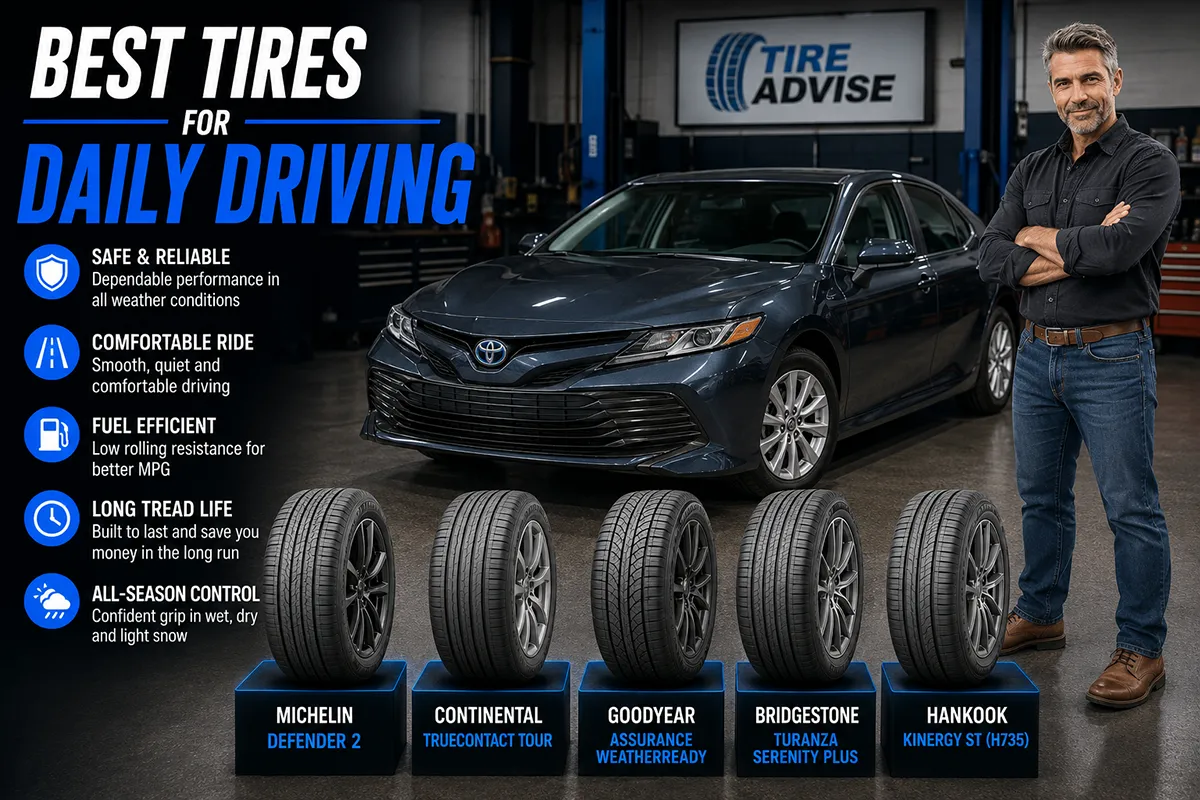
The tire that makes your commute better doesn’t have to be expensive or complicated. It just has to match how you actually drive.
That’s genuinely different depending on your vehicle and priorities — comfort, fuel economy, budget, or increasingly, EV-specific needs most guides skip entirely.
This guide is built from manufacturer specifications, aggregated owner data, and independent test results. Here’s what actually holds up for everyday driving, by priority.
- Best overall: Michelin Defender T+H.
- Best for fuel economy: Continental TrueContact Tour.
- Best for a quiet ride: Bridgestone Turanza QuietTrack.
- Best all-weather versatility: Goodyear Assurance WeatherReady2.
- Best for luxury vehicles: Pirelli P7 All Season Plus II.
- Best value: Cooper CS5 Ultra Touring.
- Best budget option: General AltiMAX RT43.
- Best for EVs: Michelin CrossClimate2.
- Full picks by priority and a note on EV-specific tire needs are below.
Liked this article?
Add TireAdvise as a preferred source so you see more of our tire reviews and guides on Google.
Daily Driving Now Includes a Lot More EVs — Here’s What Changes
This is worth addressing directly, since it’s a real gap in most tire advice for commuters. A growing share of daily drivers are now EVs, and their tire priorities genuinely differ from a gas car’s.
EVs are heavier than comparable gas vehicles, thanks to battery weight, which accelerates tire wear and demands a higher load rating. Many EV manufacturers now specify tires with an “EV” or reinforced designation for exactly this reason, so don’t assume a standard passenger tire in the right size is automatically the right fit.
Instant torque from electric motors also wears tires faster, especially at the front or rear depending on drivetrain layout. Owners commonly report needing replacement several thousand miles sooner than they would on a comparable gas vehicle, particularly on the drive axle.
Cabin noise matters more too. Without an engine to mask road noise, tire hum becomes much more noticeable — which is exactly why several EV owners specifically seek out the quiet-focused tires in this guide, even on trims that wouldn’t otherwise be marketed as comfort-oriented.
Rolling resistance has a more direct, visible impact on an EV as well, since it shows up as reduced range rather than a vague fuel-economy number. A genuinely low-rolling-resistance tire can measurably extend range, not just save a few dollars at the pump, and the difference is often large enough that owners notice it on the vehicle’s own range estimate.
None of this means EV owners need a completely separate shopping list — several tires in this guide, particularly the comfort and efficiency-focused options, work well for both. But it’s worth knowing before you buy.
How These Were Evaluated
This comparison draws on manufacturer specifications, aggregated owner reports, UTQG ratings, and independent traction and tread-wear testing for each tire.
Particular weight went to how each tire’s real-world character matches genuine daily-driving priorities: tread life, all-season capability, wet-weather grip, road noise, and fuel efficiency all carry real weight, since a daily driver needs to perform competently across all of them rather than excelling narrowly in one.
Where specific figures or comparisons are cited, the source is noted rather than presented as a personal measurement.
Quick Comparison: 11 Best Tires for Daily Driving
| Tire | Best For | Approx. Price/Tire | 3PMSF Rated | Warranty |
|---|---|---|---|---|
| Michelin Defender T+H | Best overall | $130–$160 | No | 80,000 mi |
| Continental TrueContact Tour | Fuel economy | $115–$150 | No | 80,000 mi |
| Bridgestone Turanza QuietTrack | Quiet ride | $140–$180 | No | 80,000 mi |
| Goodyear Assurance WeatherReady2 | All-weather versatility | $130–$170 | Yes | 60,000 mi |
| Pirelli P7 All Season Plus II | Luxury vehicles | $150–$200 | No | Not specified |
| Cooper CS5 Ultra Touring | Best value | $95–$130 | No | 70,000 mi |
| Yokohama AVID Ascend GT | Responsive handling | $100–$140 | No | 65,000 mi |
| Firestone WeatherGrip | Budget all-weather | $120–$160 | Yes | 65,000 mi |
| General AltiMAX RT43 | Budget option | $90–$120 | No | 65,000–75,000 mi |
| Hankook Kinergy PT | Long-distance commuters | $100–$140 | No | Not specified |
| Michelin CrossClimate2 | Best for EVs | $175–$230 | Yes | 60,000–85,000 mi (size dependent) |
Prices are street prices at major online retailers for common daily-driver sizes as of mid-2026. Expect regional and seasonal swings.
Should You Even Replace Your Factory Tires?
If your factory tires are wearing evenly and the car still feels composed, replacing like-for-like with a comparable tire in the same category is the lowest-risk, most sensible starting point.
For EV owners specifically, checking whether your factory tires carry a low-rolling-resistance or EV-specific designation is worth doing before assuming any comparable-looking replacement will perform the same on range.
1. Michelin Defender T+H: Best Overall

Price Check
Check the price of this tire at the following retailers:
This tire delivers a genuinely strong balance of performance, comfort, and longevity that makes it the strongest all-around pick for most daily drivers.
Michelin’s MaxTouch Construction distributes driving forces evenly across the contact patch, extending tread life while contributing to real fuel efficiency. Backed by an 80,000-mile warranty — among the highest in the industry — this is a genuine long-term investment.
All-season capability is a real strength, with IntelliSipe technology providing dependable traction from dry summer roads to light winter precipitation, and four wide circumferential grooves delivering confident wet-weather handling.
Comfort rounds out the package. Michelin’s Comfort Control Technology minimizes road noise through computer-optimized tread design, creating a genuinely serene cabin on longer commutes.
Pros: Genuine longevity backed by an 80,000-mile warranty, dependable all-season traction, comfortable and quiet ride.
Cons: Premium price relative to budget options.
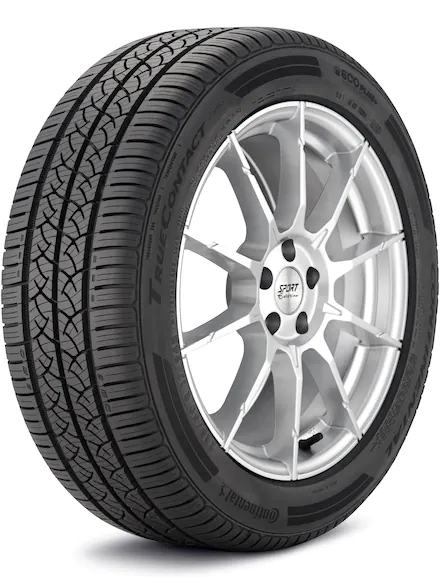
2. Continental TrueContact Tour: Best for Fuel Economy
Price Check
Check the price of this tire at the following retailers:
This tire is genuinely engineered around low rolling resistance, delivering real fuel-economy benefits that add up over thousands of commuting miles.
Continental’s EcoPlus Technology uses a silica-enhanced compound that remains flexible in cold weather while staying rigid when hot, meaning less energy loss across seasons rather than just in ideal conditions.
Backed by an 80,000-mile warranty for T-speed rated sizes, this tire delivers genuine long-term value alongside its efficiency focus. Full-depth sipes and traction grooves provide real wet-weather capability, and a comfort-tuned tread pattern keeps road noise well-controlled.
Pros: Genuine fuel-efficiency benefit, strong 80,000-mile warranty, confident wet-weather grip.
Cons: Not the sharpest handling option here, not 3PMSF rated.
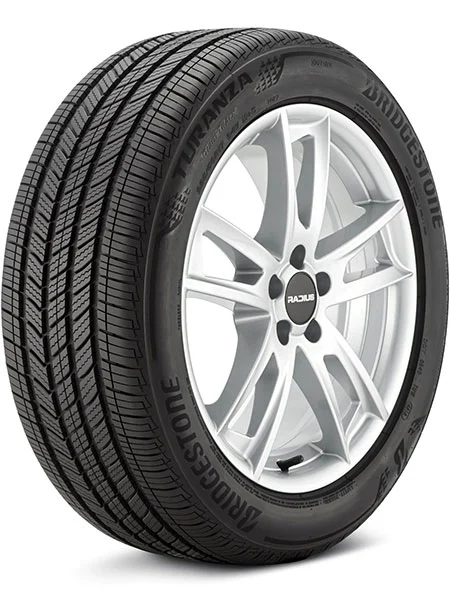
3. Bridgestone Turanza QuietTrack: Best for a Quiet Ride
Price Check
Check the price of this tire at the following retailers:
This tire is purpose-built around a genuinely serene cabin experience — a real priority for EV owners especially, given how much more noticeable road noise becomes without engine sound to mask it.
Bridgestone’s QuietTrack technology uses in-groove quiet tracks specifically engineered to break up noise patterns, and non-uniform pitch sequencing prevents the harmonics that cause persistent tire hum on lesser tires.
Comfort extends beyond noise. ComfortCruise technology combines a supple sidewall with an optimized contact patch that absorbs road imperfections, and a temperature-adaptive compound stays consistent across seasons.
Backed by an 80,000-mile warranty, with wide circumferential grooves for confident wet traction and embedded winter bite particles for adequate light-snow grip, this is the strongest pick for anyone who wants the quietest possible daily commute.
Pros: Genuinely class-leading noise reduction, strong 80,000-mile warranty, respectable light-snow traction.
Cons: Premium price, not built for aggressive driving.
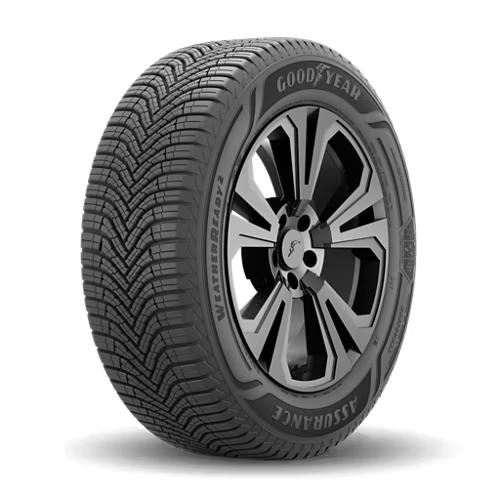
4. Goodyear Assurance WeatherReady2: Best All-Weather Versatility
Price Check
Check the price of this tire at the following retailers:
Goodyear updated the Assurance WeatherReady to the WeatherReady2, and for daily drivers who face genuinely unpredictable weather, this remains one of the strongest single-tire solutions available.
It carries real 3-Peak Mountain Snowflake certification — meaning it’s actually passed severe-snow testing, a genuine distinction from a tire that merely claims all-weather capability.
Goodyear’s Weather Reactive Technology uses evolving tread grooves that widen as the tire wears, maintaining wet performance throughout the tire’s life rather than losing capability as tread depth decreases. Deep, sweeping grooves handle heavy rain effectively, and TredLock Technology delivers confident dry handling without sacrificing wet or snow capability.
Backed by a 60,000-mile warranty, this tire eliminates the need for seasonal tire swaps for daily drivers in variable-climate regions.
Pros: Genuine 3PMSF-rated versatility, wet traction that improves rather than degrades with wear, eliminates seasonal swaps.
Cons: Premium price relative to standard all-season options.
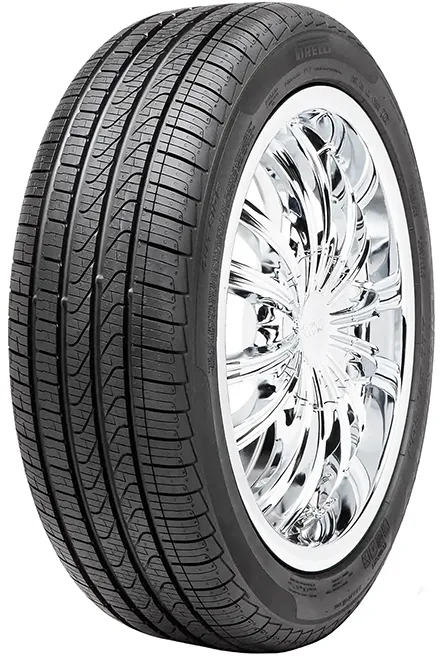
5. Pirelli P7 All Season Plus II: Best for Luxury Vehicles
Price Check
Check the price of this tire at the following retailers:
This tire delivers a genuinely premium ride quality that suits luxury sedans and crossovers particularly well.
An advanced silica-enriched compound and optimized tread pattern absorb road imperfections with real ease, delivering the plush, refined ride luxury vehicle owners expect on daily commutes.
Handling precision is a real strength too. An asymmetric tread with rigid shoulder blocks provides exceptional responsiveness during lane changes and cornering, maintaining the engineered handling dynamics luxury vehicles are tuned around.
Pirelli’s Noise Cancelling System — sound-absorbing material inside the tire — genuinely reduces road noise transmission by up to 25%, and four wide circumferential grooves deliver confident wet traction alongside respectable light-winter capability.
Pros: Genuinely premium ride quality, real noise-reduction technology, confident handling precision.
Cons: Premium price, not built for severe winter conditions.
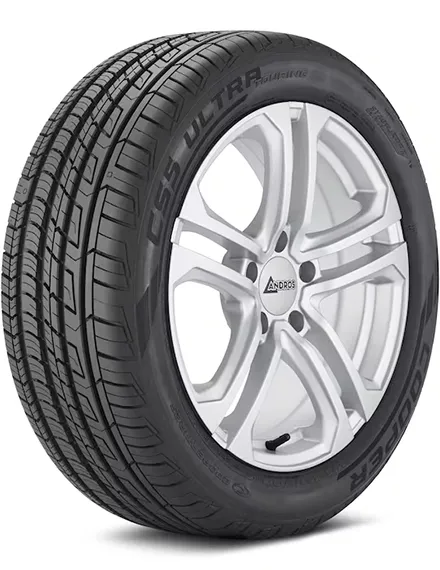
6. Cooper CS5 Ultra Touring: Best Value
Price Check
Check the price of this tire at the following retailers:
This tire delivers a genuinely strong cost-to-performance ratio, with a 70,000-mile warranty that rivals or exceeds many premium-priced competitors.
Cooper’s Stabiledge Performance technology helps maintain consistent tread block stability during everyday driving, and a symmetric tread pattern with optimized pitch sequence delivers a smooth, quiet ride that holds up throughout the tire’s life.
Wet performance is a real strength — 3D Micro-Gauge siping and Aqua Vac Channels effectively evacuate water, meaningfully reducing hydroplaning risk. Real owner reports describe steering feedback and cornering stability that feel more premium than the price suggests.
Pros: Genuine value with a strong 70,000-mile warranty, confident wet-weather grip, respectable handling for the price.
Cons: Not 3PMSF rated, doesn’t match premium tires’ outright refinement.
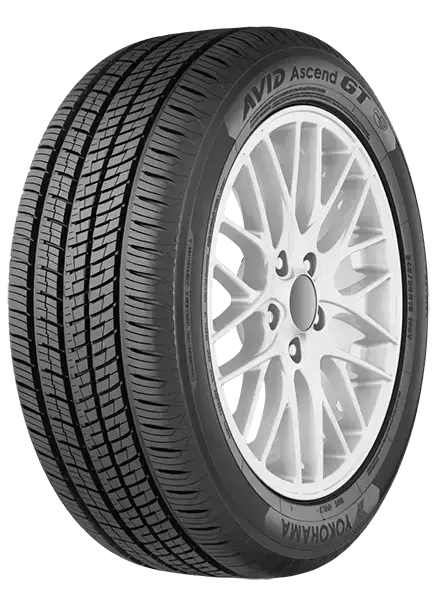
7. Yokohama AVID Ascend GT: Best Responsive Handling
Price Check
Check the price of this tire at the following retailers:
For daily drivers who want a bit more engagement without sacrificing everyday usability, this tire delivers genuinely responsive handling.
An asymmetric tread with rigid outer shoulder blocks creates a solid contact patch that maintains real stability during lane changes and highway merges, and Yokohama’s high-silica compound balances grip with longevity rather than sacrificing one for the other.
BluEarth technology reduces rolling resistance for a real fuel-efficiency benefit, and triple 3D sipes enhance wet traction without compromising the tire’s structural integrity during cornering.
Pros: Genuine steering responsiveness, real fuel-efficiency benefit, confident wet-weather grip.
Cons: Not 3PMSF rated, doesn’t match dedicated performance tires at the limit.
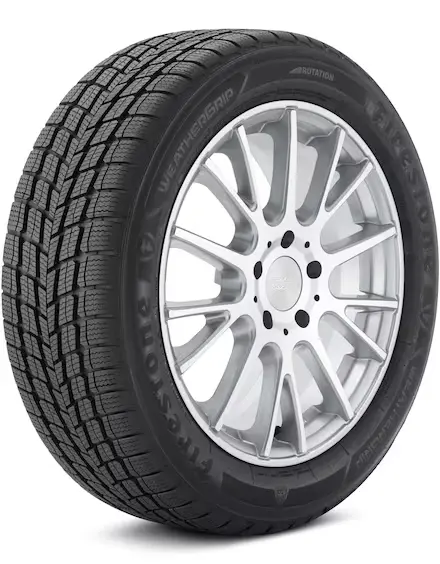
8. Firestone WeatherGrip: Best Budget All-Weather Option
Price Check
Check the price of this tire at the following retailers:
This tire delivers genuine severe-weather capability at a price well below premium alternatives, carrying real 3-Peak Mountain Snowflake certification.
An advanced full-depth tread design with open shoulder slots and deep grooves effectively channels water, slush, and snow away from the contact patch, meaningfully reducing hydroplaning risk across conditions.
Year-round usability is where this tire genuinely delivers value — a specialized all-weather compound remains flexible in cold while resisting wear in heat, eliminating the need for seasonal changes. Backed by a 65,000-mile warranty, with real owner reports describing 50,000–60,000 miles with proper maintenance.
Pros: Genuine 3PMSF-rated capability at a budget price, eliminates seasonal tire changes, strong real-world tread life.
Cons: Doesn’t match premium tires’ refinement, moderate road noise.
9. General AltiMAX RT43: Best Budget Option

Price Check
Check the price of this tire at the following retailers:
This tire proves that quality daily driving tires don’t require premium pricing, delivering genuinely impressive performance for the cost.
A twin-cushion silica tread compound provides a surprisingly comfortable, quiet ride for the price, and reliable dry-road traction with responsive steering holds up well for everyday scenarios. Circumferential grooves and Anti-Slip Sipe Design technology handle wet conditions effectively.
Longevity is a real standout — backed by a 75,000-mile warranty for T-rated sizes and 65,000 for H-rated sizes, coverage that rivals or exceeds many pricier competitors. Low Surface Abrasion technology reduces tread distortion, promoting genuinely even wear.
Pros: Genuine value with a strong warranty, comfortable ride for the price, respectable light-snow capability.
Cons: Not 3PMSF rated, doesn’t match premium tires in extreme conditions.
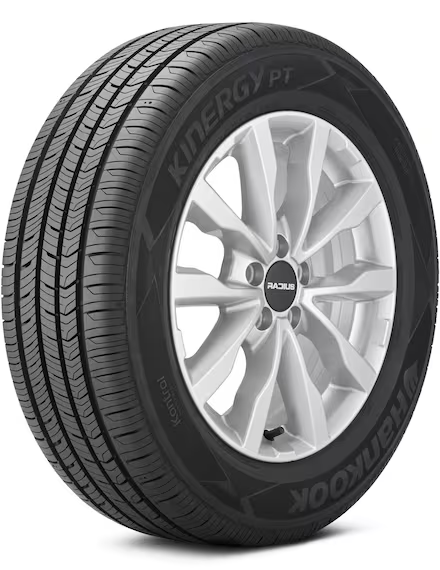
10. Hankook Kinergy PT: Best for Long-Distance Commuters
Price Check
Check the price of this tire at the following retailers:
For daily drivers who spend hours on the highway every week, this tire delivers a genuinely strong combination of durability, comfort, and value.
A high-density silica compound resists wear even under the constant stress of highway speeds, with many owners reporting 70,000-plus miles from a set — genuine long-term value for high-mileage commuters.
Highway comfort is a real strength. A symmetric tread pattern with optimized block stiffness delivers a smooth ride, and a continuous center rib maintains constant road contact, reducing the vibration fatigue that makes long drives exhausting.
Stability at highway speeds holds up well, with wide circumferential grooves managing sudden downpours effectively, and this tire’s pitch sequence design keeps noise levels low even as the tire wears — a genuine, uncommon advantage over tires that get progressively louder with age.
Pros: Genuine long-term durability for high-mileage driving, sustained low noise as the tire wears, real fuel-efficiency benefit.
Cons: Not 3PMSF rated, not the sharpest handling option here.
11. Michelin CrossClimate2: Best for EVs

Price Check
Check the price of this tire at the following retailers:
For daily drivers — especially EV owners — who want genuine winter capability without a seasonal tire swap, this tire offers the strongest all-weather, no-compromise option in this comparison.
It carries real 3PMSF certification and delivers significantly better cold-weather performance than a typical all-season tire. A V-shaped tread with dense biting edges maintains solid traction in light to moderate snow, while dry-weather handling and tread life remain genuinely respectable.
For EVs specifically, this tire’s construction handles the added weight and instant-torque wear reasonably well relative to standard all-season options, and its refined, low-noise character suits the quieter cabin of an electric vehicle.
Warranty coverage varies meaningfully by size, so confirm the specific figure for your exact fitment.
Pros: Genuine 3PMSF-rated winter capability without seasonal swapping, respectable dry handling, well-suited to EV weight and noise characteristics.
Cons: Premium price, doesn’t match a dedicated winter tire on ice.
Maintaining Daily Driving Tires
Check pressure at least monthly, and always when tires are cold. Pressure drops roughly 1 PSI for every 10°F temperature decrease, so seasonal checks matter more than owners often expect, especially during fall and spring when swings can be dramatic day to day. Confirm the correct PSI on the door jamb sticker, not the tire’s sidewall, which shows maximum pressure rather than the recommended figure.
Rotate every 5,000 to 8,000 miles, following your vehicle manufacturer’s specific pattern. Front tires typically wear faster on front-wheel-drive vehicles due to steering and acceleration forces, and EVs with a single drive axle often show even more pronounced front-to-rear wear differences worth watching for.
Have alignment checked annually, or sooner if you notice pulling to one side, a crooked steering wheel while driving straight, or uneven wear. Even a minor pothole or curb strike can knock alignment out of spec, and daily commuters who navigate the same rough patches repeatedly are more exposed to this than occasional drivers.
Watch for genuine replacement signs: tread depth below 4/32″ (the penny test works as a quick check), uneven wear patterns, sidewall bulges or cracks, or decreased wet-weather performance.
Factor in tire age, not just tread depth. Most manufacturers recommend replacement at 6–10 years regardless of remaining tread, since rubber compounds degrade with age. Check the four-digit DOT date code on the sidewall.
Choosing the Right Tire for Your Daily Drive
Match tire category to how you actually drive. Commuters who prioritize comfort and quiet get real value from the Bridgestone Turanza QuietTrack or Michelin Defender T+H. Budget-conscious drivers get genuine value from the Cooper CS5 Ultra Touring or General AltiMAX RT43.
Don’t skip winter capability facing real cold. The Goodyear Assurance WeatherReady2 or Michelin CrossClimate2 deliver genuine 3PMSF-rated traction a standard all-season tire hasn’t earned.
EV owners should weigh rolling resistance and noise more heavily than gas-car owners typically do, since both have a more direct, felt impact on the daily driving experience.
Replace tires in complete sets when possible, or at minimum in pairs placed on the rear axle, to maintain balanced handling during emergency maneuvers.
Frequently Asked Questions
How often should I rotate my daily driving tires?
Every 5,000 to 8,000 miles, following your vehicle manufacturer’s specific recommendation. Regular rotation equalizes wear patterns and extends overall tire life.
Are all-season tires good enough for winter driving?
All-season tires handle light winter conditions adequately, but for severe weather with regular snowfall or temperatures consistently below 45°F, a genuine 3PMSF-rated tire like the Goodyear Assurance WeatherReady2 delivers meaningfully better traction and safety.
Do EVs need different tires than gas cars for daily driving?
Not entirely different, but priorities shift. EVs are heavier, deliver instant torque that accelerates wear, and have quieter cabins where road noise becomes more noticeable. Look for tires with genuine low rolling resistance, EV-specific load ratings, and strong noise-reduction technology.
What’s the difference between all-season and all-weather tires?
All-season tires provide adequate performance across most conditions but can struggle in severe winter weather. All-weather tires like the Goodyear Assurance WeatherReady2 carry genuine 3-Peak Mountain Snowflake certification, delivering real severe-snow capability without requiring a seasonal tire change.
How much can good tires improve fuel economy or EV range?
Genuinely low-rolling-resistance tires like the Continental TrueContact Tour can improve gas-vehicle fuel economy by 1–3% or more. For EVs, the same rolling-resistance benefit shows up more directly as extended range rather than a fuel-cost figure.
What’s the best budget-friendly tire option for daily driving?
The General AltiMAX RT43 and Cooper CS5 Ultra Touring both deliver genuine value, with strong warranties and respectable performance at prices well below premium alternatives.
How do I know when it’s time to replace my daily driving tires?
Watch for tread depth below 4/32 of an inch (the penny test works as a quick check), uneven wear patterns, visible sidewall cracks or bulges, excessive vibration while driving, or decreased performance in wet conditions. Also factor in tire age — most manufacturers recommend replacement after 6–10 years regardless of remaining tread depth.
