

I’ll be straight with you: I ignored uneven tire wear on my first car for way too long. I could feel a faint shimmy through the steering wheel and noticed one front tire looked “different” from the others — but I kept telling myself it was nothing.
Three months later, I was standing in a parking lot with a blown tire, a bent rim, and a very humbling phone call to make.
That experience turned me into someone who now checks tires obsessively. And if you’ve landed on this page, you’ve probably noticed something off too.
Uneven tire wear is almost never random — every wear pattern tells a specific story about your tires, alignment, inflation, or suspension. Diagnose the pattern first, fix the root cause, and then decide whether a rotation will even things out or whether it’s time for new rubber. Don’t skip steps — patching the symptom without fixing the cause just burns through your next set of tires too.
Liked this article?
Add TireAdvise as a preferred source so you see more of our tire reviews and guides on Google.
Why Uneven Tire Wear Deserves Your Full Attention
Most drivers treat tires like appliances — swap them when they quit working. But tires are actually one of the most information-rich parts of your car.
The tread surface is essentially a diagnostic readout for everything happening underneath: your alignment, suspension health, inflation habits, and driving behavior all leave a signature in the rubber.
When wear is uneven, it means something is wrong right now — and it’s been wrong for a while. The longer you drive on a misdiagnosed problem, the faster it compounds.
A minor alignment issue that costs $80 to fix can quietly destroy a $200 tire in under 10,000 miles. I’ve seen it happen on my own vehicles and on dozens of cars I’ve evaluated for this site.
The good news: if you catch it early enough, uneven wear is usually fixable without replacing the tires immediately. But you have to understand what you’re looking at first.
How to Inspect Your Tires for Uneven Wear
Before we dive into patterns, let’s talk about how to actually look at your tires properly. Don’t just glance at them while walking past. Do this:
- Park on a flat surface with the wheels pointed straight ahead.
- Get down low — eye level with the tire — and look across the tread surface from the front and from the side.
- Run your hand across the tread in both directions. Your fingertips will feel feathering, cupping, and edge wear before your eyes can see it clearly.
- Check all four tires, not just the ones that look suspicious. Patterns often differ between axles, and that asymmetry is part of the diagnosis.
- Note the mileage since your last rotation and alignment check.
One thing I always do: I use a tread depth gauge at four points across the tire width — outer edge, outer shoulder, inner shoulder, and inner edge. If those numbers are more than 2/32″ apart on the same tire, something is off. A $5 depth gauge from any auto parts store will tell you more than eyeballing ever will.
The 7 Most Common Uneven Tire Wear Patterns — and What Each One Means
1. Inner Edge (Inside) Wear
What it looks like: The inner shoulder of the tire is worn significantly more than the outer tread or center.
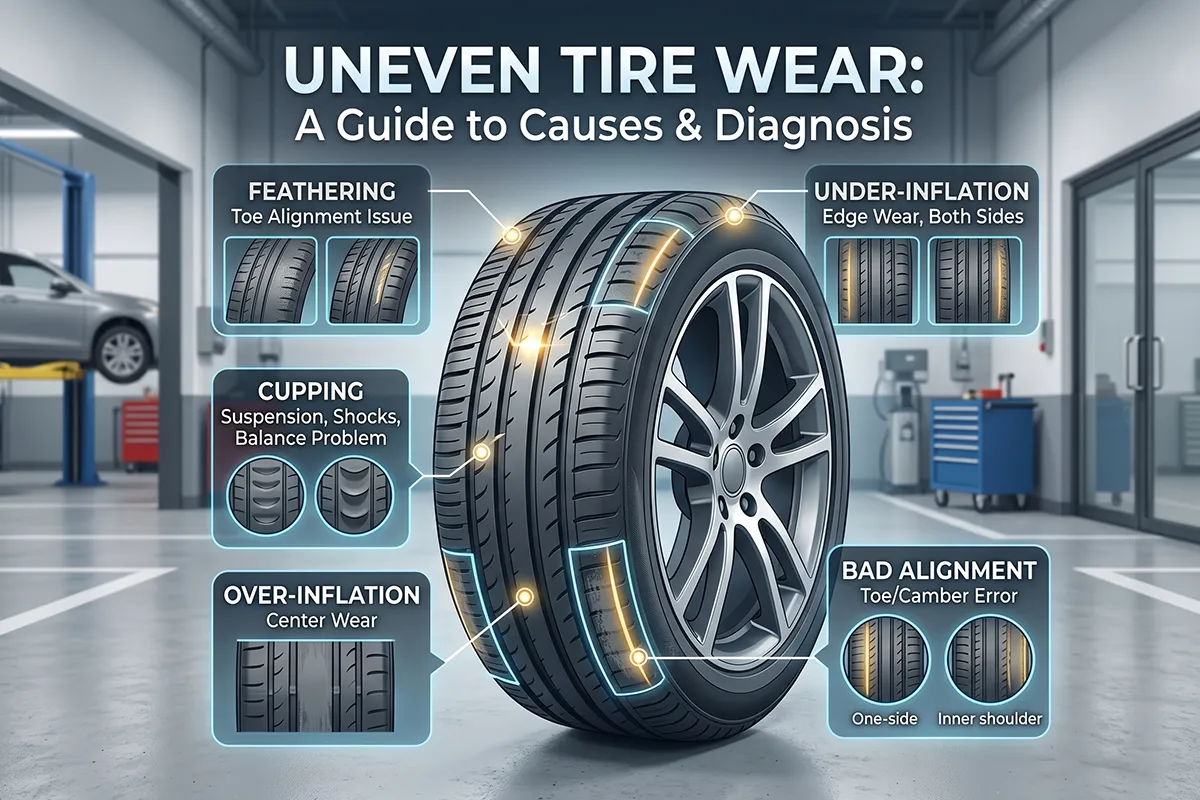
What it means: This is almost always a negative camber problem — your wheel is tilted inward at the top, which concentrates load on the inside edge. It can also be caused by worn ball joints, a collapsed strut, or a bent control arm.
I ran into this pattern on a used SUV I picked up a few years back. The previous owner had done a mild suspension lift without re-aligning, and the inner edges on the rear tires were down to 3/32″ while the centers still showed 7/32″. The tires were only 22,000 miles old.
Fix: Get a full four-wheel alignment. If alignment alone doesn’t correct it, have your suspension inspected — the camber issue may be caused by worn or damaged components that alignment adjustments can’t compensate for.
2. Outer Edge (Outside) Wear
What it looks like: The outer shoulder is worn down faster than the rest of the tread.
What it means: Usually positive camber or chronic underinflation. When a tire is underinflated, the outer shoulders carry the most load under cornering. Positive camber (wheel tilted outward at the top) creates the same mechanical wear pattern.
This is the wear pattern I see most often in daily drivers, simply because underinflation is so common. The TPMS warning light doesn’t trigger until you’re 25% below recommended PSI — by which time the outer edges are already taking a beating.
Fix: First, inflate to the pressure listed on your door jamb sticker (not the number on the tire sidewall — that’s max pressure). Then get an alignment check. If the wear is severe on one side more than the other, have the suspension inspected.
3. Center Wear
What it looks like: The center of the tread is noticeably more worn than the shoulders, giving the tire a slightly rounded or “balloon” look in cross-section.
What it means: Chronic overinflation. When you run too much air pressure, the tire bulges in the center and that center rib does all the work. The shoulders barely touch the road.
I deliberately ran one test tire 15 PSI over spec for 8,000 miles during a long-term evaluation on my personal vehicle. The center tread loss was significant — about 2/32″ more than the shoulders. The ride was also noticeably harsher and the tire was noisier.
Fix: Deflate to the correct PSI immediately. If you catch it early, a rotation can help even things out. If the center is already significantly lower than the shoulders, the tire is compromised for wet weather performance even if it still has tread depth.
4. Two-Sided Edge Wear (Both Shoulders)
What it looks like: Both outer edges are worn, but the center tread is higher — the tire looks like a “U” shape in cross-section.
What it means: Chronic underinflation. The tire is running too soft, so it flattens out under load and both edges contact the road harder than the center.
This pattern is sometimes confused with the opposite of center wear, but it’s distinct — you’ll see equal wear on both shoulders simultaneously.
Fix: Inflate to the correct pressure. If this has been ongoing, check for a slow leak at the valve stem or a bead seal issue. Always fix the pressure problem before rotating.
5. Feathering (Sawtooth Wear)
What it looks like: Individual tread blocks look sharp or “feathered” on one side and rounded on the other. Running your hand across the tread in one direction feels smooth; the other direction feels jagged, like dragging your fingers against a row of fins.
What it means: Toe misalignment. When a tire is toed in or out, it’s constantly scrubbing laterally as it rolls forward. This creates that directional, sawtoothed wear on the tread block edges. Toe-out wear typically feathers toward the outside of the tread; toe-in toward the inside.
Feathering is one of the easier patterns to detect by feel before you can see it clearly. If you’re not sure what you’re looking for, run your palm across the tread — one direction will feel noticeably rougher.
Fix: Four-wheel alignment, specifically a toe adjustment. Feathering can start showing up within a few thousand miles of an alignment going out of spec, so if your last alignment was over 12 months ago or you’ve hit a significant pothole since then, it’s worth checking.
6. Cupping or Scalloping
What it looks like: The tread surface has irregular, scalloped-out cups or dips — almost like someone took rounded scoops out of it at somewhat random intervals around the circumference.
What it means: Worn or damaged shocks/struts, or wheel balance issues. When a shock absorber is worn, the tire bounces rather than maintaining steady contact with the road. Those repeated impacts dig into the tread surface and create the scalloped pattern. An out-of-balance tire can also cause cupping by creating rhythmic high-load contact points.
Cupping is often accompanied by a thumping or rumbling noise at highway speeds and a noticeably rough, choppy ride. If your car suddenly started riding like a farm truck on a gravel road, cupped tires and worn shocks are often the cause.
This is the wear pattern I take most seriously, because it usually means the tire and the suspension component need to be addressed simultaneously.
Fix: Have your shocks and struts inspected — they likely need replacement. Check wheel balance at the same time. A cupped tire can sometimes be saved with a rotation if the wear is caught early, but more often the tire needs replacement because the cupped surface creates a rough ride and unpredictable handling even after the root cause is fixed.
7. Patchy or Flat Spot Wear
What it looks like: One or more flat, worn spots around the circumference. Unlike cupping, flat spots are more geometric and consistent in shape.
What it means: Usually the result of hard braking or skidding (especially on vehicles without ABS), prolonged parking on a cold surface, or in some cases a sticking brake caliper that drags on one spot.
I’ve also seen flat spots on vehicles that sat in storage for several months — the tire deforms slightly at the contact point when stationary under load for extended periods.
Fix: If caused by braking, rotate the tire to a non-steering position and the flat spot may wear down over time. If it’s severe or caused by a sticking caliper, the caliper needs service and the tire likely needs replacement — a flat spot creates vibration that often doesn’t fully go away.
The Root Causes: A Diagnostic Summary
| Wear Pattern | Most Likely Cause | Secondary Cause |
|---|---|---|
| Inner edge | Negative camber | Worn ball joint / control arm |
| Outer edge | Positive camber | Underinflation |
| Center wear | Overinflation | — |
| Both edges | Underinflation | Slow leak |
| Feathering | Toe misalignment | — |
| Cupping/scalloping | Worn shocks/struts | Wheel imbalance |
| Flat spots | Brake lock-up / caliper drag | Long-term static storage |
What Happens If You Ignore Uneven Tire Wear
I’ll be blunt here because I’ve seen this go badly: running on severely uneven tires isn’t just about tire longevity. It’s a safety issue.
Traction loss in wet conditions is the biggest risk. A tire with worn inner or outer edges has a fraction of the wet grip of a tire with even tread depth across the full contact patch. The grooves that channel water away from the contact patch simply aren’t there on the worn portion. Hydroplaning risk increases substantially.
Handling unpredictability is the second concern. A car with mismatched wear patterns across axles doesn’t respond the same way in every direction. Emergency maneuvers — the kind where your muscle memory has to take over instantly — can produce unexpected results.
Structural failure is the worst case. A tire worn to the point where the inner belts are exposed can fail catastrophically, especially at highway speeds. I’ve seen the aftermath. It’s not something you want to deal with at 70 mph.
Tire Rotation: When It Helps and When It Doesn’t
Rotation is your first line of defense against uneven wear — but only if you use it correctly.
A rotation makes sense when:
- Wear differences are minor (within 2–3/32″ across the tire)
- The root cause has already been fixed (alignment corrected, pressure normalized, etc.)
- You’re rotating on schedule every 5,000–7,500 miles as preventive maintenance
A rotation does not make sense when:
- The root cause hasn’t been addressed (rotating onto a different axle doesn’t fix your alignment)
- Wear is already severe on one area — rotating a dangerously worn tire to a new position just puts the problem in a different corner
- The tire is directional and can’t be moved side-to-side without dismounting and remounting
For more on keeping your tires in good shape long-term, my tire buying and maintenance guide covers rotation schedules, alignment intervals, and inflation best practices in detail.
When Is It Time to Replace the Tire?
Not every uneven wear situation means a new tire right away. Here’s my honest framework for deciding:
Replace immediately if:
- Any area of the tread is at or below 2/32″ (the legal minimum in most states)
- The wear has exposed cords, fabric, or steel belts
- The sidewall is damaged or shows bulging
- Cupping is severe enough that the tire is creating constant vibration
Consider replacement soon if:
- Wear variance across the tire is greater than 3/32″ and the tire is over 40,000 miles old
- The pattern suggests the tire has been running damaged for an extended period
Rotation + fix may be enough if:
- Wear differences are small (within 2/32″)
- The root cause is corrected before rotating
- The tire has significant remaining tread depth in its least-worn zone
How to Prevent Uneven Tire Wear Going Forward
After diagnosing and fixing a wear problem, here’s the ongoing maintenance routine that keeps tires wearing evenly in my experience:
Check inflation monthly. Tires naturally lose 1–2 PSI per month. Temperature swings accelerate this — a 10°F drop in ambient temperature reduces tire pressure by about 1 PSI. Use a quality gauge, not the one at the gas station air pump.
Rotate every 5,000–7,500 miles. I do mine every other oil change. If you’re unsure of your last rotation, put it on the calendar now.
Alignment once per year, or after any significant impact. Pothole season is real. A single hard hit can knock your alignment out of spec. If you’ve hit something substantial, get it checked — the cost of an alignment check is nothing compared to the cost of the wear it prevents.
Inspect tires visually every time you wash the car. You’re already walking around the vehicle — take 90 seconds and look at each tire from the front and from the side.
Replace shocks and struts proactively. Most OEM shocks are good for 50,000–70,000 miles. After that, their wear-absorbing capability degrades even if they haven’t technically “failed.” If you’re past that mileage and noticing cupping or a rougher ride, it’s worth a suspension inspection.
Frequently Asked Questions
What is the most common cause of uneven tire wear?
Improper inflation and misalignment are the two most frequent causes. In my experience reviewing tires and speaking with drivers, underinflation and neglected alignment — often both at once — account for the majority of uneven wear cases I see.
Can I fix uneven tire wear myself?
You can fix inflation at home immediately. Rotation is a DIY job if you have the equipment. But alignment and suspension work require professional equipment — attempting to adjust toe or camber without a proper alignment rack is likely to make things worse.
How quickly does uneven wear happen?
It depends on the severity of the underlying problem. A tire that’s consistently underinflated by 10 PSI can show shoulder wear in as little as 5,000–8,000 miles. A severe alignment issue can do the same. Mild misalignment may take 15,000–20,000 miles to create visible wear variance.
Does rotating tires fix uneven wear?
Not by itself, and not if the root cause hasn’t been addressed. Rotation redistributes wear across all four tires, which is valuable for evening out minor differences — but if your alignment is still off, you’ll just wear out the new position’s tires faster.
Is it safe to drive on tires with uneven wear?
Minor uneven wear with adequate tread depth remaining — yes, but address the root cause promptly. Severe wear, tread depth below 4/32″ on any worn zone, or cupping/scalloping that creates noticeable vibration — no. Pull over and evaluate. Wet traction is compromised before tires look visually dangerous.
How much does an alignment cost?
A standard two-wheel (front) alignment typically runs $50–$100. A four-wheel alignment runs $100–$175 at most shops. Some tire shops offer free alignment checks. Given that a set of mid-range tires costs $400–$800, an $80 alignment is one of the best investments in tire longevity you can make.
Why is only one front tire wearing unevenly?
Single-tire uneven wear on the front axle often points to a localized suspension issue — a worn ball joint, a bent strut, or a sticking caliper on that corner specifically. A full-vehicle alignment check would be the first step; if the alignment is in spec on that corner, the mechanic should look at suspension components.
Final Thoughts
Uneven tire wear is one of those things that seems like a minor annoyance until it isn’t. I’ve learned to treat any wear irregularity as a signal worth investigating immediately — not because I’m paranoid, but because every time I’ve done the diagnostic work, there’s been a real problem underneath worth fixing.
The framework is simple: identify the pattern, trace it to the root cause, fix the cause, then decide whether to rotate or replace. That sequence matters. Skipping straight to a tire swap without fixing what caused the wear is just an expensive way to repeat the same problem.
If you found this useful and want to go deeper on keeping your tires in top shape, check out my tire buying and maintenance guide — it covers everything from choosing the right tire for your vehicle to building a maintenance routine that extends tread life significantly.
Drive safe, and check your tires.
