

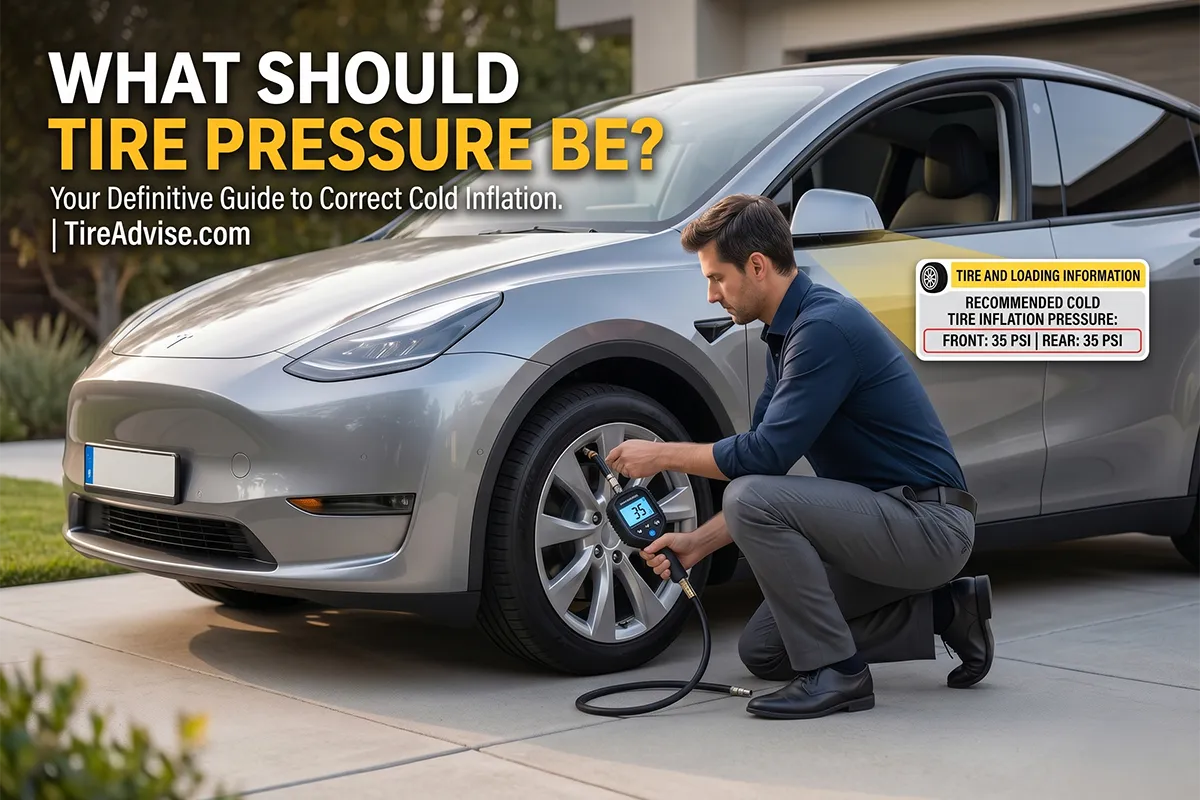
Most drivers drive on overinflated or underinflated tires without realizing it, usually only catching the mistake when the low tire pressure light illuminates—a delayed warning triggered by the vehicle’s tire pressure sensor (TPMS) after the tires have already lost a significant amount of air.
- Most passenger cars run best between 32–35 PSI.
- Trucks and SUVs typically run 35–44 PSI.
- The correct number for your specific car is printed on a sticker inside your driver’s door jamb — not the sidewall of the tire.
- Check your pressure when tires are cold, at least once a month. Read on for the full breakdown by vehicle type, season, and situation.
Before you go check your tires, take a few minutes to read through our complete tire buying and maintenance guide — it covers everything from reading tire specs to knowing when it’s time to replace.
Liked this article?
Add TireAdvise as a preferred source so you see more of our tire reviews and guides on Google.
Why Tire Pressure Matters More Than Most People Realize
I’ll be honest — for the first few years of driving, I treated tire pressure like a “check when the light comes on” situation. It wasn’t until I started writing seriously about tires that I actually understood how much PSI affects every single thing about how your car drives.
Tire pressure is the single most frequently neglected maintenance item on most vehicles, according to data from the National Highway Traffic Safety Administration (NHTSA). And yet it’s also one of the easiest to get right.
Here’s what riding on the wrong tire pressure actually does to your car:
Too low: The tire’s contact patch widens and the sidewall flexes more than it should. This generates heat — and heat is the enemy of rubber. You’ll see faster wear on the outer edges of the tread, reduced fuel economy (typically 0.2% per PSI below the recommended pressure), and in severe cases, a higher risk of a blowout, particularly at highway speeds.
Too high: The center of the tread bulges slightly and becomes the primary contact point. You’ll see premature center tread wear, a harsher ride, and reduced grip — especially in wet or emergency braking situations.
Neither extreme is “safer.” The right answer is always the manufacturer’s recommended PSI.
Where to Find Your Car’s Recommended Tire Pressure
This is the single most important thing in this article, so I want to say it clearly: do not use the maximum PSI printed on the sidewall of your tire. That number is the maximum the tire can hold — not what your car needs.
Your car’s recommended tire pressure is found in three places:
- Driver’s door jamb sticker — This is the most reliable source. Open your driver’s side door and look at the door frame or the edge of the door itself. There will be a white or yellow sticker with your vehicle’s tire size and the recommended cold inflation pressure.
- Owner’s manual — Usually in a chapter titled “Tires” or “Maintenance Specifications.”
- Fuel door or glove box — Some manufacturers put a second sticker here.
The sticker lists pressure for the front and rear tires separately. On many vehicles, these are the same number. On some performance cars and SUVs, they’re different — sometimes by as much as 4–6 PSI. Always check both.
What Is the Recommended Tire Pressure for Most Cars?
Here’s a general guide based on vehicle type. These are averages — your door sticker is always the final word.
Here’s a general guide based on vehicle type. These are averages — your door sticker is always the final word. If you want to see a detailed breakdown for specific makes and models (like Honda, Toyota, or Chevy), check out our full guide on recommended tire pressure by vehicle.
| Vehicle Type | Typical Recommended PSI (Front) | Typical Recommended PSI (Rear) |
|---|---|---|
| Compact/Sedan (e.g., Honda Civic, Toyota Corolla) | 32–35 PSI | 32–35 PSI |
| Midsize Sedan (e.g., Camry, Accord) | 32–35 PSI | 32–35 PSI |
| Crossover SUV (e.g., CR-V, RAV4) | 33–36 PSI | 33–36 PSI |
| Full-Size SUV (e.g., Tahoe, Expedition) | 35–42 PSI | 35–44 PSI |
| Half-Ton Pickup (e.g., F-150, Silverado 1500) | 35–40 PSI | 60–80 PSI (max load) |
| Minivan (e.g., Odyssey, Sienna) | 35–36 PSI | 35–36 PSI |
| Sports Car (e.g., Mustang, Camaro) | 32–35 PSI | 32–36 PSI |
Note on pickups: Many half-ton trucks have a significantly higher rear recommendation when carrying heavy loads. The door sticker on my test truck showed 35 PSI front / 35 PSI rear at base load, but the tire sidewall max was 80 PSI. Always cross-reference load conditions.
What Is “Cold” Tire Pressure — and Why Does It Matter?
Every manufacturer’s recommended PSI is a cold inflation pressure measurement. That means the tires haven’t been driven for at least three hours and have been sitting at ambient temperature.
Because outside weather dramatically changes the air density inside your tires, you’ll also want to understand the difference between tire pressure in winter vs summer to ensure you stay safe year-round.
When you drive, friction heats the air inside your tires, and hot air expands. It’s normal for tire pressure to rise 4–8 PSI after 20 minutes of highway driving. This is expected behavior — you shouldn’t let air out of a hot tire to hit the “recommended” number.
The practical takeaway: always check tire pressure before your first drive of the day, or after the car has been parked for at least 3 hours. If you’ve never done this manually before, read our quick, step-by-step tutorial on how to check tire pressure. I keep a digital tire gauge in my center console and do a quick check every few weeks when I first pull out of the garage.
What Tire Pressure Is Too Low?
I use this simple rule: anything more than 5 PSI below the recommended pressure is a problem that needs addressing today. If your recommended PSI is 35 and you’re sitting at 28, that’s not a “I’ll deal with it this weekend” situation.
Here’s a more detailed breakdown:
| Reading vs. Recommended | Status | Action |
|---|---|---|
| 0–3 PSI below | Slightly low — common due to temperature drop | Inflate to spec when convenient |
| 4–7 PSI below | Noticeably low | Inflate before your next significant drive |
| 8–10 PSI below | Significantly underinflated | Inflate now; inspect for slow leak |
| More than 25% below recommended | Severely underinflated | Do not drive; risk of tire failure |
At 20% below the recommended PSI, NHTSA considers a tire “significantly underinflated.” On a 35 PSI tire, that’s 28 PSI — a number that’s easy to hit over a cold fall or winter without noticing.
Signs your tire pressure might be low:
- Your steering feels slightly vague or “floaty”
- The car pulls slightly to one side
- Fuel economy has dropped noticeably
- The tire looks slightly flatter at the bottom when you walk past the car (the visual telltale is subtle — don’t rely on eyeballing alone)
What Tire Pressure Is Too High?
Overinflation gets less attention than underinflation, but I’ve seen it just as often — especially on cars that just came back from a tire shop where a tech quickly topped off all four tires to the same round number without checking the door sticker.
For most passenger cars, anything above 40–42 PSI is likely overinflated unless you’re in a high-load pickup or SUV application. Here’s what overinflation looks like in practice:
- The ride feels noticeably harsher, especially on rough pavement
- The center of the tire tread wears faster than the edges (a dead giveaway when you pull the tire off)
- Reduced grip — the tread crown is carrying too much of the contact load
- In extreme cases, the tire is under more structural stress and more vulnerable to impact damage from potholes
I once ran a set of all-season tires at 44 PSI on a car that called for 34 PSI — the center wear was visible after about 8,000 miles. Don’t repeat my mistake.
How Tire Pressure Changes With Temperature
This is one of the most practical things to understand about tire pressure, especially if you live somewhere with cold winters or hot summers.
The general rule: tire pressure drops about 1 PSI for every 10°F drop in ambient temperature.
So if you inflate your tires to the correct 35 PSI on a 70°F fall day, and then the temperature drops to 10°F overnight — a 60°F swing that happens regularly in places like Chicago or Minneapolis — your tires could be sitting at around 29 PSI in the morning. That’s 6 PSI below spec before you’ve even started the engine.
| Temperature Drop | Approximate PSI Loss |
|---|---|
| 10°F | ~1 PSI |
| 20°F | ~2 PSI |
| 30°F | ~3 PSI |
| 40°F | ~4 PSI |
| 50°F | ~5 PSI |
| 60°F | ~6 PSI |
Practical advice for winter: I inflate my tires to 2–3 PSI above the recommended spec in late October when temperatures first start dropping consistently. By the time the deep cold hits, I’m at or just above the correct range. Check monthly — don’t set it and forget it.
In summer, the opposite applies. Extreme heat can increase tire pressure. Most quality all-season and summer tires are engineered to handle the resulting rise, but it’s still worth a quick check if you’re heading out on a long road trip in July.
Recommended Tire Pressure for SUVs
SUV owners often ask me whether the tire pressure rules are different for them. The answer: yes and no.
The process is identical — check the door jamb sticker, use cold inflation pressure, check monthly. But the numbers are typically higher than a standard passenger car, and the variance between front and rear can be larger.
A few examples from vehicles I’ve personally worked with:
| Vehicle | Front PSI | Rear PSI |
|---|---|---|
| Honda CR-V (2020–2023) | 33 PSI | 33 PSI |
| Toyota RAV4 | 33 PSI | 33 PSI |
| Ford Explorer | 35 PSI | 35 PSI |
| Chevy Tahoe | 35 PSI | 35 PSI |
| Ford F-150 (base load) | 35 PSI | 35 PSI |
| Chevy Silverado 1500 | 35 PSI | 35 PSI |
For heavy-duty use — towing a trailer, carrying a full bed load — consult the owner’s manual for load inflation guidelines. The recommended PSI can jump significantly under load, particularly on the rear axle.
How Often Should You Check Tire Pressure?
My honest routine: once a month, plus before any road trip or long drive.
Here’s why monthly matters: tires naturally lose air through the rubber itself — even a perfectly healthy tire loses about 1–3 PSI per month under normal conditions. That’s not a leak, it’s just the physics of a pressurized gas permeating a rubber membrane over time. Over three or four months of ignoring it, you can easily find yourself 6–8 PSI below spec without any puncture or damage involved.
For the best accuracy:
- Check in the morning before driving
- Use a quality digital gauge (analog pencil gauges can be off by 4–5 PSI — I’ve tested them)
- Check all four tires, not just the one that “looks low”
- Don’t forget to check the spare — a flat spare is useless when you need it
The TPMS Light — What It Actually Means
Your Tire Pressure Monitoring System (TPMS) warning light — the horseshoe-shaped icon with an exclamation point — illuminates when one or more tires drops 25% or more below the recommended pressure. On a 35 PSI tire, that means the light doesn’t come on until you’re at roughly 26 PSI.
That’s a pretty significant drop before the car bothers to tell you. Which is exactly why I don’t rely on the TPMS as my primary tire pressure check — it’s a floor, not a target.
What to do when the TPMS light comes on:
- Don’t panic — but don’t ignore it either
- Pull over when safe and visually inspect all four tires for obvious damage
- Use a gauge to check the pressure on all four tires (one might be fine; another might be the culprit)
- Inflate any low tires to the recommended PSI
- If the light stays on after inflating and driving a few miles, the sensor may need to be reset or serviced
If the light is flashing (not solid), that’s a different issue — it typically indicates a TPMS sensor malfunction rather than just low pressure. That’s a service issue, not something you can fix with air.
FAQ: Common Tire Pressure Questions
What is the average tire pressure for a car?
The average recommended tire pressure for most passenger cars is 32–35 PSI. This varies by vehicle, so always verify with your door jamb sticker.
What tire pressure is too low to drive on?
Any tire that is 25% or more below the recommended PSI (e.g., below 26 PSI on a 35 PSI tire) is dangerously underinflated. You should not drive on it at highway speeds. At extreme underinflation — below 20 PSI on a standard passenger car tire — you risk tire failure and loss of vehicle control.
Should tire pressure be higher in summer or winter?
Tire pressure drops in cold weather and rises in warm weather. Your target PSI stays the same year-round — what changes is how often you need to add air. In winter, expect to top off more frequently as temperatures drop.
Is 40 PSI too high for car tires?
For most standard passenger cars, yes — 40 PSI exceeds the recommended pressure and will cause center tread wear and a harsher ride. For larger SUVs, full-size trucks, and some performance vehicles, 40 PSI may be within spec. Check your door sticker.
Can I use the number on the tire sidewall as my target?
No. The number on the sidewall is the maximum inflation pressure the tire can safely hold — not the recommended pressure for your vehicle. Using it as your target will result in significant overinflation on most cars.
How do I check tire pressure at a gas station?
Most gas stations have an air hose with a gauge built into the chuck. Before inflating, note your target PSI from the door sticker. Attach the hose to the valve stem, read the current pressure, and add air in short bursts. Recheck between bursts. If you overshoot, press the small pin in the center of the valve stem to release a small amount of air.
Does tire pressure affect gas mileage?
Yes. Underinflated tires increase rolling resistance, which means your engine works harder to maintain speed. The U.S. Department of Energy estimates you can improve gas mileage by about 0.5–3% by keeping tires properly inflated. At current gas prices, that adds up over a year of driving.
What is the recommended tire pressure for an SUV?
Most crossover SUVs (CR-V, RAV4, Equinox) call for 33–36 PSI front and rear. Larger body-on-frame SUVs (Tahoe, Expedition) typically run 35–42 PSI. Always check your door sticker — SUV recommendations vary more widely than passenger cars.
Final Thoughts: Make Tire Pressure a Habit, Not a Reaction
After years of testing tires and paying close attention to how they wear, I can tell you that tire pressure is the highest-leverage thing you can do for your tires between now and whenever they need to be replaced. It costs nothing but a minute of your time, and it directly affects safety, tread life, ride quality, and fuel economy.
My suggestion: pick a recurring day — the first of every month, or every time you fill up on gas — and make it automatic. Keep a quality digital gauge in the car. If you don’t have one yet, see our top picks for the best tire pressure gauges to find an accurate one for your glovebox.
Know your target PSI from memory (it’s on that sticker). It takes two minutes.
For everything else you need to know about keeping your tires in great shape, check out our complete tire buying and maintenance guide.
Have a question about your specific tire pressure situation? Drop it in the comments — I check them regularly and answer every one.

Good article. My Buick Lucerne says 30 psi on the door jam. I’ve never seen 32. Must only be on the imports.
Thanks