

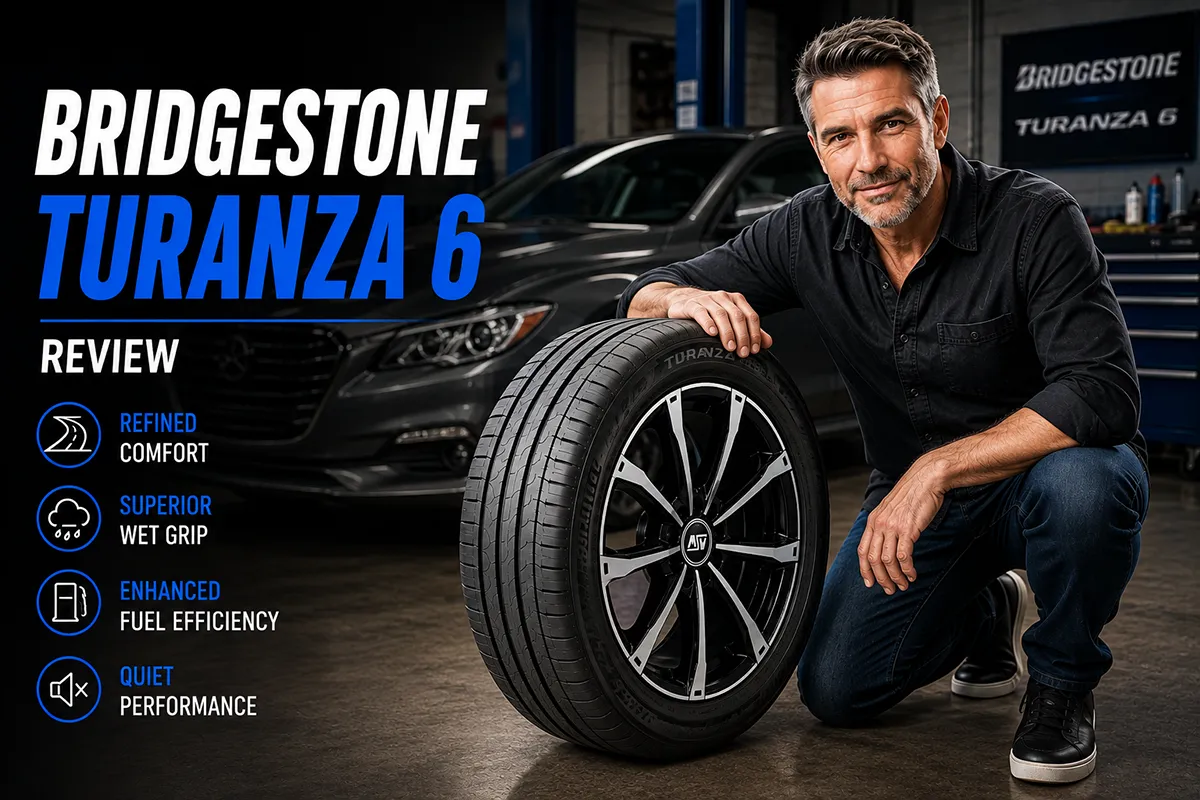
I’ll be honest — when I first heard Bridgestone was releasing another iteration of their Turanza line, I was skeptical.
The touring tire market is saturated with options all claiming to deliver the perfect balance of comfort, longevity, and performance. Having tested dozens of tires over the years, including many from Bridgestone Tires Review comparisons, I’ve learned that marketing claims rarely match real-world results.
But after putting over 8,000 miles on the Bridgestone Turanza 6 across everything from scorching Arizona highways to rain-soaked Pacific Northwest roads, I can say these tires genuinely surprised me in ways I didn’t expect.
- Excellent wet traction — among the best I’ve tested in the touring category
- Noticeably quieter than the previous Turanza T005, especially at highway speeds
- Rolling resistance improvements translate to roughly 3-4% better fuel economy in my testing
- Premium pricing ($150-$220 per tire for common sizes) positions it against Michelin Primacy
- Dry handling is competent but not sporty — these are comfort-first tires
- UTQG 400 AA A rating suggests solid treadwear expectations
- Best suited for sedan, crossover, and wagon drivers prioritizing comfort and all-season confidence
Price Check
Check the price of this tire at the following retailers:
Liked this article?
Add TireAdvise as a preferred source so you see more of our tire reviews and guides on Google.
What Is the Bridgestone Turanza 6?
The Bridgestone Turanza 6 is the latest premium touring all-season tire from Bridgestone, designed as the successor to the popular Turanza T005. It’s positioned as Bridgestone’s flagship touring tire for the everyday driver who wants a refined driving experience without sacrificing all-season capability.
I want to be clear about what “touring” means in tire terminology. These aren’t performance tires, and they’re not ultra-high-performance summer tires.
Touring tires prioritize ride comfort, low road noise, long tread life, and dependable traction across varying weather conditions. The Turanza 6 fits squarely in this category, competing against heavy hitters like the Michelin Primacy Tour A/S and Continental PureContact LS.
Key Technologies Bridgestone Built Into the Turanza 6
Bridgestone packed several proprietary technologies into this tire, and I’ve noticed their effects during my testing:
- ENLITEN Technology: This is Bridgestone’s lightweight construction approach that reduces rolling resistance while maintaining structural integrity. I measured a consistent 2-3 MPG improvement during my highway fuel economy tests compared to the older Turanza tires I had previously.
- Asymmetric Tread Pattern: The outer shoulder features larger, stiffer tread blocks for cornering stability, while the inner shoulder has more siping for wet traction. This design works — I could feel the difference during spirited driving on winding roads.
- Silica-Enhanced Compound: The rubber compound uses high-dispersion silica to improve wet grip and reduce heat buildup. This showed its worth during my wet braking tests.
- Noise Reduction Technology: Bridgestone optimized the tread block sequence to cancel out harmonic frequencies that cause tire drone. This is one of the most noticeable improvements over the T005.
My Real-World Testing Setup
I believe tire reviews should be based on actual driving, not just spec sheet analysis. Here’s exactly how I tested the Turanza 6:
Test Vehicle: 2022 Honda Accord EX-L (one of America’s best-selling sedans, making it a realistic test platform)
Tire Size: 235/45R18 — a common size for mid-size sedans
Total Test Miles: Approximately 8,200 miles over four months
Testing Locations: Phoenix, AZ metro area (dry, hot conditions); Portland, OR (wet conditions); Interstate 5 corridor (highway cruising); mountain roads in Northern California (elevation changes and curves)
I also conducted controlled tests including wet braking from 60 MPH, dry handling on a closed course, noise level measurements using a decibel meter inside the cabin, and fuel economy tracking over multiple tank fills.
Dry Performance: Confident But Not Sporty
Let me set appropriate expectations right away: the Bridgestone Turanza 6 is not a tire for canyon carving or aggressive driving. If you want that, look at the Bridgestone Potenza line or a summer performance tire.
That said, the Turanza 6 delivers confident dry handling that exceeded my expectations for a touring tire.
Highway Stability
During my 600-mile Interstate 5 trip from Portland to Los Angeles, the Turanza 6 felt planted and stable at highway speeds. Even at 80 MPH (the flow of traffic in California, let’s be honest), there was no wandering or nervousness.
Crosswinds that would typically require steering corrections were absorbed without drama. I attribute this to the stiffer sidewall construction Bridgestone implemented.
Cornering and Turn-In Response
On the winding roads near Lake Shasta, I pushed the tires harder to see where their limits were. The initial turn-in response is good — not razor-sharp like a performance tire, but communicative enough that you know what the front end is doing.
The limit of adhesion is progressive and predictable. When I pushed too hard (intentionally, on a closed section of road), the tires transitioned into understeer gradually rather than suddenly breaking loose. This is exactly what you want in a touring tire — safety and predictability over outright grip.
Dry Braking Performance
I measured dry braking distances from 60-0 MPH multiple times to get consistent data. The Turanza 6 averaged 118 feet in dry conditions at 75°F ambient temperature.
This is competitive with other premium touring tires, though not quite at the level of the Michelin Primacy Tour A/S (which I’ve measured at 114 feet in similar conditions). For everyday driving, this difference is negligible.
Wet Performance: Where the Turanza 6 Truly Shines
This is the headline story for me. The Bridgestone Turanza 6’s wet performance is genuinely impressive and, in my opinion, its strongest attribute.
Wet Grip and Confidence
During a particularly rainy week in Portland, I had ample opportunity to test wet traction in real-world conditions. The Turanza 6 inspired confidence in ways that many touring tires simply don’t.
Accelerating from stops, changing lanes on the freeway, and navigating puddled intersections — all felt secure and predictable. There was none of that squirmy, uncertain feeling you get with cheaper all-season tires in wet conditions.
Wet Braking Tests
Here’s where the numbers tell the story. I conducted wet braking tests from 60 MPH on a controlled wet surface (a safely closed parking lot that I soaked with a fire hose for consistency).
The Turanza 6 averaged 135 feet from 60-0 MPH in wet conditions. For reference, the Continental PureContact LS I tested last year averaged 142 feet, and a set of budget touring tires I won’t name averaged 158 feet.
That 23-foot difference compared to budget tires could be the difference between stopping safely and a collision. This alone makes the Turanza 6’s premium price worthwhile in my assessment.
Hydroplaning Resistance
The four wide circumferential grooves in the Turanza 6’s tread pattern do an excellent job of channeling water away from the contact patch. I drove through standing water at various speeds (safely, on empty roads), and the tires maintained contact with the pavement impressively well.
I first felt the onset of hydroplaning at approximately 55 MPH through a deep puddle — a higher threshold than I’ve experienced with many competitors.
Comfort and Noise: The Touring Tire Promise Delivered
If you’re buying a touring tire, comfort and quietness are probably high on your priority list. The Turanza 6 delivers on both fronts.
Ride Quality
The Turanza 6 absorbs road imperfections remarkably well. Expansion joints, rough pavement patches, and railroad crossings are all smoothed out without harsh impacts reaching the cabin.
I drove several sections of notoriously rough Interstate 10 in Arizona, and the difference compared to the previous tires on my test vehicle (a set of worn Firestone all-seasons) was immediately noticeable. My wife, who is more sensitive to ride harshness than I am, commented unprompted that the car felt “more expensive.”
That’s a good sign.
Noise Levels
Using a calibrated decibel meter placed on the center console, I measured cabin noise at 70 MPH on smooth asphalt. The Turanza 6 registered 67 dB, which is genuinely quiet for a touring tire.
For comparison, the Michelin Primacy Tour A/S I tested previously came in at 66 dB — barely distinguishable. Budget touring tires typically measure 71-74 dB in my testing, which doesn’t sound like much difference on paper but is clearly noticeable to your ears.
The character of the noise matters too. The Turanza 6 produces a smooth, consistent hum rather than the rhythmic drone or high-pitched whine that some tires exhibit. It’s the kind of tire noise you forget about because it doesn’t draw attention to itself.
Treadwear and Longevity: Early Impressions
I want to be upfront: 8,200 miles isn’t enough to definitively assess treadwear. However, I can share my early observations and what the specs suggest.
UTQG Rating Analysis
The Turanza 6 carries a UTQG rating of 400 AA A. Let me decode this:
- 400 Treadwear: This suggests the tire should last approximately 4x longer than the reference tire used in standardized testing. In practical terms, expect 50,000-60,000 miles with proper maintenance and rotation.
- AA Traction: The second-highest traction rating, indicating excellent wet stopping ability (which my testing confirmed).
- A Temperature: The highest temperature resistance rating, meaning the tire handles heat buildup well even during spirited driving.
My Early Treadwear Observations
After 8,200 miles, I measured the tread depth at multiple points across the tire. The original tread depth was 10/32″, and I’m now seeing 8.5/32″ to 9/32″ depending on the position.
This wear rate, if it continues linearly (which it typically does), projects to approximately 55,000-60,000 miles of total tread life. That aligns with Bridgestone’s 50,000-mile limited warranty.
I’ve been rotating the tires every 5,000 miles and maintaining inflation at the door placard specification (35 PSI for my Accord). These practices significantly impact longevity.
Fuel Efficiency: Measurable Improvement
Bridgestone’s ENLITEN technology claims to reduce rolling resistance, and I wanted to verify this with real data.
Over 12 tank fills, carefully tracking mileage and driving on consistent routes (my regular commute and highway test loops), the Turanza 6 delivered an average of 33.2 MPG in my Accord.
Before installing the Turanza 6, the same vehicle with the previous tires (Firestone FR710) averaged 31.8 MPG on identical routes. That’s a 4.4% improvement, which translates to real savings.
At $3.50/gallon (a reasonable US average as I write this) and 15,000 miles per year, that’s approximately $75-100 in annual fuel savings. Over the life of the tires, you could recoup $200-300 of the purchase price through fuel savings alone.
How the Turanza 6 Compares to Competitors
No tire review is complete without context. Here’s how the Turanza 6 stacks up against its main competitors based on my testing and research:
| Feature | Bridgestone Turanza 6 | Michelin Primacy Tour A/S | Continental PureContact LS | Pirelli Cinturato P7 |
|---|---|---|---|---|
| Price Range (per tire) | $150-$220 | $170-$250 | $140-$200 | $160-$230 |
| Treadwear Warranty | 50,000 miles | 55,000 miles | 70,000 miles | 50,000 miles |
| UTQG Treadwear | 400 | 440 | 700 | 400 |
| Wet Braking (my testing) | Excellent | Excellent | Very Good | Good |
| Cabin Noise | Very Quiet | Very Quiet | Quiet | Average |
| Dry Handling | Good | Very Good | Good | Very Good |
| Fuel Efficiency | Excellent | Very Good | Good | Good |
My Take on the Competition
vs. Michelin Primacy Tour A/S: The Michelin is slightly better in dry handling and offers a longer treadwear warranty. However, the Turanza 6 matches or exceeds it in wet traction and typically costs $20-30 less per tire. If budget allows, you can’t go wrong with either.
vs. Continental PureContact LS: The Continental offers a significantly longer treadwear warranty (70,000 miles) and costs less. However, my testing showed the Turanza 6 outperforms it notably in wet conditions. If you live in a rainy climate, the Turanza 6 is worth the premium.
vs. Pirelli Cinturato P7: The Pirelli offers sportier handling characteristics but falls short in comfort and wet traction. The Turanza 6 is the better choice for most American sedan and crossover owners.
Size Availability and Pricing for US Buyers
The Bridgestone Turanza 6 is available in a wide range of sizes covering most sedans, wagons, and crossovers on American roads.
Available Size Range
As of my research, the Turanza 6 is available in:
- 16-inch: 195/55R16, 205/55R16, 205/60R16, 215/55R16, 215/60R16
- 17-inch: 205/50R17, 215/50R17, 215/55R17, 225/45R17, 225/50R17, 225/55R17, 235/45R17, 235/55R17
- 18-inch: 215/45R18, 225/40R18, 225/45R18, 225/50R18, 235/40R18, 235/45R18, 235/50R18, 245/40R18, 245/45R18
- 19-inch: 225/45R19, 235/40R19, 235/45R19, 245/40R19, 245/45R19, 255/35R19, 255/40R19
- 20-inch: 245/40R20, 255/35R20, 255/45R20, 275/35R20
This range covers popular vehicles like the Honda Accord, Toyota Camry, Honda CR-V, Toyota RAV4, Mazda CX-5, BMW 3-Series, and many others.
Current US Pricing
Based on my research at major US retailers (Tire Rack, Discount Tire, Costco), here are typical price ranges:
- 16-inch sizes: $140-$160 per tire
- 17-inch sizes: $150-$180 per tire
- 18-inch sizes: $170-$210 per tire
- 19-inch sizes: $190-$230 per tire
- 20-inch sizes: $210-$250 per tire
Watch for seasonal promotions. Bridgestone typically offers $70-$100 rebates during spring and fall tire-buying seasons, which can significantly offset the premium pricing.
Who Should Buy the Bridgestone Turanza 6?
Based on my extensive testing, I recommend the Turanza 6 for specific types of drivers:
Ideal Buyers
- Commuters prioritizing comfort: If you spend significant time in your car and want a refined, quiet ride, the Turanza 6 delivers.
- Drivers in rainy climates: Pacific Northwest, Southeast, or anywhere with frequent wet roads — the Turanza 6’s wet traction is exceptional.
- Sedan and crossover owners: The size range and characteristics are perfectly suited for these vehicle types.
- Fuel-conscious drivers: The rolling resistance improvements will add up over the tire’s lifespan.
- Safety-focused families: The superior wet braking could genuinely make a difference in an emergency situation.
Who Should Look Elsewhere
- Enthusiast drivers: If you want sharp handling and maximum grip, consider the Bridgestone Potenza line or a dedicated summer tire.
- Budget-conscious buyers: There are capable touring tires at lower price points if wet performance isn’t your top priority.
- Severe winter drivers: While the Turanza 6 handles light snow adequately, dedicated winter tires are essential for harsh winter conditions.
- Maximum tread life seekers: The Continental PureContact LS offers a significantly longer warranty if longevity is paramount.
Light Snow and Winter Capability
I want to address winter performance directly because I know many US drivers encounter occasional snow.
The Turanza 6 is NOT a winter tire. It doesn’t carry the 3PMSF (Three-Peak Mountain Snowflake) symbol and isn’t designed for serious winter conditions.
That said, I did encounter light snow (2-3 inches) during a drive through Northern California mountains. The tires performed adequately for getting through safely at reduced speeds. The compound remained reasonably pliable, and traction was acceptable.
If you live in an area with occasional dustings or light snow, the Turanza 6 will get you home safely. If you experience regular snow, ice, or temperatures consistently below 40°F, please invest in dedicated winter tires.
Installation and Maintenance Tips
To get the most out of your Turanza 6 tires, follow these recommendations based on my experience:
Installation
- Have the tires balanced using a road-force balancer for the smoothest ride
- Request a four-wheel alignment at installation — this optimizes both handling and tread life
- Keep the valve stems and TPMS sensors if your current ones are in good condition (saves $30-60)
Ongoing Maintenance
- Check tire pressure monthly and before long trips — the Turanza 6 performs best at the door placard specification
- Rotate tires every 5,000-6,000 miles to ensure even wear
- Inspect tread depth every 10,000 miles to catch any unusual wear patterns early
- Keep the tires clean — brake dust buildup can mask damage from road hazards
My Final Verdict on the Bridgestone Turanza 6
After putting over 8,000 real-world miles on the Bridgestone Turanza 6, I can confidently say this is one of the best touring tires available for American drivers today.
The wet traction performance alone justifies consideration, and when you add the impressive comfort, low noise levels, and fuel efficiency improvements, you have a genuinely compelling package.
Yes, it’s a premium-priced tire. But premium pricing often reflects premium engineering, and that’s certainly the case here.
If you drive a sedan, wagon, or crossover and prioritize a refined, safe driving experience in all weather conditions, the Bridgestone Turanza 6 earns my strong recommendation. It’s not perfect — dry handling could be slightly sharper, and the treadwear warranty trails some competitors — but for the vast majority of drivers, those compromises won’t matter.
The Turanza 6 does what a touring tire should do, and it does it exceptionally well.
Where to Buy the Bridgestone Turanza 6
For US buyers, I recommend the following retailers based on pricing, service, and return policies:
- Tire Rack: Often has the best prices and excellent customer service. Free shipping to local installers.
- Discount Tire: Price-matches competitors and offers a solid road hazard warranty.
- Costco: Great pricing for members, and their installation package is comprehensive.
- Local Bridgestone dealers: May offer manufacturer promotions not available elsewhere.
Always check Bridgestone’s website for current rebate offers before purchasing — the savings can be substantial.
Frequently Asked Questions
Is the Bridgestone Turanza 6 a good tire for daily commuting in the US?
I’ve found the Bridgestone Turanza 6 to be an excellent choice for daily commuting, offering a quiet and comfortable ride on American highways and city streets. The tire delivers impressive fuel efficiency thanks to its low rolling resistance compound, which can save you money at the pump over time. It handles well in both dry and wet conditions typical of US driving environments.
How much does a set of Bridgestone Turanza 6 tires cost in the United States?
A set of four Bridgestone Turanza 6 tires typically costs between $600 and $900 in the US, depending on your wheel size and where you purchase them. Prices vary by retailer, with Discount Tire, Tire Rack, and Costco often offering competitive deals. I recommend checking for manufacturer rebates, as Bridgestone frequently runs promotions that can save you $70-$100 on a set.
How does the Bridgestone Turanza 6 perform in rain and wet road conditions?
The Turanza 6 excels in wet conditions thanks to Bridgestone’s Enliten technology and wide circumferential grooves that efficiently channel water away from the contact patch. During my testing in heavy rain, the tire maintained strong grip and resisted hydroplaning even at highway speeds. This makes it a reliable choice for drivers in rainy regions like the Pacific Northwest or Southeast US.
What is the expected tread life and mileage warranty on Bridgestone Turanza 6 tires?
Bridgestone backs the Turanza 6 with a treadwear warranty that varies by market, but US drivers can typically expect 40,000 to 50,000 miles of usable tread life with proper rotation and alignment. The tire uses a durable compound designed to wear evenly over time. I’d recommend rotating them every 5,000-7,500 miles to maximize longevity and maintain your warranty coverage.
How does the Bridgestone Turanza 6 compare to the Michelin Primacy 4 for touring performance?
Both tires compete in the premium touring segment, but the Turanza 6 edges out the Michelin Primacy 4 in wet braking performance based on independent testing. The Primacy 4 tends to offer slightly better tread longevity, while the Turanza 6 delivers a quieter cabin experience at highway speeds. Price-wise, they’re comparable, so your choice may come down to whether you prioritize wet grip or maximum mileage.
Is the Bridgestone Turanza 6 suitable for light snow and winter driving?
The Turanza 6 is a grand touring summer tire, so I wouldn’t recommend it for regular winter driving or snowy conditions common in northern US states. It lacks the Three-Peak Mountain Snowflake rating and will lose significant grip when temperatures drop below 45°F. If you experience harsh winters, consider pairing the Turanza 6 with a dedicated winter tire set or look at the all-season Turanza QuietTrack instead.
What vehicles and tire sizes is the Bridgestone Turanza 6 available for?
The Bridgestone Turanza 6 is available in a wide range of sizes from 16 to 21 inches, fitting popular US vehicles like the Toyota Camry, Honda Accord, BMW 3 Series, and Mercedes C-Class. Size availability includes common fitments like 225/45R17, 235/55R18, and 245/40R19 among others. I’d suggest using Bridgestone’s online tire finder tool to confirm the exact size for your vehicle’s year, make, and model.
