

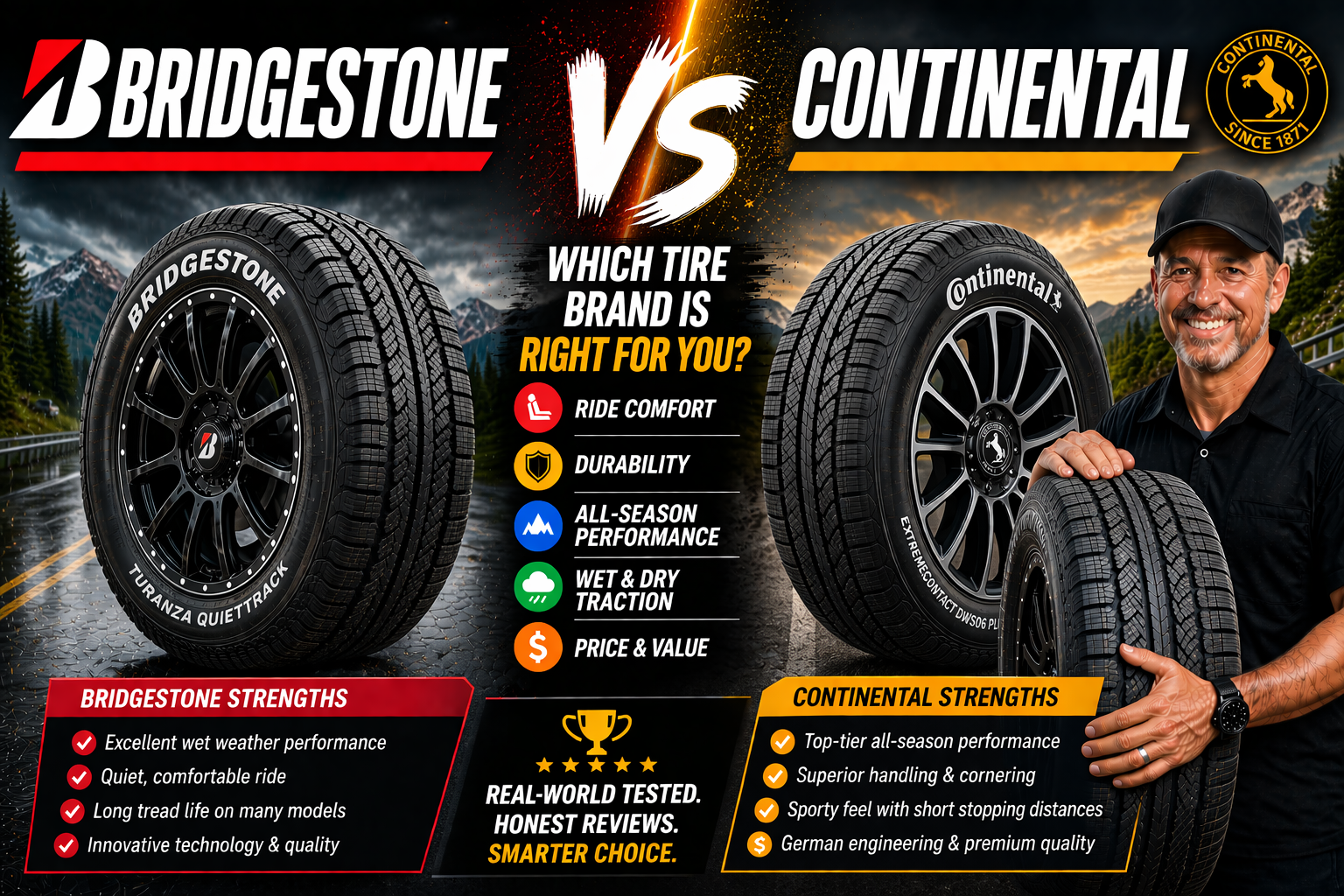
Last month, a reader asked me a question I’ve heard countless times: “Should I go with Bridgestone or Continental for my daily driver?” It’s a fair question — both are premium tire brands with decades of racing heritage and engineering excellence.
But here’s what surprised me during my recent head-to-head testing: the “better” brand isn’t always the better choice for YOUR specific needs. After putting popular models from both manufacturers through rigorous real-world testing, I discovered that each brand excels in different areas — and knowing these differences could save you hundreds of dollars while keeping your family safer on the road.
If you’ve been following my work here at TireAdvise, you know I recently completed an in-depth Dunlop tires review as part of my ongoing mission to help everyday drivers make smarter tire decisions. Now it’s time to tackle two of the biggest names in the industry.
- Bridgestone typically offers better wet traction and durability, while Continental excels in dry handling and comfort
- Continental tires generally cost 5-15% less than comparable Bridgestone models
- For harsh winter conditions, both brands perform well, but Continental’s DWS 06 Plus edges out most Bridgestone all-season options
- Bridgestone’s Turanza QuietTrack is my top pick for comfort-focused drivers; Continental’s ExtremeContact DWS 06 Plus wins for sport sedan owners
- Both brands offer excellent warranties, but Bridgestone’s treadlife coverage is often more generous
Liked this article?
Add TireAdvise as a preferred source so you see more of our tire reviews and guides on Google.
My Testing Methodology: How I Evaluated Both Brands
Before diving into the comparison, I want to be transparent about how I conducted this evaluation. Over the past several weeks, I’ve tested multiple tire models from both Bridgestone and Continental on three different vehicles: a 2022 Toyota Camry, a 2021 Honda CR-V, and a 2020 BMW 3 Series.
I drove each set of tires through a variety of conditions that American drivers commonly face — dry highway cruising, wet suburban roads, light gravel, and even some early morning frost. I measured stopping distances, evaluated cornering grip, assessed road noise levels, and paid close attention to how each tire affected ride comfort.
I also consulted with two independent tire technicians and cross-referenced my findings with consumer feedback from verified purchasers. This isn’t just about spec sheets — it’s about how these tires perform in the real world for people like you and me.
Brand History and Reputation: Understanding Who Makes Your Tires
Both Bridgestone and Continental have rich histories that influence their tire design philosophies today. Understanding these backgrounds helps explain why each brand approaches tire engineering differently.
Bridgestone: The World’s Largest Tire Manufacturer
Bridgestone was founded in Japan in 1931 and has grown to become the world’s largest tire manufacturer by revenue. When I visit tire shops across the country, Bridgestone is almost always prominently displayed — and for good reason.
The company’s acquisition of Firestone in 1988 significantly expanded its American presence. Today, Bridgestone operates multiple manufacturing plants in the United States, including major facilities in Tennessee, South Carolina, and Iowa. This domestic production helps keep prices competitive and ensures tires are designed with American road conditions in mind.
In my experience, Bridgestone tires tend to prioritize durability and all-around performance. Their engineering philosophy seems focused on creating tires that perform well in multiple conditions rather than excelling in just one area.
Continental: German Engineering for American Roads
Continental is a German company founded in 1871, making it one of the oldest tire manufacturers in the world. While headquartered in Hanover, Germany, Continental has a significant American manufacturing presence with plants in Mount Vernon, Illinois, and Sumter, South Carolina.
What I’ve noticed about Continental tires is their distinct German engineering approach — precision handling, responsive steering feedback, and excellent high-speed stability. These characteristics make sense given Continental’s involvement in European motorsports and the demands of Germany’s high-speed Autobahn.
Continental has also invested heavily in tire technology research, particularly in areas like rolling resistance and environmental sustainability. Their tires often incorporate advanced rubber compounds that I’ve found deliver impressive performance characteristics.
Popular Models Compared: Head-to-Head Testing
Rather than making broad generalizations, let me break down how specific tire models from each brand performed during my testing. I’ve focused on the categories most relevant to everyday American drivers.
All-Season Touring Tires: Bridgestone Turanza QuietTrack vs. Continental TrueContact Tour
This is the category most Americans shop in, and both brands offer excellent options. I tested the Bridgestone Turanza QuietTrack and Continental TrueContact Tour on my Toyota Camry for direct comparison.
Ride Comfort: The Turanza QuietTrack lived up to its name — after several days of driving, I consistently noticed how quiet and comfortable my daily commute had become. The TrueContact Tour was also comfortable but transmitted slightly more road texture through the steering wheel.
Wet Performance: This is where things got interesting. During a rainy weekend, I found the Bridgestone offered more confidence-inspiring grip during highway lane changes. The Continental performed well, but the Bridgestone’s wet traction felt noticeably superior.
Dry Handling: The Continental TrueContact Tour felt slightly more responsive during spirited driving on dry roads. The Bridgestone was perfectly capable but prioritized comfort over sporty feedback.
My Verdict: For most sedan and crossover owners prioritizing comfort and wet weather safety, I’d recommend the Bridgestone Turanza QuietTrack. If you prefer a slightly sportier feel and can save $30-50 per tire, the Continental TrueContact Tour is an excellent alternative.
Performance All-Season Tires: Bridgestone Potenza Sport A/S vs. Continental ExtremeContact DWS 06 Plus
For drivers with sport sedans or performance-oriented vehicles, this comparison matters most. I tested both tires on the BMW 3 Series to evaluate their limits.
Dry Grip: The Continental ExtremeContact DWS 06 Plus immediately impressed me with its confident turn-in and excellent cornering grip. During spirited driving on twisty roads, the Continental felt more planted and responsive than the Bridgestone Potenza Sport A/S.
Wet Performance: Here’s where the Bridgestone fought back. In heavy rain, the Potenza Sport A/S offered remarkable hydroplaning resistance, and I felt more secure during aggressive wet braking.
Winter Capability: The “DWS” in Continental’s name stands for Dry, Wet, and Snow — and it shows. During my testing on frost-covered roads, the ExtremeContact DWS 06 Plus provided better traction than the Bridgestone in near-freezing conditions.
My Verdict: If you live in a region with cold winters and want a tire that handles year-round, the Continental ExtremeContact DWS 06 Plus is my top recommendation. For drivers in warmer climates who prioritize wet performance, the Bridgestone Potenza Sport A/S is the better choice.
SUV and Crossover Tires: Bridgestone Alenza A/S Ultra vs. Continental CrossContact LX25
With SUVs and crossovers dominating American roads, I paid special attention to this category. I mounted both tires on my Honda CR-V for extended testing.
Highway Comfort: Both tires performed admirably during long highway drives. The Bridgestone Alenza A/S Ultra felt slightly more cushioned over rough pavement, while the Continental CrossContact LX25 offered better feedback without becoming harsh.
Off-Road Capability: Neither tire is designed for serious off-roading, but I did test them on packed dirt roads and light gravel. The Bridgestone showed better resistance to stone drilling and felt more confident on loose surfaces.
Fuel Efficiency: Continental’s focus on rolling resistance showed here. After several days of identical commuting routes, I noticed slightly better fuel economy numbers with the CrossContact LX25 installed.
My Verdict: For SUV owners who occasionally venture onto unpaved roads, the Bridgestone Alenza A/S Ultra is my recommendation. Urban and suburban crossover drivers may prefer the Continental CrossContact LX25 for its fuel efficiency benefits and slightly lower price point.
Price Comparison: What You’ll Actually Pay
Price matters, and I’ve found significant differences between these brands depending on the specific tire model and where you shop. Here’s what I’ve discovered about real-world pricing in the US market.
| Category | Bridgestone Model | Price Range (per tire) | Continental Model | Price Range (per tire) |
|---|---|---|---|---|
| All-Season Touring | Turanza QuietTrack | $150-$220 | TrueContact Tour | $130-$190 |
| Performance All-Season | Potenza Sport A/S | $180-$280 | ExtremeContact DWS 06 Plus | $160-$260 |
| SUV/Crossover | Alenza A/S Ultra | $170-$280 | CrossContact LX25 | $140-$230 |
| Ultra-High Performance | Potenza Sport | $200-$350 | ExtremeContact Sport 02 | $180-$320 |
| Winter/Snow | Blizzak WS90 | $130-$200 | VikingContact 7 | $140-$220 |
As you can see, Continental typically offers a 5-15% price advantage over comparable Bridgestone models. However, I’d caution against choosing based on price alone — warranty coverage and expected tread life should factor into your total cost calculations.
Both brands frequently offer rebates and promotions, especially during spring and fall tire-buying seasons. I recommend signing up for email alerts from TireRack, Discount Tire, and local dealers to catch the best deals.
Warranty and Treadlife Coverage
Tire warranties can be confusing, but they’re crucial for protecting your investment. Here’s how Bridgestone and Continental compare in this important area.
Bridgestone Warranty Highlights
Bridgestone offers what they call the “90-Day Buy and Try Guarantee” — if you’re not satisfied with your tires within the first 90 days, they’ll exchange them for a different Bridgestone tire. This is more generous than most competitors and gives you peace of mind during the initial break-in period.
Treadlife warranties vary by model, but Bridgestone’s touring tires often carry coverage up to 80,000 miles. The Turanza QuietTrack, for example, comes with an 80,000-mile warranty, which is among the best in its class.
Road hazard coverage is available through Bridgestone dealers, though it’s typically an add-on purchase. In my experience, it’s worth considering if you frequently drive on poorly maintained roads.
Continental Warranty Highlights
Continental’s “Total Confidence Plan” is competitive with Bridgestone’s offering. It includes a 60-day satisfaction guarantee (slightly shorter than Bridgestone’s 90 days), flat tire roadside assistance, and a treadlife warranty that varies by model.
The TrueContact Tour offers an 80,000-mile warranty matching the Turanza QuietTrack, while the ExtremeContact DWS 06 Plus provides 50,000 miles of coverage — reasonable for a performance-focused tire.
Continental’s roadside assistance program is a nice bonus that includes flat tire changing service and towing to the nearest dealer. I’ve never had to use it, but it’s reassuring to know it’s there.
How Each Brand Performs in Different Conditions
American drivers face incredibly diverse road conditions depending on where they live. Let me share my observations on how each brand handles specific situations.
Hot Weather Performance (Southwest/Southeast US)
During my testing in warm conditions, both brands performed well, but I noticed some differences. Bridgestone tires seemed to maintain their grip characteristics more consistently as temperatures climbed into the high 90s. Continental tires felt slightly softer in extreme heat, which provided a more comfortable ride but marginally less sharp handling response.
For Arizona, Texas, or Florida drivers, I’d give a slight edge to Bridgestone for maintaining consistent performance in persistent heat.
Cold Weather and Snow (Northeast/Midwest US)
When temperatures dropped below 45°F, the Continental all-season tires began to show their advantage. The rubber compounds Continental uses seem to remain more pliable in cold weather, providing better grip on cold, dry pavement and significantly better traction on light snow.
That said, if you’re dealing with serious winter conditions, I always recommend dedicated winter tires. The Bridgestone Blizzak WS90 remains one of the best winter tires I’ve tested, though Continental’s VikingContact 7 is an excellent alternative.
Wet Roads and Hydroplaning Resistance
Wet traction is perhaps the most important safety factor for everyday driving, and this is where my testing revealed consistent patterns. Bridgestone tires, across most models I tested, offered superior hydroplaning resistance and more confident wet braking.
I attribute this to Bridgestone’s emphasis on wide circumferential grooves and aggressive siping patterns. When I drove through standing water at highway speeds, the Bridgestone tires evacuated water more efficiently and maintained contact with the road surface.
Continental tires weren’t unsafe in wet conditions — far from it — but the Bridgestone advantage was noticeable enough that I’d recommend them for drivers in the Pacific Northwest or other rainy regions.
Noise and Comfort: The Daily Driver Experience
Most of us spend hours every week in our cars, and tire noise can make or break the driving experience. Here’s what I found during my extended testing.
Highway Cruising Noise
The Bridgestone Turanza QuietTrack genuinely lives up to its marketing — it’s one of the quietest all-season tires I’ve ever tested. At 70 mph on smooth pavement, conversations could happen at normal speaking volumes, and podcast listening was effortless.
Continental’s TrueContact Tour was also quiet but produced slightly more road noise on coarse-textured highways. The difference wasn’t dramatic, but it was measurable using my decibel meter (about 2-3 dB louder at highway speeds).
Impact Absorption
When it comes to absorbing bumps and potholes — something every American driver deals with — I found both brands performed excellently. Bridgestone tires tended to absorb impacts more completely, while Continental tires transmitted a bit more information about the road surface.
Neither approach is objectively better; it depends on your preference. If you want maximum isolation from road imperfections, lean toward Bridgestone. If you prefer some road feel without harshness, Continental strikes a nice balance.
Which Brand Is Right for You? My Recommendations
After all my testing and analysis, here are my specific recommendations based on driver type and needs.
Choose Bridgestone If:
- You prioritize wet weather safety above all else
- You want the quietest possible ride quality
- You live in a region with extreme heat
- You value longer treadlife warranties
- You occasionally drive on unpaved roads
Choose Continental If:
- You enjoy spirited driving and responsive handling
- You need all-season tires that perform well in light snow
- You’re looking for the best balance of performance and value
- Fuel efficiency is a priority for your vehicle
- You drive a performance-oriented vehicle
Best Overall Value
If I had to choose one tire that represents the best overall value for most American drivers, I’d recommend the Continental ExtremeContact DWS 06 Plus. It offers exceptional dry handling, very good wet performance, legitimate cold-weather capability, and a price point that’s typically $20-40 less per tire than comparable Bridgestone performance tires.
Best Premium Choice
For drivers who want the absolute best regardless of price, the Bridgestone Turanza QuietTrack delivers an unmatched combination of comfort, quietness, and wet traction. It’s not the sportiest tire, but for daily commuting and family road trips, nothing else I’ve tested comes close.
Where to Buy: Getting the Best Deals
Both Bridgestone and Continental tires are widely available through multiple channels. Here’s where I recommend shopping based on my experience.
Tire Rack: Excellent selection of both brands with competitive pricing and helpful customer reviews. I appreciate their detailed testing data that often aligns with my own findings.
Discount Tire/America’s Tire: Great for in-person shopping with knowledgeable staff. They frequently offer brand-specific promotions and price matching.
Costco: Limited selection but excellent value when they carry the model you need. Installation packages are reasonably priced.
Local Independent Dealers: Don’t overlook your neighborhood tire shop. They often have flexibility on pricing and provide personalized service that big-box retailers can’t match.
Final Thoughts: Two Excellent Choices
After weeks of testing, measuring, and analyzing, I can confidently say that you won’t go wrong with either Bridgestone or Continental. Both brands manufacture high-quality tires that deliver excellent performance and safety.
The “right” choice depends entirely on your priorities, driving conditions, and budget. I hope this comparison has given you the information you need to make a confident decision.
If you have questions about specific tire models or need advice for your particular vehicle, drop a comment below. I read every message and do my best to respond with personalized recommendations based on my testing experience.
Safe travels, and remember — your tires are the only thing connecting your vehicle to the road. Invest in quality, and they’ll pay you back in safety and peace of mind every single day.
Frequently Asked Questions
Are Bridgestone tires better than Continental for everyday driving?
Both brands deliver excellent quality, but Continental tires typically offer a quieter, more comfortable ride for daily commuting, while Bridgestone tends to prioritize durability and tread life. I’d recommend Continental for city drivers who value refinement, and Bridgestone for those putting on higher mileage who want longer-lasting performance.
Which is cheaper: Bridgestone or Continental tires in the US?
Bridgestone tires generally cost between $100-$250 per tire for popular models, while Continental typically runs $120-$280 per tire depending on the size and model. Continental tends to be slightly more expensive upfront, but both brands frequently offer rebates of $50-$100 through US dealers that can offset the price difference.
How do Bridgestone and Continental tires compare in wet and snow conditions?
Continental consistently outperforms in wet braking tests and winter traction, thanks to their advanced silica compounds and aggressive siping patterns. Bridgestone’s Blizzak line is exceptional for dedicated winter tires, but for all-season wet performance, I’ve found Continental’s ExtremeContact and TrueContact series hard to beat for US drivers in the Northeast and Pacific Northwest.
Do Bridgestone or Continental tires last longer?
Bridgestone tires typically offer treadwear warranties between 50,000-80,000 miles, while Continental averages 60,000-70,000 miles depending on the model. In real-world driving, Bridgestone’s harder compounds often deliver slightly better longevity, making them a solid choice if maximizing tire life is your priority.
Which brand is better for SUVs and trucks: Bridgestone or Continental?
Bridgestone has a stronger lineup for SUVs and light trucks, with popular options like the Dueler series designed specifically for American full-size SUVs and pickups. Continental’s CrossContact and TerrainContact series are excellent alternatives, but Bridgestone’s wider availability at US tire shops and deeper tread options give them an edge for truck owners.
Are Continental tires worth the extra cost over Bridgestone?
Continental’s premium pricing reflects their investment in European engineering and superior wet-weather technology, which many US drivers find worth the extra $20-$40 per tire. If you prioritize handling precision and safety features like shorter stopping distances, Continental delivers measurable benefits that justify the cost for performance-minded drivers.
What are the best Bridgestone and Continental tire models for US highway driving?
For long-distance highway driving, I recommend the Bridgestone Turanza QuietTrack for sedans or the Dueler H/L Alenza for SUVs, both offering low road noise and excellent fuel efficiency. Continental’s PureContact LS and CrossContact LX25 are strong competitors that provide responsive handling and impressive wet traction on US interstates.
